
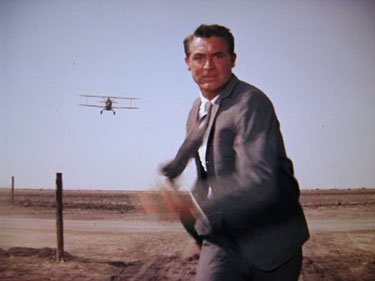
Todd McEwen discusses ‘by far the best suit in the movie, in the movies, perhaps the whole world.”
North By Northwest isn’t a film about what happens to Cary Grant, it’s about what happens to his suit. The suit has the adventures, a gorgeous New York suit threading its way through America. The title sequence in which the stark lines of a Madison Avenue office building are ‘woven’ together could be the construction of Cary in his suit right there — he gets knitted into his suit, into his job, before our very eyes. Indeed some of the popular ‘suitings’ of that time (‘windowpane’ or ‘glen plaid’) perfectly complemented office buildings. Cary’s suit reflects New York, identifies him as a thrusting exec, but also arms him, protects him: what else is a suit for? Reflects and Protects. a slogan Cary’s character, Roger Thornhill, might have come up with himself. …
The suit, Cary inside it, strides with confidence into the Plaza Hotel. Nothing bad happens to it until one of the greasy henchmen grasps Cary by the shoulder. We’re already in love with this suit and it feels like a real violation. They’ve mistaken Roger Thornhill for a federal agent called George Kaplan. They bundle him into a cab and shoot out to Long Island, not much manhandling yet. In fact Martin Landau is impressed: ‘He’s a well-tailored one, isn’t he?’ He loves the suit. But next moment Cary tries to escape… there’s a real struggle, they force all that bourbon down his throat. (He later thinks they’ll find liquor stains on the sofa, but if there was that much violence why aren’t there any on the suit?) Cut to Cary being stuffed into the Mercedes-Benz — he’s managed to get completely pissed without even ‘mussing’ his hair. On his crazy drink-drive, the collar of his jacket is turned the wrong way round. That’s all. He gets arrested, jerked around by the cops, conks out on a table and appears before the judge next morning, and the suit and the shirt both look great. But this is the point in the picture where you start to worry about Cary’s personal hygiene. Start to ITCH. Cops aren’t generally too open-handed with showers.
It’s back to the bad guy’s house, then back to the Plaza, looking good. I always hope he’ll grab a quick shower in the hotel room — he keeps gravitating towards the bathroom. There’s a good suit moment when he tries on one belonging to Kaplan, the guy he’s looking for, who doesn’t exist. Kaplan’s suits are stodgy, old-fashioned, unbelievably heavy for a summer in New York with turn-ups on the trousers. So much for the sartorial acumen of the US government. ‘I don’t think that one does anything for you,’ says Cary’s mom, and boy is she right. She also jokes that Kaplan maybe ‘has his suits mended by invisible weavers’, which is what happens to Cary’s suit throughout the picture! His suit is like a victim of repeated cartoon violence in the next shot it’s always fine.
Off to the United Nations, where the Secretariat looks even more like Cary than his own office building. He sublimely matches a number of modern wall coverings and stone walls here and throughout the picture. He pulls a knife out of a guy, but doesn’t get any blood on himself. There’s a curious lack of blood in North By Northwest; it must be all to save the suit, though there must be ten or even twenty of them in reserve, no? Cary evades the bad guys again and scoots over to Grand Central Station, where they have, or had, showers, but he’s too busy.
This is what’s ingenious about this picture, at least as far as the SUIT goes — Cary’s able to travel all over the country in just this one beautiful suit because the weather has been planned for the suit by Ernest Lehman! It’s the perfect weather for an adventure in this suit, and that’s why it happens. At the same time, there’s a CREEPINESS about the whole escapade generated by our own fears that in some situation Cary will be inappropriately dressed (Cary GRANT?) and this will hinder him; or that the thin covering of civilization the suit provides him with will be pierced and here he is, thousands of miles from home, with not so much as a topcoat. Men ought to admit that they can experience suit-fear: the fear of suddenly being too cold in the suit you thought would do (in Glen Cove, Long Island, even on a summer night) or too hot (the prairie, to come). Exposed, vulnerable. Cary does have some money though, we know that, so he could buy something to wear if he had to, assuming his wallet isn’t destroyed along with the suit. But it would be too traumatic to see this suit getting totaled, that would be way beyond Hitchcock’s level of sadism. This feeling of exposure, the idea of having suddenly to make a desperate journey in just the clothes you have on, comes up in The Thirty-Nine Steps (book and movie): Richard Hannay is alone in a desolate landscape in inappropriate town clothes when a menacing autogiro spots him from the air.
In the suit are a number of subtle tools for Cary. It’s so well cut you can’t tell if he’s even carrying a wallet (turns out he is). Here’s what he’s got in that suit! He goes all the way from New York to Chicago to the face of Mount Rushmore with: a monogrammed book of matches, his wallet and some nickels, a pencil stub, a hanky, a newspaper clipping and his sunglasses, but these are shortly to be demolished when Eva Marie Saint folds him into the upper berth in her compartment. (Really this is a good thing, because Cary Grant in dark glasses looks appallingly GUILTY.) All this stuff fits into the pockets of the most wonderful suit in the world. Does the suit get crushed in the upper berth as his Ray-Bans are smashed? No. Cary keeps his jacket on in the make-out scene that follows. The suit defines him, he’s not going to take off that jacket. I know this feeling.

But, is it really a New York suit?
Richard Torregrossa, in Cary Grant and the Secrets of the Perfect Suit, also identifies a number of its points of excellence, but I was persuaded that he is wrong in identifying THE SUIT as having been tailored by Kilgour, French & Stanbury, an old Savile Row firm most familiar to Americans simply as a licensed label of Barney’s used on suits made domestically as one of their house brands from the 1980s to around 2000.
The correct tailor is most likely identified in this Ask Andy Forum thread, which links to four pages of definitive discussion on the valuable resource on this subject area, LondonLounge.Net

The answer? A subtle glen plaid, probably in 13 oz flannel or 10 oz fresco tropical weave, tailored by Quintino of Beverly Hills.
————————————-
Hat tip to Karen L. Myers.





EW
Respectfully, you and Andy are wrong about this. I have studied this subject off and on for years. There are many things about the suit that debunk your hypothesis, but the best evidence for the maker of the suit is a brief scene in the film, but you have to pay attention and watch very carefully. Hint: It’s a visible label inside the suit. Have fun.
North By NorthWest « Minty’s Menagerie
[…] with the titles to ‘Panic Room‘. ‘Northwest’ is of course a film about a suit, a sartorial wonder that our hero Cary Grant,the true personification of the word debonair, propels […]
Richard Torregrossa
I object to you saying that I erroneously identified CG’s suit in NbyNW as being made by Kilgour, French, & Stanbury, especially without proper documentation. Kilgour most definitely made the suit. And proof positive will be revealed at a later date.
This silly business of drawing conclulsions by freeze framing on a brief glimpse of an unreadable label is pure silliness. There were seven suits used in the film. How do you think the continuity people and wardrobe department kept track of them. By sewing in labels.
A knowledge of film making is equally important as a knowledge of tailoring in determing these matters.
As for Quintino, they probably made back-up suits, repairs, alterations, and suits for the stuntmen and other actors. No way they could cut a suit that exquistely.
JDZ
At the time, I was quite persuaded by the argument made somewhere on thelondonlounge.net, which is taking a lot of effort to retrieve at this point. I still have not gotten back far enough on that BB to find it. All these years later, with those in possession of the facts deceased, it is probably impossible to prove who is right.
Your theory that the wardrobe department may have sewn in a Quintino label to identify one of seven suits seems something of a reach. But I have no personal acquaintance with the styles and workmanship of either firm in that particular period which was before my time. I will, however, slightly rephrase, indicating that your being mistaken is only my personal opinion.
It is an amusing project, leading to entertaining arguments, trying to identify its provenance.
Glad to hear from you.
Cheers,
David
Dennis Llano
Where can I purchase a replica?
vittorio
the glasses were not rayban,but persol:)
We must remember 'We are a minority'!
[…] […]
cynhtia
I was in North by Northwest..as a child model, just an extra, and I have watched the movie 1,00,00 + times ! I have never laughed as hard as I did when hearing this story read on the radio a few weeks ago…the movie was on again tonight..my 60th birthday and I could hardly keep my mouth shut about his suit!!! When the film was being made, the one episode that blew me away was that of Mt. Rushmore, when they constructed the carved faces and they were flat on the ground and the scene when Cary and Eva were hanging from them was just merely a scene with them lying on those plaster noses!!
Richard Torregrossa
This still bugs me: “Your theory that the wardrobe department may have sewn in a Quintino label to identify one of seven suits seems something of a reach.”
I wasn’t suggesting they sewed in a Quintino label. Jeezus. Why would they do that. My point is that the London Lounge screen capture of the label was vaue, and you could not clearly see “Quintino” or any other tailor’s name. My point was that was it was a wardrobe designation. I have no idea what it actually said because the screen capture is unreadable. The London Lounge seems or thinks otherwise, that it said Quintino. To my mind no way. CG was a lifelong patron of Savile Row. Kilgour, Hawees & Curtis etc. The suits were cut flawlessly. My opinion is that I seriously doubt Quintino could have cut a suit to his precise specifications the way Savile had been doing for him for decades.
Herbert Bellino
This phenomenal suite never looked better than in the BluRay edition of N by NW when viewed on a good HDTV! Detail of the plaid is exquisite. For years I stupidly thought I was the only one in love with this suit. If I had a dollar for every blank stare I’ve gotten from salesmen at designer men’s stores in Manhattan and elsewhere when asking about a close match…well, could have a duplicate made. Perhaps that’s the key. The suit pursuit continues.
Herbert Bellino
Suit not suite
jeremy karpel
I have been a lifelong fan of both Cary Grant and North by Northwest, and when I was younger worked in both the high fashion retail buisness in London’s Bond Street and St James’s as well as in the UK film industry – so therefore I feel uniquely placed to make a comment on this. To this day I buy my suits both in Mayfair and occasionally in Savile Row. I have read a number of biographies of CG where it is clearly stated that he preferred his suits and shirts (with their larger collars) to be tailored in London. I knew people in St James’s who used to serve him! I agree with Richard Torregrossa that all the evidence points to Kilgour. The cut of the suit and its detailing are typically British in execution albeit that the tie in with the dark ox-blood leather loafers places the overall styling somewhere in the middle of the Atlantic!
Derek Lyons
My late grandfather Arthur Lyons fitted Cary Grant and made this suit.
The suit was made by Kilgour French and Stanbury, specifically tailored by Arthur Lyons (who also made suits for Edward, Duke of Windsor, Rex Harrison, Robert Mitchum and Fred Astaire)
Kilgour
Located at No. 8 Savile Row. Founded in 1882 as T & F French in Piccadilly, in 1923 it merged with existing Savile Row tailor A.H. Kilgour to form Kilgour & French. In 1925, Fred and Louis Stanbury joined the firm, and in 1937 the business changed its name to Kilgour, French and Stanbury. Reverting to the name Kilgour in 2003, it was bought by JMH Lifestyle in 2008.
Michael Powers
This is certainly the suit that the viewer most notices more than any other in all the annals of cinema and is probably the reason that I love wearing suits myself.
hcg diet plan canada reviews
Howdy, I believe your blog may be having browser compatibility issues.
When I take a look at your blog in Safari, it looks fine but when opening
in I.E., it has some overlapping issues. I simply wanted to
provide you with a quick heads up! Other than that, wonderful blog!
Richard Eves
Many thanks for your comments Mr. Lyons. You appear to have solved the mystery.
raspberry ketone
Awesome blog! Is your theme custom made or did you download it from somewhere?
A theme like yours with a few simple adjustements would really make my blog shine.
Please let me know where you got your theme. Thanks a lot
raspberry ketone diet review
I am curious to find out what blog platform you happen to
be utilizing? I’m experiencing some small security issues with my latest site and I’d like to find something more safe.
Do you have any suggestions?
Please Leave a Comment!