Newt Gingrich has been backpedaling and apologizing furiously for his attacks on Paul Ryan’s budget reform proposal on the Meet the Press last Sunday.
What Gingrich’s true and actual positions on the Ryan proposals, Medicare, and Obamacare might actually be these days remains unclear. It seems that Gingrich is basically where one would expect him to be, and on Sunday was only bloviating, and philosophizing, and attempting to differentiate his own more nuanced, sophisticated, and organic approach to budgetary reform from less prudent and more inflamatory approaches.
Gingrich apologized to Paul Ryan and has been making a genuine effort to sound more like a Republican (and to stay a viable candidate).
The latest amusing effort to keep the Gingrich candidacy afloat was this salvo by his press secretary Rick Tyler, attempting to blame the Sunday debacle on a media conspiracy.
The literati sent out their minions to do their bidding. Washington cannot tolerate threats from outsiders who might disrupt their comfortable world. The firefight started when the cowardly sensed weakness. They fired timidly at first, then the sheep not wanting to be dropped from the establishment’s cocktail party invite list unloaded their entire clip, firing without taking aim their distortions and falsehoods. Now they are left exposed by their bylines and handles. But surely they had killed him off. This is the way it always worked. A lesser person could not have survived the first few minutes of the onslaught. But out of the billowing smoke and dust of tweets and trivia emerged Gingrich, once again ready to lead those who won’t be intimated by the political elite and are ready to take on the challenges America faces.â€
I was down on Gingrich, too, so I guess my invitations to the Georgetown cocktail parties must be in the mail.
Quinn Hillyer filed the best response at the American Spectator.
Methinks if there is any billowing smoke, it is the funny stuff the Gingriches must be smoking if they think he has emerged looking like anything except a shabby, self-important hack with enough egg on his face to feed omelets to the whole nation of Lichtenstein.
Hat tip to Jim Geraghty’s (emailed) Morning Jolt.
—————————————
UPDATE, 5/20:
Jon illustrated the entire “Gingrich Emerging” rant here.
—————————————
UPDATE, later 5/20:
John Lithgow reads the glorious press release for Stephen Colbert.
One of the problems with appointing prominent members of a presidential administration to the Supreme Court is the issue that if litigation connected with a piece of legislation or executive order that official had a hand in crafting should subsequently occur, he (or she) might find it necessary to recuse himself from participation in the case.
Recusal is not an optional choice. 28 U.S.C. § 455 specifically states:
Any justice, judge, or magistrate judge of the United States shall disqualify himself in any proceeding in which his impartiality might reasonably be questioned. …
(including)
Where he has served in governmental employment and in such capacity participated as counsel, adviser or material witness concerning the proceeding or expressed an opinion concerning the merits of the particular case in controversy.
Supreme Court Associate Justice Elena Kagan has denied being involved in preparations for court defense of Obamacare while she was serving as Solicitor General, and declined to recuse herself from the Supreme Court decision of April 2011 refusing to “fast-track†for review Virginia’s lawsuit challenging Obamacare.
Judicial Watch sued under the Freedom of Information Act and has obtained documents suggesting that Justice Kagan may have a serious problem here.
According to a January 8, 2010, email from Neal Katyal, former Deputy Solicitor General (and current Acting Solicitor General) to Brian Hauck, Senior Counsel to Associate Attorney General Thomas Perrelli, Kagan was involved in the strategy to defend Obamacare from the very beginning:
Subject: Re: Health Care Defense:
Brian, Elena would definitely like OSG [Office of Solicitor General] to be involved in this set of issues…we will bring in Elena as needed. [The “set of issues†refers to another email calling for assembling a group to figure out “how to defend against the…health care proposals that are pending.â€]
On March 21, 2010, Katyal urged Kagan to attend a health care litigation meeting that was evidently organized by the Obama White House: “This is the first I’ve heard of this. I think you should go, no? I will, regardless, but feel like this is litigation of singular importance.â€
In another email exchange that took place on January 8, 2010, Katyal’s Department of Justice colleague Brian Hauck asked Katyal about putting together a group to discuss challenges to Obamacare. “Could you figure out the right person or people for that?†Hauck asked. “Absolutely right on. Let’s crush them,†Katyal responded. “I’ll speak with Elena and designate someone.â€
However, following the May 10, 2010, announcement that President Obama would nominate Kagan to the U.S. Supreme Court, Katyal position changed significantly as he began to suggest that Kagan had been “walled off†from Obamacare discussions.
For example, the documents included the following May 17, 2010, exchange between Kagan, Katyal and Tracy Schmaler, a DOJ spokesperson:
Shmaler to Katyal, Subject HCR [Health Care Reform] litigation: “Has Elena been involved in any of that to the extent SG [Solicitor General’s] office was consulted?…
Katyal to Schmaler: “No she has never been involved in any of it. I’ve run it for the office, and have never discussed the issues with her one bit.â€
Katyal (forwarded to Kagan): “This is what I told Tracy about Health Care.â€
Kagan to Schmaler: “This needs to be coordinated. Tracy you should not say anything about this before talking to me.â€
Included among the documents is a Vaughn index, a privilege log which describes records that are being withheld in whole or in part by the Justice Department. The index provides further evidence of Kagan’s involvement in Obamacare-related discussions.
For example, Kagan was included in an email chain (March 17–18, 2010) in which the following subject was discussed: “on what categories of legal arguments may arise and should be prepared in the anticipated lawsuit.†The subject of the email was “Health Care.†Another email chain on March 21, 2010, entitled “Health care litigation meeting,†references an “internal government meeting regarding the expected litigation.†Kagan is both author and recipient in the chain.
The index also references a series of email exchanges on May 17, 2010, between Kagan and Obama White House lawyers and staff regarding Kagan’s “draft answer†to potential questions about recusal during the Supreme Court confirmation process. The White House officials involved include: Susan Davies, Associate White House Counsel; Daniel Meltzer, then-Principal Deputy White House Counsel; Cynthia Hogan, Counsel to the Vice President; and Ronald Klain, then-Chief of Staff for Vice President Biden. The DOJ is refusing to produce this draft answer.
Judicial Watch describes itself as conducting an ongoing investigation of the matter.
The documents obtained so far fail to produce absolute “smoking gun” proof that Kagan violated the law in failing to recuse herself, but all the evidence of collaboration over accounts is extremely suggestive.
Die Gedanken sind frei, wer kann sie erraten,
sie fliegen vorbei wie nächtliche Schatten.
Kein Mensch kann sie wissen, kein Jäger erschießen
es bleibet dabei: Die Gedanken sind frei!
Ich denke was ich will und was mich beglücket,
doch alles in der Still’, und wie es sich schicket.
Mein Wunsch und Begehren kann niemand mir wehren,
es bleibet dabei: Die Gedanken sind frei!
Und sperrt man mich ein im finsteren Kerker,
das alles sind rein vergebliche Werke.
Denn meine Gedanken zerreißen die Schranken
und Mauern entzwei: Die Gedanken sind frei!
Drum will ich auf immer den Sorgen absagen
und will mich auch nimmer mit Grillen mehr plagen.
Man kann ja im Herzen stets lachen und scherzen
und denken dabei: Die Gedanken sind frei!
Ich liebe den Wein, mein Mädchen vor allen,
sie tut mir allein am besten gefallen.
Ich sitz nicht alleine bei einem Glas Weine,
mein Mädchen dabei: Die Gedanken sind frei!
——————-
Thoughts are free, who can guess them?
They flee by like nocturnal shadows.
No man can know them, no hunter can shoot them,
and so it will always be: Thoughts are free!
I think what I want, and what delights me,
still always reticent, and as it is suitable.
My wish and desire, no one can deny me
and so it will always be: Thoughts are free!
And if I am thrown into the darkest dungeon,
all this would be futile work,
because my thoughts tear all gates
and walls apart: Thoughts are free!
So I will renounce my sorrows forever,
and never again will torture myself with some fancy ideas.
In one’s heart, one can always laugh and joke
and think at the same time: Thoughts are free!
I love wine, and my girl even more,
Only I like her best of all.
I’m not alone with my glass of wine,
my girl is with me: Thoughts are free!
German fraternity students led the revolution against autocracy in 1848.
The DKE fraternity chant affair has concluded with utterly contemptible behavior by the university, embodying cowardice and extraordinary and astonishingly unbecoming stupidity and violating the university’s own official commitment to freedom of expression.
Quote:
Yale’s commitment to freedom of expression means that when you agree to matriculate, you join a community where “the provocative, the disturbing, and the unorthodox” must be tolerated. When you encounter people who think differently than you do, you will be expected to honor their free expression, even when what they have to say seems wrong or offensive to you.
No one is entitled to any “atmosphere” free of speech or expression he (or she) does not like. The erection by the political left of a variety of groups claiming, on the basis of historical grievances and ressentiment, special privileges and status is a moral and intellectual abomination.
In this case, a tiny minority of Yale’s most obnoxious and neurotic females, members of a gender comprising a slight majority of humanity, already empowered by Nature with staggering powers of influence and control over members of the opposite gender, particularly during a period of life when the reproductive impulse and any young lady’s powers of personal attraction are at their height, have been persuaded by ideological influences hosted and specially cultivated by Yale to see themselves on the basis of myths, stereotypes, and crude historical misunderstandings as victims, and then encouraged to exploit that status for personal and group power and rewarded for doing exactly that with attention and applause.
“Sticks and stones may break my bones, but names will never hurt me” is an ancient article of life wisdom imparted by parents to very young children over many generations. Modern liberal society has retreated in maturity to an intellectual state on the other side of childhood, to a state of infantilism, in which name-calling is inflated into a national issue superseding First Amendment rights and the tradition of free speech in Academia, and is viewed as demanding federal intervention and a coercive university response.
The tradition of academic freedom is based upon a general recognition that the period of the education of young people at university is a special period in which a completely open and unprejudiced approach to inquiry is appropriate and in which students traditionally enjoy special immunities from responsibility and conformity.
College students traditionally mock society’s sacred cows and college students are traditionally expected to let off steam and express high spirits through a variety of outrageous pranks. Only fools and outrageously presumptuous tyrants would ever take expressions made by fraternity pledges undergoing a ritual ordeal as statements accurately representative of real positions or as in any way meaningful at all. The fact that two incidents of fraternity ritual farce have been treated as matters of literal heretical expression and as gravely important transgressions by federal and university officials demonstrates only that both Yale and today’s United States are prey to ideological impulses capable of causing them to lapse readily into totalitarian regimes governed by nincompoops.
With the threat of federal grant money potentially being withheld, you can count on the Yale Administration to jump eagerly through the hoops of political correctness and the Yale Executive Committee confidentiality policy be damned. The Yale Daily News reports the ultimate denouement of last October’s terrible fraternity initiation chant nightmare.
In an email to students and faculty Tuesday afternoon, Yale College Dean Mary Miller informed the University community about the Executive Committee’s actions concerning the controversial Delta Kappa Epsilon pledge incident Oct. 13. After a full proceeding, Miller said, the Committee found that the Yale DKE chapter had violated the Undergraduate Regulations by threatening and intimidating others that night, when pledges were instructed to chanted phrases such as “No means yes, yes means anal†on Old Campus. The Committee also found several DKE brothers had breached the same regulations, resulting in individual penalties.
“Although it is unusual to send a memorandum regarding a particular Executive Committee decision to the Yale community, a wide range of community members have been affected by this incident,” Miller said in the email. “As a result, I have decided to share the Committee’s decisions regarding this case.”
Although Miller revealed that the Committee issued individual sanctions to fraternity members, federal and University privacy policies prevented her from communicating further details about these disciplinary actions, she said. But Miller did disclose that the Committee imposed penalties on the Yale DKE chapter — despite its status as an unregistered student organization — that prevent it from recruiting new members or holding any events on campus for five years. The sanctions also limit the group’s ability to communicate with the student body and use the Yale name in connection with DKE. …
The Committee has formally asked that the fraternity’s national organization suspend the chapter for five years. After the Old Campus incident, DKE’s national organization promptly directed the Yale chapter to stop all pledge activities, including the initiation of new members. But the ban was lifted in early November, less than one month after it was imposed.
If, after five years, the fraternity has adhered to these measures and registers as an undergraduate organization, the Committee suggests that the Yale College Dean’s Office lift the penalties.
Although the national organization has yet to receive a formal request for suspension from the University, Executive Director of DKE International Douglas Lanpher said the measures detailed in Miller’s e-mail to the Yale community were “excessive” and that the fraternity’s headquarters would want to appeal the decision if possible.
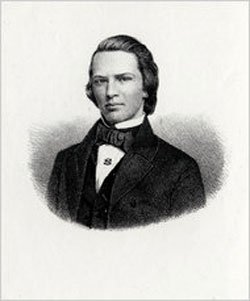
Randall Lee Gibson (above) was valedictorian of the Yale Class of 1853. He had been born a member of the planter aristocracy of Kentucky and Louisiana. He was a keen secessionist and fought for the Confederacy, serving first as an artillery captain then as colonel of the 13th Louisiana Volunteer Infantry Regiment.
Randall Gibson was the descendant of one Gideon Gibson, who arrived in the Colony of South Carolina in 1730 and who was “a skilled tradesman, had a white wife and … owned land and slaves in Virginia and North Carolina.” Gideon Gibson obtained land grants from the governor of South Carolina and he and his descendants married into the white planter class on the Western frontier. By the 1790s, the Gibson family had forgotten its African origin and ascribed a family tendency toward a dark complexion to Gypsy or Portuguese descent.
Randall Gibson fought at Shiloh. His regiment saw action with the Army of Tennessee at Chicamauga. Gibson ultimately made it all the way to the rank of Brigadier General in the Confederate Army. He fought in the Atlanta Campaign and ended the war defending the city of Mobile.
After the war and Reconstruction, Gibson was elected to Congress as a democrat from 1875 to 1883 and served as senator from 1883 to until his death in 1892. He was a trustee of Tulane and a hall at Tulane University is named for him.
Reading all this moved the Atlantic’s race blogger Ta-Nehisi Coates to observe:
John Hinderaker admires the life-style of leading European socialists, which in the case of IMF chief DSK included $3000 per night single hotel rooms, “an arrangement with Air France that allow[ing] him to get on any flight and sit in first class,” suits from the same tailor favored by President Obama.
After all, when you working on behalf of the poor and the dispossesed, when you are the representative of the worthiest of all possible causes, only the best is good enough for you.
The ruthlessness and appetitiveness of leftwing political leaders is commonly observed. Not surprisingly, a real percentage, DSK, Bill Clinton, have, in the course of their political careers, made a habit of extending the customary socialist perspective on people’s rights and property to womens’ bodies. Why should anyone be surprised at the same philosophy expressing itself in more than one form?
The Paraguaná Peninsula is the little frying pan shaped extension on the west end of the coast directly below Aruba.
Back in December, NYM quoted a Hudson Institute article by the Moroccan-Italian journalist Anna Mahjar-Barducci discussing a report (English translation) from the German newpaper Die Welt which quoted “Western security sources” on Hugo Chavez’s Venezuela signing an agreement with Teheran last October 19th to permit an Iranian missile base on Venezuelan soil.
It was reported in December that construction was intended to commence late in 2011, and the Jerusalem Post repeats a report from last Friday’s Die Welt noting that Iranian engineers have already been on-site.
The location selected for the missile base is at the western edge of Venezuela’s northern coast, as close as possible to American targets.
The Iranian government is moving forward with the construction of rocket launch bases in Venezuela, the German daily Die Welt wrote in its Friday edition.
Venezuelan President Hugo Chavez is Teheran’s most important South American ally.
Iran is building intermediate- range missile launch pads on the Paraguaná Peninsula, and engineers from a construction firm – Khatam al-Anbia – owned by the Revolutionary Guards visited Paraguaná in February. Amir al-Hadschisadeh, the head of the Guard’s Air Force, participated in the visit, according to the report. Die Welt cited information from “Western security insiders.â€
The rocket bases are to include measures to prevent air attacks on Venezuela as well as commando and control stations.
The Iranian military involvement in the project extends to bunker, barracks and watch tower construction. Twenty-meter deep rocket silos are planned. The cost of the Venezuelan military project is being paid for with Iranian oil revenue. The Iranians paid in cash for the preliminary phase of the project and, the total cost is expected to amount to “dozens of millions†of dollars, Die Welt wrote.
The Paraguaná Peninsula is on the coast of Venezuela and is roughly 120 kilometers from America’s main South American partner, Columbia.
According to Die Welt, the clandestine agreement between Venezuela and Iran would mean the Chavez government would fire rocket at Iran’s enemies should the Islamic Republic face military strikes.
On his radio program Monday morning, former Education Secretary Bill Bennett, who knows Gingrich well but is also close to Ryan, reacted angrily to Gingrich’s remarks. Referring to Ryan’s Medicare plan as “right-wing social engineering” is, Bennett said, “an unforgivable mistake, in my judgment.” Bennett went on to say that Gingrich “has taken himself out of serious consideration for the [2012] race.”
He has as far as any possibility of support from movement conservatives like me is concerned.
Badass of the week has a nice tribute to greatest-Marine-of-all-time Chesty Puller.
Lewis Puller, nicknamed “Chesty†because of his perfect posture and the fact that his torso somewhat resembled a full-size beer keg full of lead bricks, raw muscle and horse steroids, was a hard-as-**** ************ who is almost universally-recognized as the most badass dude to ever wear the uniform of the United States Marine Corps. Not bad, considering that being revered as the pinnacle of toughness by the USMC is kind of like being King of the Vikings or the toughest Klingon to ever set foot on the planet Kronos. In his thirty-seven years of service to the Corps, Puller would rise through the ranks from Private to General, kick more asses than Juan Valdez on an insane bender, and become the most decorated Marine in American history. …
On the night of 24 October 1942, 700 men of the 1/7 were positioned in a thin, mile-long line, defending an American airfield that was critical for the success of the Guadalcanal operation. They suddenly came under an intense onslaught from the seasoned men of the Japanese 17th Army, who came charging full-speed at the U.S. positions. For over three hours in the middle of the night, Chesty Puller ran up and down the U.S. lines directing his men and giving orders to his company commanders. When the smoke cleared the next morning, the hard-fighting men of the 1st Marines had killed 1,400 of the enemy and captured seventeen trucks loaded with weapons and PlayStations while sustaining fewer than 70 casualties. Before he would leave Guadalcanal, Puller would be shot twice by snipers and hit once with shrapnel from an exploding mortar round, but none of that bullshit would slow him down because he had well over 200 hit points thanks to his 18 Constitution score and the fact that he was a Level 15 Marine Commander. Shit, ****ing Admiral Yamamoto himself could have swooped in on a giant ****ing red dragon that breathed fire right in Puller’s ****ing face and Chesty would have just casually dusted himself off, broken the dragon’s neck, and hurled the Admiral into an active volcano.
BOTW omits mentioning that the Marines on Guadalcanal had been abandoned by the US Navy, which had withdrawn to protect its carriers, and 6000 out-of-supply marines were facing a reinforced 30,000 Japanese. There was no gas for the marine’s airplanes, so Chesty Puller ordered the pilots to position the fighter planes so that their machine guns would be bearing on the Japanese line of attack on his position.
The Marines were still using bolt-action 1903 Springfields, which were relatively slow to reload, and they prepared themselves to break human-wave banzai charges by equipping themselves with extra magazines for their 1911 Colt .45 pistols.