
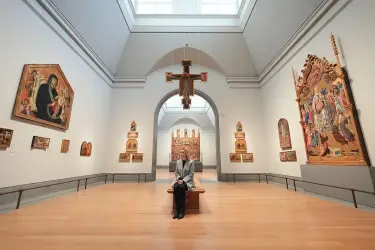
Mary Harrington makes the interesting point that “Art” is a modern way of viewing objects.
If we look at the longer history of humans making beautiful things, it’s clear that what this term means now isn’t an eternal feature of the cultural sphere, but specific to modernity. In fact the trajectory whereby making beautiful things became “art” tracks the onset of modernity more generally. In Saving the Appearances (1957) the literary historian Owen Barfield traces the slow retreat of what he calls “participation”, which is to say our felt sense of interconnection and implication in everything we observe.
I read Owen Barfield against Jacques Derrida here, as contrasting approaches to postmodernism. Meanwhile, I’ve also argued recently that the resulting emergence of objectivity, and with it modernity, is impossible to disaggregate from the cultural transformations enabled by the printing press. This new distinctive norm of “objectivity”; of seeing things as objects, in turn helped shape the emergence of art galleries as cultural spaces, within which one consumes beautiful things in the abstract, as objects. And once established, this mode of seeing art would go on to retcon earlier work within its own paradigm.
But if you look at premodern paintings, even those hung in the de-contextualised space of a modern art gallery such as the National Gallery’s Sainsbury Wing, you will swiftly realise that these artefacts may be on display as though they created for the objectifying eye of the “art critic”. But that’s not what they are at all. On the contrary, you are looking almost exclusively at devotional objects created for a culture of participation, and whose referent is not material but spiritual.
You are not looking at artefacts that were created to be examined critically as “symbols” or “representations” of some abstraction or other, or consumed as aesthetic objects. You are not looking at “artworks” at all. You are looking at artefacts created to be venerated, perhaps as visual focus for spiritual meditation, or simply to focus a prayer for help.





Please Leave a Comment!