Category Archive 'Modernity'

06 Sep 2025

Then Versus Now

,

Mary Harrington makes the interesting point that “Art” is a modern way of viewing objects.

If we look at the longer history of humans making beautiful things, it’s clear that what this term means now isn’t an eternal feature of the cultural sphere, but specific to modernity. In fact the trajectory whereby making beautiful things became “art” tracks the onset of modernity more generally. In Saving the Appearances (1957) the literary historian Owen Barfield traces the slow retreat of what he calls “participation”, which is to say our felt sense of interconnection and implication in everything we observe.

I read Owen Barfield against Jacques Derrida here, as contrasting approaches to postmodernism. Meanwhile, I’ve also argued recently that the resulting emergence of objectivity, and with it modernity, is impossible to disaggregate from the cultural transformations enabled by the printing press. This new distinctive norm of “objectivity”; of seeing things as objects, in turn helped shape the emergence of art galleries as cultural spaces, within which one consumes beautiful things in the abstract, as objects. And once established, this mode of seeing art would go on to retcon earlier work within its own paradigm.

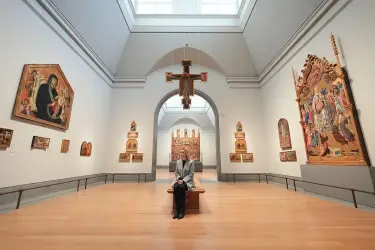
But if you look at premodern paintings, even those hung in the de-contextualised space of a modern art gallery such as the National Gallery’s Sainsbury Wing, you will swiftly realise that these artefacts may be on display as though they created for the objectifying eye of the “art critic”. But that’s not what they are at all. On the contrary, you are looking almost exclusively at devotional objects created for a culture of participation, and whose referent is not material but spiritual.

You are not looking at artefacts that were created to be examined critically as “symbols” or “representations” of some abstraction or other, or consumed as aesthetic objects. You are not looking at “artworks” at all. You are looking at artefacts created to be venerated, perhaps as visual focus for spiritual meditation, or simply to focus a prayer for help.
18 Mar 2018

Modernity Killing Western Man

, ,


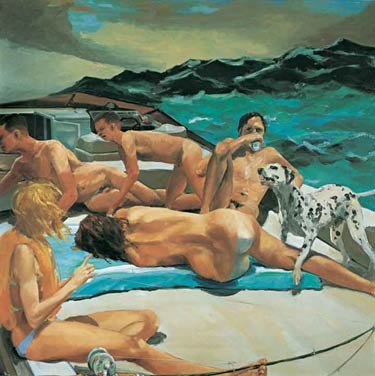
Eric Fischl, The Old Man’s Boat and the Old Man’s Dog, 1982. –Our time’s version of The Raft of the Medusa.

Brett Stevens notes that the birthrate of Europeans (and that of the more elite sectors of the American population) has fallen below replacement and he blames Modernity itself.

Modernity is killing us. As Plato intuited, the problem with bad systems is not solely that they are inept, but that this ineptitude shapes people. It causes people to despair. They then die out, much as Western Europeans are in Europe and North America. Why strive if life is fundamentally empty, miserable, and filled with neurotic worry?

Just as with animals, when we are in a good environment, we thrive; when we are confined, hopeless, cornered, despairing, miserable, or in pain, we will ourselves to death. Western European people worldwide have been living in a state of constant hopelessness since the end of WW1, but our doubt about life itself goes much deeper.

Modernity arose with the French Revolution. Away went the little villages ruled by gentle lords, the customs and culture, and the sense of purpose and faith in life itself that quelled our existential suffering. Before the Revolution, we knew we were doing the right thing if we lived according to our tradition.

After the Revolution, in came bureaucracy. Cities replaced the towns. Mass culture and mass mobilization replaced intelligent leadership. There was constant infighting, from the politics of elections to the churn among companies trying to decide who would control large swathes of the economy.

Our once-intelligent society had become shocking dumb. Not only did the stupid but obedient thrive in the age of managerial control, because every manager loves a low-risk worker even if that worker is not particularly good at anything, but all public opinions had to pander to a crowd with the collective intelligence of the audience for an amusement park.

Spread by social coercion, this stupidity quickly absorbed every institution in the West so that they got dumb together. Government got dumb at the same rate that the church, art scene, schools, professionals, corporations, and non-profits did. We kept pace as we rushed into the abyss.

By the time 1968 came around, ready for the coup de grâce, the West had given up on itself for three generations. They had nothing to believe in because modern life was really not all that much fun. Sure, it was prosperous, but everyone spent their time in mindless unnecessary jobs, maintaining glitchy gadgets, babysitting third world or low caste labor, dealing with government and our crazy fellow citizens, filing paperwork, and otherwise being forced into confronting the tedious, ugly, and faith-crushing every day.

This delighted the Left, who are fundamentally neurotics that are motivated by a desire to destroy everything beautiful, good, and true because they do not detect those things in themselves. Solipsism, it turns out, is a form of neurosis where we mistake ourselves for the source of reality itself, when we are really only mirrors.

Our modern world makes us hate life. We spend way too much time working in jobs that are jails, then must live in ugly cities where most people are neurotic or otherwise low-grade mentally disturbed, and participate in a process of life that is designed to humble, humiliate, bore, and subjugate all of us. No wonder people are not reproducing.

RTWT

21 May 2017

Why Modern Western Man Doesn’t Care About Having Children

, ,

Michel Houellebecq, The Elementary Particles:

Children existed solely to inherit a man’s trade, his moral code and his property. This was taken for granted among the aristocracy, but merchants, craftsmen and peasants also bought into the idea, so it became the norm at every level of society. That’s all gone now: I work for someone else, I rent my apartment from someone else, there’s nothing for my son to inherit. I have no craft to teach him, I haven’t a clue what he might do when he’s older. By the time he grows up, the rules I lived by will have no value—he will live in another universe. If a man accepts the fact that everything must change, then he accepts that life is reduced to nothing more than the sum of his own experience; past and future generations mean nothing to him. That’s how we live now. For a man to bring a child into the world now is meaningless.

27 Apr 2014

Aperçu

,

modernWorld

The modern world will not be punished.

It is the punishment.

~Nicolás Gómez Dávila

From Armchair Oxford Scholar via Madame Scherzo.


Your are browsing
the Archives of Never Yet Melted in the 'Modernity' Category.
/div>


Feeds
Entries (RSS)
Comments (RSS)
Feed Shark