The Daily Mail reports that discoveries of more sites and more artifacts are continuing to undermine the “Clovis First” theory. Evidence for what is being called the Solutrean Hypothesis keeps piling up.
America was first discovered by Stone Age hunters from Europe, according to new archaeological evidence.
Across six locations on the U.S. east coast, several dozen stone tools have been found.
After close analysis it was discovered that they were between 19,000 and 26,000 years old and were a European-style of tool.
The discovery suggests that the owners of the tools arrived 10,000 years before the ancestors of the American Indians set foot in the New World…
Finding the tools is being heralded as one of the most important archaeological breakthroughs for several decades.
Archaeologists are hopeful that they will add another dimension to understanding the spread of humans across the world.
Three of the sites were discovered by archaeologist Dr Darrin Lowery of the University of Delaware, while another one is in Pennsylvania and a fifth site is in Virginia.
Fishermen discovered a sixth on a seabed 60 miles from the Virginian coast, which in prehistoric times would have been dry land.
Darren Webster was meant to be going back to work after dropping his son off at home when, on a whim, he stopped by a field and decided to have a quick forage with his metal detector.
Within 20 minutes he made a discovery that was to introduce a new name to the turbulent history of medieval England.
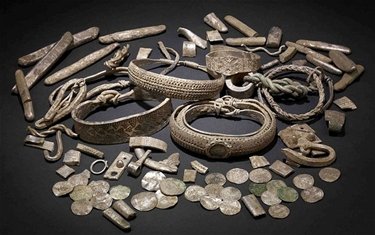
One of the objects in a hoard of silver buried one metre down in the earth was a coin marked with the name of Airedeconut, thought to refer to Harthacnut, a previously unrecorded Viking king powerful enough to have his own currency in 10th-century Northumbria.
Mr Webster, who has a stone tile workshop in Yealand Conyers, Lancashire, said that he had permission to search in the field near his home in Silverdale but did not choose it for any particular reason.
“My machine was telling me that I’d found some kind of silver. So I was slightly disheartened when I saw a lead pot. It was as I was lifting it that silver pieces started falling out of it.”
Once the lead container had been prised open there were 201 silver objects, including 27 coins, ten arm-rings, six brooch fragments, two finger rings, a fine wire braid and 14 ingots.
There were also 141 fragments of metal known as hacksilver, which would have been used for barter.
Gareth Williams, curator of early medieval coins at the British Museum, where the discovery was announced yesterday, said that the hoard would have been worth a midsized herd of cows in the 10th century, and would probably fetch a “high five-figure sum” today.
The exact value will be determined by a panel of experts in the spring, when museums will be allowed to bid for it. The Lancaster City Museum has already expressed an interest.
Under the Treasure Act, Mr Webster will be awarded half the value of the hoard, and the remainder will be given to the owner of the field, who has asked to remain anonymous.
Why someone hid a small fortune is a mystery, but burying treasure is usually an attempt to keep valuables safe in uncertain times.
“It is a period of political instability,” said Dr Williams. “The Vikings of Dublin were expelled and came to the North of England. There was also the Battle of Tettenhall, on the outskirts of Wolverhampton, where several northern kings were killed.”
The hoard was placed in a lead box and buried underground at a time when the Anglo-Saxons were attempting to wrest control of the north of the country from the Vikings.
Yesterday, the central London museum unveiled the hoard, the fourth largest ever found, which included Anglo-Saxon, Anglo-Viking, German and Islamic coins.
In total there were 201 silver objects, including the 27 coins which date the burial around 900AD, around the time the Vikings had been expelled from Dublin and were fighting the Anglo-Saxons to keep control of the north of England.
It also includes also coins from the time of Alfred the Great, who reigned from 871 to 899, and from the Viking kingdom of Northumbria.
One silver denier, bears the name Charles. Others bear the name Airdeconut, a Viking ruler in northern England.
Officials said the inscription Airdeconut, appeared to be an attempt to represent the Scandinavian name Harthacnut.
They said this was because many Vikings had converted to Christianity within a generation of settling in Britain.
On the other side were the words DNS (Dominus) REX, which was arranged in the form of a cross.
“The design of the coin relates to known coins of the kings Siefredus and Cnut, who ruled the Viking kingdom of Northumbria around AD900, but Harthacnut is otherwise unrecorded,†a museum spokesman said.
“It is a very significant find. It is a very large haul and it is the fourth large Viking find in the UK. Because it is recently discovered there is lots of research to be done.â€
Experts believe the hoard, which also includes 10 arm rings, two finger rings, 14 ingots, six brooch fragments and a fine wire braid which may have been worn as a necklace, could have been buried by a Viking warrior before he went into battle.
The collection of 10 bracelets and other jewellery are thought to have been worn to signify rank of the influential owner.
Dr Gareth Williams, the curator of early medieval coins at the museum, said: “Some of the coins reinforce the things we already know but with some of them it fills in the gaps where we didn’t even know we had gaps.
“It is always great when you get a new piece of evidence. This is the first new medieval King for at least 50 years and the first Viking King discovered since 1840. It is a very exciting find.”
It was found in September by Darren Webster, 39 using a metal detector on land around Silverdale, in north Lancashire.
The Aurignacian culture of the Upper Paleolithic (Late Old Stone Age) flourished between 45,000 and 35,000 years ago (or so we think, theories of carbon dating are subject to revision).
The Aurignacians are generally awarded the title of being our earliest genuinely human ancestors in Europe on the basis of artistic achievement. It was they who produced the Hohle-Fels Venus, the Chauvet cave paintings, and the Stadel cave Löwenmensch (“Lion Man”), all powerfully moving, but cryptic and fundamentally incomprehensible to us, artistic expressions.
The last object, the Löwenmensch, was discovered in a cave in the Swabian Alps in 1939. WWII resulted in its being neglected for 30 years, but eventually scholar attention arrived. The fragments were assembled, and interpreted. First, as a deity or a shaman representing a lion god, later as (Gawd help us!) a “cave lioness” and an icon of Stone Age Feminism.
Near the end of the last century, a few more pieces were discovered, so scientists are now in the process of removing earlier “restored” bits and having a go at reassembling the original artifact absent recent interpolations. The results will be very interesting.
The Hodinkee blog recently reported that the Hublot watch company of Geneva is building a new ultra complication watch as a tribute to the Antikythera Mechanism.
The finished product, scheduled to be unveiled at a show in Basel next Spring, will combine a watch with the functions recently identified by archaeologists in the Antikythera device.
The fragment of leather on the broken bronze buckle was carbon-dated to 600 A.D.
A University of Colorado Bouilder archeology team excavating a 1000-year-old Inupiat Eskimo house at Cape Espenberg on Alaska’s Seward Peninsula found a partial bronze artifact resembling a buckle, which is apparently even older.
Bronze-casting is a technology not known ever to have existed in any New World culture, so the artifact was presumably made in Asia and reached Alaska by some unknown early system of trade.
Gold earrings depicting the goddess Nike [Victory]. Hellenistic (Late 4th Century B.C), Varna Archaeological Museum, Varna, Bulgaria
Yesterday, a Facebook friend Ekaterina Ilieva Ilieva posted a photograph of these extraordinary Hellenistic portraits of the Greek goddess Nike in the form of earrings.
(The earrings can be seen worn today in a 0:26 video here.)
I wanted to quote a favorite passage of mine from Xenophon illustrating the importance of Nike to Greek soldiers in the same period, but Facebook’s programmed formatting truncated the quotation, so I’m making my intended comment into a blog post.
Xenophon’s Anabasis is an account of the Middle Eastern campaign of ten thousand Greek mercenaries employed by Cyrus the Younger in an attempt to wrest the throne of Persia from his brother Artaxerxes II in 401 B.C.
Xenophon’s account of the Battle of Cunaxa, which took place 70 km. north of Baghdad on the left bank of the Euphrates, contains reference to the Greeks invoking Nike in the watchwords selected before the battle.
Cyrus was with his bodyguard of cavalry about six hundred strong, all armed with corselets like Cyrus, and cuirasses and helmets; but not so Cyrus: he went into battle with head unhelmeted. …
At this time the barbarian army was evenly advancing, and the Hellenic division was still riveted to the spot, completing its formation as the various contingents came up. Cyrus, riding past at some distance from the lines, glanced his eye first in one direction and then in the other, so as to take a complete survey of friends and foes;
when Xenophon the Athenian, seeing him, rode up from the Hellenic quarter to meet him, asking him whether he had any orders to give. Cyrus, pulling up his horse, begged him to make the announcement generally known that the omens from the victims, internal and external alike, were good.
While he was still speaking, he heard a confused murmur passing through the ranks, and asked what it meant. The other replied that it was the watchword being passed down for the second time. Cyrus wondered who had given the order, and asked what the watchword was. On being told it was “Zeus the Saviour and Victory,” he replied,
“I accept it; so let it be,” and with that remark rode away to his own position. And now the two battle lines were no more than three or four furlongs apart, when the Hellenes began chanting the paean, and at the same time advanced against the enemy.
Church of the Holy Redeemer, built 1035 to house a fragment of the True Cross.
I had not ever hear of the abandoned city of Ani until seeing Boogie Man’s photoessay.
Ani, located in Eastern Turkey, was in the 10th Century the capital of an Armenian principality. In its prime, the city’s population was similar in size (100,000 — 200,000) to Constantinople, Baghdad, and Cairo. It became the seat of the Catholicoi, the head of the Armenian Apostolic Church in 992.
Ani was sacked by the Seljuk Turks in 1064, and by the Mongols in 1236. The city declined over subsequent centuries, ceasing to be a dynastic capitol around 1400, and losing the Armenian Catholicosate in 1441. Ani gradually dwindled to a small settlement within the walls of the former city, and was completely abandoned by the 18th century.
The site was excavated and documented by the Russian linguist and archaeologist Nicholas Marr 1892-93 and 1904-17.
Daily Mail reports that archaeologists using radar discovered a 120 m. (or 130 yard) long tunnel beginning under the Temple of the Feathered Serpent in the ancient pre-Mexican city of Teotihuacan apparently sealed roughly 1800 years ago. The tunnel leads to three chambers likely to be burial vaults of some of the city’s former rulers.
Human remains of Bronze Age began turning up along the banks of the Tollense River, near Neubrandenburg on the Mecklenburg plain north of Berlin, in 1997.
More than 2000 bones representing the skeletal remains of 90 individuals, along with war clubs and the remains of horses, have been found, providing evidence of a battle fought here around 1250 B.C.
An article appearing in this month’s Antiquity (behind subscription screen) reports:
Chance discoveries of weapons, horse bones and human skeletal remains along the banks of the River Tollense led to a campaign of research which has identified them as the debris from a Bronze Age battle. The resources of war included horses, arrowheads and wooden clubs, and the dead had suffered blows indicating face-to-face combat. This surprisingly modern and decidedly vicious struggle took place over the swampy braided streams of the river in an area of settled, possibly coveted, territory. Washed along by the current, the bodies and weapons came to rest on a single alluvial surface.
The archaeological investigation does not seem to have turned up any metal weapons. Perhaps, metal swords and spear points were so valuable in the region in that period that they would have been carefully recovered at the time of the battle. The wooden weapons found, some examples described as resembling a baseball bat and a polo mallet, must have been used by common tribesmen, insufficiently wealthy to arm themselves with swords. History records pagan Baltic tribesmen from Samogitia going into battle against the Teutonic knights as late as the time of the battle of Grunwald in 1410 A.D. armed with knotted oaken war clubs in which flints had been embedded.
Who was fighting and what the conflict was all about are completely unknown, but the German researchers estimate that at least 200 men must have been killed in the course of a single action.
An Austrian residing in or near the city of Wiener Neustadt, referred to in news accounts only as “Andreas K.”, was digging to expand a small pond in his backyard garden in 2007 when he discovered a medieval horde of 200 pieces of jewelry, buckles, and silver plates embedded with precious stones, pearls, and fossilized coral.
The finder failed to recognize their value at the time, and simply placed all the objects in a box. He sold his house and moved in 2009, at which time he happened to glance in the box previously stored in the basement. The dirt covering the object had dried and begun to fall off revealing jewels and precious metals.
The finder made inquiries on the Internet and knowledgeable collectors advised him to contact the Bundesdenkmalamt Österreich (BDA), the Austrian Heritage Office.
The BDA press office released a news report on Friday, but it is obvious that the objects have yet to be seriously analyzed and evaluated.