Category Archive 'Community of Fashion'
27 Aug 2010


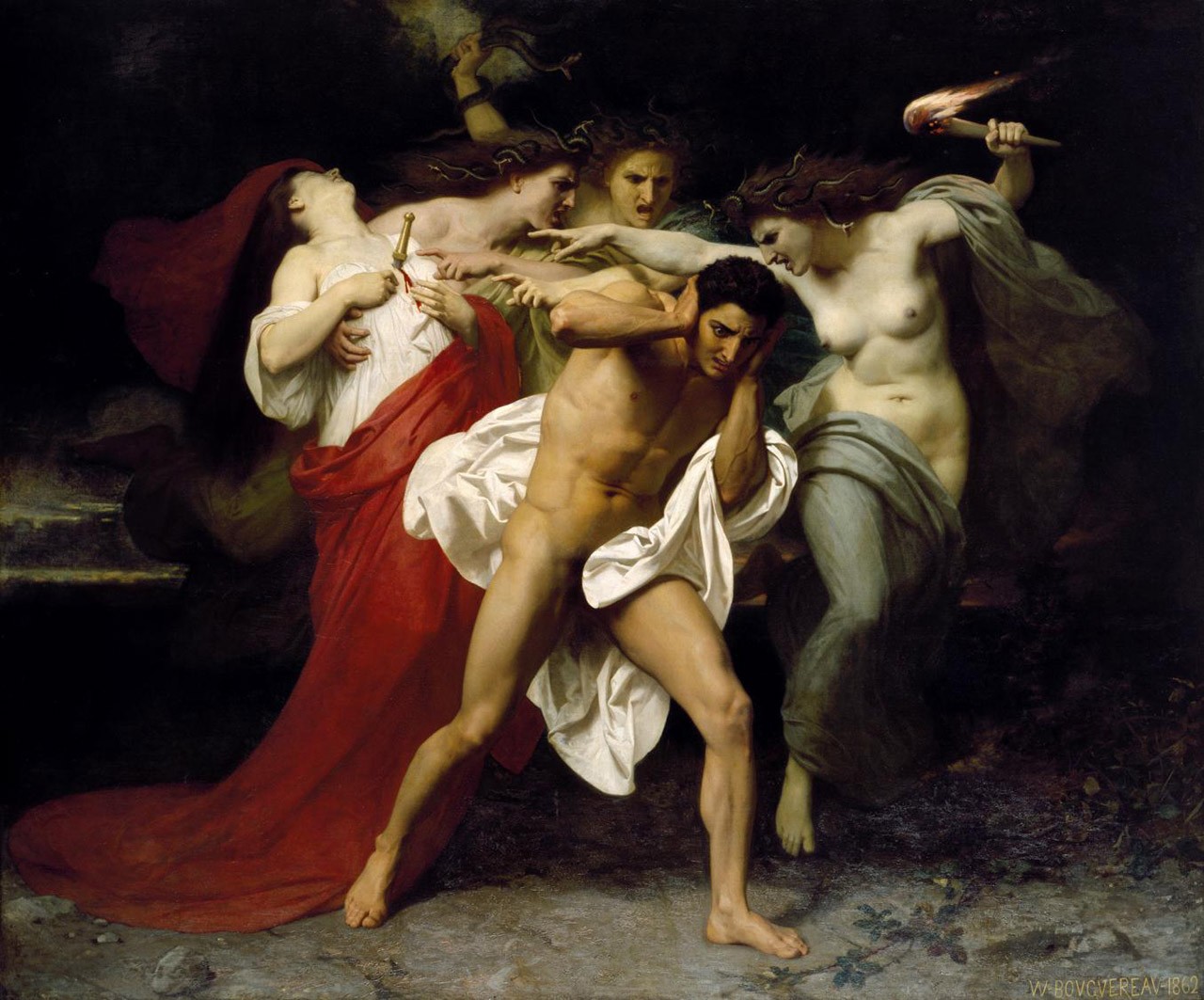
Willem-Adolphe Bouguereau, Liberal Democrat Pursued By the Furies, 1862, Chrysler Museum of Art
Rich Lowery explains how the democrat minority lucked into control of both electoral branches of government and then proceeded to self destruct.
The frustrations of minority status can drive a political party batty.
The temptation is to substitute belligerence for thought, insist on a self-destructive purity, lash out at the American public and question the wisdom and viability of the country’s institutions. Indulging in these tendencies almost always makes a party’s position worse rather than better.
The Obama Democrats may be the first party to engage in this self-defeating behavior — borne of a frustrated desperation — while holding the presidency and both houses of Congress by substantial margins.
Through an accident of timing (a national election coinciding with a financial crisis) and the exhaustion of the Bush-DeLay Republicans (who lost power almost by default), liberals took the commanding heights of the federal government while remaining a minority disposition in our national life. In short, they became a rump majority.
Through President Obama’s alchemy, these temporarily enlarged congressional numbers were supposed to be transformed into a permanent realignment. It hasn’t worked out, obviously.
In the last 20 months, Democrats have had the power to do almost everything they want, except command the allegiance of the public. That has made them and their allies feel embattled, isolated and perpetually aggrieved. They act like a forlorn minority at the same time they control every lever of elective power in Washington.
The ultimate source of the Democrats’ discontent is quite simple: They’ve lost independents. In 1994, in taking Congress, Republicans won independents by 14 percentage points. In 2006, in taking it back, Democrats won independents by 18 points. In the latest Gallup survey, Republicans lead among independents by 11 points. …
The pollster.com average of Obama’s approval rating among independents is a dismal 37.9 percent. This meltdown should have launched a thousand agonized liberal op-eds, conferences and strategy papers on how to win back the center. If, that is, liberalism had any realistic sense of its limits.
In the midst of a catastrophic loss of the middle, Obama’s supporters exhort him to get more angry, insistent and ambitiously liberal. Having already pushed for a bridge too far, they want to go farther still. When they can’t, they conclude it’s a damning indictment of Obama’s failure of nerve and the nation’s ungovernablility.
There’s little acknowledgment that the country is in a different place than they are. To the extent there is, so much worse for the country, which is condemned for its backwardness and intolerance. The majority is not just wrong on immigration enforcement and the Ground Zero mosque, it’s contemptible. Who knew that the American public would get accused of bigotry more often after electing an African-American president than before?
As former Bush speechwriter Peter Wehner writes, liberals “are expressing deepening alienation from our nation and turning on the American people with a vengeance.” They thought they had a mandate from heaven in 2008 and can’t bear the thought that they deluded themselves. They’ve gone from triumphalism to a petulant and uncomprehending tantrum in less than two years. The rump majority looks more exhausted by the day.
27 Aug 2010
The single most annoying thing about liberals is their false claim to intellectual superiority founded not on the merits of their arguments and analysis but on their long-term successful domination and near monopoly of certain institutions and professions conferring exceptional power and prestige.
They never really win any debates, but rely on their ability to shout down and, as Charles Krauthammer describes, marginalize their opposition with smears.
Liberalism under siege is an ugly sight indeed. Just yesterday it was all hope and change and returning power to the people. But the people have proved so disappointing. Their recalcitrance has, in only 19 months, turned the 40-year liberal ascendancy that James Carville predicted into a full retreat.
Ah, the people, the little people, the small-town people, the “bitter” people, as Barack Obama in an unguarded moment once memorably called them, clinging “to guns or religion or” — this part is less remembered — “antipathy toward people who aren’t like them.”
That’s a polite way of saying: clinging to bigotry. And promiscuous charges of bigotry are precisely how our current rulers and their vast media auxiliary react to an obstreperous citizenry that insists on incorrect thinking.
Resistance to the vast expansion of government power, intrusiveness and debt, as represented by the Tea Party? Why, racist resentment toward a black president.
Disgust and alarm with the federal government’s unwillingness to curb illegal immigration, as crystallized in the Arizona law? Nativism.
Opposition to the most radical redefinition of marriage in human history, as expressed in Proposition 8 in California? Homophobia.
Opposition to a 15-story Islamic center and mosque near Ground Zero? Islamophobia.
Now we know why the country has become “ungovernable,” last year’s excuse for the Democrats’ failure of governance: Who can possibly govern a nation of racist, nativist, homophobic Islamophobes?
Note what connects these issues. In every one, liberals have lost the argument in the court of public opinion. Majorities — often lopsided majorities — oppose President Obama’s social-democratic agenda (e.g., the stimulus, ObamaCare), support the Arizona law, oppose gay marriage and reject a Ground Zero mosque.
What’s a liberal to do? Pull out the bigotry charge, the trump that pre-empts debate and gives no credit to the seriousness and substance of the contrary argument.
—————————–
Laura Ingraham denounces the same pattern of liberal behavior and calls for genuine debate. 2:23 video
11 Aug 2010
Tony Blankley says it’s time for Americans to put our self-appointed rulers, the urban pseudo-intellectual community of fashion, in its place. Register and be sure to vote in November. Let’s restore democracy and take America back.
A foul and dangerous brew is heating up that is composed of: (1) The economic collapse that started in 2008; (2) the radical, “fundamentally transforming” left-wing agenda of the government; and, (3) the thwarting of the public will — with glee — by the entrenched, non-elected powers (in the courts, media, colleges and government bureaucracies) as they get into the face and under the skin of the cultural and political majority.
It is insufferable (and will not long be suffered) to be lectured to and imposed upon by a ruling class that loathes our nation’s history, values and accomplishments; by those who are not, in fact, our genuine betters. They are neither better educated nor more profoundly morally versed.
In fact, they are our intellectual and moral inferiors — not superiors. Constantly grinning Supreme Court Justice Elena Kagan didn’t think the Declaration of Independence’s proclamation that human beings “are endowed by their Creator with certain unalienable rights” should in any way affect her understanding of our constitutional rights — presumably, if any.
Part of the building danger derives from the fact that Americans now tend to self-select our news, opinion and entertainment sources based on our political beliefs and cultural and religious preferences. As a result, the nation no longer shares a common database of civic reality. Many liberals have no sense of how deep and roiling this no-longer-just-conservative passion is. Or they assume it involves some small, mendacious, ideological faction rather than a broad-based, nonideological, building national majority, which it does.
08 Aug 2010
Historian Victor Davis Hanson points out that the past explains how America got where it is today.
If one were to survey the elite campuses around 1975 and talk to those in law school, poly sci, or the humanities, then imagine them 35 years later as our elite leaders in government, the media, the universities, the foundations, and the arts, one could pretty much expect what we now have.
The present symptoms that characterize both our popular culture and current governance — shrill self-righteousness; abstract communalism juxtaposed with concrete pursuit of the aristocratic good life; race/class/gender cosmic sermonizing with private school and Ivy league for the kids; crass and tasteless public expression; a serial inability to take responsibility for one’s actions; the bipartisan mega-deficits; the inability to cut pensions and social security for the baby boomers — from the trivial to the fundamental, all derive from a bankrupt cohort that came of age in the sixties and seventies.
We see the arrested adolescence and hypocrisy that come from that sermonizing generation, whether in Al Franken’s puerile face-making, the ideologically driven suicide at Newsweek, the steady destruction of the New York Times, John Kerry’s tax-avoiding yacht, the Great Gatsby Clinton wedding, Michelle on the Costa del Sol, Nancy Pelosi’s jet, Tim Geithner’s tax skipping, or the constant race-card playing of a Charles Rangel and Maxine Waters. Yes, one walk across the Yale or Stanford campus circa 1975, and one could see pretty clearly what sort of culture that bunch would create when it came of age and was handed power.
05 Aug 2010
Christopher Hitchens shares his current near-death experience.
The notorious stage theory of Elisabeth Kübler-Ross, whereby one progresses from denial to rage through bargaining to depression and the eventual bliss of “acceptance,†hasn’t so far had much application in my case. In one way, I suppose, I have been “in denial†for some time, knowingly burning the candle at both ends and finding that it often gives a lovely light. But for precisely that reason, I can’t see myself smiting my brow with shock or hear myself whining about how it’s all so unfair: I have been taunting the Reaper into taking a free scythe in my direction and have now succumbed to something so predictable and banal that it bores even me. Rage would be beside the point for the same reason. Instead, I am badly oppressed by a gnawing sense of waste. I had real plans for my next decade and felt I’d worked hard enough to earn it. Will I really not live to see my children married? To watch the World Trade Center rise again? To read—if not indeed write—the obituaries of elderly villains like Henry Kissinger and Joseph Ratzinger? But I understand this sort of non-thinking for what it is: sentimentality and self-pity. Of course my book hit the best-seller list on the day that I received the grimmest of news bulletins, and for that matter the last flight I took as a healthy-feeling person (to a fine, big audience at the Chicago Book Fair) was the one that made me a million-miler on United Airlines, with a lifetime of free upgrades to look forward to. But irony is my business and I just can’t see any ironies here: would it be less poignant to get cancer on the day that my memoirs were remaindered as a box-office turkey, or that I was bounced from a coach-class flight and left on the tarmac? To the dumb question “Why me?†the cosmos barely bothers to return the reply: Why not?
Hitch writes wittily and one admires his courage, but I must say I do find myself a bit puzzled by the eagerness of professional literati like Hitchens not merely to share, but to avidly harvest, process, package, and market such close-to-the-bone experiences as a personal fatal illness.
My own natural inclination is to regard broad areas of personal life and experience, particularly this kind, as completely private. I would no more desire to tell an audience of strangers what I thought when I learned I had a fatal condition than I would care to disrobe in public.
It seems certain to me that my attitude must be a residual feature of my primitive, ordinary American, working class origins. Nothing could be more characteristic of membership in the Ivy League, elite world of high achievement, celebrity, and success than rushing, as quickly as possible following any notable experience, to the keyboard and hurrying one’s account of myself and whatever into print.
All experience was once considered useful for the forging of the human character. Today, all experience is simply more fodder for publication.
True members of the community of fashion are always marketing themselves. One can picture Hitchens arguing with Charon about not being permitted to retain his Blackberry and the lack of Wifi access from the River Styx. There would be such a huge opportunity for a major feature on exactly what a chap sees, and everything he experiences, as he is drawn irresistibly in the direction of that bright white light. How frustrating it would be!
Let’s hope Hitchens beats the odds and can go on writing and self-revelating for a long time yet.
30 Jul 2010

Rep. Barney F. Bourbon
Richard Fernandez identifies the international aspects of the thesis of Angelo Codevilla’s recent important essay.
Niall Ferguson is touring Australia warning that the end of American dominance may be imminent and sudden. Somehow the ideas in Codevilla’s essay are popping up everywhere, whether people have read it or not. Ferguson describes how rapidly empires can fall.
The Bourbon monarchy in France passed from triumph to terror with astonishing rapidity. The sun set on the British Empire almost as suddenly. The Suez crisis in 1956 proved that Britain could not act in defiance of the US in the Middle East, setting the seal on the end of empire.
But those things happen only to the denizens of history. People who live in the today usually think they are different. So despite evidence of dramatic change, people who have spent their whole lives among the policy certainties of the postwar period find it difficult to accept they may have to build a world of their own from first principles. Ferguson asks his audience: “what would you do in a world without America? Has the question even crossed your mind?â€
Australia’s post-war foreign policy has been, in essence, to be a committed ally of the US. But what if the sudden waning of American power that I fear brings to an abrupt end the era of US hegemony in the Asia-Pacific region? Are we ready for such a dramatic change in the global balance of power? Judging by what I have heard here since I arrived last Friday, the answer is no. Australians are simply not thinking about such things.
But if the Australians are not thinking about it, the Chinese are certainly preparing for it. The Wall Street Journal recently noted that Beijing objected to the right of US naval vessels to exercise in the Yellow Sea, despite the fact that they are international waters. At least they used to be. Waters are only international if kept so by a powerful navy committed to the freedom of the seas. People sometimes forget that treaties reflect realities rather than create them, no matter what the European Union may think. …
[Caroline Glick observes that] “[j]ust as US bureaucrats, journalists, politicians and domestic policy wonks tend to combine forces to perpetuate and expand the sclerotic and increasingly bankrupt welfare state, so their foreign policy counterparts tend to collaborate to perpetuate failed foreign policy paradigms that have become writs of faith for American and Western elites.†In other words, when it comes down to funding politics or funding defense, fund politics. Ferguson made the same point more starkly: “it is quite likely that the US could be spending more on interest payments than on defense within the next decade.â€
If the love of money is the root of all evil, the lack of it is the cause of the fall of empires. Ferguson gave some examples:
Think of Spain in the 17th century: already by 1543 nearly two-thirds of ordinary revenue was going on interest on the juros, the loans by which the Habsburg monarchy financed itself.
Or think of France in the 18th century: between 1751 and 1788, the eve of Revolution, interest and amortisation payments rose from just over a quarter of tax revenue to 62 per cent.
Finally, consider Britain in the 20th century. Its real problems came after 1945, when a substantial proportion of its now immense debt burden was in foreign hands. Of the pound stg. 21 billion national debt at the end of the war, about pound stg. 3.4bn was owed to foreign creditors, equivalent to about a third of gross domestic product.
Alarm bells should therefore be ringing very loudly indeed in Washington, as the US contemplates a deficit for 2010 of more than $US1.47 trillion ($1.64 trillion), about 10 per cent of GDP, for the second year running.
But alarm bells aren’t ringing in Washington. The entire alarm system has been disabled, disconnected, perhaps scrapped. Anyone who wants to turn it back on will have to root through the dumpster to see if any usable parts can still be retrieved. No better symptom of the absence of alarms is the genuine astonishment of Charles Rangel that it is illegal to break the law. Almost as a matter of course he concealed hundreds of thousands of dollars in income, used Congressional letterhead to solicit donations for private causes, took four rent controlled apartments for himself. Innocently. He probably didn’t think he was doing anything wrong. Things had been so sweet, so long that even after he was offered the chance to negotiate his way out of 13 separate violations of House rules and federal statutes he simply refused to believe it was happening.
Like Brecht’s fictional Atlantean who “the night the seas rushed in … still bellowed for their slaves,†the members of what Codevilla called the “ruling class†can’t believe it is happening. They still want their last dollar, their last perk. Literally, no matter what. “Massachusetts Congressman Barney Frank caused a scene when he demanded a $1 senior discount on his ferry fare to Fire Island’s popular gay haunt, The Pines, last Friday. Frank was turned down by ticket clerks at the dock in Sayville because he didn’t have the required Suffolk County Senior Citizens ID. A witness reports, ‘Frank made such a drama over the senior rate that I contemplated offering him the dollar to cool down the situation.’â€
The worst thing about the ferry incident is the possibility that if the witness had really offered Frank the dollar he might actually have taken it. Automatically; out of conditioning, like a Pavlovian dog. The culture in which the chairman of the House Financial Services Committee rose to power is one in which it is OK to blithely borrow more money than the entire defense budget can service and yet refuse to spend one whole dollar of his own money. The ethos of that world can be captured in one phrase: “don’t you know who I am?â€
17 Jul 2010
Angelo M. Codevilla wonders how long two-thirds of America can possibly be ruled by a well-entrenched elitist third.
Never has there been so little diversity within America’s upper crust. Always, in America as elsewhere, some people have been wealthier and more powerful than others. But until our own time America’s upper crust was a mixture of people who had gained prominence in a variety of ways, who drew their money and status from different sources and were not predictably of one mind on any given matter. The Boston Brahmins, the New York financiers, the land barons of California, Texas, and Florida, the industrialists of Pittsburgh, the Southern aristocracy, and the hardscrabble politicians who made it big in Chicago or Memphis had little contact with one another. Few had much contact with government, and “bureaucrat” was a dirty word for all. So was “social engineering.” Nor had the schools and universities that formed yesterday’s upper crust imposed a single orthodoxy about the origins of man, about American history, and about how America should be governed. All that has changed.
Today’s ruling class, from Boston to San Diego, was formed by an educational system that exposed them to the same ideas and gave them remarkably uniform guidance, as well as tastes and habits. These amount to a social canon of judgments about good and evil, complete with secular sacred history, sins (against minorities and the environment), and saints. Using the right words and avoiding the wrong ones when referring to such matters — speaking the “in” language — serves as a badge of identity. Regardless of what business or profession they are in, their road up included government channels and government money because, as government has grown, its boundary with the rest of American life has become indistinct. Many began their careers in government and leveraged their way into the private sector. Some, e.g., Secretary of the Treasury Timothy Geithner, never held a non-government job. Hence whether formally in government, out of it, or halfway, America’s ruling class speaks the language and has the tastes, habits, and tools of bureaucrats. It rules uneasily over the majority of Americans not oriented to government.
The two classes have less in common culturally, dislike each other more, and embody ways of life more different from one another than did the 19th century’s Northerners and Southerners — nearly all of whom, as Lincoln reminded them, “prayed to the same God.” By contrast, while most Americans pray to the God “who created and doth sustain us,” our ruling class prays to itself as “saviors of the planet” and improvers of humanity. Our classes’ clash is over “whose country” America is, over what way of life will prevail, over who is to defer to whom about what. The gravity of such divisions points us, as it did Lincoln, to Mark’s Gospel: “if a house be divided against itself, that house cannot stand.”
A must read.
27 Jun 2010
 
José Saramago
Jeff Jacoby, in the Boston Globe, quarrels with the establishment’s indulgence of intellectuals’ and artists’ communist affiliations.
The artist fascist is executed by firing squad, like Robert Brasillach, or hidden away in a madhouse, like Ezra Pound. Communists commonly receive the Nobel Prize for Literature.
If José Saramago, the Portuguese writer who died on Friday at 87, had been an unrepentant Nazi for the last four decades, he would never have won international acclaim or received the 1998 Nobel Prize for Literature. Leading publishers would never have brought out his books, his works would not have been translated into more than 20 languages, and the head of Portugal’s government would never have said on his death — as Prime Minister José Sócrates did say last week — that he was “one of our great cultural figures and his disappearance has left our culture poorer.’’
But Saramago wasn’t a Nazi, he was a communist. And not just a nominal communist, as his obituaries pointed out, but an “unabashed’’ (Washington Post), “unflinching’’ (AP), “unfaltering’’ (New York Times) true believer. A member since 1969 of Portugal’s hardline Communist Party, Saramago called himself a “hormonal communist’’ who in all the years since had “found nothing better.’’ Yet far from rendering him a pariah, Saramago’s communist loyalties have been treated as little more than a roguish idiosyncrasy. Without a hint of irony, AP’s obituary quoted a comment Saramago made in 1998: “People used to say about me, ‘He’s good but he’s a communist.’ Now they say, ‘He’s a communist but he’s good.’ ’’
But the idea that good people can be devoted communists is grotesque. The two categories are mutually exclusive. There was a time, perhaps, when dedication to communism could be absolved as misplaced idealism or naiveté, but that day is long past. After Auschwitz and Babi Yar, only a moral cripple could be a committed Nazi. By the same token, there are no good and decent communists — not after the Gulag Archipelago and the Cambodian killing fields and Mao’s “Great Leap Forward.’’ Not after the testimonies of Alexander Solzhenitsyn and Armando Valladares and Dith Pran.
In the decades since 1917, communism has led to more slaughter and suffering than any other cause in human history. Communist regimes on four continents sent an estimated 100 million men, women, and children to their deaths — not out of misplaced zeal in pursuit of a fundamentally beautiful theory, but out of utopian fanaticism and an unquenchable lust for power. …
Saramago may have been a fine writer, but he was no exemplar of goodness. Good people do not embrace communism, and communists are not good.
Read the whole thing.
Saramago is a good communist now.
15 Jun 2010

Japan’s Keisuke Honda (2nd R) scores against Cameroon yesterday
Liberal David Zirin says that the American Far Right, e.g. Glenn Beck and G. Gordon Liddy, don’t like soccer because it is a game popular abroad and they are racists and nativists.
Among adults, the sport is also growing because people from Latin America, Africa, and the West Indies have brought their love of the beautiful game to an increasingly multicultural United States. As sports journalist Simon Kuper wrote very adroitly in his book Soccer Against the Enemy, “When we say Americans don’t play soccer we are thinking of the big white people who live in the suburbs. Tens of millions of Hispanic Americans [and other nationalities] do play, and watch and read about soccer.” In other words, Beck rejects soccer because his idealized “real America” – in all its monochromatic glory – rejects it as well. To be clear, I know a lot of folks who can’t stand soccer. It’s simply a matter of taste. But for Beck it’s a lot more than, “Gee. It’s kind of boring.” Instead it’s, “Look out whitey! Felipe Melo’s gonna get your mama!”
—————————-
Ace responds with a far superior analysis. Americans don’t follow soccer because:
It is a low scoring game. (And we Americans are into fast and frequent gratification).
Our best athletes play football, baseball, and basketball. Who wants to watch low quality performers?
It requires an investment in time and attention to understand the point of any sport, and Americans are already otherwise fully invested.
And, leftie fashionistas like soccer, so we don’t.
—————————-
I watched small portions of some World Cup matches recently. I would add:
Soccer just looks strange. It really is foot ball. Watching people chasing a ball around, using only their feet, is a lot like watching a ball game played by some other species which unfortunately lacks hands and arms. I get an “I’m watching some kind of Special Olympics ballgame” feeling and start looking around for a cup to place my donation in.
Compared to American football, soccer is an exercise in pacifism. They just don’t tackle people. Americans like our own football because we like violence. We like to see people deliberately running into other people, hitting them, and knocking them down. We also like really big muscular guys. Americans would rather watch a bunch of 300+ lb. linemen crushing people than watch a bunch of slender fellows in short pants and high stockings running lithely over the grass.
Ace is right that soccer is also burdened with politics and symbolism. Americans know that our Obama-voting suburban elite deliberately has replaced American-style football in its own schools with multicultural, politically correct, non-violent soccer. The replacement of football by soccer is a metonymy for the community of fashion’s rejection of “hard, isolate, stoic” traditional American culture in favor of a less decidedly masculine internationalist alternative. New Canaan and Brookline are saying to the rest of America: “We don’t want to be provincial ruffians like you. We want to be Italian or Brazilian.”
Finally, soccer games are accompanied by what Dan Nosowitz aptly describes as the “grating, stab-your-ears-with-a-pencil drone of the vuvuzela,” an obnoxious plastic horn which was apparently first adopted by the Zulus of South Africa to replace their dreaded iklwa.

Vuvuzela
23 Apr 2010

Charles Edouard Delort, Marie Antoinette at the Petit Trianon Versailles Playing at Being a Shepherdess
Charlotte Allen explains how modern Puritan triumphalism manages to make simplicity the new luxury and distinction.
Hunting is usually taboo in the simplicity movement because it involves guns (hated by the professionally simple) and exploitation of animals (ditto). However, if you’re hunting boar in the upscale hills ringing the San Francisco Bay so as to furnish yourself a “locally grown” boar paté, as does Berkeley professor and simplicity movement guru Michael (The Omnivore’s Dilemma) Pollan, or perhaps to experience an “epiphany,” as another well-fixed Bay Area boar hunter recently told the New York Times, you’re doing a fine job of returning to the simple life. Indeed, the Times article was replete with quotations from portfolio managers, systems analysts, and graphic designers who have taken up shooting boar, deer, and bison in their spare time because it affords them a “primal connection” with the food on their plates and is also “carbon-neutral” (zero “food miles” if the deer you slay happened to have been munching the tulips in your backyard). But if you’re a laid-off lumber mill worker bagging possums in Eutaw Springs, S.C., because your main primal connection with food is that you don’t have much money to spend on it, you’re an unsophisticated redneck.
Simplicity movement people always seem to shell out more money than the not-so-simple, usually because the simple things they love always seem to cost more than the mass-produced versions. On a website called Passionate Homemaking that’s dedicated to making, among other things, your own cheese, your own beeswax candles, and your own underarm deodorant, you are also advised to cook with nothing but raw cultured butter from a mail-order outfit called Organic Pastures. The butter probably tastes great. It also costs $10.75 a pound – plus UPS shipping. At farmer’s markets, where those striving for simplicity like to browse with their cloth shopping bags, the organic, the locally grown, and the humanely raised come at a price: tomatoes at $4 a pound, bread at $8 a loaf, and $6 for a cup of “artisanal” gelato.
Wealthy and well-born people admiring – and sparing themselves no expense in convincing themselves that they’re cultivating – the virtues of humble folk is nothing new. Two millennia ago, Virgil, in his Georgics, heaped praise upon the tree pruners and beekeepers whom he likely could see toiling in the distance while he sipped wine on the veranda of his wealthy patron, Maecenas. Marie Antoinette liked to dress up as a shepherdess and hold court in her “rustic” cottage at the Petit Trianon. Other harbingers of today’s simplicity movement were the arts-and-crafts devotees of the early 1900s who filled their homes with handcrafted medieval-looking benches and the 1960s hippies whose minibuses and geodesic domes that enabled their gypsy lifestyles usually came courtesy of checks from their parents.
But it has been only in the last decade or so that the simplicity movement has come into its own, aligning itself not only with aesthetic style but also with power. Thanks to the government-backed war against obesity (fat people, conveniently, tend to belong to the polyester-clad, Big Mac-guzzling lower orders) and the “green” movement in its various save-the-planet manifestations, simplicity people can look down their noses at the not-so-simple with their low-rent tastes while also putting them on the moral defensive. Thus you have Michael Pollan, whose zero-impact ethic of food simplicity won’t let him eat anything not grown within one hundred miles of his Bay Area home, and preferably grown (or killed, milked, churned, or picked) himself. He bristles with outrage not only at McDonald’s burgers, Doritos, and grapes imported from Chile (foreign fruit destroys people’s “sense of place,” he writes in The Omnivore’s Dilemma) but even at Walmart’s announcement in 2006 that it would start stocking organic products at affordable prices. Walmart, like factory farms, SUVs, wide-screen TVs, and outlet malls, is usually anathema to the simplicity set, but here you would think the giga-chain would be doing poor people a favor by widening their access to healthy, less-fattening produce. Not as far as Pollan is concerned. Instead, as Reason magazine’s Katherine Mangu-Ward reported, Pollan worried on his blog that “Walmart’s version of cheap, industrialized organic food” might drive the boutique farms that served him and his locavore neighbors out of business. …
The problem with the simplicity movement isn’t simply that you’ve got to be rich to live simply. In their 2007 book Plenty, Alisa Smith and James MacKinnon, who had vowed to spend a year sticking to the 100-mile locavore eating radius (and, as freelance writers, had plenty of time to put together meals that lived up to this promise), discovered that they were spending $11 per jar on honey to substitute for $2.59 sugar and that one of their locally foraged dinners cost them $130 and more than a day to prepare. …
The problem with the simplicity movement is that its proponents mistake simplicity, which is an aesthetic lifestyle choice, for humility, which is a genuine virtue.
Read the whole thing.
Hat tip to Karen L. Myers.
18 Apr 2010

Today’s Day By Day illustrates Richard’s point about the sophistication of Tea Party commentary
Richard Fernandez notes that Tea Parties have taken the political debate to deeper than customary levels of analysis, which may possibly be connected to the recently discovered fact that Tea Party activists are not really the rubes and yokels that the community of fashion inevitably supposed they were.
Perhaps the greatest distinction between the Tea Parties and the televised “debates†between candidates is that issues are raised at fundamentally different levels. In the first the money is for the candidate to dispense. In the second it is about how much he has a right to dispense not at the margins but structurally. The psychological difference is captured perfectly by Barack Obama’s response to the Tea Parties. ABC News reported that
Speaking at a Democratic fundraiser tonight, President Obama touted his administration’s tax cuts and said that the recent tea party rallies across the nation have “amused†him.
“You would think they should be saying thank you,†the president said to applause.
Members of the audience shouted, “Thank you.â€
‘Thank you for what?’ the Tea Partiers might respond, ‘it is our money.’ The incendiary potential of that type of conversation may explain the heat which has been generated by the crashers and anti-crashers at these events. The Tea Parties are less a debate than political clash. Glenn Reynolds at Instapundit has a number of links to sites which have promised to infiltrate the Tea Parties and efforts repel boarders. It has the aspect of conflict and consequently generates many of the same emotions. Dana Milbank at the Washington Post was nearly beside himself at the sight of these “faux populistsâ€, only recently described as hicks, but now revealed to have Harvard Degrees.
A CBS News/New York Times poll released on Tax Day found that Tea Party activists are wealthier than average (20 percent of their households earn more than $100,000, compared with 14 percent of the general population) and better educated (37 percent have college or postgraduate degrees vs. 25 percent of Americans ).
Milbank should be careful about opening that can of worms lest it lead to a discussion of whether the half of US households who pay Federal Income Tax so it can be transferred to the other half should have any say on how their money is spent. Because the only thing worse than the narrative that Tea Partiers are the ingrates who should be saying “thank you†to the quality that wisely governs them is the reverse: a narrative where the Tea Partiers are the quality who dare to question the ingrates that govern and write about them. Any idea that threatens to invert the positions of the elite and the peasantry is by definition subversive. The real problem with portraying the rebels as well educated and smart is that it begs the question of what their critics are.
17 Mar 2010
Victor Davis Hanson explains who is conducting today’s Revolution in the United States and against whom it is directed.
[T]he present attempt to remake America is the effort of the liberal well-to-do — highly educated at mostly private universities, nursed on three decades of postmodern education, either with inherited wealth or earning top salaries, lifestyles of privilege indistinguishable from those they decry as selfish, and immune from the dictates they impose on others.
Such are basically the profiles of the Obama cabinet and sub-cabinet, the pillars of liberalism in the Congress and state legislatures, the public intellectuals in the universities and foundations, the arts crowd, and the Hollywood elite. Let us be clear about that.
They are all battling on behalf of “them,†the poorer half of America, currently in need of some sort of housing, education, food, or legal subsidy, whom the above mentioned elite, in the way they live, send their children to school, socialize, and vacation so studiously avoid. (The New York Times owners are likely to follow the cut-throat business practices of Wall Street, live in the most refined areas of New York, and assume privileges indistinguishable from other CEOs; the difference is that they so visibly care about those they never see or seek out).
Note well the term “poor.†These are not Dickensian or Joads poor, but largely Americans who by the standards of the 1940s would be considered lucky. Partly because of globalized Chinese consumer goods, and partly redistributive practices of a half-century, our current “underclass†has access to clothes, electronics, entertainment, apartments, cell phones, transportation, etc., undreamed of by the middle class of the recent past. I live in one of the poorest areas of one of the poorest counties in a bankrupt state; and those I see poor are not like those I saw 40 years ago in the same locale.
No, the revolution is not one of the abject poor and starving storming the Bastille, but of the angry and self-righteous well-off— angry as hell that the less well-off are living lives quite differently from the very well-off. (A trodden down poor person today flies standby from San Francisco to LAX; a very rich person gets into his $50 million Gulfstream — but note modernism’s paradox: the poor person’s United Airlines pilots are as good, he gets there as safely and in some comfort, and not much later as well.)
Some of the revolutionaries are guided by genuine noblesse oblige. Others act out of guilt and can justify their own consumption if they “care†for a distant poorer other. Still more explain their own privilege through using government to redistribute income. A few are driven by genuine hatred — stemming from the fact that the highly educated academic or artist makes far less than the doctor, lawyer, CEO, or — heaven forbid — tire store owner, family orthodontist, or owner of a half dozen Little Caesar pizza franchises.
Your are browsing
the Archives of Never Yet Melted in the 'Community of Fashion' Category.
/div>

Feeds
|