Roger Cohen finds that everything old is new again: both the anti-immigrant passion of the late-1840s-early-1850s American Party and the America First isolationist movement of the late 1930s. Like Protectionism (which has been discredited for decades and decades after the Smoot-Hawley Tariff provoked a universal trade war which played an important role in the world-wide Great Depression), Nativism and Isolationism have been for a very long time looked upon as discredited political positions, which it would be intrinsically disgraceful and discrediting to embrace.
Donald Trump proved that none of the three grave historic fallacies of American politics was a third rail that killed candidacies any longer. His supporters in general didn’t know their history and didn’t care.
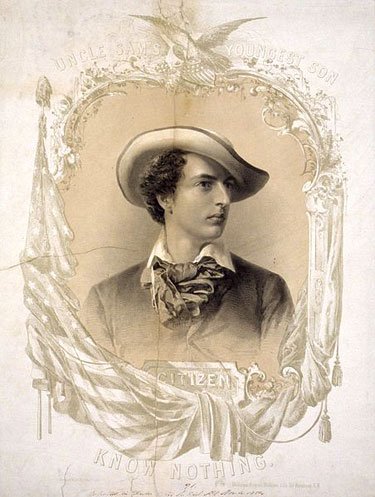
On the evidence, ethnocentrism is a pretty basic human instinct. Band together with your own. Keep the outsider down or out. In the 1850s, at another moment of American unease, the Know-Nothings swept Massachusetts and won mayoral elections in Philadelphia and Washington on a nativist platform to “purify†national politics by stopping the influx of Irish and German Catholics.
Papist influence was then the perceived scourge through which the Know-Nothing movement, as the Native American Party (later the American Party) was commonly known, built its following. Today the supposed threat is Muslim and Mexican infiltration. Or so Donald Trump, the de facto Republican presidential candidate, would have us believe in his “America First†program.
A know-nothing tide is upon us. Tribal politics, anchored in tribal media, has made knowing nothing a badge of honor. Ignorance, loudly declaimed, is an attribute, especially if allied to celebrity. Facts are dispensable baggage. To display knowledge, the acquisition of which takes time, is tantamount to showing too much respect for the opposition tribe, who know nothing anyway.
Any slogan can be reworked, I guess. America First has a long, unhappy history, the America First Committee having pressed the view that the United States should stay out of the war to defeat Fascism in World War II. …
Well, America First is back, tweaked as Trump’s we-won’t-be-suckers-anymore ideology. …
The know-nothings are on the march. But of course they must know something. Millions of people who vote for Trump cannot be wrong. Perhaps their core idea, along with the unchanging appeal of ethnocentrism, is that politics no longer really matter. Celebrity matters.
Jam Matejko, Adoption of the Polish Constitution of May 3, 1791, 1891, Royal Castle, Warsaw.
The painting depicts King Stanislaus Augustus together with members of the Grand Sejm and inhabitants of Warsaw entering St John’s Cathedral in order to swear in the new national constitution just after it had been adopted by the Grand Sejm in the Royal Castle visible in the background.
Below is a short film celebrating the passage of the first liberal constitution in Europe by the Polish senate, May 3, 1791, the passage of which provoked treason by magnatial aristocrats (The Confederacy of Targowica) followed by intervention and partition of the country by Russia, Prussia, and Austria. Tadeusz Kosciuszko led the national resistance to the partition. The final defeat of Kosciuszko’s forces was followed in 1795 by the Third and final Partition of Poland-Lithuania. The actual document wound up locked in an iron box under guard in Moscow’s Kremlin, so much terror did it strike in the hearts of despots. Poles and Lithuanians still sing the praises of the Constitution of the 3rd of May which extended the rights enjoyed by the nobility to the entire country. The Third of May is today a national holiday in both countries.
Captain Cook’s famous ship has seemingly been discovered in the US 230 years since it was sold, sunk and forgotten.
The Endeavour is one of the most famous ships in naval history and was used by Captain James Cook to discover the East Coast of Australia in 1770.
The last sighting of the Endeavour was around 1778 when it is believed the ship was sold, renamed the Lord Sandwich, and then used to transport British troops during the American Revolution.
Archaeologists believe they have found the scuttled remains of the Endeavour in Newport Harbour, Rhode Island.
The Rhode Island Marine Archaeology Project made the discovery, saying the ship was scuttled in the harbour by British forces in the lead up to the Battle of Rhode Island in 1778.
RIMAP said it was ’80 to 100 per cent certain’ that the remains it has discovered belonged to the Endeavour.
Donald Trump has been vociferously complaining that delegate contests he doesn’t win are undemocratic and unfair, and demanding that the GOP Convention rules be changed to award the nomination to him, if he should be in possession of a plurality of votes on the first ballot. And, as usual, you can find a lot of the dimmer commentators, particularly on television, succumbing to his arguments.
The truth of the matter is that the nomination process was never intended or designed to function as a uniform and monolithic expression of pure and direct democracy.
The contest for the nomination was obviously never meant to be decided entirely and consistently by voting in primaries. Nor was the nomination ever intended necessarily to be decided prior to the convention itself. In recent years, the impact of coverage of the primary contests by the national media has added much greater emphasis to primary voting than was the case in earlier periods, and has encouraged the snowballing of a frontrunner’s success, but 2016 is proving to be an unusual cycle featuring a minority populist groundswell of support for one candidate, who –like some others in the past– is widely unpopular and completely unacceptable to a large portion of the Party.
The Nominating Convention is not simply a rubber stamp process which counts up the results of primary voting. Political parties are private organizations operating on the basis of their own systems of rules, whose rules and processes commonly differ over 50 states. Different states choose their delegates at different times and different states appoint delegates by different processes. Some delegates are bound by the rules to vote (on at least the first ballot) for a particular candidate. Others are unbound.
The essence of the situation is that convention will be composed of delegates representing their state parties, and not by robots mechanically operating in accordance with a direct democracy.
If the nominating process were a pure democracy, one would suppose that, instead of our current system, there would be held a nation-wide primary balloting all on the same day, and no convention would be necessary.
But, actually, the nomination contest is intended to function as a complex process, incorporating local and regional customs, preferences, and eccentricities, and going on over an extended interval of time intentionally in order to expose potential candidates to a diverse geographical collection of constituencies and interests, to test their abilities and personalities, and to expose their records and personal histories to intense scrutiny at length.
The fact that, in recent decades, the American nominating system has grown more predictable, more primary-based, and less reliant on delegate contests at the convention itself does not mean that, in this unusual year featuring a highly-unusual front-runner candidate of controversial character and carrying dubious credentials, we may not see a return to a more old-fashioned convention-based decision-making process.
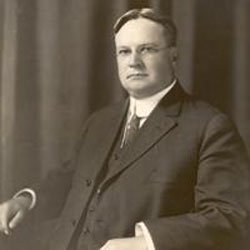
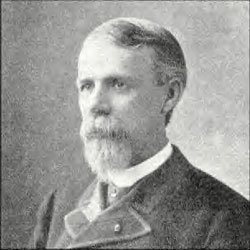
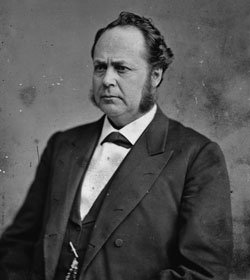
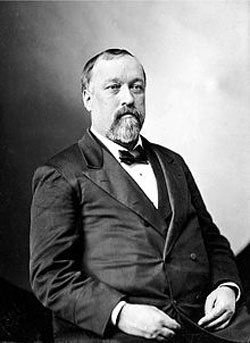
Donald Trump won’t like it if he loses despite entering the convention with the largest number of first ballot votes, but if that happens to Trump, he won’t be the first GOP front-runner to fall behind in the course of convention balloting. It has not happened recently, not since 1940, but Donald Trump would actually be the 23rd of 22 men who had exactly the same experience (two of them, John Sherman and James G. Blaine, twice).
1940:
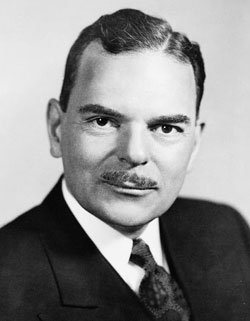
Thomas Dewey had 36% of the delegate votes on the first ballot of the Republican Convention of 1940, but Wendell Willkie (who started with only 10.5% of the votes) won the nomination on the 6th ballot. Wilkie, of course, lost to Franklin D. Roosevelt who was breaking tradition by seeking a third term.
Benjamin Harrison, who was initially not among the top four candidates in votes, won the nomination after 8 ballots. He went on to defeat Grover Cleveland in the general election.
Grant had the most votes on the first ballot, and all these other gentlemen had some, while James Garfield had zero, but after 36 ballots Garfield got the needed majority. Garfield was elected president, but was assassinated a few months after taking office.
Dark horse Rutherford Hayes of Ohio rose from an approximate tie for 5th place to win on the 6th ballot. Hayes lost the popular vote to Samuel Tilden. 20 electoral college votes were disputed, but a special commission (containing a Republican majority) awarded them, and the election to Hayes. Democrats agreed to stop resisting his inauguration after Hayes promised to end Reconstruction.
Abraham Lincoln’s floor managers successfully pulled off a deal with the Pennsylvania delegation and got him enough votes by the third ballot to take the nomination away from William Seward.
“I will not be forced to vote for somebody I don’t want to.”
I guess Clem here got up off the couch and joined the GOP earlier this year when Donald J. Trump the Savior suddenly appeared on the political event horizon.
Trumpkins like Clem are naturally angry and upset. Donald Trump came in on top in a number of primaries and currently possesses a plurality in the delegate count. That obviously means that he is entitled to keep winning and the Republican Party ought to make him the nominee. But now the tide has begun to turn against him, and that is completely unfair.
Who wouldn’t be upset?
I guess old Clem (in the Cabela’s t-shirt) has never in his long life been previously disappointed in the candidate nominated by the GOP. Unlike myself, Clem must have rejoiced when they put up Nixon in ’68 and ’72. I couldn’t vote in ’68, but in ’72, faced with the nauseating choice of Nixon or (commie) George McGovern, I voted sarcastically for Bircher John Schmitz, who believed in the Illuminati Conspiracy.
Presumably it was OK with Clem when the evil and unconservative Republican Establishment denied the nomination in 1976 to the demigod Ronald Reagan and gave it to the inevitable loser Gerald Ford. I was disappointed, and being of Lithuanian extraction, I was actively angry that Ford clumsily misspoke during a debate with the peanut farmer seemingly denying that the countries of Eastern Europe were “captive nations” under Soviet domination, but I nonetheless grudgingly pulled the lever for Ford.
There was no problem for me, or presumably for Clem (if he actually voted) in 1980, or 1984, or 1988. The Republican choices of Ronald Reagan and then his Vice President George H.W. Bush were not controversial for most of us.
But (obviously led to self-destruction by some Greek god) George H.W. Bush flagrantly broke his campaign promise (“Read my lips: No new taxes!”), and conservatives were incensed. I voted for Pat Buchanan in the GOP Primary, and wrote in “Donald Duck” in the general election. Clearly, though, things were still hunky dory with Clem.
In 1996, I strongly preferred a conservative candidate like Steve Forbes or Phil Gramm. The Party nominated tired old, moderate old Bob Dole, a business-as-usual, Establishment Republican if there ever was one. I voted for him, but we still got hosed.
2000 was shaping up to be a Republican victory. I was still for Forbes, but George W. Bush, if not a shining light, seemed tolerably conservative, and I supported him. I was more enthusiastically behind GWB in 2004, as he was running against the Vietnam War traitor and consummate shit John Kerry.
In the course of my own long lifetime, I’ve only ever twice seen the GOP nominate guys I was in wholehearted support of: Barry Goldwater in 1964, when I was much too young to vote, and Ronald Reagan. I’ve been sufficiently hostile to GOP nominees twice (Nixon in ’72 and George H.W. Bush the oath-breaker in ’92) that I refused to vote for them. But I never gave up on the two-party system or burned my Republican registration card, because I didn’t get my way one particular year.
Personally, I always figured that people intelligent enough to be conservative were more or less bound to find themselves generally in the minority, and I recognized long ago that victories in national elections are not something we can hope to gain with any kind of real assurance. Conservatives have to look at politics the way Addison’s Cato the Elder did:
“’Tis not in mortals to command success, But we’ll do more, Sempronius; we’ll deserve it.â€
You simply do not have a gifted and principled national figure like Ronald Reagan available to run every four years. And even when you do, the timeservers, functionaries, and trimmers are liable to beat you, the way they beat us in ’76.
So, no, I do not have a lot of respect for Clem’s position or perspective. Screw him.
I will say though that all this Trump business is depressing, because a lot of more significant and talented people than Clem have lost their grip and joined the Trump Movement. There are a lot of conservative bloggers I follow and like dancing along in the wake of Donald the Blue-Suited-and-tied-excessively-long-necktied Piper. I’m making something of an heroic effort these days to restrain myself from saying the cruelest things I can possibly say, because I think they are inevitably going to lose, and I don’t really want to alienate many of them. I don’t think the Conservative Movement or the Conservative Blogosphere can do without them. Unlike Clem there, in the Cabela’s t-shirt. To hell with Clem.
It appears that Trump supporters who have rallied behind Larry Wayne Lindsey have been schlonged.
Lindsey became an overnight sensation after the Trump Report Drudge Report highlighted a video of the wannabe Trump delegate burning his Republican party registration after pro-Cruz political insiders cast him aside. The trouble with Larry’s story is that it is a big fat lie.
Larry did not attend the county caucus, which is where he needed to go in order to get elected as a delegate to the state convention. …
NBC News actually reported that Larry was shut out likely due to his own “lack of familiarity with the process.â€
“But a sign-in sheet from his county’s March 19 assembly, the second step of the process where delegates were elected to the statewide assembly, reveals that Lindsey never showed up to that meeting, and an alternate signed in for him instead.â€
And when confronted with the fact that he did not attend the correct meeting, Larry Wayne Lindsey, who regularly posts Prntly articles headlining Ted Cruz’s alleged sexual exploits and supposed ineligibility, “admits he may have missed a meeting,†but following in the footsteps of his dear leader, shockingly blames one of the “many Cruz supporters who deliberately tried to mislead him on several occasions, including on dates and times of meetings.â€
Theodore Roosevelt (Progressive Party), William H. Taft (Republican), Woodrow Wilson (Democrat). Miss Columbia hands out the presidency.
Joseph Cummins reminded us, at Politico last month, that the country has a long history of scurrilous and unseemly presidential election contests. Take the 1912 Election, for instance…
[O]ne of the great American presidential manliness taunters in American history was Teddy Roosevelt. Henry James called him “a monstrous embodiment of unprecedented and resounding noise,†and he is the presidential candidate whose bombast most resembles that of Donald Trump. During the election of 1904, he called the president of Venezuela “a villainous little monkey†and tagged his Democratic opponent, Judge Alton Parker, “that neutral-tinted individualâ€â€”the “low-energy†charge of its time. In 1912, during the historic election that split the Republican Party and handed the presidency to Woodrow Wilson and the Democrats (sound familiar?), Roosevelt (who would run as a Progressive “Bull Moose†Republican) showed up at the contested convention wearing a sombrero, smoking a cigar and calling President William Howard Taft a “rat in a corner.†(Unmanned, Taft could only respond weakly that Roosevelt was “neurotic.â€) During that same fractious election, after letters came to light that seemed to indicate that the married Woodrow Wilson might be having an affair, Teddy sneered: “It wouldn’t work. You can’t cast a man as Romeo who looks and acts so much like an apothecary clerk.â€
Maggs Bros. Ltd., a London Antiquarian bookselling firm established in 1853, recently made a rather sensational find: a manuscript breviary belonging to one Leonardus Haslinger, a parish priest resident at Thalheim bei Wells in the Traun Valley of Upper Austria, written in the 1450 and 1460s, which contains on the last pages, following the devotional text, a couple of pages listing artificial fly dressings, recipes for bait, and other fishing instructions.
The Haslinger Breviary fly patterns predates the patterns listed in both the Treatyse of Fysshynge with an Angle (1496) and the Tegernseer Angel- und Fishbucklein (1500), the two earliest sources of artificial fly patters post Classical Antiquity, which featured Claudius Aelian‘s description of the use of an artificial called the Hippouros on a trout stream in Macedonia.
This important item was scheduled to be offered for sale at the shortly-upcoming New York Antiquarian Book Fair for $185,000, but it was snapped up in advance of the event by an as-yet-undisclosed institutional library.
In consolation to the public, the Haslinger Breviary was exhibited yesterday at a special meeting of the Anglers’ Club of New York for those willing to pay an entrance fee of $75.
The American Museum of Fly Fishing will be publishing a translation by Richard Hoffman in the Spring issue of American Fly Fisher.
Chris Allen, at Phys Org, describes how microbiologists are using the bacteria in horse manure to attempt to identify the route used by Hannibal’s Carthaginians to cross the Alps and invade Italy.
Despite thousands of years of hard work by brilliant scholars, the great enigma of where Hannibal crossed the Alps to invade Italy remained unsolved. But now it looks like we may just have cracked it – all thanks to modern science and a bit of ancient horse poo. As a microbiologist, I was part of the team that carried out the research.
Hannibal was the leader of the Carthaginian army during the Second Punic War with Rome (218-201BC). He famously led his 30,000 assorted troops (including 37 elephants and over 15,000 horses) across the Alps to invade Italy – bringing the Roman war machine to its knees. While the great general was ultimately defeated after 16 years of bloody conflict, this campaign is now regarded as one of the finest military endeavours of antiquity. We can say, in retrospect, that these events ultimately shaped the later Roman Empire and therefore the European civilisation as we know it.
For more than 2,000 years historians, statesmen and academics have argued about the route he took. Even Napoleon is known to have shown an interest. But until now, there’s not been any solid archaeological evidence.
Our international team, led by Bill Mahaney of York University in Toronto, have finally provided solid evidence for the most likely transit route: a pass called the Col de Traversette. This narrow pass between a row of peaks is located on the border slightly south-east of Grenoble in France and south-west of Turin in Italy. Our findings are published in Archaeometry.
Gerard van der Leun of American Digest (who is normally our most kindred spirit blogger) disagrees with NYM on Trump. Yesterday, he responded indignantly in a comment to our quoting John Hawkins‘s negative opinion of Trump:
The enemy of my enemy is always my friend until he helps me to destroy my enemy. After that he becomes my enemy again.
That or adios supreme court for one or two generations.
I think myself that Mr. van der Leun is not looking properly at the big picture. He ought to consider the historical perspective proposed by National Review’s Avi Snyder, to begin with.
With the GOP looking at the possibility of an open convention — complete with floor fights, riots, and the threat that the party will tear itself in two — the best historical analogue seems clear: Donald Trump is Teddy Roosevelt, and this is 1912 all over again.
The 1912 Republican National Convention was a battle for the soul of the party.
Though President William Howard Taft had been Theodore Roosevelt’s chosen successor in 1908, by 1912, the increasingly radical Roosevelt was dissatisfied with Taft’s relative conservatism in office. In violation of an earlier pledge not to run for a second full term, Roosevelt chose to challenge the president for the Republican nomination.
Much like Donald Trump, the progressive Roosevelt was a post-constitutional candidate. There are parallels between Trump’s defense of eminent domain abuse and Roosevelt’s contempt for property rights, and Trump’s strongman tendencies have antecedents in TR’s impatience with the machinery of constitutional government.
In the early 20th century, only a handful of states held popular primaries to choose presidential nominees, and the results weren’t even binding. But Roosevelt was a popular figure, and he took advantage of these contests, carrying nine out of twelve primaries. President Taft, however, still controlled the machinery of the party, and in states where convention delegates were chosen by party regulars, Taft’s forces dominated.
This didn’t stop Roosevelt from crying foul. “I believe in pure democracy,†he had proclaimed at the Ohio Constitutional Convention in February of that year. As the forces of his era’s Republican establishment stood arrayed against him, Roosevelt, in the words of historian Lewis Gould, remained “firm in his conviction that the nomination was being stolen from him.†One can almost imagine the outrage of Trump boosters, such as Sean Hannity, Newt Gingrich and others, at the notion that the “will of the people†could be so successfully thwarted by the party apparatus. Unlike Trump, Roosevelt didn’t promise riots if he failed to secure the nomination, but the convention organizers were prepared for them. A thousand policemen patrolled the aisles of the convention, and barbed wire was hidden beneath the bunting of the speaker’s platform in order to prevent assaults. For Roosevelt had cast his battle for the nomination in apocalyptic language, proclaiming to his followers that: “We stand at Armageddon, and we battle for the Lord.â€
None of these protests stopped the conservative forces of President Taft from denying Roosevelt the nomination. Taft’s ally Elihu Root defeated Roosevelt’s chosen candidate for convention chairman. Roosevelt’s forces lost important votes on the floor, and the convention awarded contested delegates to Taft. Roosevelt had won more primaries and had entered the convention with a plurality of delegates, but Taft easily wrapped up the nomination on the first ballot.
Taft and Root knew that denying Roosevelt the nomination would likely lead him and his supporters to bolt the convention and run on a third-party ticket, splitting the GOP vote and virtually guaranteeing a Democratic victory in November. Of course, this is precisely what happened. Combined, Roosevelt and Taft won over 50 percent of the popular vote, but Democrat Woodrow Wilson won the election with just over 40 percent.
Why was the Republican establishment of the day so intent on denying Roosevelt the nomination? Didn’t they know that their dirty tricks would “hand the election to the Democrats?†Didn’t they know it was time to “come together as a party?†What Taft, Root, and their allies understood was that, as Root would later put it, “worse things can happen to a party than to be defeated.†In fact, as Root understood the situation before the party, “the result of the convention was more important than the question of the election.â€
Root and Taft insisted that the party of Lincoln should be maintained as “a nucleus about which the conservative people who are in favor of maintaining constitutional government can gather.†And even though they lost the election, ushering in Wilson’s disastrous presidency, history has proven their wisdom. It is hard to imagine a President Coolidge, a candidate Goldwater, or a “Reagan Revolution†had the Republican party become the vehicle for promoting Roosevelt’s proto-welfare state. In the face of defeat, the losers of the election of 1912 could rest in the knowledge that they had ensured constitutionalism would continue to find a home in one of America’s major parties.
The relevance of 1912 to the 2016 GOP primary race should be obvious.
———————-
Of course, apart from such grand issues as preserving the alternative of a constitutionalist party, one needs to bear in mind that it likely to be better for the future of the country, and of the conservative cause, to see one’s adversaries elect a failed and disastrous presidency than to elect one of those supposedly representing your own party and your own principles.
I do not believe that Donald Trump shows any reasonable probability at all of winning, making America great, or making good decisions or appointments. I can easily picture Donald nominating his liberal sister and a few random poker buddies to the Supreme Court. I can picture Donald Trump taking a shot at reviving tariffs and Protectionism and instigating a world-wide trade war, dramatically deepening the economic bad times, and shaking the foundations of the world economic order.
I can picture Donald Trump bullying corporations, initiating his own series of New-Deal-style make-work federal programs, and adding some next larger entitlement to the Welfare State.
I think that four years of Donald Trump at the helm will produce results similar to Trump University’s or Trump steaks’, and that electing Donald Trump as a Republican will inevitably result in giving the radical democrat party a “One-Free-Presidency” coupon to be cashed for absolutely anyone.
Beyond these practical considerations, I think that we have a duty as citizens to respect our country and our institutions and to support for the chief magistracy only, in the words of John Adams’ prayer, “wise and honest men.”
It may be, this year, as in 2008 and other disastrous years, that Fate is against us. There is nothing we can do to win. We may not be able to command success, but we can, at least, conduct ourselves, and choose, in such a way as to deserve it.
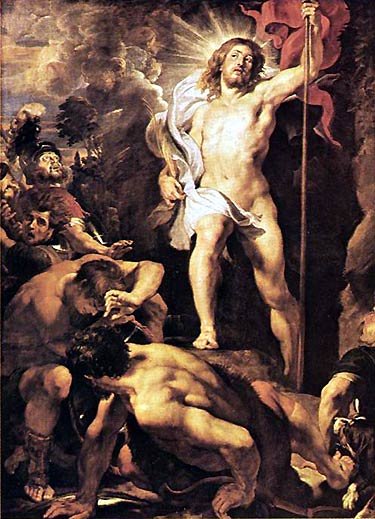
Peter Paul Rubens, The Resurrection of Christ, 1611-1612, Vrouwekathedraal, Antwerp
From Robert Chambers, The Book of Days, 1869:
Easter
Easter, the anniversary of our Lord’s resurrection from the dead, is one of the three great festivals of the Christian year,—the other two being Christmas and Whitsuntide. From the earliest period of Christianity down to the present day, it has always been celebrated by believers with the greatest joy, and accounted the Queen of Festivals. In primitive times it was usual for Christians to salute each other on the morning of this day by exclaiming, ‘Christ is risen;’ to which the person saluted replied, ‘Christ is risen indeed,’ or else, ‘And hath appeared unto Simon;’—a custom still retained in the Greek Church.
The common name of this festival in the East was the Paschal Feast, because kept at the same time as the Pascha, or Jewish passover, and in some measure succeeding to it. In the sixth of the Ancyran Canons it is called the Great Day. Our own name Easter is derived, as some suppose, from Eostre, the name of a Saxon deity, whose feast was celebrated every year in the spring, about the same time as the Christian festival—the name being retained when the character of the feast was changed; or, as others suppose, from Oster, which signifies rising. If the latter supposition be correct, Easter is in name, as well as reality, the feast of the resurrection.
Though there has never been any difference of opinion in the Christian church as to why Easter is kept, there has been a good deal as to when it ought to be kept. It is one of the moveable feasts; that is, it is not fixed to one particular day—like Christmas Day, e. g., which is always kept on the 25th of December—but moves backwards or forwards according as the full moon next after the vernal equinox falls nearer or further from the equinox. The rule given at the beginning of the Prayer-book to find Easter is this: ‘Easter-day is always the first Sunday after the full moon which happens upon or next after the twenty-first day of March; and if the full moon happens upon a Sunday, Easter-day is the Sunday after.’
The paschal controversy, which for a time divided Christendom, grew out of a diversity of custom. The churches of Asia Minor, among whom were many Judaizing Christians, kept their paschal feast on the same day as the Jews kept their passover; i. e., on the 14th of Nisan, the Jewish month corresponding to our March or April. But the churches of the West, remembering that our Lord’s resurrection took place on the Sunday, kept their festival on the Sunday following the 14th of Nisan. By this means they hoped not only to commemorate the resurrection on the day on which it actually occurred, but also to distinguish themselves more effectually from the Jews. For a time this difference was borne with mutual forbearance and charity. And when disputes began to arise, we find that Polycarp, the venerable bishop of Smyrna, when on a visit to Rome, took the opportunity of conferring with Anicetas, bishop of that city, upon the question. Polycarp pleaded the practice of St. Philip and St. John, with the latter of whom he had lived, conversed, and joined in its celebration; while Anicetas adduced the practice of St. Peter and St. Paul. Concession came from neither side, and so the matter dropped; but the two bishops continued in Christian friendship and concord. This was about A.D. 158.
Towards the end of the century, however, Victor, bishop of Rome, resolved on compelling the Eastern churches to conform to the Western practice, and wrote an imperious letter to the prelates of Asia, commanding them to keep the festival of Easter at the time observed by the Western churches. They very naturally resented such an interference, and declared their resolution to keep Easter at the time they had been accustomed to do. The dispute hence-forward gathered strength, and was the source of much bitterness during the next century. The East was divided from the West, and all who, after the example of the Asiatics, kept Easter-day on the 14th, whether that day were Sunday or not, were styled Qiccertodecimans by those who adopted the Roman custom.
One cause of this strife was the imperfection of the Jewish calendar. The ordinary year of the Jews consisted of 12 lunar months of 292 days each, or of 29 and 30 days alternately; that is, of 354 days. To make up the 11 days’ deficiency, they intercalated a thirteenth month of 30 days every third year. But even then they would be in advance of the true time without other intercalations; so that they often kept their passover before the vernal equinox. But the Western Christians considered the vernal equinox the commencement of the natural year, and objected to a mode of reckoning which might sometimes cause them to hold their paschal feast twice in one year and omit it altogether the next. To obviate this, the fifth of the apostolic canons decreed that, ’ If any bishop, priest, or deacon, celebrated the Holy Feast of Easter before the vernal equinox, as the Jews do, let him be deposed.’
At the beginning of the fourth century, matters had gone to such a length, that the Emperor Constantine thought it his duty to take steps to allay the controversy, and to insure uniformity of practice for the future. For this purpose, he got a canon passed in the great Ecumenical Council of Nice (A.D. 325), that everywhere the great feast of Easter should be observed upon one and the same day; and that not the day of the Jewish passover, but, as had been generally observed, upon the Sunday afterwards. And to prevent all future disputes as to the time, the following rules were also laid down:
‘That the twenty-first day of March shall be accounted the vernal equinox.’
‘That the full moon happening upon or next after the twenty-first of March, shall be taken for the full moon of Nisan.’
‘That the Lord’s-day next following that full moon be Easter-day.’
‘But if the full moon happen upon a Sunday, Easter-day shall be the Sunday after.’
As the Egyptians at that time excelled in astronomy, the Bishop of Alexandria was appointed to give notice of Easter-day to the Pope and other patriarchs. But it was evident that this arrangement could not last long; it was too inconvenient and liable to interruptions. The fathers of the next age began, therefore, to adopt the golden numbers of the Metonic cycle, and to place them in the calendar against those days in each month on which the new moons should fall during that year of the cycle. The Metonie cycle was a period of nineteen years. It had been observed by Meton, an Athenian philosopher, that the moon returns to have her changes on the same month and day of the month in the solar year after a lapse of nineteen years, and so, as it were, to run in a circle. He published his discovery at the Olympic Games, B.C. 433, and the cycle has ever since borne his name. The fathers hoped by this cycle to be able always to know the moon’s age; and as the vernal equinox was now fixed to the 21st of March, to find Easter for ever. But though the new moon really happened on the same day of the year after a space of nineteen years as it did before, it fell an hour earlier on that day, which, in the course of time, created a serious error in their calculations.
A cycle was then framed at Rome for 84 years, and generally received by the Western church, for it was then thought that in this space of time the moon’s changes would return not only to the same day of the month, but of the week also. Wheatley tells us that, ‘During the time that Easter was kept according to this cycle, Britain was separated from the Roman empire, and the British churches for some time after that separation continued to keep Easter according to this table of 84 years. But soon after that separation, the Church of Rome and several others discovered great deficiencies in this account, and therefore left it for another which was more perfect.’—Book on the Common Prayer, p. 40. This was the Victorian period of 532 years. But he is clearly in error here. The Victorian period was only drawn up about the year 457, and was not adopted by the Church till the Fourth Council of Orleans, A.D. 541.
Now from the time the Romans finally left Britain (A.D. 426), when he supposes both churches to be using the cycle of 84 years, till the arrival of St. Augustine (A.D. 596), the error can hardly have amounted to a difference worth disputing about. And yet the time the Britons kept Easter must have varied considerably from that of the Roman missionaries to have given rise to the statement that they were Quartodecimans, which they certainly were not; for it is a well-known fact that British bishops were at the Council of Nice, and doubtless adopted and brought home with them the rule laid down by that assembly. Dr. Hooke’s account is far more probable, that the British and Irish churches adhered to the Alexandrian rule, according to which the Easter festival could not begin before the 8th of March; while according to the rule adopted at Rome and generally in the West, it began as early as the fifth. ‘They (the Celts) were manifestly in error,’ he says; ‘but owing to the haughtiness with which the Italians had demanded an alteration in their calendar, they doggedly determined not to change.’—Lives of the Archbishops of Canterbury, vol. i. p. 14.
After a good deal of disputation had taken place, with more in prospect, Oswy, King of Northumbria, determined to take the matter in hand. He summoned the leaders of the contending parties to a conference at Whitby, A.D. 664, at which he himself presided. Colman, bishop of Lindisfarne, represented the British church. The Romish party were headed by Agilbert, bishop of Dorchester, and Wilfrid, a young Saxon. Wilfrid was spokesman. The arguments were characteristic of the age; but the manner in which the king decided irresistibly provokes a smile, and makes one doubt whether he were in jest or earnest. Colman spoke first, and urged that the custom of the Celtic church ought not to be changed, because it had been inherited from their forefathers, men beloved of God, &c. Wilfrid followed:
‘The Easter which we observe I saw celebrated by all at Rome: there, where the blessed apostles, Peter and Paul, lived, taught, suffered, and were buried.’ And concluded a really powerful speech with these words: ‘And if, after all, that Columba of yours were, which I will not deny, a holy man, gifted with the power of working miracles, is he, I ask, to be preferred before the most blessed Prince of the Apostles, to whom our Lord said, “Thou art Peter, and upon this rock will I build my church, and the gates of hell shall not prevail against it; and to thee will I give the keys of the kingdom of heaven†?’
The King, turning to Colman, asked him, ‘Is it true or not, Colman, that these words were spoken to Peter by our Lord?’ Colman, who seems to have been completely cowed, could not deny it. ‘It is true, 0 King.’ ‘Then,’ said the King, ‘can you shew me any such power given to your Columba? ’ Colman answered, ’ No.’ ‘You are both, then, agreed,’ continued the King, are you not, that these words were addressed principally to Peter, and that to him were given the keys of heaven by our Lord?’ Both assented. ‘Then,’ said the King, ‘I tell you plainly, I shall not stand opposed to the door-keeper of the kingdom of heaven; I desire, as far as in me lies, to adhere to his precepts and obey his commands, lest by offending him who keepeth the keys, I should, when I present myself at the gate, find no one to open to me.’
This settled the controversy, though poor honest Colman resigned his see rather than submit to such a decision.
On Easter-day depend all the moveable feasts and fasts throughout the year. The nine Sundays before, and the eight following after, are all dependent upon it, and form, as it were, a body-guard to this Queen of Festivals. The nine preceding are the six Sundays in Lent, Quinquagesima, Sexagesima, and Septuagesima; the eight following are the five Sundays after Easter, the Sunday after Ascension Day, Whit Sunday, and Trinity Sunday.
EASTER CUSTOMS
The old Easter customs which still linger among us vary considerably in form in different parts of the kingdom. The custom of distributing the ‘pace’ or ‘pasche ege,’ which was once almost universal among Christians, is still observed by children, and by the peasantry in Lancashire. Even in Scotland, where the great festivals have for centuries been suppressed, the young people still get their hard-boiled dyed eggs, which they roll about, or throw, and finally eat. In Lancashire, and in Cheshire, Staffordshire, and Warwickshire, and perhaps in other counties, the ridiculous custom of ‘lifting’ or ‘heaving’ is practised.
On Easter Monday the men lift the women, and on Easter Tuesday the women lift or heave the men. The process is performed by two lusty men or women joining their hands across each other’s wrists; then, making the person to be heaved sit down on their arms, they lift him up aloft two or three times, and often carry him several yards along a street. A grave clergyman who happened to be passing through a town in Lancashire on an Easter Tuesday, and having to stay an hour or two at an inn, was astonished by three or four lusty women rushing into his room, exclaiming they had come ‘to lift him.’ ‘To lift me!’ repeated the amazed divine; ‘what can you mean?’ ‘Why, your reverence, we’re come to lift you, ‘cause it’s Easter Tuesday.’ ‘Lift me because it’s Easter Tuesday? I don’t understand. Is there any such custom here?’ ‘Yes, to be sure; why, don’t you know? all us women was lifted yesterday; and us lifts the men today in turn. And in course it’s our rights and duties to lift ‘em.’
After a little further parley, the reverend traveller compromised with his fair visitors for half-a-crown, and thus escaped the dreaded compliment. In Durham, on Easter Monday, the men claim the privilege to take off the women’s shoes, and the next day the women retaliate. Anciently, both ecclesiastics and laics used to play at ball in the churches for tansy-cakes on Eastertide; and, though the profane part of this custom is happily everywhere discontinued, tansy-cakes and tansy-puddings are still favourite dishes at Easter in many parts. In some parishes in the counties of Dorset and Devon, the clerk carries round to every house a few white cakes as an Easter offering; these cakes, which are about the eighth of an inch thick, and of two sizes —the larger being seven or eight inches, the smaller about five in diameter— have a mingled bitter and sweet taste. In return for these cakes, which are always distributed after Divine service on Good Friday, the clerk receives a gratuity- according to the circumstances or generosity of the householder.
S.A. Miller, at the Washington Times, explains that close has very commonly historically proven to be not good enough in nominating convention delegate votes. Donald Trump would by no means be the first candidate to arrive at a GOP convention with more votes than his rival candidates, but short of the necessary majority. It has frequently happened that the front runner then proved unable to attract the necessary extra votes and another man became the nominee. Just ask Thomas E. Dewey.
If Donald Trump finds himself in a contested convention this summer, a looming question for the Republican presidential front-runner will be whether he is a Lincoln or a Dewey.
Mr. Trump obviously would prefer to follow in the footsteps of Abraham Lincoln, who emerged the nominee from a brokered Republican convention in 1860 and went on to win the White House and become one of America’s most revered presidents.
Unfortunately for Mr. Trump, the experience of Thomas E. Dewey at contested Republican conventions is more common and far less inspirational. The front-runner heading into a contested Republican convention has never won the White House and most of the time does not even secure the party’s nomination. …
“The notion that you go in with a plurality, therefore you deserve the nomination is just flat wrong,” said Merrill Matthews, resident scholar at the Dallas-based think tank Institute for Policy Innovation.
“It would not surprise me if we go to a contested convention and Trump ends up losing in that contested convention,” he said. “But I think it is too early to say. We have to see if the voters begin to gravitate toward him, as they typically do in presidential elections, and even if he doesn’t get 1,237, if the momentum is clearly behind him, I think it would be hard to deny him the nomination.”
Still, Mr. Matthews stressed that Mr. Trump will have to close the deal on the convention floor.
“He’s got to make the case to the delegates there,” he said. “He needs to persuade the other delegates that they should change their vote to him.”
Dewey ended up like most candidates who enter the Republican convention with the most delegates but short a majority — a position Mr. Trump could easily find himself in July in Cleveland — either passed over for the nomination or the loser in the general election.
Dewey experienced both outcomes. He was denied the nomination in 1940 and received it in 1948 only to lose that November to Democrat Harry S. Truman, despite the famously erroneous banner headline on the front page of The Chicago Daily Tribune.
In 1940 and eight years later, Dewey had a plurality of delegates when the convention opened.
In the history of the Republican Party, there have been 10 conventions where no candidate arrived with a majority of the delegates needed to clinch the nomination on the first ballot.
At seven of those brokered conventions, the candidate who arrived with the most delegates did not win the nomination. Half the time, the nomination went to the candidate who had the fewest delegates.
Lincoln was one of the candidates with the fewest delegates at the start of the convention. Another was Rep. James A. Garfield of Ohio, who entered the Chicago convention with no delegates but got the nomination after 36 ballots, the longest convention vote in Republican history.
In all three cases, when the candidates with the most delegates at the start of a contested convention emerged as the nominee, that candidate lost in the general election. Dewey shares that dubious distinction with Supreme Court Justice Charles Evans Hughes and U.S. Sen. James G. Blaine of Maine.