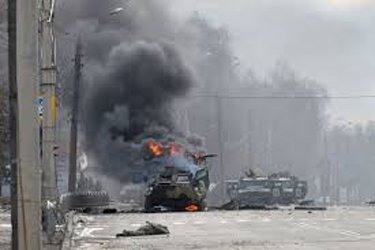
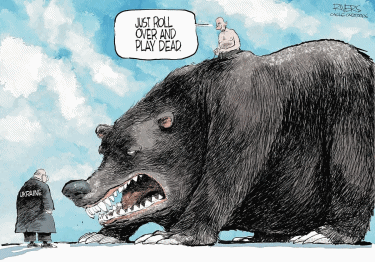
There are estimates that Russia has lost 40,000 soldiers (killed or wounded) out of 190,000 after the first three weeks of the Russia-Ukraine war. Russia has 900,000 in the military but this includes Navy and Air Force. Russia has about 250,000-300,000 in the Army. Russia has 2 million in reserve but those are mostly x-conscripts and 14 million men of military age (18-30).
Independent UK and many other sources cite a senior NATO official estimate of up to 40000 Russian Casualties.
NATO and US estimates of 7000 to 15000 Russian war dead. (via AP).
According to Oryx, as of March 23, 2022, Russia has lost somewhere in the region of 279 tanks, of which 116 have been destroyed, 4 damaged, 41 abandoned. Some 118 have been captured. (via interesting engineering and other sources.
Putting more untrained people into this conflict will just get most of them killed. One of the Russian problems is the poor training of its military. The other aspect is that the death and wounded rates could go up if Russia commits to major urban warfare. If the supply line situation is as bad as some reports indicate then the 70,000 soldiers in the north could run out of ammo and food and collapse. This would mean a lot killed, wounded and captured.
Russia started the war with 1200 Tanks committed to the conflict. Russia had about 2800 active tanks. They had about 10,000 Soviet-era tanks in storage. Those tanks in storage were not modernized and are even more crappy that what Russia has been losing. Russia has lost 270-500 tanks already. All of Russia’s tanks are vulnerable to Javelin missiles. There are 17000 Javelin missiles in the Ukrainian army now.
Russia has lost 100 planes and Russian pilots are flying very defensively. They are trying to avoid getting shotdown instead of focusing on military objectives.
Putin/Russia should already cut a peace deal and withdraw. Losing the northern Army (70,000) would be an even greater catastrophe. Going into Kyiv or any other major city in urban combat would also ratchet up the losses.
It took Russia twenty years to make 2800 modern tanks.
The current pace of losses cannot be sustained for more than two more months. Four more weeks of losses at this pace is devastating as half of the soldiers they went in with would be injured or dead. Russia is already digging into defensive positions. Unless there is a significant improvement in strategy and tactics there is no way that even with 50,000 or 100,000 new conscripts or other force replacements would a second offensive be effective in taking Kyiv or other major Ukrainian cities.
It is even difficult to see how Putin/Russia could sustain a campaign with annual losses like the first month of this war.
Ukrainian forces have defeated the initial Russian campaign of this war. That campaign aimed to conduct airborne and mechanized operations to seize Kyiv, Kharkiv, Odesa, and other major Ukrainian cities to force a change of government in Ukraine. That campaign has culminated. Russian forces continue to make limited advances in some parts of the theater but are very unlikely to be able to seize their objectives in this way. The doctrinally sound Russian response to this situation would be to end this campaign, accept a possibly lengthy operational pause, develop the plan for a new campaign, build up resources for that new campaign, and launch it when the resources and other conditions are ready. The Russian military has not yet adopted this approach. It is instead continuing to feed small collections of reinforcements into an ongoing effort to keep the current campaign alive. We assess that that effort will fail.
The ultimate fall of Mariupol is increasingly unlikely to free up enough Russian combat power to change the outcome of the initial campaign dramatically. …
Russian forces in the south appear to be focusing on a drive toward Kryvyi Rih, presumably to isolate and then take Zaporizhiya and Dnipro from the west but are unlikely to secure any of those cities in the coming weeks if at all. …
The Russian military continues to commit small groups of reinforcements to localized fighting rather than concentrating them to launch new large-scale operations. …
The culmination of the initial Russian campaign is creating conditions of stalemate throughout most of Ukraine. …
Stalemate will likely be very violent and bloody, especially if it protracts. …
Which antagonist—if either—will prevail in Ukraine?
The longevity and success of Russia’s offensive is a hot topic of debate among foreign-policy practitioners and the commentariat. Nor is it an idle topic. But beware of too-confident assessments. Canvassing military history indicates that campaigns tend to sputter over time. A campaign may stagnate, and reversals of fortune are far from rare. It takes not just a proficient military machine but leadership possessed of ingenuity and force of character to keep the momentum going, or regain it if it slips way.
So Russia isn’t predestined to be the victor over Ukraine even though it’s the stronger combatant—by far—by the numbers. Indeed, the Russian offensive has shown signs of faltering since day one. A lesser combatant that makes maximum use of its latent combat power can stymie an opponent that wastes its potential.
Ukraine has a chance.
Martial sage Carl von Clausewitz explains the rhythms of the battlefield in somewhat mystical terms, showing how military success relates to and helps bring about political success. The central idea he puts forward is the “culminating point,” the point at which the fortunes of war start to change for one or both combatants, sometimes in drastic ways. One antagonist’s relative strength may top out while the other’s bottoms out and starts to rebound. Or they may come to a crossover point beyond which the erstwhile stronger competitor is now the weaker.
First, there’s the “culminating point of victory.” Clausewitz posits that the attacker amasses initial supremacy in the military balance by virtue of surprise, the initiative, the prerogative to choose the initial point of impact, and so forth. At the same time, though, Clausewitz believes tactical defense is the strongest form of warfare. That being the case, he prophesies that the attacker’s military advantage will crest and start to dwindle over time. But because political advantage—bargaining leverage that goes to the likely victor—starts to ebb away after the culminating point, so does the attacker’s ability to impose its will on the defender.
Call it the Clausewitzian paradox. The attacker generally has to press its offensive beyond the culminating point of victory—its maximum margin of military superiority—to seize what it wants. But it’s in a weaker and weaker position as the offensive goes on. It takes masterful generalship to sustain the battlefield advantage long enough to pluck the fruits of war.
Politically speaking, Russia may already have culminated. Its failure to score the lightning triumph craved by President Vladimir Putin has stained Russia’s reputation for martial prowess. Fewer foreign leaders will fear Moscow’s threats in the future, or seek out support from what seems like an untrustworthy ally. Repute is everything in power politics, and Russia has damaged its brand.
Through its unprovoked assault, moreover, Russia stands revealed as a foe of small sovereign states everywhere, and as an unworthy steward of the U.N.-led world order put in place at San Francisco in 1945. It has outdone China for lawlessness, which is saying something nowadays. Russian arms may yet prevail in Ukraine by brute force. But Russia’s political standing has suffered—making lasting political gains elusive.
There is no doubt whatsoever that Ukraine has succeeded in winning enormous international sympathy and support, causing Russia enormous economic harm, and even more importantly delegitimating its regime and making Russia into an outcast, outlaw state.
The Ukrainian defense which has held off tenfold superior Russian forces for over three weeks has also effectively destroyed Russia’s standing as a potential conventional war combatant. If this was Russia’s best, Russia versus NATO would be a complete turkey shoot. No doubt, defense analysts all over the West are thinking: If this was the Russian Army and the Russia Air Force in action, is it possible that Russia’s Strategic Forces are also a vastly-over-rated Potemkin-village fraud?
Iwo Jima was the bloodiest battle in Marine Corps History. My father’s commanding officer, Graves B. Erskine commented:
“Victory was never in doubt. Its cost was…What was in doubt, in all our minds, was whether there would be any of us left to dedicate our cemetery at the end, or whether the last Marine would die knocking out the last Japanese gun and gunner.”
In 36 days of fighting on Iwo Jima during World War II, nearly 7,000 Marines were killed. Now, 20 days after President Vladimir V. Putin of Russia invaded Ukraine, his military has already lost more soldiers, according to American intelligence estimates.
The conservative side of the estimate, at more than 7,000 Russian troop deaths, is greater than the number of American troops killed over 20 years in Iraq and Afghanistan combined.
It is a staggering number amassed in just three weeks of fighting, American officials say, with implications for the combat effectiveness of Russian units, including soldiers in tank formations. Pentagon officials say a 10 percent casualty rate, including dead and wounded, for a single unit renders it unable to carry out combat-related tasks.
With more than 150,000 Russian troops now involved in the war in Ukraine, Russian casualties, when including the estimated 14,000 to 21,000 injured, are near that level. And the Russian military has also lost at least three generals in the fight, according to Ukrainian, NATO and Russian officials.
Pentagon officials say that a high, and rising, number of war dead can destroy the will to continue fighting. The result, they say, has shown up in intelligence reports that senior officials in the Biden administration read every day: One recent report focused on low morale among Russian troops and described soldiers just parking their vehicles and walking off into the woods. …
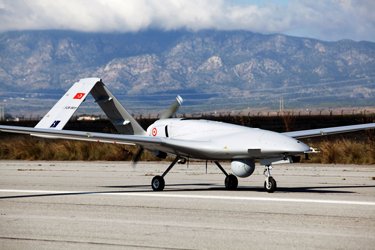
Gabriel Gavin, in the London Spectator, reports that the Turkish Bayraktar drone is playing an important role in Ukraine’s defense against the Russian Invasion, and its fame has even carried over into gaming and popular music culture.
A cheer rings out in a secret command centre. On the screen, another Russian missile launcher has vanished in a cloud of shrapnel and smoke. Working miles behind the front line, a team of Ukrainian drone operators is trying to turn the tide of the war against the Kremlin’s forces. The most effective weapon in their arsenal is the Turkish-made Bayraktar TB2. Soaring 160 meters above the battlefield, it delivers death at the push of a button. So fearsome is its reputation that it has inspired a love song that has gone viral in Ukraine and even a video game.
Lightweight and with a small profile, the Bayraktars are designed to evade anti-air systems and stay undetected for as long as possible, weighing in at less than a sixth of the US’s flagship Predator drone. At the same time, its 12-meter wingspan helps it stay in the air for as long as 30-hours. Plenty of time to unleash its four laser-guided missiles. Russia, meanwhile, lacks any attack drones. Instead, they rely on reconnaissance vehicles to guide their artillery. And where the American Predator drone costs around £30 million, the Turkish equivalent can be bought for as little as £750,000.
The Bayraktars’ success has cemented Turkey’s status as one of the world’s leading drone makers. Despite close relations with Russia, Ankara has long supported Ukraine by sending it extra Bayraktars in recent months, in addition to around two dozen it has sold to Kiev since 2019. Even more concerning for commanders in Moscow was the news last year that Ukraine had struck a deal to co-produce the TB2 locally as part of a partnership agreement.
Francis Fukuyama, of “End of History” fame, again climbs out on the predicting limb and tells us: Russia’s going to lose.
I’ll stick my neck out and make several prognostications:
Russia is heading for an outright defeat in Ukraine. Russian planning was incompetent, based on a flawed assumption that Ukrainians were favorable to Russia and that their military would collapse immediately following an invasion. Russian soldiers were evidently carrying dress uniforms for their victory parade in Kyiv rather than extra ammo and rations. Putin at this point has committed the bulk of his entire military to this operation—there are no vast reserves of forces he can call up to add to the battle. Russian troops are stuck outside various Ukrainian cities where they face huge supply problems and constant Ukrainian attacks.
The collapse of their position could be sudden and catastrophic, rather than happening slowly through a war of attrition. The army in the field will reach a point where it can neither be supplied nor withdrawn, and morale will vaporize. This is at least true in the north; the Russians are doing better in the south, but those positions would be hard to maintain if the north collapses.
There is no diplomatic solution to the war possible prior to this happening. There is no conceivable compromise that would be acceptable to both Russia and Ukraine given the losses they have taken at this point. …
Putin will not survive the defeat of his army. He gets support because he is perceived to be a strongman; what does he have to offer once he demonstrates incompetence and is stripped of his coercive power? …
The war to this point has been a good lesson for China. Like Russia, China has built up seemingly high-tech military forces in the past decade, but they have no combat experience. The miserable performance of the Russian air force would likely be replicated by the People’s Liberation Army Air Force, which similarly has no experience managing complex air operations. We may hope that the Chinese leadership will not delude itself as to its own capabilities the way the Russians did when contemplating a future move against Taiwan.
Hopefully Taiwan itself will wake up as to the need to prepare to fight as the Ukrainians have done, and restore conscription. Let’s not be prematurely defeatist.
Turkish drones will become bestsellers.
A Russian defeat will make possible a “new birth of freedom,” and get us out of our funk about the declining state of global democracy. The spirit of 1989 will live on, thanks to a bunch of brave Ukrainians.
On PJMedia, “Spengler” gravely strokes his chin, compares today to August 1914, and equates Putin’s yearning for a cordon sanitaire of Russian satellites and puppet states to the Cuban Missile Criss of 1962.
Vladimir Putin acted wickedly, and illegally, by invading Ukraine, but also rationally: Russia has an existential interest in keeping NATO away from his border. Russia will no more tolerate American missiles in Kyiv than the United States would tolerate Russian missiles in Cuba.
The United States could have averted a crisis by adhering to the Minsk II framework of local rule for the Russophone provinces of Eastern Ukraine within a sovereign Ukrainian state but chose instead to keep open Ukraine’s option to join NATO. That was rational, but also stupid: It backed Putin into a corner.
There is no excuse for Putin’s action, but there is an explanation that’s similar to one that applied to his forbears of 1914: Putin chose to attack before the West had the opportunity to arm Ukraine with sophisticated weapons that would raise the future cost of military action.
Well, I don’t think everybody in 1914 was equally “rational,” or equally responsible. Russia seems to me more responsible by far than average for trouble-making in the Balkans, instigating Serbian Nationalism, and then stepping in as Serbia’s protector (its self-appointed role as defender of the Eastern Orthodox) when a Nationalist fanatic murdered the Austrian Grand Duke.
I’d say Britain was responsible, too, for enormous damage to herself, by rushing to the defense of plucky little Belgium on the basis of an antiquated, widely forgotten 19th Century treaty and a heap of Jingoism.
As to the supposed equivalence of Soviet missiles in Cuba in 1962 and Ukraine joining NATO in 2022, there are enormous differences. The Soviet Union in 1962 was an ambitious, aggressor power who explicitly promised “to bury” the United States.
NATO, in 2022 pre-the Russian-Invasion-of-Ukraine, was a decidedly decadent and complacent defensive alliance, whose wealthy Western European members begrudged spending the 2% on GDP promised by treaty on defense, who were perfectly willing to depend for energy requirements on Russia, and all of whose members had absolutely zero claims on Russian territory or ambitions to attack Russia.
Vladimir Putin’s rational causus belli, according to “Spengler,” was potential missiles in Ukraine some fine day, but any such future missiles, assuming Ukraine was ever permitted to join NATO and assuming America kept electing hawkish Republican presidents with the cojones to defend Central Europe, those missiles would be purely defensive missiles.
NATO-member missile-equipped Ukraine would not, in Putin’s phrase, be “holding a knife to Russia’s throat.” That Ukraine would merely possess a credible deterrent.
All rational Russia was standing to lose was the opportunity unprovokedly to invade, occupy, shell, bomb, ravage, and annex a sovereign neighboring state without a shred of legitimacy.
Russia’s real position is that of the violent criminal who claims self defense in the course of gunning down an unarmed law abiding citizen, because, he says, he was afraid that in the future his victim might arm himself.
To understand why the invasion was rational for Putin, we have to step into his shoes. Three beliefs came together at the same time in his calculus: 1. Ukraine’s condition as a country 2. Russian military’s condition 3. The West’s geopolitical condition
1. Ukraine’s condition. Putin spent the last 20 years believing that Ukraine is not a real nation and, at best, should be a satellite state. Maidan ended any hope of keeping Ukraine independent and pro-Kremlin. He thought the West was behind it. pic.twitter.com/Ze8YzpMCb9
2. Russian military. The Kremlin spent the last 20 years trying to modernize its military. Much of that budget was stolen and spent on mega-yachts in Cyprus. But as a military advisor you cannot report that to the President. So they reported lies to him instead. Potemkin military
3. The West. The Russian ruling elite believed its own propaganda that Pres. Biden is mentally inept. They also thought the EU was weak because of how toothless their sanctions were in 2014. And then the U.S. botched its withdrawal from Afghanistan, solidifying this narrative.