WWI came to an end by an armistice arranged to occur at the eleventh hour of the eleventh day of the eleventh month of 1918. The date and time, selected at a point in history when mens’ memories ran much longer, represented a compliment to St. Martin, patron saint of soldiers, and thus a tribute to the fighting men of both sides. The feast day of St. Martin, the Martinmas, had been for centuries a major landmark in the European calendar, a date on which leases expired, rents came due; and represented, in Northern Europe, a seasonal turning point after which cold weather and snow might be normally expected.
It fell about the Martinmas-time, when the snow lay on the borders…
—Old Song.
From Robert Chambers, The Book of Days, 1869:
St. Martin, the son of a Roman military tribune, was born at Sabaria, in Hungary, about 316. From his earliest infancy, he was remarkable for mildness of disposition; yet he was obliged to become a soldier, a profession most uncongenial to his natural character. After several years’ service, he retired into solitude, from whence he was withdrawn, by being elected bishop of Tours, in the year 374.
The zeal and piety he displayed in this office were most exemplary. He converted the whole of his diocese to Christianity, overthrowing the ancient pagan temples, and erecting churches in their stead. From the great success of his pious endeavours, Martin has been styled the Apostle of the Gauls; and, being the first confessor to whom the Latin Church offered public prayers, he is distinguished as the father of that church. In remembrance of his original profession, he is also frequently denominated the Soldier Saint.
The principal legend, connected with St. Martin, forms the subject of our illustration, which represents the saint, when a soldier, dividing his cloak with a poor naked beggar, whom he found perishing with cold at the gate of Amiens. This cloak, being most miraculously preserved, long formed one of the holiest and most valued relics of France; when war was declared, it was carried before the French monarchs, as a sacred banner, and never failed to assure a certain victory. The oratory in which this cloak or cape—in French, chape—was preserved, acquired, in consequence, the name of chapelle, the person intrusted with its care being termed chapelain: and thus, according to Collin de Plancy, our English words chapel and chaplain are derived. The canons of St. Martin of Tours and St. Gratian had a lawsuit, for sixty years, about a sleeve of this cloak, each claiming it as their property. The Count Larochefoucalt, at last, put an end to the proceedings, by sacrilegiously committing the contested relic to the flames.
Another legend of St. Martin is connected with one of those literary curiosities termed a palindrome. Martin, having occasion to visit Rome, set out to perform the journey thither on foot. Satan, meeting him on the way, taunted the holy man for not using a conveyance more suitable to a bishop. In an instant the saint changed the Old Serpent into a mule, and jumping on its back, trotted comfortably along. Whenever the transformed demon slackened pace, Martin, by making the sign of the cross, urged it to full speed. At last, Satan utterly defeated, exclaimed:
Signa, te Signa: temere me tangis et angis:
Roma tibi subito motibus ibit amor.’
In English—
‘Cross, cross thyself: thou plaguest and vexest me without necessity;
for, owing to my exertions, thou wilt soon reach Rome, the object of thy wishes.’
The singularity of this distich, consists in its being palindromical—that is, the same, whether read backwards or forwards. Angis, the last word of the first line, when read backwards, forming signet, and the other words admitting of being reversed, in a similar manner.
The festival of St. Martin, happening at that season when the new wines of the year are drawn from the lees and tasted, when cattle are killed for winter food, and fat geese are in their prime, is held as a feast-day over most parts of Christendom. On the ancient clog almanacs, the day is marked by the figure of a goose; our bird of Michaelmas being, on the continent, sacrificed at Martinmas. In Scotland and the north of England, a fat ox is called a mart, clearly from Martinmas, the usual time when beeves are killed for winter use. In ‘Tusser’s Husbandry, we read:
When Easter comes, who knows not then,
That veal and bacon is the man?
And Martilmass beef doth bear good tack,
When country folic do dainties lack.’
Barnaby Googe’s translation of Neogeorgus, shews us how Martinmas was kept in Germany, towards the latter part of the fifteenth century
‘To belly chear, yet once again,
Doth Martin more incline,
Whom all the people worshippeth
With roasted geese and wine.
Both all the day long, and the night,
Now each man open makes
His vessels all, and of the must,
Oft times, the last he takes,
Which holy Martin afterwards
Alloweth to be wine,
Therefore they him, unto the skies,
Extol with praise divine.’
A genial saint, like Martin, might naturally be expected to become popular in England; and there are no less than seven churches in London and Westminster, alone, dedicated to him. There is certainly more than a resemblance between the Vinalia of the Romans, and the Martinalia of the medieval period. Indeed, an old ecclesiastical calendar, quoted by Brand, expressly states under 11th November: ‘The Vinalia, a feast of the ancients, removed to this day. Bacchus in the figure of Martin.’ And thus, probably, it happened, that the beggars were taken from St. Martin, and placed under the protection of St. Giles; while the former became the patron saint of publicans, tavern-keepers, and other ‘dispensers of good eating and drinking. In the hall of the Vintners’ Company of London, paintings and statues of St. Martin and Bacchus reign amicably together side by side.
On the inauguration, as lord mayor, of Sir Samuel Dashwood, an honoured vintner, in 1702, the company had a grand processional pageant, the most conspicuous figure in which was their patron saint, Martin, arrayed, cap-Ã -pie, in a magnificent suit of polished armour; wearing a costly scarlet cloak, and mounted on a richly plumed and caparisoned white charger: two esquires, in rich liveries, walking at each side. Twenty satyrs danced before him, beating tambours, and preceded by ten halberdiers, with rural music. Ten Roman lictors, wearing silver helmets, and carrying axes and fasces, gave an air of classical dignity to the procession, and, with the satyrs, sustained the bacchanalian idea of the affair.
A multitude of beggars, ‘howling most lamentably,’ followed the warlike saint, till the procession stopped in St. Paul’s Churchyard. Then Martin, or his representative at least, drawing his sword, cut his rich scarlet cloak in many pieces, which he distributed among the beggars. This ceremony being duly and gravely performed, the lamentable howlings ceased, and the procession resumed its course to Guildhall, where Queen Anne graciously condescended to dine with the new lord mayor.
RPS ORDERS
No. 47 (Series 1921)
HEADQUARTERS U.S. MARINE CORPS
Washington, November 1, 1921
759. The following will be read to the command on the 10th of November, 1921, and hereafter on the 10th of November of every year. Should the order not be received by the 10th of November, 1921, it will be read upon receipt.
(1) On November 10, 1775, a Corps of Marines was created by a resolution of Continental Congress. Since that date many thousand men have borne the name “Marine”. In memory of them it is fitting that we who are Marines should commemorate the birthday of our corps by calling to mind the glories of its long and illustrious history.
(2) The record of our corps is one which will bear comparison with that of the most famous military organizations in the world’s history. During 90 of the 146 years of its existence the Marine Corps has been in action against the Nation’s foes. From the Battle of Trenton to the Argonne, Marines have won foremost honors in war, and is the long eras of tranquility at home, generation after generation of Marines have grown gray in war in both hemispheres and in every corner of the seven seas, that our country and its citizens might enjoy peace and security.
(3) In every battle and skirmish since the birth of our corps, Marines have acquitted themselves with the greatest distinction, winning new honors on each occasion until the term “Marine” has come to signify all that is highest in military efficiency and soldierly virtue.
(4) This high name of distinction and soldierly repute we who are Marines today have received from those who preceded us in the corps. With it we have also received from them the eternal spirit which has animated our corps from generation to generation and has been the distinguishing mark of the Marines in every age. So long as that spirit continues to flourish Marines will be found equal to every emergency in the future as they have been in the past, and the men of our Nation will regard us as worthy successors to the long line of illustrious men who have served as “Soldiers of the Sea” since the founding of the Corps.
Tun Tavern, Philadelphia, Pennsylvania, November 10th 1775
Captains Nicholas and Mullens, having been tasked by the 2nd Continental Congress to form 2 battalions of Marines, set up the Corps’ first recruiting station in the tavern.
The first likely prospect was, in typical recruiters fashion, promised a “life of high adventure in service to Country and Corps”. And, as an extra bonus: If he enlisted now he would receive a free tankard of ale….
The recruit gladly accepted the challenge and, receiving the free tankard of ale, was told to wait at the corner table for orders.
The first Marine sat quietly at the table sipping the ale when he was joined by another young man, who had two tankards of ale.
The first Marine looked at the lad and asked where he had gotten the two tankards of ale?
The lad replied that he had just joined this new outfit called the Continental Marines, and as an enlistment bonus was given two tankards of ale.
The first Marine took a long hard look at the second Marine and said, ” It wasn’t like that in the old Corps.”
Remember, remember!
The fifth of November,
Gunpowder, treason, and plot;
There is no reason
Why the Gunpowder treason
Should ever be forgot!
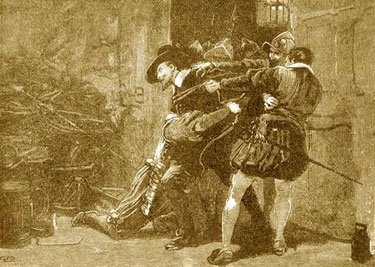
Early in the morning of November 5, Guy Fawkes crept, torch in hand, into the cellar beneath the House of Lords in the Palace of Westminster. In that cellar, he and his fellow conspirators had previously placed a cache of 1800 pounds ((36 barrels, or 800 kg) of gunpowder. Just as he was about to ignite the barrels, blowing himself and the House of Lords to Kingdom Come, the torch was snatched from his hand by a man named Peter Heywood.
Fawkes was arrested and taken before the privy council where he remained defiant. When asked by one of the Scottish lords what he had intended to do with so much gunpowder, Fawkes answered him, “To blow you Scotch beggars back to your own native mountains!”
So went the attempted Gunpowder Plot of 1605.
The intention of the plotters was to use the explosion, timed to coincide with the opening of Parliament, to kill King James I and eliminate much of the ruling Protestant aristocracy. They also intended to kidnap the royal children, then raise the standard of revolt in the Midlands with the object of restoring the freedom to practice Catholicism in England.
The royal beekeeper – in an arcane tradition thought to date back centuries – has informed the hives kept in the grounds of Buckingham Palace and Clarence House of the Queen’s death.
And the bees have also been told, in hushed tones, that their new master is now King Charles III.
The official Palace beekeeper, John Chapple, 79, told MailOnline how he travelled to Buckingham Palace and Clarence House on Friday following news of The Queen’s death to carry out the superstitious ritual.
He placed black ribbons tied into bows on the hives, home to tens of thousands of bees, before informing them that their mistress had died and that a new master would be in charge from now on.
He then urged the bees to be good to their new master – himself once famed for talking to plants.
The strange ritual is underpinned by an old superstition that not to tell them of a change of owner would lead to the bees not producing honey, leaving the hive or even dying.
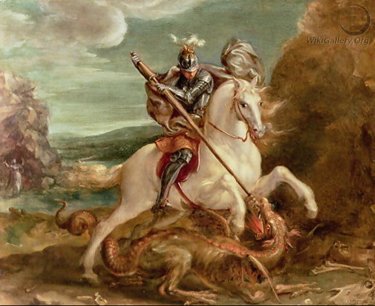
Hans von Aachen, St. George Slaying the Dragon, c. 1600, Private Collection, London
From Robert Chambers, The Book of Days, 1869:
Butler, the historian of the Romish calendar, repudiates George of Cappadocia, and will have it that the famous saint was born of noble Christian parents, that he entered the army, and rose to a high grade in its ranks, until the persecution of his co-religionists by Diocletian compelled him to throw up his commission, and upbraid the emperor for his cruelty, by which bold conduct he lost his head and won his saintship. Whatever the real character of St. George might have been, he was held in great honour in England from a very early period. While in the calendars of the Greek and Latin churches he shared the twenty-third of April with other saints, a Saxon Martyrology declares the day dedicated to him alone; and after the Conquest his festival was celebrated after the approved fashion of Englishmen.
In 1344, this feast was made memorable by the creation of the noble Order of St. George, or the Blue Garter, the institution being inaugurated by a grand joust, in which forty of England’s best and bravest knights held the lists against the foreign chivalry attracted by the proclamation of the challenge through France, Burgundy, Hainault, Brabant, Flanders, and Germany. In the first year of the reign of Henry V, a council held at London decreed, at the instance of the king himself, that henceforth the feast of St. George should be observed by a double service; and for many years the festival was kept with great splendour at Windsor and other towns. Shakspeare, in Henry VI, makes the Regent Bedford say, on receiving the news of disasters in France:
Bonfires in France I am forthwith to make
To keep our great St. George’s feast withal!’
Edward VI promulgated certain statutes severing the connection between the ‘noble order’ and the saint; but on his death, Mary at once abrogated them as ‘impertinent, and tending to novelty.’ The festival continued to be observed until 1567, when, the ceremonies being thought incompatible with the reformed religion, Elizabeth ordered its discontinuance. James I, however, kept the 23rd of April to some extent, and the revival of the feast in all its glories was only prevented by the Civil War. So late as 1614, it was the custom for fashionable gentlemen to wear blue coats on St. George’s day, probably in imitation of the blue mantle worn by the Knights of the Garter.
In olden times, the standard of St. George was borne before our English kings in battle, and his name was the rallying cry of English warriors. According to Shakspeare, Henry V led the attack on Harfleur to the battle-cry of ‘God for Harry! England! and St. George!’ and ‘God and St. George’ was Talbot’s slogan on the fatal field of Patay. Edward of Wales exhorts his peace-loving parents to
‘Cheer these noble lords,
And hearten those that fight in your defence;
Unsheath your sword, good father, cry St. George!’
The fiery Richard invokes the same saint, and his rival can think of no better name to excite the ardour of his adherents:
‘Advance our standards, set upon our foes,
Our ancient word of courage, fair St. George,
Inspire us with the spleen of fiery dragons.’
England was not the only nation that fought under the banner of St. George, nor was the Order of the Garter the only chivalric institution in his honour. Sicily, Arragon, Valencia, Genoa, Malta, Barcelona, looked up to him as their guardian saint; and as to knightly orders bearing his name, a Venetian Order of St. George was created in 1200, a Spanish in 1317, an Austrian in 1470, a Genoese in 1472, and a Roman in 1492, to say nothing of the more modern ones of Bavaria (1729), Russia (1767), and Hanover (1839).
Legendarily the Sacred Military Constantinian Order of Saint George was founded by the Emperor Constantine (312-337 A.D.). On the factual level, the Constantinian Order is known to have functioned militarily in the Balkans in the 15th century against the Turk under the authority of descendants of the twelfth-century Byzantine Emperor Isaac II Angelus Comnenus.
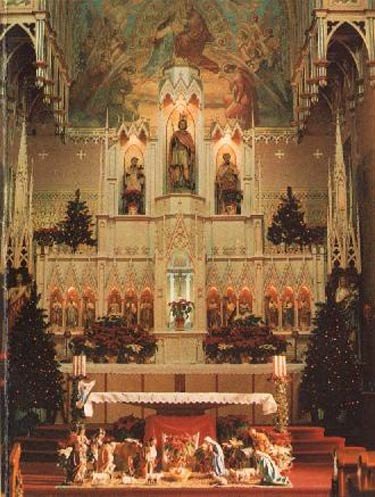
We Lithuanians liked St. George as well. When I was a boy I attended St. George Lithuanian Parish Elementary School, and served mass at St. George Lithuanian Roman Catholic Church in Shenandoah, Pennsylvania.
St. George Church, Shenandoah, Pennsylvania, Christmas, 1979. This church, built by immigrant coal miners in 1891, was torn down by the Diocese of Allentown in 2010.
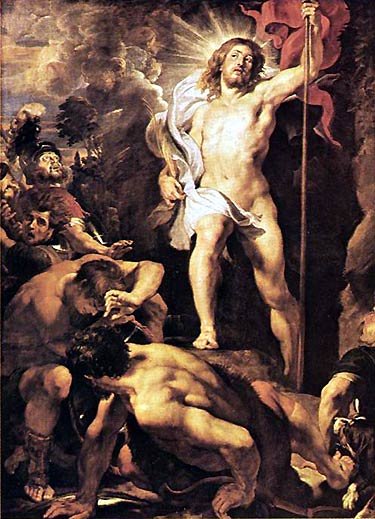
Peter Paul Rubens, The Resurrection of Christ, 1611-1612, Vrouwekathedraal, Antwerp
From Robert Chambers, The Book of Days, 1869:
Easter
Easter, the anniversary of our Lord’s resurrection from the dead, is one of the three great festivals of the Christian year,—the other two being Christmas and Whitsuntide. From the earliest period of Christianity down to the present day, it has always been celebrated by believers with the greatest joy, and accounted the Queen of Festivals. In primitive times it was usual for Christians to salute each other on the morning of this day by exclaiming, ‘Christ is risen;’ to which the person saluted replied, ‘Christ is risen indeed,’ or else, ‘ And hath appeared unto Simon;’—a custom still retained in the Greek Church. Easter retains many religious customs today but there are also many commercial aspects to the holiday. The Easter bunny, Easter candy and Easter baskets are all part of the celebration. Giving Easter baskets filled with candy is a joyous family activity, but it is important to remember the true meaning of the Easter holiday. Read the rest of this entry »
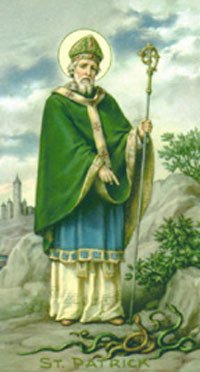
Almost as many countries arrogate the honour of having been the natal soil of St. Patrick, as made a similar claim with respect to Homer. Scotland, England, France, and Wales, each furnish their respective pretensions: but, whatever doubts may obscure his birthplace, all agree in stating that, as his name implies, he was of a patrician family. He was born about the year 372, and when only sixteen years of age, was carried off by pirates, who sold him into slavery in Ireland; where his master employed him as a swineherd on the well-known mountain of Sleamish, in the county of Antrim. Here he passed seven years, during which time he acquired a knowledge of the Irish language, and made himself acquainted with the manners, habits, and customs of the people. Escaping from captivity, and, after many adventures, reaching the Continent, he was successively ordained deacon, priest, and bishop: and then once more, with the authority of Pope Celestine, he returned to Ireland to preach the Gospel to its then heathen inhabitants.
The principal enemies that St. Patrick found to the introduction of Christianity into Ireland, were the Druidical priests of the more ancient faith, who, as might naturally be supposed, were exceedingly adverse to any innovation. These Druids, being great magicians, would have been formidable antagonists to any one of less miraculous and saintly powers than Patrick. Their obstinate antagonism was so great, that, in spite of his benevolent disposition, he was compelled to curse their fertile lands, so that they became dreary bogs: to curse their rivers, so that they produced no fish: to curse their very kettles, so that with no amount of fire and patience could they ever be made to boil; and, as a last resort, to curse the Druids themselves, so that the earth opened and swallowed them up. …
The greatest of St. Patrick’s miracles was that of driving the venomous reptiles out of Ireland, and rendering the Irish soil, for ever after, so obnoxious to the serpent race, that they instantaneously die on touching it. Colgan seriously relates that St. Patrick accomplished this feat by beating a drum, which he struck with such fervour that he knocked a hole in it, thereby endangering the success of the miracle. But an angel appearing mended the drum: and the patched instrument was long exhibited as a holy relic. …
When baptizing an Irish chieftain, the venerable saint leaned heavily on his crozier, the steel-spiked point of which he had unwittingly placed on the great toe of the converted heathen. The pious chief, in his ignorance of Christian rites, believing this to be an essential part of the ceremony, bore the pain without flinching or murmur; though the blood flowed so freely from the wound, that the Irish named the place St. fhuil (stream of blood), now pronounced Struill, the name of a well-known place near Downpatrick. And here we are reminded of a very remarkable fact in connection with geographical appellations, that the footsteps of St. Patrick can be traced, almost from his cradle to his grave, by the names of places called after him.
Thus, assuming his Scottish origin, he was born at Kilpatrick (the cell or church of Patrick), in Dumbartonshire. He resided for some time at Dalpatrick (the district or division of Patrick), in Lanarkshire; and visited Crag-phadrig (the rock of Patrick), near Inverness. He founded two churches, Kirkpatrick at Irongray, in Kireudbright; and Kirkpatrick at Fleming, in Dumfries: and ultimately sailed from Portpatrick, leaving behind him such an odour of sanctity, that among the most distinguished families of the Scottish aristocracy, Patrick has been a favourite name down to the present day.
Arriving in England, he preached in Patterdale (Patrick’s dale), in Westmoreland: and founded the church of Kirkpatrick, in Durham. Visiting Wales, he walked over Sarn-badrig (Patrick’s causeway), which, now covered by the sea, forms a dangerous shoal in Carnarvon Bay: and departing for the Continent, sailed from Llan-badrig (the church of Patrick), in the island of Anglesea. Undertaking his mission to convert the Irish, he first landed at Innis-patrick (the island of Patrick), and next at Holmpatrick, on the opposite shore of the mainland, in the county of Dublin. Sailing northwards, he touched at the Isle of Man, sometimes since, also, called. Innis-patrick, where he founded another church of Kirkpatrick, near the town of Peel. Again landing on the coast of Ireland, in the county of Down, he converted and baptized the chieftain Dichu, on his own threshing-floor. The name of the parish of Saul, derived from Sabbal-patrick (the barn of Patrick), perpetuates the event. He then proceeded to Temple-patrick, in Antrim, and from thence to a lofty mountain in Mayo, ever since called Croagh-patrick.
He founded an abbey in East Meath, called Domnach-Padraig (the house of Patrick), and built a church in Dublin on the spot where St. Patrick’s Cathedral now stands. In an island of Lough Deng, in the county of Donegal, there is St. Patrick’s Purgatory: in Leinster, St. Patrick’s Wood; at Cashel, St. Patrick’s Rock; the St. Patrick’s Wells, at which the holy man is said to have quenched his thirst, may be counted by dozens. He is commonly stated to have died at Saul on the 17th of March 493, in the one hundred and twenty-first year of his age. …
The shamrock, or small white clover (trifolium repens of botanists), is almost universally worn in the hat over all Ireland, on St. Patrick’s day. The popular notion is, that when St. Patrick was preaching the doctrine of the Trinity to the pagan Irish, he used this plant, bearing three leaves upon one stem, as a symbol or illustration of the great mystery. To suppose, as some absurdly hold, that he used it as an argument, would be derogatory to the saint’s high reputation for orthodoxy and good sense: but it is certainly a curious coincidence, if nothing more, that the trefoil in Arabic is called skamrakh, and was held sacred in Iran as emblematical of the Persian Triads. Pliny, too, in his Natural History, says that serpents are never seen upon trefoil, and it prevails against the stings of snakes and scorpions. This, considering St. Patrick’s connexion with snakes, is really remarkable, and we may reasonably imagine that, previous to his arrival, the Irish had ascribed mystical virtues to the trefoil or shamrock, and on hearing of the Trinity for the first time, they fancied some peculiar fitness in their already sacred plant to shadow forth the newly revealed and mysterious doctrine. …
In the Galtee or Gaultie Mountains, situated between the counties of Cork and Tipperary, there are seven lakes, in one of which, called Lough Dilveen, it is said Saint Patrick, when banishing the snakes and toads from Ireland, chained a monster serpent, telling him to remain there till Monday.
The serpent every Monday morning calls out in Irish, ‘It is a long Monday, Patrick.’
That St Patrick chained the serpent in Lough Dilveen, and that the serpent calls out to him every Monday morning, is firmly believed by the lower orders who live in the neighbourhood of the Lough.
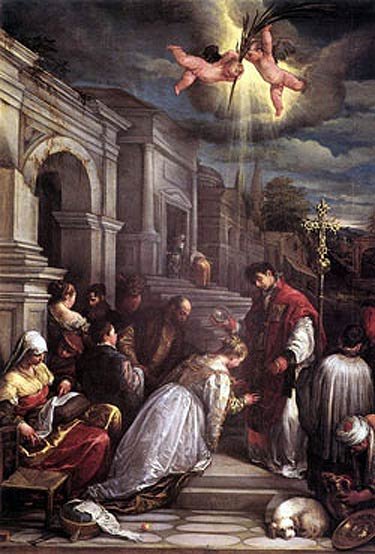
Jacopo Bassano, St Valentine Baptizing St Lucilla, 1575, oil on canvas, Museo Civico, Bassano del Grappa
The popular customs associated with Saint Valentine’s Day undoubtedly had their origin in a conventional belief generally received in England and France during the Middle Ages, that on 14 February, i.e., half way through the second month of the year, the birds began to pair. Thus in Chaucer’s Parliament of Foules we read:
For this was sent on Seynt Valentyne’s day
Whan every foul cometh ther to choose his mate.
For this reason the day was looked upon as specially consecrated to lovers and as a proper occasion for writing love letters and sending lovers’ tokens. Both the French and English literatures of the fourteenth and fifteenth centuries contain allusions to the practice. Perhaps the earliest to be found is in the 34th and 35th Ballades of the bilingual poet, John Gower, written in French; but Lydgate and Clauvowe supply other examples. Those who chose each other under these circumstances seem to have been called by each other their Valentines.
In the Paston Letters, Dame Elizabeth Brews writes thus about a match she hopes to make for her daughter (we modernize the spelling), addressing the favoured suitor:
And, cousin mine, upon Monday is Saint Valentine’s Day and every bird chooses himself a mate, and if it like you to come on Thursday night, and make provision that you may abide till then, I trust to God that ye shall speak to my husband and I shall pray that we may bring the matter to a conclusion.
——————————————–
From Robert Chambers, The Book of Days, 1869: Feast Day: St. Valentine, priest and martyr, circ. 270.
Valentine’s Day is now almost everywhere a much degenerated festival, the only observance of any note consisting merely of the sending of jocular anonymous letters to parties whom one wishes to quiz, and this confined very much to the humbler classes. The approach of the day is now heralded by the appearance in the print-sellers’ shop windows of vast numbers of missives calculated for use on this occasion, each generally consisting of a single sheet of post paper, on the first page of which is seen some ridiculous coloured caricature of the male or female figure, with a few burlesque verses below. More rarely, the print is of a sentimental kind, such as a view of Hymen’s altar, with a pair undergoing initiation into wedded happiness before it, while Cupid flutters above, and hearts transfixed with his darts decorate the corners. Maid-servants and young fellows interchange such epistles with each other on the 14th of February, no doubt conceiving that the joke is amazingly good: and, generally, the newspapers do not fail to record that the London postmen delivered so many hundred thousand more letters on that day than they do in general. Such is nearly the whole extent of the observances now peculiar to St. Valentine’s Day.
At no remote period it was very different. Ridiculous letters were unknown: and, if letters of any kind were sent, they contained only a courteous profession of attachment from some young man to some young maiden, honeyed with a few compliments to her various perfections, and expressive of a hope that his love might meet with return. But the true proper ceremony of St. Valentine’s Day was the drawing of a kind of lottery, followed by ceremonies not much unlike what is generally called the game of forfeits. Misson, a learned traveller, of the early part of the last century, gives apparently a correct account of the principal ceremonial of the day.
‘On the eve of St. Valentine’s Day,’ he says, ‘the young folks in England and Scotland, by a very ancient custom, celebrate a little festival. An equal number of maids and bachelors get together: each writes their true or some feigned name upon separate billets, which they roll up, and draw by way of lots, the maids taking the men’s billets, and the men the maids’: so that each of the young men lights upon a girl that he calls his valentine, and each of the girls upon a young man whom she calls hers. By this means each has two valentines: but the man sticks faster to the valentine that has fallen to him than to the valentine to whom he is fallen. Fortune having thus divided the company into so many couples, the valentines give balls and treats to their mistresses, wear their billets several days upon their bosoms or sleeves, and this little sport often ends in love.’
…
St. Valentine’s Day is alluded to by Shakspeare and by Chaucer, and also by the poet Lydgate (who died in 1440). …
The origin of these peculiar observances of St. Valentine’s Day is a subject of some obscurity. The saint himself, who was a priest of Rome, martyred in the third century, seems to have had nothing to do with the matter, beyond the accident of his day being used for the purpose. Mr. Douce, in his Illustrations of Shakspeare, says:
‘It was the practice in ancient Rome, during a great part of the month of February, to celebrate the Lupercalia, which were feasts in honour of Pan and Juno. whence the latter deity was named Februata, Februalis, and Februlla. On this occasion, amidst a variety of ceremonies, the names of young women were put into a box, from which they were drawn by the men as chance directed. The pastors of the early Christian church, who, by every possible means, endeavoured to eradicate the vestiges of pagan superstitions, and chiefly by some commutations of their forms, substituted, in the present instance, the names of particular saints instead of those of the women: and as the festival of the Lupercalia had commenced about the middle of February, they appear to have chosen St. Valentine’s Day for celebrating the new feast, because it occurred nearly at the same time.
This is, in part, the opinion of a learned and rational compiler of the Lives of the Saints, the Rev. Alban Butler.
It should seem, however, that it was utterly impossible to extirpate altogether any ceremony to which the common people had been much accustomed—a fact which it were easy to prove in tracing the origin of various other popular superstitions. And, accordingly, the outline of the ancient ceremonies was preserved, but modified by some adaptation to the Christian system. It is reasonable to suppose, that the above practice of choosing mates would gradually become reciprocal in the sexes, and that all persons so chosen would be called Valentines, from the day on which the ceremony took place.’
***********************************************
February 14th, prior to 1969, was the feast day of two, or possibly three, saints and martyrs named Valentine, all reputedly of the Third Century.
The first Valentine, legend holds, was a physician and priest in Rome, arrested for giving aid to martyrs in prison, who while there converted his jailer by restoring sight to the jailer’s daughter. He was executed by being beaten with clubs, and afterwards beheaded, February 14, 270. He is traditionally the patron of affianced couples, bee keepers, lovers, travellers, young people, and greeting card manufacturers, and his special assistance may be sought in conection with epilepsy, fainting, and plague.
A second St. Valentine, reportedly bishop of Interamna (modern Terni) was also allegedly martyred under Claudius II, and also allegedly buried along the Flaminian Way.
A third St. Valentine is said to have also been martyred in Roman times, along with companions, in Africa.
Due to an insufficiency of historical evidence in the eyes of Vatican II modernizers, the Roman Catholic Church dropped the February 14th feast of St. Valentine from its calendar in 1969.
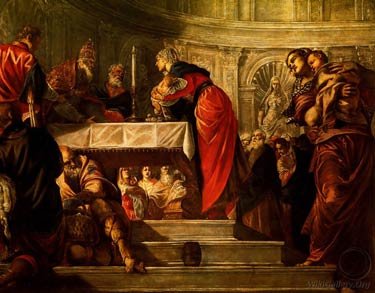
Tintoretto, Presentation of Jesus at the Temple, 1550-1555, Gallerie dell Accademi, Venice
From Robert Chambers, The Book of Days, 1869:
From a very early, indeed unknown date in the Christian history, the 2nd of February has been held as the festival of the Purification of the Virgin, and it is still a holiday of the Church of England. From the coincidence of the time with that of the Februation or purification of the people in pagan Rome, some consider this as a Christian festival engrafted upon a heathen one, in order to take advantage of the established habits of the people; but the idea is at least open to a good deal of doubt. The popular name Candlemass is derived from the ceremony which the Church of Rome dictates to be observed on this day; namely, a blessing of candles by the clergy, and a distribution of them amongst the people, by whom they are afterwards carried lighted in solemn procession. The more important observances were of course given up in England at the Reformation; but it was still, about the close of the eighteenth century, customary in some places to light up churches with candles on this day.
At Rome, the Pope every year officiates at this festival in the beautiful chapel of the Quirinal. When he has blessed the candles, he distributes them with his own hand amongst those in the church, each of whom, going singly up to him, kneels to receive it. The cardinals go first; then follow the bishops, canons, priors, abbots, priests, &c., down to the sacristans and meanest officers of the church. According to Lady Morgan, who witnessed the ceremony in 1820:
‘When the last of these has gotten his candle, the poor conservatori, the representatives of the Roman senate and people, receive theirs. This ceremony over, the candles are lighted, the Pope is mounted in his chair and carried in procession, with hymns chanting, round the ante-chapel; the throne is stripped of its splendid hangings; the Pope and cardinals take off their gold and crimson dresses, put on their usual robes, and the usual mass of the morning is sung.’
Lady Morgan mentions that similar ceremonies take place in all the parish churches of Rome on this day.
It appears that in England, in Catholic times, a meaning was attached to the size of the candles, and the manner in which they burned during the procession; that, moreover, the reserved parts of the candles were deemed to possess a strong supernatural virtue:
‘This done, each man his candle lights,
Where chiefest seemeth he,
Whose taper greatest may be seen; And fortunate to be,
Whose candle burneth clear and bright: A wondrous force and might
Both in these candles lie, which if At any time they light,
They sure believe that neither storm Nor tempest cloth abide,
Nor thunder in the skies be heard, Nor any devil’s spide,
Nor fearful sprites that walk by night,
Nor hurts of frost or hail,’ &c.
The festival, at whatever date it took its rise, has been designed to commemorate the churching or purification of Mary; and the candle-bearing is understood to refer to what Simeon said when he took the infant Jesus in his arms, and declared that he was a light to lighten the Gentiles. Thus literally to adopt and build upon metaphorical expressions, was a characteristic procedure of the middle ages. Apparently, in consequence of the celebration of Mary’s purification by candle-bearing, it became customary for women to carry candles with them, when, after recovery from child-birth, they went to be, as it was called, churched. A remarkable allusion to this custom occurs in English history. William the Conqueror, become, in his elder days, fat and unwieldy, was confined a considerable time by a sickness. ‘Methinks,’ said his enemy the King of France, ‘the King of England lies long in childbed.’ This being reported to William, he said, ‘When I am churched, there shall be a thousand lights in France !’ And he was as good as his word; for, as soon as he recovered, he made an inroad into the French territory, which he wasted wherever he went with fire and sword.
At the Reformation, the ceremonials of Candlemass day were not reduced all at once. Henry VIII proclaimed in 1539:
‘On Candlemass day it shall be declared, that the bearing of candles is done in memory of Christ, the spiritual light, whom Simeon did prophesy, as it is read in. the church that day.’
It is curious to find it noticed as a custom down to the time of Charles II, that when lights were brought in at nightfall, people would say–‘God send us the light of heaven!’ The amiable Herbert, who notices the custom, defends it as not superstitious. Some-what before this time, we find. Herrick alluding to the customs of Candlemass eve: it appears that the plants put up in houses at Christmas were now removed.
Down with the rosemary and bays,
Down with the mistletoe;
Instead of holly now upraise
The greener box for show.
The holly hitherto did sway,
Let box now domineer,
Until the dancing Easter day
Or Easter’s eve appear.
The youthful box, which now hath grace
Your houses to renew,
Grown old, surrender must his place
Unto the crisped yew.
When yew is out, then birch comes in,
And many flowers beside,
Both of a fresh and fragrant kin’,
To honour Whitsuntide.
Green rushes then, and sweetest bents,
With cooler oaken boughs,
Come in for comely ornaments,
To re-adorn the house.
Thus times do shift; each thing in turn does hold;
New things succeed, as former things grow old.’
The same poet elsewhere recommends very particular care in the thorough removal of the Christmas garnishings on this eve:
‘That so the superstitious find
No one least branch left there behind;
For look, how many leaves there be
Neglected there, maids, trust to me,
So many goblins you shall see.’
He also alludes to the reservation of part of the candles or torches, as calculated to have the effect of protecting from mischief:
‘Kindle the Christmas brand, and then
Till sunset let it burn,
Which quenched, then lay it up again, Till Christmas next return.
Part must be kept, wherewith to tend
The Christmas log next year;
And where ‘tis safely kept, the fiend Can do no mischief there.’
Considering the importance attached to Candlemass day for so many ages, it is scarcely surprising that there is a universal superstition throughout Christendom, that good weather on this day indicates a long continuance of winter and a bad crop, and that its being foul is, on the contrary, a good omen. Sir Thomas Browne, in his Vulgar Errors, quotes a Latin distich expressive of this idea:
‘Si sol splendescat Maria purificante,
Major erit glacies post festum quam fait ante;
which maybe considered as well translated in the popular Scottish rhyme:
If Candlemass day be dry and fair,
The half o’ winter’s to come and mair;
If Candlemass day be wet and foul,
The half o’ winter’s gave at Yule.’
In Germany there are two proverbial expressions on this subject: 1. The shepherd would rather see the wolf enter his stable on Candlemass day than the sun; 2. The badger peeps out of his hole on Candlemass day, and when he finds snow, walks abroad; but if he sees the sun shining, he draws back into his hole. It is not improbable that these notions, like the festival of Candlemass itself, are derived from pagan times, and have existed since the very infancy of our race. So at least we may conjecture, from a curious passage in Martin’s Description of the Western Islands. On Candlemass day, according to this author, the Hebrideans observe the following curious custom:
The mistress and servants of each family take a sheaf of oats and dress it up in women’s apparel, put it in a large basket, and lay a wooden club by it, and this they call Brύd’s Bed.; and then the mistress and servants cry three times, “Brύd is come; Brύd is welcome!” This they do just before going to bed, and when they rise in the morning they look among the ashes, expecting to see the impression of Brύd’s club there; which, if they do, they reckon it a true presage of a good crop and prosperous year, and the contrary they take as an ill omen.
——————————————————————
Groundhog Day is simply a modern commercialized adaptation of the earlier weather traditions associated with the Christian feast day.
Born: Richard II, King of England, 1366; Joan d’Arc, 1402; Peter Metastasio, poet, 1698; Benjamin Franklin, philosopher, Boston, U.S., 1706; David Dale, philanthropist, 1739; George Thomas Doo, engraver, 1800.
Feast Day: St. Melanius, bishop, 490. St. Nilammon, Hermit. St. Peter, abbot of St. Austin’s, Canterbury, 608.
TWELFTH-DAY
This day, called Twelfth-Day, as being in that number after Christmas, and Epiphany from the Greek ‘‘ΕπιΦáνєια”, signifying appearance, is a festival of the Church, in commemoration of the Manifestation of Christ to the Gentiles; more expressly to the three Magi, or Wise Men of the East, who came, led by a star, to worship him immediately after his birth. (Matt. ii. 1-12.) The Epiphany appears to have been first observed as a separate feast in the year 813. Pope Julius I is, however, reputed to have taught the Church to distinguish the Feasts of the Nativity and Epiphany, so early as about the middle of the fourth century.
The primitive Christians celebrated the Feast of the Nativity for twelve days, observing the first and last with great solemnity; and both of these days were denominated Epiphany, the first the greater Epiphany, from our Lord having on that day become Incarnate, or made his appearance in “the flesh;” the latter, the lesser Epiphany, from the three-fold manifestation of His Godhead—the first, by the appearance of the blazing star which conducted Melchior, Jasper, and Balthuzar, the three Magi, or wise men, commonly styled the three Kings of Cologne, out of the East, to worship the Messiah, and to offer him presents of “Gold, Frankincense, and Myrrh”—Melchior the Gold, in testimony of his royalty as the promised King of the Jews; Jasper the Frankincense, in token of his Divinity; and Balthuzar the Myrrh, in allusion to the sorrows which, in the humiliating condition of a man, our Redeemer vouchsafed to take upon him: the second, of the descent of the Holy Ghost in the form of a Dove, at the Baptism: and the third, of the first miracle of our Lord turning water into wine at the marriage in Cana. All of which three manifestations of the Divine nature happened on the same day, though not in the same year.
‘To render due honour to the memory of the ancient Magi, who are supposed to have been kings, the monarch of this country himself, either personally or through his chamberlain, offers annually at the altar on this day, Gold, Frank-incense, and Myrrh; and the kings of Spain, where the Feast of Epiphany is likewise called the “Feast of the Kings,” were accustomed to make the like offerings. — Brady.
As a general statement, it may be asserted that neither the last evening of the old year nor the first day of the new one is much, observed in England as an occasion of festivity. In some parts of the country, indeed, and more especially in the northern counties, various social merry-makings take place; but for the most part, the great annual holiday-time is already past. Christmas Eve, Christmas-day, and St. Stephen’s or Boxing Day have absorbed almost entirely the tendencies and opportunities of the community at large in the direction of joviality and relaxation. Business and the ordinary routine of daily life have again been resumed; or, to apply to English habits the words of an old Scottish rhyme still current, but evidently belonging to the old times, anterior to the Reformation, when Christmas was the great popular festival:
Yule’s come and Yule ‘s gane,
And we hae feasted weel;
Sae Jock maun to his flail again,
And Jenny to her wheel.’
Whilst thus the inhabitants of South Britain are settling down again quietly to work after the festivities of the Christmas season, their fellow-subjects in the northern division of the island are only commencing their annual saturnalia, which, till recently, bore, in the license and boisterous merriment which used to prevail, a most unmistakable resemblance to its ancient pagan namesake. The epithet of the Daft [mad] Days, applied to the season of the New Year in Scotland, indicates very expressively the uproarious joviality which characterized the period in question. This exuberance of joyousness—which, it must be admitted, sometimes led to great excesses—has now much declined, but New-year’s Eve and New-year’s Day constitute still the great national holiday in Scotland. Under the 1st of January, we have already detailed the various revelries by which the New Year used to be ushered in, in Scotland. It now becomes our province to notice those ceremonies and customs which are appropriate to the last day of the year, or, as it is styled in Scotland, Hogmanay.
This last term has puzzled antiquaries even more than the word Yule, already adverted to; and what is of still greater consequence, has never yet received a perfectly satisfactory explanation. Some suppose it to be derived from two Greek words, άιαμηνη· (the holy moon or month), and in reference to this theory it may be observed, that, in the north of England, the term used is Hagmenu, which does not seem, however, to be confined to the 31st of December, but denotes generally the period immediately preceding the New Year. Another hypothesis combines the word with another sung along with it in chorus, and asserts ‘Hogmanay, trollolay!’ to be a corruption of ‘Homma est né’”Trois Rois lá¡’ (‘A Man is born ‘ — ‘ Three Kings are there ‘), an allusion to the birth of our Saviour, and the visit to Bethlehem of the Wise Men, who were known in medieval times as the ‘Three Kings.’
But two additional conjectures seem much more plausible, and the reader may select for himself what he considers the most probable. One of these is, that the term under notice is derived from Hoggu-nott, Hogenat, or Hogg-night, the ancient Scandinavian name for the night preceding the feast of Yule, and so called in reference to the animals slaughtered on the occasion for sacrificial and festal purpose word hogg signifying to kill. The other derivation of Hogmanay is from ‘Au gui menez’ (‘To the mistletoe go’), or ”Au gui l’an neuf’ ‘ (‘To the mistletoe this New Year ‘), an allusion to the ancient Druidical ceremony of gathering that plant. In the patois of Touraine, in France, the word used is Aguilanneu; in Lower Normandy, and in Guernsey, poor persons and children used to solicit a contribution under the title of Hoguinanno or 0guinano; whilst in Spain the term, Aguinaldo, is employed to denote the presents made at the season of Christmas.
In country places in Scotland, and also in the more retired and primitive towns, it is still customary on the morning of the last day of the year, or Hogmanay, for the children of the poorer class of people to get themselves swaddled in a great sheet, doubled up in front, so as to form a vast pocket, and then to go along the streets in little bands, calling at the doors of the wealthier classes for an expected dole of oaten-bread. Each child gets one quadrant section of oat-cake (some-times, in the case of particular favourites, improved by an addition of cheese), and this is called their hogmanay. In expectation of the large demands thus made upon them, the housewives busy themselves for several days beforehand in preparing a suitable quantity of cakes. The children on coming to the door cry, ‘Hogmanay!’ which is in itself a sufficient announcement of their demands; but there are other exclamations which either are or might be used for the same purpose. One of these is:
‘Hogmanay, Trollolay, Give us of your white bread, and none of your gray.’
And another favourite rhyme is:
Get up, goodwife, and shake your feathers,
And dinna think that we are beggars;
For we are bairns come out to play,
Get up and gie’s our hogmanay!’
The following is of a moralising character, though a good deal of a truism:
Get up, goodwife, and binna sweir,
And deal your bread to them that ‘s here;
For the time will come when ye’ll be dead,
And then ye’ll neither need ale nor bread.’
The most favourite of all, however, is more to the point than any of the foregoing :
My feet’s cauld, my shoon’s thin;
Gie’s my cakes, and let me rin!’
It is no unpleasing scene, during the forenoon, to see the children going laden home, each with his large apron bellying out before him, stuffed full of cakes, and perhaps scarcely able to waddle under the load. Such a mass of oaten alms is no inconsiderable addition to the comfort of the poor man’s household, and enables him to enjoy the New-year season as much as his richer neighbours.
In the primitive parish of Deerness, in Orkney, it was customary, in the beginning of the present century, for old and young of the common class of people to assemble in a great band upon the evening of the last day of the year, and commence a round of visits throughout the district. At every house they knocked at the door, and on being admitted, commenced singing, to a tune of its own, a song appropriate to the occasion. The following is what may be termed a restored version of this chant, the imagination having been called on to make up in several of the lines what was deficient in memory. The ‘Queen Mary’ alluded to is evidently the Virgin:
‘This night it is grid New’r E’en’s night,
We’re a’ here Queen Mary’s men;
And we ‘re come here to crave our right,
And that’s before our Lady.
The very first thing which we do crave,
We ‘re a’ here Queen Mary’s men;
A bonny white candle we must have,
And that’s before our Lady.
Goodwife, gae to your butter-ark,
And weigh us here ten mark.
Ten mark, ten pund,
Look that ye grip weel to the grund.
Goodwife, gae to your geelin vat,
And fetch us here a skeet o’ that.
Gang to your awmrie, gin ye please,
And bring frae there a yow-milk cheese.
And syne bring here a sharping-stane,
We’ll sharp our whittles ilka ane.
Ye’ll cut the cheese, and eke the round,
But aye take care ye cutna your thoom.
Gae fill the three-pint cog o’ ale,
The maut maun be aboon the meal.
We houp your ale is stark and stout,
For men to drink the auld year out.
Ye ken the weather’s snow and sleet,
Stir up the fire to warm our feet.
Our shoon’s made o’ mare’s skin,
Come open the door, and let’s in.’
The inner-door being opened, a tremendous rush was made ben the house. The inmates furnished a long table with all sorts of homely fare, and a hearty feast took place, followed by copious libations of ale, charged with all sorts of good-wishes. The party would then proceed to the next house, where a similar scene would be enacted. How they contrived to take so many suppers in one evening, heaven knows ! No slight could be more keenly felt by a Deerness farmer than to have his house passed over unvisited by the New-year singers.
The doings of the guisers or guizards (that is, masquers or mummers) form a conspicuous feature in the New-year proceedings throughout Scotland. The favourite night for this exhibition is Hogmanay, though the evenings of Christmas, New-year’s Day, and Handsel Monday, enjoy like-wise a privilege in this respect. Such of the boys as can lay any claim to the possession of a voice have, for weeks before, been poring over the collection of ‘excellent new songs,’ which lies like a bunch of rags in the window-sill; and being now able to screech up ‘Barbara Allan,’ or the ‘Wee cot-house and the wee kail-yardie,’ they determine upon enacting the part of guisers. For this purpose they don old shirts belonging to their fathers, and mount mitre-shaped casques of brown paper, possibly borrowed from the Abbot of Unreason; attached to this is a sheet of the same paper, which, falling down in front, covers and conceals the whole face, except where holes are made to let through the point of the nose, and afford sight to the eyes and breath to the mouth. Each vocal guiser is, like a knight of old, attended by a sort of humble squire, who assumes the habiliments of a girl, ‘with an old-woman’s cap and a broomstick, and is styled ‘Bessie: Bessie is equal in no respect, except that she shares fairly in the proceeds of the enterprise. She goes before her principal, opens all the doors at which he pleases to exert his singing powers; and busies herself, during the time of the song, in sweeping the floor with her broomstick, or in playing any other antics that she thinks may amuse the indwellers. The common reward of this entertainment is a halfpenny, but many churlish persons fall upon the unfortunate guisers, and beat them out of the house. Let such persons, however, keep a good watch upon their cabbage-gardens next Halloween!
The more important doings of the guisers are of a theatrical character. There is one rude and grotesque drama which they are accustomed to perform on each of the four above-mentioned nights; and which, in various fragments or versions, exists in every part of Lowland Scotland. The performers, who are never less than three, but sometimes as many as six, having dressed themselves, proceed in a band from house to house, generally contenting themselves with the kitchen for an arena; whither, in mansions presided over by the spirit of good-humour, the whole family will resort to witness the spectacle. Sir Walter Scott, who delighted to keep up old customs, and could condescend to simple things without losing genuine dignity, invariably had a set of guisers to perform this play before his family both at Ashestiel and Abbotsford. The drama in question bears a close resemblance, with sundry modifications, to that performed by the mummers in various parts of England, and of which we have already given a specimen.
Such are the leading features of the Hogmanay festivities in Scotland. A similar custom to that above detailed of children going about from house to house, singing the Hagmena chorus, and obtaining a dole of bread or cakes, prevails in Yorkshire and the north of England; but, as we have already mentioned, the last day of the year is not in the latter country, for the most part, invested with much peculiar distinction.
——————————–
Marred by an annoying advertisement, but still moving, the Scottish Parliament (with Sean Connery present) sings Auld Lang Syne.
“The wren, the wren, the king of all birds,
St. Stephen’s Day was caught in the furze.
Although he was little his honor was great,
Jump up me lads and give us a treat.”