Archive for August, 2014
09 Aug 2014

“I consider it part of my responsibility as president of the United States to fight against negative stereotypes of Islam wherever they appear.â€
— Barack Obama, Remarks by the President at Cairo University, 04 June 2009.
The nationality of the drone and that of the Muslims is unclear. Some sources identify the video as captured by an Israeli drone and the principals as Hamas fighters in Gaza. Others as a US drone overseeing Taliban supporters in Afghanistan.
There are more references to Israel, but I think it may be Afghanistan.
Back in 2009, Brian Mockenhaupt, in Esquire, wrote of US Predator drone pilots:
[T]hey see many things meant to be secret, like men having sex with sheep and goats in the deep of night. I first heard this from infantry soldiers and took it as rumor, but at Bagram I met a civilian contractor who works in UAV operations. “All the time,†he said. “They just don’t think we can see them.†Which sums up a major allure of UAVs: Though they should know better by now, many insurgents still feel safe working in darkness or in the shelter of distant mountains and valleys, so they are exposed again and again. The unmanned planes have eroded their freedom of movement and simple early-warning systems, two of their few assets when outmatched in weapons, technology, and resources. Helicopters can be heard a mile or more away. Spotters watch vehicles leave bases and follow the slow advance of dismounted patrols. Surprise is a rarity for U. S. forces in Iraq and Afghanistan. The insurgents almost always know they’re coming, with at least several minutes’ notice. So they toss weapons behind a rock and become, in an instant, civilians. But with a camera parked three miles overhead, last-minute subterfuge doesn’t work.
From Moonbattery via Vanderleun.
——————————
Snopes:
I have heard the exact same story from 3 different national guard servicemen who served in Iraq. They all belong to the same local national guard unit, but served non-overlapping tours. I am not sure if they know each other or not. The story goes that while on duty at night in Iraq, one of the other soldiers using night vision goggles saw an Iraqi man having sex with a goat and then all the other soldiers came and saw with their own night vision goggles. This strikes me as implausible that three different soldiers in three different years, 2003, 2006, and 2007, all saw something so bizarre.
09 Aug 2014

Lou Andreas-Salome poses jestingly as dominating female with Paul Rée and Nietszche.
Maria Popova shares the ten rules of writing sent by Friedrich Nietszche to Lou Andreas-Salome.
Between August 8 and August 24 of 1882, Friedrich Nietzsche set down ten stylistic rules of writing in a series of letters to the Russian-born writer, intellectual, and psychoanalyst Lou Andreas-Salomé — a woman celebrated as the “muse of Europe’s fin-de-siècle thinkers and artists,†to whom Rainer Maria Rilke would later come to write breathtaking love letters. …
Collected under the heading “Toward the Teaching of Style,†they read:
Of prime necessity is life: a style should live.
Style should be suited to the specific person with whom you wish to communicate. (The law of mutual relation.)
First, one must determine precisely “what-and-what do I wish to say and present,†before you may write. Writing must be mimicry.
Since the writer lacks many of the speaker’s means, he must in general have for his model a very expressive kind of presentation of necessity, the written copy will appear much paler.
The richness of life reveals itself through a richness of gestures. One must learn to feel everything — the length and retarding of sentences, interpunctuations, the choice of words, the pausing, the sequence of arguments — like gestures.
Be careful with periods! Only those people who also have long duration of breath while speaking are entitled to periods. With most people, the period is a matter of affectation.
Style ought to prove that one believes in an idea; not only that one thinks it but also feels it.
The more abstract a truth which one wishes to teach, the more one must first entice the senses.
Strategy on the part of the good writer of prose consists of choosing his means for stepping close to poetry but never stepping into it.
It is not good manners or clever to deprive one’s reader of the most obvious objections. It is very good manners and very clever to leave it to one’s reader alone to pronounce the ultimate quintessence of our wisdom.
——————————–
The 1882 photo scene depicted in “Beyond Good and Evil” (‘Al di là del bene e del male’) by Liliana Cavani (1977).
08 Aug 2014


kintsugi-repair:
Guess what this is.
This is is a tool called taiki, which means tai fish tooth. Don’t say it’s creepy. It’s a traditional tool to polish gold. Tai fish has strong teeth, so it is one of the best tool to make sprinkled gold shinny.
My friend who also learns kintsugi is a chef, and he gave a dozen of teeth. it’s interesting to hand make kintsugi tools.
鯛牙をã¤ãã£ã¦ã¿ãŸï¼
ã“ã‚Œã¯æ–‡å—通り鯛ã®ç‰™ã‚’ç†ã®æŸ„ã«ãã£ã¤ã‘ãŸã ã‘ã®é“å…·ã§ã€æ˜”ã‹ã‚‰é‡‘を磨ãã®ã«ä½¿ã‚ã‚Œã¦ã„るらã—ã„。
金継ãŽå‹ã®å‹äººãŒæ–™ç†äººã§ã€é¯›ã®ç‰™ã‚’ã”ã£ãã‚Šãã‚ŒãŸã®ã 。ã‚ã‚ŠãŒãŸã‚„ï¼
鯛牙ã¯ãŠåº—ã§ã‚‚è²·ãˆã‚‹ã‘ã©ã€è‡ªåˆ†ã§ä½œã‚‹ã¨ã•ã‚‰ã«æ„›ç€ãŒã‚ããー
Via Collections & Recollections.
——————–
Wikipedia:
Kintsugi (金継�) (Japanese: golden joinery) or Kintsukuroi (金繕�) (Japanese: golden repair) is the Japanese art of fixing broken pottery with lacquer resin dusted or mixed with powdered gold, silver, or platinum a method similar to the maki-e technique. As a philosophy it speaks to breakage and repair becoming part of the history of an object, rather than something to disguise.
08 Aug 2014
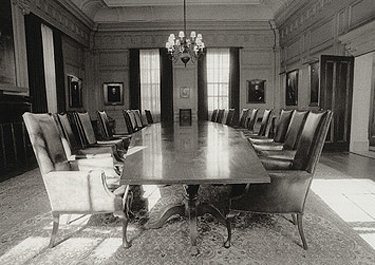
Woodbridge Hall, meeting room where Yale’s top officials make decisions.
K.C. Johnson, at Minding the Campus, describes the truly Orwellian system of adjudicating complaints of sexual assault which has evolved at Yale as the result of threats of sanctions by Barack Obama and Eric Holder’s Department of Justice’s Office of Civil Rights.
Yale, as part of an agreement with OCR (Office of Civil Rights), revised its procedures and promised biannual reports from Yale deputy provost Stephanie Spangler.
Over the past three years, these Spangler documents have provided a first-hand illustration of what passes for due process at one of the nation’s leading universities. From them, we learned that more than a half-dozen Yale students (including former quarterback Patrick Witt) had been found culpable for sexual assault under “informal complaint†procedures that provide no grounds for an accused student to present evidence of his innocence. The latest Spangler report has now been released. It suggests that due process still stands in short supply on the New Haven campus. …
Seven cases this semester have gone through the “informal†process—which can best be seen as a kind of “Scarlet Letter†approach. That is: given the limitations on the accused student’s ability to present evidence, it’s almost impossible for an “informal complaint†to end without the accused student being branded a rapist. But beyond the branding, Yale allows only limited punishment through the informal procedure. Of the six students (one case remains pending) who faced charges of sexual assault through the “informal complaint†process, each received the same punishment—“counseling†and a prohibition on contacting the accuser.
For one student last spring, the allegation was just the beginning. Yale’s “formal complaint†procedure prevents the accused from having an attorney as part of the process; brands the accused a rapist based on a 50.01 percent finding from a panel specially trained panel; and denies the accused any right to cross-examine the accuser. Even under these guilt-tilting procedures, one accused student was found not culpable—meaning that Yale’s disciplinary panel concluded that it was more likely than not he was the subject of a false allegation.
The outcome of the case? The accused student was punished. He received a no-contact order with his accuser (there was no reciprocal order)—meaning that if the two happen to enroll in the same course, the accused student would need to drop the class; or if the two happened to be assigned to the same dorm, the accused student would have to move.
Yale also referred the accused student for “sexual consent training.†(Yale’s website contains no description of what this “training†entails, but here’s a summary from a feminist blog.) Again: Yale concluded that it was more likely than not that the accused student was the victim of a false allegation. Yet even though Yale’s own accuser-friendly procedures concluded that it was more likely than not the accuser leveled a false allegation, the accused was punished, while the accuser received no punishment of any sort.
In the several years of Spangler reports, there never has been any indication that Yale has punished even one student for filing a false claim of sexual assault. …
One of the Title IX cases from the spring provides a sense of the Orwellian nature of the Title IX coordinator’s work. “A third party reported,†according to Spangler, “that more than one female [Yale] student, whom the reporter would not identify, [emphasis added] was sexually assaulted by a male Yale student.â€
Or, in plain English, a Yale student is now being investigated as a serial rapist, with the possibility of sanctions—even though none of the females he allegedly raped have filed a complaint, or have even been identified. How any student could defend himself against such a charge is unclear.
Read the whole thing, and feel your blood run cold.
07 Aug 2014
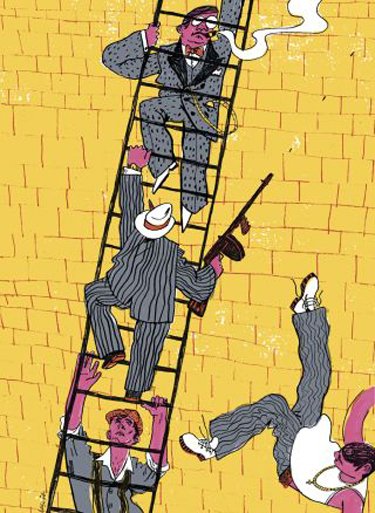
Malcolm Gladwell, in the New Yorker, looks a number of studies suggesting that crime used to be a viable path to social mobility. Modern intensity of policing and the absence of corruption, studies suggest, leave poor African American hoodlums today no “blind eye” under which they can prosper and become rich and respectable as their predecessors did.
Six decades ago, Robert K. Merton argued that there was a series of ways in which Americans responded to the extraordinary cultural emphasis that their society placed on getting ahead. The most common was “conformityâ€: accept the social goal (the American dream) and also accept the means by which it should be pursued (work hard and obey the law). The second strategy was “ritualismâ€: accept the means (work hard and obey the law) but reject the goal. That’s the approach of the Quakers or the Amish or of any other religious group that substitutes its own moral agenda for that of the broader society. There was also “retreatism†and “rebellionâ€â€”rejecting both the goal and the means. It was the fourth adaptation, however, that Merton found most interesting: “innovation.†Many Americans—particularly those at the bottom of the heap—believed passionately in the promise of the American dream. They didn’t want to bury themselves in ritualism or retreatism. But they couldn’t conform: the kinds of institutions that would reward hard work and promote advancement were closed to them. So what did they do? They innovated: they found alternative ways of pursuing the American dream. They climbed the crooked ladder.
All three of the great waves of nineteenth- and early-twentieth-century European immigrants to America innovated. Irish gangsters dominated organized crime in the urban Northeast in the mid to late nineteenth century, followed by the Jewish gangsters—Meyer Lansky, Arnold Rothstein, and Dutch Schultz, among others. Then it was the Italians’ turn. They were among the poorest and the least skilled of the immigrants of that era. Crime was one of the few options available for advancement. The point of the crooked-ladder argument and “A Family Business†was that criminal activity, under those circumstances, was not rebellion; it wasn’t a rejection of legitimate society. It was an attempt to join in. …
[The most important thing] is not the cultural difference between being an Italian thug in the early part of the twentieth century and being an African-American thug today. It’s the role of law enforcement in each era. … Until the nineteen-seventies, outstanding warrants in the city of Philadelphia were handled by a two-man team, who would sit in an office during the evening hours and make telephone calls to the homes of people on their list. Anyone stopped by the police could show a fake I.D. Today, there are computers and sometimes even fingerprint machines in squad cars. Between 1960 and 2000, the ratio of police officers to Philadelphia residents rose by almost seventy per cent.
In the previous era, according to Goffman, the police “turned a fairly blind eye†to prostitution, drug dealing, and gambling in poor black neighborhoods. But in the late nineteen-eighties, she writes, “corruption seems to have been largely eliminated as a general practice, at least in the sense of people working at the lower levels of the drug trade paying the police to leave them in peace.â€
[Old-time Italian gangsters], of course, routinely paid the police to leave them in peace, as did the other crime families of their day. They got the benefit of law enforcement’s “blind eye.†…
The Federal Witness Protection Program did not yet exist; federal wiretaps weren’t admissible in court. Only the F.B.I. was properly equipped to tackle organized crime, and under J. Edgar Hoover the bureau saw targeting Communism and political subversion as its primary mandate. “As late as 1959, the FBI’s New York field office had only 10 agents assigned to organized crime compared to over one hundred and forty agents pursuing a dwindling population of Communists,†the attorney C. Alexander Hortis writes, in “The Mob and the City.†In the unlikely event that a mobster was arrested, Hortis points out, he could expect to walk. Between 1960 and 1970, forty-four per cent of indictments of organized-crime figures in courts around New York City were dismissed before trial. In that same ten-year period, five hundred and thirty-six mobsters were arrested on felony charges, but only thirty-seven ended up in prison. …
That’s why the crooked ladder worked as well as it did. The granddaughter could end up riding horses because the law—whether from indifference, incompetence, or corruption—left her gangster grandfather alone.
The idea that, in the course of a few generations, the gangster can give way to an equestrian is perhaps the hardest part of the innovation argument to accept. We have become convinced of the opposite trajectory: the benign low-level drug dealer becomes the malignant distributor and then the brutal drug lord. The blanket policing imposed on 6th Street is justified by the idea that, left unchecked, [low-level criminals] will get worse. Their delinquency will metastasize… [C]rooked-ladder theorists looked at the Mafia’s evolution during the course of the twentieth century, however, and reached the opposite conclusion: that, over time, the criminal vocation was inevitably domesticated.
06 Aug 2014

Don Bergland, Ideology, Digital drawing
Jed Perl gets down to some serious chin-stroking in the New Republic about the contemporary Left’s preference for ideology over aesthetic considerations.
Back in 1950, in the preface to The Liberal Imagination, Lionel Trilling worried that liberalism’s “vision of a general enlargement and freedom and rational direction of human life . . . drifts toward a denial of the emotions and the imagination.†Liberalism, he argued, “in the very interest of affirming its confidence in the power of the mind . . . inclines to constrict and make mechanical its conception of the nature of the mind.†In the sixty-four years since Trilling published those words the process of constriction and mechanization has only become more pronounced. This process is reflected in the ever-growing obsession with polls, surveys, and sundry forms of bureaucratic analysis, which threaten to reduce all art’s unruly richness to a set of data points. Instead of viewing life’s unquantifiable artistic experiences as a check on quantification, the well-intended impulse among many liberal commentators is to try and quantify the unquantifiable. But the power of art, which is so personal and so particular, is finally unquantifiable—and therefore a source of embarrassment to the rationalizing mind. What is at stake is art’s freestanding power.
I suppose it is the casualness with which that freestanding power can now be dismissed that struck me in what was on the face of it a fairly off-the-cuff observation in a review that Alex Ross published in The New Yorker not too long ago. Ross is a winningly fluid writer, and he knows how to report on the musical performances that mean the most to him in such a way that his readers become as excited as he is; we share his avidity, his intentness, his keen pleasure. He is a friend of the arts, and he obviously cares passionately about the musical arts. This is why a passing remark in a piece about the Russian conductor Valery Gergiev has held my attention. In the midst of a discussion of Gergiev—who was conducting the opening night of Eugene Onegin at the Metropolitan Opera, and had voiced his strong support for Putin in spite of the Putin regime’s abhorrent support of homophobic legislation in Russia—Ross complained that Gergiev “dabbles in politics, yet insists that politics stops at the doors of art.†And then—and this is the remark that pulled me up short—Ross announced, referring to the idea that politics stops at the doors of art: “This is an old illusion.†There was something in the mingled broadness and offhandedness of Ross’s comment—the sense that this was not just an illusion but an old illusion—that set me to wondering and worrying.
Note that there is no place in contemporary culture for conservatives. We will be lucky, at best, as Auden put it, to be pardoned.
Time that is intolerant
Of the brave and the innocent,
And indifferent in a week
To a beautiful physique,
Worships language and forgives
Everyone by whom it lives;
Pardons cowardice, conceit,
Lays its honours at their feet.
Time that with this strange excuse
Pardoned Kipling and his views,
And will pardon Paul Claudel,
Pardons him for writing well.
05 Aug 2014
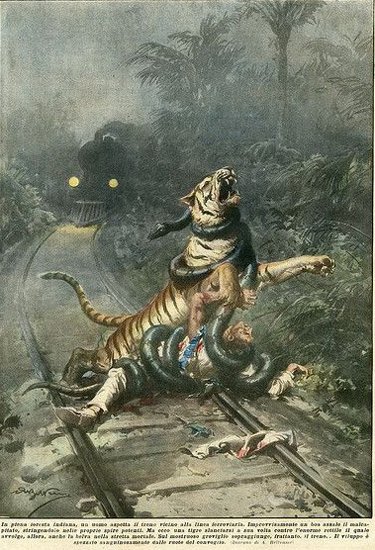
The Italian reads: “In the middle of the Indian forest, a man waiting for the train to stop just near the line. Suddenly, a boa attacks its victim, squeezing with its powerful coils. But then a tiger hurls itself upon the huge reptile which wraps, then, even the beast in a stranglehold. A monstrous tangle occurs, meanwhile, along comes the train. The whole tangle winds up bloody and broken by the wheels of the train.”
Via Ratak Mondosico.
More of the bloodcurdling illustrations of the great Achille Beltrame can be seen here.
Achille Beltrame (1871-1945)did the cover of La Domenica del Corriere every week from its beginning in 1899 until his own death in 1945.
05 Aug 2014

Karen and I have been filling up our eReaders with free classics, forgotten novels, new releases, and classic pulp. After re-reading all of John D. MacDonald’s Travis McGee mysteries, I just started working my way through Ian Fleming’s James Bonds.
You can really feel the passage of time, reading these 60 years on. In Diamonds Are Forever, Bond stays at the Astor Hotel in New York (torn down in 1968). He rejoices that Felix Leiter is taking him to an air-conditioned restaurant: Sardi’s. Back in 1956, not all restaurants were.
Bond’s gracious host Felix proceeds to order Bond a special meal.
“… I’ve taken a chance and ordered you smoked salmon and Brizzola,” said Leiter. “This is one of the best places in town for beef, and Brizzola’s the best cut of that, straight cut across the bone. Roasted and then broiled. Suit you?” …
The smoked salmon was from Nova Scotia, and a poor substitute for the product of Scotland, but the Brizzola was all that Leiter said, so tender that Bond could cut it with a fork.
These days, of course, a fellow can look up Brizzola on the Internet, and not just wonder at Ian Fleming’s savoir faire versus one’s own ignorance.
And one finds that one is not alone in wondering about this mysterious dish.
Peter Morwood writes:
Bond writer Raymond Benson, in The James Bond Bedside Companion describes it as a fictional invention by Fleming. One thing it certainly is not, was the only Italian form of meat with a similar name that I was able to find. Bresaola, though looking and sounding close to Brizzola, is neither roasted nor broiled but air dried and served in thin slices as an antipasto starter or snack.
This could have been on Sardi’s menu along with some other beef main course, and Fleming mixed them up. He did that in several books, with food, wine and even guns (but carried off his mistakes with such verve that these are the Bondian aspects he’s supposed to have been most knowledgeable about!) I suspect we’re back to that fir-cone situation, where Fleming was told something he’d never heard of before, and described it in terms that seemed most familiar to him. …
The Brizzola business of double-cooking made me think of that memorable dinner, not only roasting beef, but broiling it afterwards. One would think that would end up with seriously overcooked meat, but from Bond’s reaction, it clearly did no such thing. More to the point, a consultation of our cookbooks – we have about 400, after the last cull – suggest that “broiling” isn’t just a way to cook food, but also to finish it after another, longer cooking method. You can see the elements falling into place…
Then I encountered an Italian dish called Brasato di Manzo al Barolo, which is beef braised in (very good) red wine, then served in thick slices – tranches, to use the old term. The slices are thick enough to pass under a seriously-hot commercial broiler to produce a burnt, crunchy finish without actually cooking the slice of braised meat any further, and whether this was done to the proper recipe or not, it sounded like a feasible way for a restaurant to put its individual spin on the dish.
Besides describing unfamiliar things in familiar terms, Ian Fleming, bless his little cotton socks, had (according to at least a couple of observers) no head for drink, and as a result his “research meals” for James Bond novels were often something of a mishmash of incorrect or illegible notes. I’ve even seen one source suggesting that Bond’s famous “shaken not stirred” Martini – which apparently contradicts the way in which every martini was made prior to that – was a result of Fleming sampling far too many martinis, getting the method wrong, and then sticking to his guns afterwards. It doesn’t hurt that in his essay How to Write a Thriller he elaborates on how someone going against the grain like that makes for a more interesting character, which works for me. The only place it doesn’t work is that such behaviour makes said character stand out and become memorable – both characteristics that a spy would do well to avoid.
It seemed to me that we’d found at least one likely candidate for “Brizzola.” Diane had other suggestions; that it might originally have been a deliberately-underdone rib roast cut between the ribs into individual portions like really large T-bone steaks, and finished on or under a grill. Alternately, it could have been a London broil sliced and finished in the same way, which is what I did to a fine piece of rump steak the other night, for my birthday dinner.
The meat had been marinating since Monday in olive oil, red wine, red wine vinegar, oregano, cracked pepper and crushed garlic. It was then slow roasted, frequently basted with the marinade, then cut into four thick slices and whizzed under the grill. Luckily our kitchen cooker has a very enthusiastic grill, if it’s allowed to preheat properly, so the end result was delicious.
And yes, you can cut it with a fork…!

05 Aug 2014


Two Gifs illustrating the toggle-action of the Luger. Great hand grip on these, lousy trigger. Now all Lugers are hideously expensive, alas!
/div>

Feeds
|