Top Gear’s Jeremy Clarkson has taken his millions and done what wealthy Brits always do: Move to the country to enjoy rural life and sports.
And, like any good country squire, Jeremy has taken up Shooting Driven Game.
His column is behind a paywall in the Sunday Times:
I was up early the other day because I was keen to write about the Britannia Hotels group’s incredible achievement of being voted the UK’s worst chain for the seventh year running. Imagine. You’re told you’re rubbish once and then you keep on being rubbish for six straight years. I wanted to comment about such an extraordinary level of commitment to slack-jawed slovenliness.
But then I noticed that the survey had been done by Which?, an organisation that is really only interested in reaching adenoidal people in action trousers and sandals who contribute to TripAdvisor and run the neighbourhood watch scheme. As a general rule, I’ve always reckoned that if something does badly in Which?, it’s probably pretty good.
As I sat, deciding which side to take in the great hotel debate, I was distracted by an annoying man on Radio 4’s Farming Today show. He was from the airborne wing of the Labour Party — also known as the Royal Society for the Prevention of Birds — and he was talking about how he thought shooting game birds might be a bad thing.
The RSPB has always been prevented by its royal charter from campaigning against the shooting industry — Mrs Queen likes to strangle a pheasant or two at Christmas time, as we know — but it has worked out that it can comment if it reckons shooting is done by rich bastards in Range Rovers.
Now, the columnist Charles Moore said recently that the actress Olivia Colman had a “left-wing faceâ€. I won’t comment on that, but I will say that Martin Harper, the man the RSPB sent to Radio 4, had a left-wing voice. Chris Packham has both a left-wing voice and a left-wing face, and he wants us all to stop using fly spray.
Anyway, Martin reckoned that if you release 50m non-native game birds into the British countryside every year, it’s bound to have an effect. When pressed by the interviewer for a specific effect, he said: “Er, climate change.†That was lucky for the Britannia Hotels chain, because I immediately abandoned my original plan and decided to write about shooting instead.
The first thing I did when I started a small shoot was plant several acres of so-called cover crops. Maize, sunflowers and something called kale, which can be eaten by humans if they are very deranged. These crops provide warmth, food and a place to hide from Johnny Fox, not just for my pheasants but a whole squadron of other birds too.
We keep reading about how endangered the yellowhammer is these days; well, not on my farm it isn’t. Since I started my shoot, the skies are black with them. And goldcrests. And wrens. And skylarks. The dawn chorus used to be nothing but the occasional squawk of a murderous crow, whereas now it’s positively philharmonic.
Research has shown that if you run through a field of crops planted by a shootist, you are 340 times more likely to encounter a songbird than if you do a Theresa May and run through a field of grass.
So, Martin, if the RSPB does manage to ban shooting, then, yes, you will be championed as a class hero throughout the vegan strongholds of Islington and Shoreditch, but you will also be responsible for the deaths of a million linnets. Which, as far as I know, isn’t why the RSPB was founded.
And then there are the woods, where the pheasants are held until they are old enough to forage on their own. Woods are beautiful and still. They’re places to shelter from the endless drone of light-aircraft enthusiasts. Mine are full of roe deer and muntjac and squirrels and badgers, and at this time of year there are many mushrooms too. I love to spend an evening down there as the leaves turn golden, giggling. Everyone likes woods, except if you are in a horror film.
But they generate no income. So if shooting were banned, I’d have to get Brazilian on their arses and turn them into farmland. Is that what you want, Martin? Because I fear that would create a damn sight more climate change than my Range Rover.
Of course, I’m well aware that some people might bridle at the sight and sound of eight hedge-fund managers in tweed shorts, braying their way through a pint of sloe gin while brandishing a pair of £20,000 shotguns, but what good comes from making them take up golf instead?
There are many hobbies that inflict far more pain and misery on others: light aircraft — I’m not giving up on that — the violin, motorcycling, strimming, morris dancing and so on, so why pick on one that’s good for nature and good for the way the countryside looks?
Pointedly, it’s good for birds too. Not just songbirds, but the kind of stuff that makes kids point at the sky and squeak with joy. Birds of prey. Since I started a shoot, I have seen a huge increase in the number of kestrels and buzzards over my farm. I even think I spotted a peregrine falcon the other day, and that made my heart soar.
Was it here because it likes eating my pheasants and partridges? There’s some debate about that, but the truth is I don’t really care if it does take a few. Because I like having it around.
Clarkson is right in saying that the Ringneck pheasant (Phasianus colchicus) is not native to Britain, but they were actually introduced by Julius Caesar a very long time ago, you’d think they’d have been given naturalized citizenship by now.
Scientists have re-created the face of a female Viking warrior who lived more than 1,000 years ago.
The woman is based on a skeleton found in a Viking graveyard in Solør, Norway, and is now preserved in Oslo’s Museum of Cultural History.
While the remains had already been identified as female, the burial site had not been considered that of a warrior ‘simply because the occupant was a woman’, archaelogist Ella Al-Shamahi told The Guardian.
But now British scientists have brought the female warrior to life using cutting-edge facial recognition technology.
Scientists reconstructed the face of the female warrior who lived more than 1,000 years ago by anatomically working from the muscles and layering of the skin
And scientists found the woman was buried with a hoard of deadly weaponry including arrows, a sword, a spear and an axe.
Researchers also discovered a dent in her head, which rested on a shield in her grave, that was consistent with a sword wound.
It is unclear whether the brutal injury was the cause of her death however it is believed to be ‘the first evidence ever found of a Viking woman with a battle injury’, according to Ms Al-Shamahi.
She added: I’m so excited because this is a face that hasn’t been seen in 1,000 years… She’s suddenly become really real.’
The British newspaper the Scottish Sun reports on a recent pronouncement from an “Instagram Influencer.” I know what Instagram is, but I had not been aware that it had “influencers.” I also had not really been aware that British millennials successfully rivaling ours in deficient masculinity. Wow!
Freddie Bentley, 22, said he thought the schools’ curriculum on the devastating conflict should be cut back because it was “so intenseâ€.
Bentley, who appeared on The Circle, told Good Morning Britain today: “It was a hard situation, World War 2, I don’t want anyone to think I’m being disrespectful.â€
He added: “I remember learning it as a child thinking ‘Oh my God it’s so intense’.â€
He thought that any mental health issues a youngster may have could be worsened by learning about the war that saw the Allied forces defeat Nazi Germany.
He told the show’s presenters Ben Shephard and Kate Garraway: “’I don’t think encouraging death or telling people how many people died in the world war is going to make it better.â€
Instead of youngsters learning about the horrendous war that claimed at least 70million lives, Bentley suggested schools could instruct pupils in topics such as understanding Brexit and how to get a mortgage.
He said: “There’s so many problems going on in the world, like Brexit, that’s not taught in schools.
“When I left school it hit me like a ton of bricks – I didn’t know anything to do with life.”
Currently, Key Stage 3 pupils learn about about the war, covering areas such as the rise of Adolf Hitler and the Nazis, the Battle of Dunkirk and Winston Churchill’s leadership.
Facebook political arguments with liberals prove, again and again, that the consensus of the community of fashion is built largely upon class marker signifying. In democratic society, the stupid and inferior eagerly adopt establishment-sanctioned opinions in order to identify themselves as “superior and intelligent.” They are too dumb to realize that intellectual conformism is anything but a sign of high intelligence.
And, of course, these educational failures simply do not recognize that the consensus they value so highly is nothing other than the mass culture of our time, and they have never learned enough to understand that mass culture consists primarily of popular delusions, fads, and temporary bouts of mass insanity.
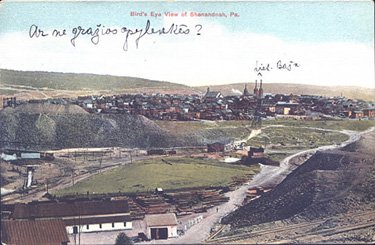
A view of my hometown, Shenandoah, Pennsylvania, from the southwest, in the vicinity of the West Shenandoah Colliery, overlooking the culm banks, circa 1910. The writing says in Lithuanian: “Ar ne grazios apylenkis?” (sarcastically) “Are not the surroundings beautiful?” The location of the Lithuanian church is also marked by hand.
The Economist quotes a British DNA study contending that it wasn’t brains or character or superior family culture that caused the lucky ones who got out to leave. No, it was deterministic genes.
To establish baselines for their work, Dr Abdellaoui, Dr Visscher and their colleagues turned first to 33 published studies that used a technique called genome-wide association study. This is intended to discern the contributions to a trait of large numbers of genetic differences that each have a small effect. It concentrates on so-called single-nucleotide polymorphisms (SNPs)—places in the DNA where an individual genetic “letter†routinely varies from person to person. There are, for example, about 100,000 SNPs that affect height. On average, each makes a contribution, either positive or negative, of 0.14mm to someone’s adult stature. This is in contrast to Mendelian variations, where a single difference between individuals has a pronounced effect—such as the difference between brown and blue eyes.
Each of the 33 baseline studies identified large numbers of SNPs that had positive or negative effects on a particular trait: extroversion, heart disease, height, body fat, age at menopause, recreational drug use and so on. The researchers then applied these SNP patterns to the records of 450,000 UK Biobank participants, and asked various questions. One thing they looked for was geographical clustering of SNPS related to individual traits. This, they discovered in abundance. Of the 33 traits under consideration, 21 showed evidence of SNP-related geographical clustering.
The most strongly clustered of all, they found were SNPS for educational attainment (ie, how many years an individual had spent at school and college). SNPs lowering educational attainment were particularly clustered in former coal-mining areas. These are places that have seen a lot of internal migration, both inward, when the mines were developed during the late 18th and 19th centuries, and outward, after the second world war, as mining shrank from being one of Britain’s biggest employers to its current state of near non-existence.
Dr Abdellaoui and Dr Visscher were able, from their studies of the biobank’s records, to chart the effects of the more recent, outward migration. They divided participants into four groups: those born in mining areas who had subsequently left; those born in mining areas who had stayed; those born outside mining areas who had moved into one; and those who had never lived in a mining area. The results were stark. People in the first group, outward migrants from mining areas, had significantly more educational-attainment-promoting SNPS, and fewer damaging ones, than any of the other groups, while people in the second group, stay-at-homes in mining areas, had the opposite.
Though not quite so sharply as with educational achievement, this pattern was also reflected in all but one of the other 20 SNP-related traits the researchers looked at. With the exception of bipolar disorder, the best outcomes were found in outward migrants from coalfields and the worst in stay-at-homes. The healthy, in other words, depart. The less healthy remain.
The upshot is a vicious spiral. That young, ambitious, healthy people tend to leave economically deprived areas is hardly news. But to see that written clearly in their DNA, which they take with them when they leave, while the converse is written in the DNA of those who stay behind, raises questions of nature and nurture that society is ill-equipped to answer, and possibly unwilling to confront.