“Marxism can in some senses be understood as a perversion of Christian empathy, and that’s certainly how it manifests itself in someone like the current Pope or like Bishop Budde. It is an economic recasting of good and evil not by actions but by socioeconomic status. A rich man must be evil and a poor man must be good, without reference to their actions. And it extends that fallacy of course towards nations and cultures too. A rich or successful nation must be evil, and a poor or failing nation must be good. Western civilisation must be evil because it is successful. Non western civilisation must be good because they were less successful.
Marxist victim narratives have always used, to some extent, a cloaking language of Christian compassion, although Marx and Lenin were both too deeply unpleasant themselves as individuals to do so with much conviction or regularity. Lenin is often cheerfully psychopathic in his commentary, and Marx riddled with poisonous prejudices, bitterness and hatred that bubbles up through the layers of supposed concern for the working class like noxious gases escaping from a swamp.”
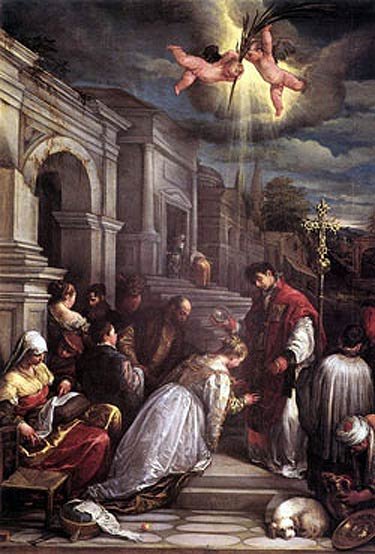
Jacopo Bassano, St Valentine Baptizing St Lucilla, 1575, oil on canvas, Museo Civico, Bassano del Grappa
The popular customs associated with Saint Valentine’s Day undoubtedly had their origin in a conventional belief generally received in England and France during the Middle Ages, that on 14 February, i.e., half way through the second month of the year, the birds began to pair. Thus in Chaucer’s Parliament of Foules we read:
For this was sent on Seynt Valentyne’s day
Whan every foul cometh ther to choose his mate.
For this reason the day was looked upon as specially consecrated to lovers and as a proper occasion for writing love letters and sending lovers’ tokens. Both the French and English literatures of the fourteenth and fifteenth centuries contain allusions to the practice. Perhaps the earliest to be found is in the 34th and 35th Ballades of the bilingual poet, John Gower, written in French; but Lydgate and Clauvowe supply other examples. Those who chose each other under these circumstances seem to have been called by each other their Valentines.
In the Paston Letters, Dame Elizabeth Brews writes thus about a match she hopes to make for her daughter (we modernize the spelling), addressing the favoured suitor:
And, cousin mine, upon Monday is Saint Valentine’s Day and every bird chooses himself a mate, and if it like you to come on Thursday night, and make provision that you may abide till then, I trust to God that ye shall speak to my husband and I shall pray that we may bring the matter to a conclusion.
——————————————–
From Robert Chambers, The Book of Days, 1869: Feast Day: St. Valentine, priest and martyr, circ. 270.
Valentine’s Day is now almost everywhere a much degenerated festival, the only observance of any note consisting merely of the sending of jocular anonymous letters to parties whom one wishes to quiz, and this confined very much to the humbler classes. The approach of the day is now heralded by the appearance in the print-sellers’ shop windows of vast numbers of missives calculated for use on this occasion, each generally consisting of a single sheet of post paper, on the first page of which is seen some ridiculous coloured caricature of the male or female figure, with a few burlesque verses below. More rarely, the print is of a sentimental kind, such as a view of Hymen’s altar, with a pair undergoing initiation into wedded happiness before it, while Cupid flutters above, and hearts transfixed with his darts decorate the corners. Maid-servants and young fellows interchange such epistles with each other on the 14th of February, no doubt conceiving that the joke is amazingly good: and, generally, the newspapers do not fail to record that the London postmen delivered so many hundred thousand more letters on that day than they do in general. Such is nearly the whole extent of the observances now peculiar to St. Valentine’s Day.
At no remote period it was very different. Ridiculous letters were unknown: and, if letters of any kind were sent, they contained only a courteous profession of attachment from some young man to some young maiden, honeyed with a few compliments to her various perfections, and expressive of a hope that his love might meet with return. But the true proper ceremony of St. Valentine’s Day was the drawing of a kind of lottery, followed by ceremonies not much unlike what is generally called the game of forfeits. Misson, a learned traveller, of the early part of the last century, gives apparently a correct account of the principal ceremonial of the day.
‘On the eve of St. Valentine’s Day,’ he says, ‘the young folks in England and Scotland, by a very ancient custom, celebrate a little festival. An equal number of maids and bachelors get together: each writes their true or some feigned name upon separate billets, which they roll up, and draw by way of lots, the maids taking the men’s billets, and the men the maids’: so that each of the young men lights upon a girl that he calls his valentine, and each of the girls upon a young man whom she calls hers. By this means each has two valentines: but the man sticks faster to the valentine that has fallen to him than to the valentine to whom he is fallen. Fortune having thus divided the company into so many couples, the valentines give balls and treats to their mistresses, wear their billets several days upon their bosoms or sleeves, and this little sport often ends in love.’
…
St. Valentine’s Day is alluded to by Shakspeare and by Chaucer, and also by the poet Lydgate (who died in 1440). …
The origin of these peculiar observances of St. Valentine’s Day is a subject of some obscurity. The saint himself, who was a priest of Rome, martyred in the third century, seems to have had nothing to do with the matter, beyond the accident of his day being used for the purpose. Mr. Douce, in his Illustrations of Shakspeare, says:
‘It was the practice in ancient Rome, during a great part of the month of February, to celebrate the Lupercalia, which were feasts in honour of Pan and Juno. whence the latter deity was named Februata, Februalis, and Februlla. On this occasion, amidst a variety of ceremonies, the names of young women were put into a box, from which they were drawn by the men as chance directed. The pastors of the early Christian church, who, by every possible means, endeavoured to eradicate the vestiges of pagan superstitions, and chiefly by some commutations of their forms, substituted, in the present instance, the names of particular saints instead of those of the women: and as the festival of the Lupercalia had commenced about the middle of February, they appear to have chosen St. Valentine’s Day for celebrating the new feast, because it occurred nearly at the same time.
This is, in part, the opinion of a learned and rational compiler of the Lives of the Saints, the Rev. Alban Butler.
It should seem, however, that it was utterly impossible to extirpate altogether any ceremony to which the common people had been much accustomed—a fact which it were easy to prove in tracing the origin of various other popular superstitions. And, accordingly, the outline of the ancient ceremonies was preserved, but modified by some adaptation to the Christian system. It is reasonable to suppose, that the above practice of choosing mates would gradually become reciprocal in the sexes, and that all persons so chosen would be called Valentines, from the day on which the ceremony took place.’
***********************************************
February 14th, prior to 1969, was the feast day of two, or possibly three, saints and martyrs named Valentine, all reputedly of the Third Century.
The first Valentine, legend holds, was a physician and priest in Rome, arrested for giving aid to martyrs in prison, who while there converted his jailer by restoring sight to the jailer’s daughter. He was executed by being beaten with clubs, and afterwards beheaded, February 14, 270. He is traditionally the patron of affianced couples, bee keepers, lovers, travellers, young people, and greeting card manufacturers, and his special assistance may be sought in conection with epilepsy, fainting, and plague.
A second St. Valentine, reportedly bishop of Interamna (modern Terni) was also allegedly martyred under Claudius II, and also allegedly buried along the Flaminian Way.
A third St. Valentine is said to have also been martyred in Roman times, along with companions, in Africa.
Due to an insufficiency of historical evidence in the eyes of Vatican II modernizers, the Roman Catholic Church dropped the February 14th feast of St. Valentine from its calendar in 1969.
“Athena Protects the Young Hero,” sculpture by Gustav Blaeser, 1854, Schlossbrücke (Castle Bridge), Berlin, Germany.
This is a must-read essay from the author using the penname N.S. Lyons:
“The great project of post-war establishment liberalism became to tear down the walls of the closed society and banish its gods forever. To be erected on its salted ground was an idyllic but exceptionally vague vision of an “open society” animated by peaceable weak gods of tolerance, doubt, dialogue, equality, and consumer comfort. This politically and culturally dominant “open society consensus” drew on theorists like Adorno and Popper to advance a program of social reforms intended to open minds, disenchant ideals, relativize truths, and weaken bonds.
As Reno catalogues in detail, new approaches to education, psychology, and management sought to relativize truths, elevate “critical thinking” over character, vilify collective loyalties, cast doubt on hierarchies, break down all boundaries and borders, and free individuals from the “repression” of all moral and relational duties. Aspiration to a vague universal humanitarianism soon became the only higher good that it was socially acceptable to aim for other than pure economic growth.
The anti-fascism of the twentieth century morphed into a great crusade – characterized, ironically, by a fiery zeal and fierce intolerance. By making “never again” its ultimate priority, the ideology of the open society put a summum malum (greatest evil) at its core rather than any summum bonum (highest good). The singular figure of Hitler didn’t just lurk in the back of the 20th century mind; he dominated its subconscious, becoming a sort of secular Satan, forever threatening to tempt mankind into new wickedness. This “second career of Adolf Hitler,” as Renaud Camus jokingly calls it, provided the parareligious raison d’etre for the open society consensus and the whole post-war liberal order: to prevent the resurrection of the undead Führer.
This doctrine of prevention grants enormous moral weight to ensuring that open society values triumph over those of the closed society in every circumstance. If it’s assumed that the only options are “the open society or Auschwitz” then maintaining zero tolerance for the perceived values of the closed society is functionally a moral commandment. To stand in the way of any possible aspect of societal opening and individual liberation – from secularization, to the sexual revolution and LGBTQ rights, to the free movement of migrants – was to do Hitler’s work and risk facilitating fascism’s return (no matter how far removed the subject concerned from actual fascism). It was established as the open society’s only inviolable rule that, as Reno puts it, it is “forbidden to forbid.” Thus a strict new cultural orthodoxy was consolidated, in which to utter any opinion contrary to the continuous project of further opening up societies became verboten as a moral evil. Complete inclusion required rigorous exclusion. We are familiar with this dogma today as political correctness.”
In Good Queen Victoria’s day, you did not buy your pet food at the supermarket. It was delivered door-to-door.
Kathryn Hughes shares a fascinating detail of daily life in London in times gone by.
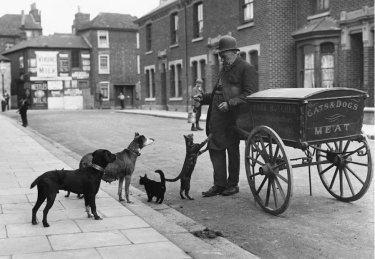
On January 10, 1901, twelve days before Queen Victoria did the unthinkable and died, 250 cat’s meat men sat down to a slap-up dinner at a restaurant in Holborn, on the edge of central London. A cat’s meat man was an itinerant vendor who pushed a cart of cheap offal and horsemeat around residential streets while calling out something that sounded like “CA-DOE-MEE!” Sometimes he stopped at a house and delivered a pre-ordered package of meat, often threaded onto a long skewer. At the same time, his shout was the signal for householders and domestics to come out onto the pavement and buy their pets’ food straight from the barrow. For all that cats were supposed to cater for themselves by catching kitchen pests, urban owners increasingly found the money from the household budget to supplement their board.
Within minutes of the cat’s meat man embarking on his circuit, the barrow would be surrounded by felines, some of whom had perfectly good homes to go to and others who did not but still hoped that a sliver of flesh might fall their way. Although there were plenty of grim jokes circulating about how cat’s meat men supplied the toughest meat they could get away with, the fact was that many of these rough diamonds were known for their tender hearts. It was not unusual to spot a cat’s meat man slipping scraps to the hopeful strays that wound around his ankles. He was their guardian, their special friend. Sometimes he could even bring about fairy-tale transformations: no less a lady than the Duchess of Bedford had recently adopted a stray that had been rescued by her local London cat’s meat man.
During the middle years of Victoria’s reign, the cat’s meat man, in his livery of blue apron, shiny black hat, and corduroy trousers, had become a gift to investigative journalists of an anthropological turn. In his London Labour and the London Poor (1851), Henry Mayhew plunges deep into their visible yet still mysterious world. According to Mayhew, there were a thousand such traders in London, serving about 300,000 cats, one for every house (allowing for multiple cats in some homes, plus strays).
They claim only to apply to a small percentage of households in order to gain a majority vote, but then rapidly evolve to cover everyone. https://t.co/q6cWEcFBgr
DOWN with rosemary and bayes,
Down with the mistleto,
Instead of holly, now up-raise
The greener box, for show.
The holly hitherto did sway;
Let box now domineere,
Until the dancing Easter-day,
Or Easter’s eve appeare.
Then youthful box, which now hath grace
Your houses to renew,
Grown old, surrender must his place
Unto the crisped yew.
When yew is out, then birch comes in,
And many flowers beside,
Both of a fresh and fragrant kinne
To honor Whitsontide.
Green rushes then, and sweetest bents,
With color oken boughs,
Come in for comely ornaments,
To re-adorn the house.
Thus times do shift; each thing his turn does hold;
New things succeed as former things grow o.