Category Archive 'Uncategorized'
14 Oct 2022

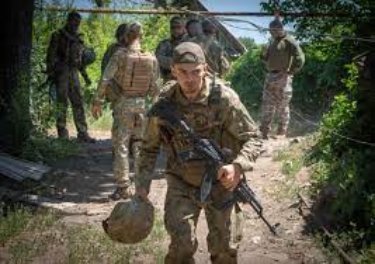
Russian Forces Retreating From Ukrainian Counter-Offensive.
Adam Roach answers an interesting question on Quora.
Russia is known as one of the biggest arms manufacturers, and they have no problem sending old equipment to the battlefield, yet reports say the lack equipment in the Ukranian war, where did all of their weapons go?
There are a couple of things at play in this.
On paper, Russia had one of the largest militaries in the world. In every metric. Manpower, tanks, airplanes, artillery pieces, ships, helicopters and missiles.
So factor 1; Russia just lied.
Russia claimed to have 900,000 troops at the beginning of the war. They put about a third of that number on Ukraine but then lacked reinforcements and fresh troops to rotate the tired guys out.
In NATO it’s not uncommon to have 3 backfield support guys for every frontline soldier but that’s not how Russia is set up. If it was it would have much better logistics.
Currently the rest of Russia is thin on troops. This seems confirmed by non partisan satellite imaging and actual Intel reports. Not to mention Russian citizens on Telegram. So either they lied or they have an awful lot of troops concentrated in very strange places.
While this doesn’t seem to impact actual weapons at first, it really does.
The Russians claim to operate more than a thousand fixed wing military aircraft. Only the US has more but, for instance, the US Air Force has 5000 aircraft and 400 ICBMs. To maintain all of that the Air Force has about a half a million employees in various roles and types of employment. 99% of whom are backfield support.
Most US planes are ready to go at any moment. Which is what happens when 25+ guys are tasked with keeping a single plane up and running.
Just given Russia’s published manpower numbers and assuming a somewhat similar civilian role involvement. Russia doesn’t have nearly enough people to keep its planes in the air. That is assuming Russia hasn’t fudged their manpower numbers and they absolutely have. Read the rest of this entry »
12 Oct 2022

There is a Lithuanian language epithet (approximate spelling) šventobezdi (š is pronounced as “sh”) which I often heard as a boy applied by adults I knew to the excessively sanctimonious type of person accusing him of flatulating holiness.
Today’s PMC (Professional Managerial Class) Community of Fashion is stacked to the rafters with šventobezdys (plural — švento means “holy” — bezdi is self-explanatory).
There was a simply dreadful referee call in Monday last’s Chiefs-Raiders game. During a third-and-eight play with 1:13 left in the first half, Raiders quarterback Derek Carr was sacked by Chiefs defensive lineman Chris Jones for a loss of six yards. While Jones was taking Carr to the ground, he stripped away the football and his momentum carried him to land on top of Carr. Referee Carl Cheffers called it “Roughing the Passer,” giving the Raiders back the ball and a first down.
Football fans were justifiably outraged, and former great Cowboys quarterback Troy Aikman commentating on the game, in natural frustration at the sissification of the game, called aloud for the NFL Competition Committee “to take the dresses off.”
Me, oh my! What he said! All the fruits and nuts belonging to the self-appointed Committee to Assure Politically Correct American Speech and Expression pounced on Aikman like the proverbially duck on a Junebug.
Aikman’s “toxic masculinity” was reliably attributed by his holier-than-thou betters to previous brain injury and declared to be the kind of WrongSpeech that must be punished.
Sports Illustrated polluted the air with considerable holiness.
11 Oct 2022
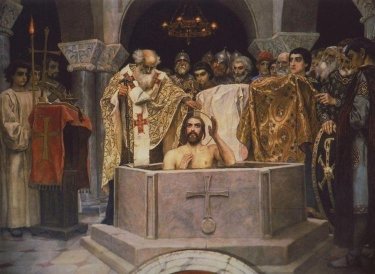
Victor Vasnetsov, Baptism of Prince Vladimir, 1885-1893.
Tim Snyder explains that Vladimir Putin’s view of History, and territorial claims based thereon, are utter and complete nonsense.
Crimea is a district of Ukraine, as recognized by international law, and by treaties between Ukraine and the Russian Federation. Putin, however, has taken the view, for more than a decade now, that international law must yield to what he calls “civilization,” meaning his eccentric understanding of the past. The annoying features of the world that do not fit his scheme of the past are classified as alien, and illegitimate, and subject to destruction (Ukraine, for example).
The example of Crimea lays bare a problem within Putin’s thinking. The idea that there is some sort of immutable “civilization,” outside of time and human agency, always turns out to be based upon nothing. In the case of Crimea, Putin’s notion that the peninsula was “always” Russia is absurd, in almost more ways than one can count.
The Crimean Peninsula has been around for quite a long time, and Russia is a recent creation. What Putin has in mind when he speaks of eternity and is the baptism of a ruler of Kyiv, Valdimar, in 988. From this moment of purity, we are to understand, arose a timeless reality of Russian Crimea (and a Russian Ukraine). which we all must accept or be subject to violence. Crimea becomes “holy.”
It takes time to recount even a small portion of the ways in which this is nonsensical. First of all, the historical event itself is not at all clear. One source says that Valdimar was baptized in Crimea, as Putin likes to say; others that he was baptized in Kyiv. None of the sources date from the period itself, and so we cannot be certain that it took place at all, let alone of the locale. (If Valdimar was indeed baptized in Crimea, Putin’s logic would seem to suggest that the peninsula belongs to modern Greece, since the presumed site was part of Byzantium at the time.)
Valdimar was, to put it gently, not a Russian. There were no Russians at the time. He was the leader of a clan of Scandinavian warlords who had established a state in Kyiv, having wrenched the city from the control of Khazars. His clan was settling down, and the conversion to Christianity was part of the effort to build a state. It was called “Rus,” apparently from a Finnish word for the slavetrading company that brought the Vikings to Kyiv in the first place. It was not called “Rus” because of anything to do with today’s Russia — nor could it have been, since there was no Russia then, and no state would bear that name for another seven hundred years. Moscow, the city, did not exist at the time.
Baptism, whatever its other merits, does not create some kind of timeless continuum of power over whatever range of territory some later figure chooses to designate. If it did, international relations would certainly look very different. When Emperor Constantine converted to Christianity, the Roman Empire controlled what is now Portugal, Spain, France, the Balkans, Israel, Turkey, North Africa… But we would be very surprised to hear an Italian leader (even now) cite Constantine’s baptism to claim all of these countries.
To take an example of another east European baptism: at the moment when the Lithuanian grand duke converted to Christianity, he ruled not only today’s Lithuania, but also what is now Belarus, most of what is now Ukraine, and a portion of what is now Russia. By way of baptism in 1386 he was able to marry the Polish king (who was a girl) and take the Polish crown. The Lithuanians at the time were also deeply engaged in Crimea, fighting the Crimean Khanate. Taking advantage of fractures and power struggles, the Lithuanians integrated sizable numbers of Crimean Tatars into their own armed forces, and allowed them and their descendants to settle in Lithuania, to enter commercial trades (such as tanning), to build mosques, and to print holy books.
In 1410, when the Lithuanian Grand Duke defeated the Teutonic Knights in the famous battle of Grünwald, some of his fighters were Crimean Tatars. Ostroh, in what is now Ukraine, is known as the place where the first slavonic bible was published, but it was also the site of a mosque for Crimean Tatars. Navahrudak, in what is now Belarus, is the birthplace of the famous Polish Romantic poet Adam Mickiewicz; it too was the site of a mosque for Crimean Tatars. In my office I have a printed edition of a kitab, a Crimean Tatar prayer book from the Grand Duchy of Lithuania, using Arabic script, but in a Polish-Belarusian language with Turkish phrases. Its first words, enticingly, are “This is the key to heaven.” It bespeaks a coherent Crimean Tatar culture that endured for centuries extended well beyond the borders of the Crimean Khanate itself.
I like to think that this Lithuanian-Polish-Belarusian-Ukrainian-Crimean history is worth knowing — I am busily teaching it — but if the Lithuanian president were to proclaim today that Jogaila’s baptism in 1386 somehow gave him the right to rule Poland, Belarus, Ukraine and its Crimean province, we would be puzzled.
In one respect, though, our imaginary Italian or Lithuanian claims are less nonsensical than the Russian one. Even if we were to accept every other Putinesque oddity, including the profound fallacy of the legitimation of present borders by ancient baptisms, we would be brought to a halt by geography. Putin’s mythical structure is based upon the restoration of Rus, an east European entity centered in Kyiv whose high point was a thousand years ago. The Lithuanian and Italian governments are based in Vilnius and Rome, which were also the ancient capitals. Putin is talking about a state that is distant not only in time but in space. Moscow was not the capital of Rus; it did not exist when Valdimar was baptized.
RTWT
Really, it’s the other way around. If we are going by History, Ukraine belongs to Poland (or Lithuania), and “Russia” (i.e. Moscow) belongs to Kiev (i.e. Ukraine).
11 Oct 2022

UPI:
In 1910, President Theodore Roosevelt became the first U.S. president to take flight in an airplane. Piloted by Arch Hoxsey, Roosevelt would stay aloft for 4 minutes in a Wright brothers-built plane at Kinloch Field in St. Louis, Mo.
11 Oct 2022
———————-
“warmongers”? Sounds like she is going to become a Buchananite Isolationist Republican. Better than a democrat, of course, but…
10 Oct 2022
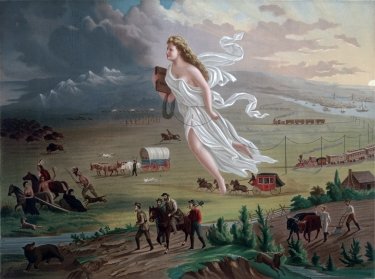
John Gast, American Progress, 1872, Autry Museum of the American West, Los Angeles, California.
Jeff Fynn-Paul debunks the leftist myth of European guilt.
[N]o matter who ‘discovered’ the New World, it is inevitable that a large proportion of New World inhabitants would have died within the first few decades after first contact. This is universally acknowledged by specialists in the field. The New World population was smaller and more homogenous than the Old World population. Thus, its people had less immunity to disease than the people of the Old World, where disease communities from Africa, Asia and Europe had been intermingling for millennia. Even though some European captains did try and spread smallpox around a few forts and villages from time to time, the effect of their efforts was almost negligible compared with the natural spread of disease. So the claims of genocide by disease have almost nothing to do with European actions, apart from their simply reaching the New World. And of course, Europeans of the time had no way of envisioning the continent-wide epidemic repercussions of their actions. Verdict: not guilty.
Let us also acknowledge that Native American society was just as warlike as any other in human history. The anthropologists’ vision of Native Americans as peace-pipe-smoking environmentalists which gained purchase in the 1970s has long since given way to a more Hobbesian portrait of pre-Columbian reality. In North America, most Natives were primitive farmers. This means that (with some exceptions) they had no permanent settlements: they farmed in an area for a few decades until the soil got tired, before moving on to greener pastures where the hunting was better and the lands more fertile. This meant that tribes were in constant conflict with other tribes. It also meant that chiefs were continually vying for power, creating confederations under themselves, and that the question of who owned the land was in a more or less constant state of flux. In most of North America, the idea that any one piece of land belonged to any one tribe, for more than 50 or 100 years, is therefore highly questionable. In short, if you looked at a map of Native Canada 200 years before Europeans arrived, it would have been entirely different. In the meantime, some groups of natives would have slaughtered, bullied or enslaved others. Should we not be grieving for those Native Canadians whose land was stolen by other Native Canadians? Or is that somehow OK? I don’t suppose there is an app for that.
The idea that the Europeans stole some land which had belonged in perpetuity to any one tribe is therefore ludicrous. The situation in most of North America was similar to northern Europe on the eve of the Germanic migrations, or western Europe as the Celts were moving across the landscape. Precisely to whom the land belonged in any given century at these periods in history was anyone’s guess. The very notion of property is a Greco-Roman invention which most cultures found foreign until quite recently. But Europeans of the time had little chance of grasping this difference. What the Europeans did in the New World was insert themselves into a fluid power struggle which had been ongoing for millennia. Many Native American chiefs were ready to pledge allegiance to the Great ‘Chief of the English’, as a political expedient, just as various English colonies sided with this or that Native American ‘Great Chief’. Despite a few sensational cases of duplicity, most of the time, Europeans tried to buy land from Indians, just like they would buy an acre of land in England. If the local chief assented to this and liked the price, where then was the crime? Many individual Europeans believed that according to the norms of both parties, they had legal usufruct to the land they were working. To judge this as theft is therefore anachronistic. As Europeans set up farming communities, and introduced guns to North America, Native American communities were forced to move further away from European lands as game retreated. The areas around white settlements were often empty for this reason, making the land seem all the more abandoned. Musket use by natives probably depleted animal stocks at a higher rate than previously, meaning that the very introduction of firearms might have spelled the doom of hunting and gathering in North America in the long run, even if the Europeans had otherwise left the country alone.
Another major structural issue is this: what precisely would our pious anthropology professors have had Europeans do with the New World once they found it?
This is not a joke. Political reality has a way of crashing in on the pipe dreams of liberal academics. The reality is, if the English had not colonized, then the French or the Dutch would have. If the Spanish had not colonized, the Portuguese would have. This would have shifted the balance of power at home, and any European country which had not colonized, would have been relegated to secondary status. And it is easy to overestimate the amount of control that European governments actually had. As soon as the New World was discovered, many fisherman and traders sailed across the Atlantic on their own, in hopes of circumventing tax authorities and scoring a fortune. Long before colonies were established in most regions, the New World was crawling with Europeans whose superior technology gave them an edge in combat. Nonetheless, it was extremely dangerous for Europeans to provoke fights with Native Americans, and most of them tried to avoid this when possible. In retrospect, one could in theory be impressed that so many European governments showed a genuine concern to rein in the worst excesses of their subjects, with an express eye to protecting the Indians from depredation. The logic was simple: they attempted to protect their subjects at home, in order to secure good order and a better tax base. So they would do the same to their subjects in the New World. For a long time, few Europeans harbored any master plan of pushing the Native Americans out of their own lands. In more densely populated regions such as Mexico, such an idea must have seemed an absurdity. Reality tends to occur ad hoc. Boundaries often took generations to move, and would have seemed fixed at the time. For several centuries, many Europeans assumed that they would long be a minority on the North American continent. In Mexico and Peru, they always have been.
RTWT
I think it is worth noting that none of those sanctimonious lefties telling Americand and Canadians that they are residing on land rightfully belonging to this or that “First People” tribe can be seen packing their bags and hopping on a plane back to Europe.
10 Oct 2022
———————————–
———————————–
10 Oct 2022

Christopher Columbus (detail), from Alejo Fernández, La Virgen de los Navegantes, circa 1505 to 1536, Alcázares Reales de Sevilla.
In his magisterial biography, Admiral of the Ocean Sea, 1942, Samuel Elliot Morrison observes:
[Christopher Columbus did] more to direct the course of history than any individual since Augustus Caesar. …
The voyage that took him to “The Indies” and home was no blind chance, but the creation of his own brain and soul, long studied, carefully planned, repeatedly urged on indifferent princes, and carried through by virtue of his courage, sea-knowledge and indomitable will. No later voyage could ever have such spectacular results, and Columbus’s fame would have been secure had he retired from the sea in 1493. Yet a lofty ambition to explore further, to organize the territories won for Castile, and to complete the circuit of the globe, sent him thrice more to America. These voyages, even more than the first, proved him to be the greatest navigator of his age, and enabled him to train the captains and pilots who were to display the banners of Spain off every American cape and island between Fifty North and Fifty South. The ease with which he dissipated the unknown terrors of the Ocean, the skill with which he found his way out and home, again and again, led thousands of men from every Western European nation into maritime adventure and exploration.
The whole history of the Americas stem from the Four Voyages of Columbus; and as the Greek city-states looked back to the deathless gods as their founders, so today a score of independent nations and dominions unite in homage to Christopher the stout-hearted son of Genoa, who carried Christian civilization across the Ocean Sea.
An annual post.
10 Oct 2022
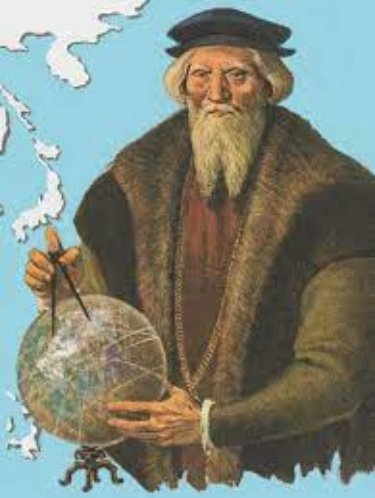
John Cabot
Glenn Reynolds links a 2005 posting from Jim Bennett that contends that America’s been celebrating the wrong Italian.
During the 19th century, Columbus was reinvented by Washington Irving and his successors as a sort of Yankee visionary entrepreneur before his time. His specific roots in time, space, and culture as a Genoese in the service of Spanish monarchs was downplayed; what was celebrated was his seeming prescience and capacity for self-reinvention.
In fact Columbus did have some such characteristics; entrepreneurism is often a leap into the unknown, and he was neither the first nor the last to set out to seek one thing and discover another, nor to venture on the basis of mistaken calculations and assumptions. There was, it is true, a certain Enron-like quality to his mileage calculations.
Subsequently, this useful narrative was seized upon and expanded by Catholic immigrant communities eager to demonstrate that Catholicism was not inconsistent with being American. Italian immigrant groups found Columbus a particularly appealing figure; here was an Italian Catholic already elevated to heroic status by the Americans they sought to join. Columbus Day became established as an American holiday, but for reasons and with symbolism quite different from those for which it is celebrated in Latin America..
Now, of course, Columbus Day is under attack as a holiday in the United States by the forces of political correctness. This is primarily an effect of the Calvinist Puritan roots of American progressivism. Just as Calvinists believed in the centrality of the depravity of man, with the exception of a miniscule contingent of the Elect of God, their secularized descendants believe in the depravity and cursedness of Western civilization, with their own enlightened selves in the role of the Elect.
I do not particularly sympathize with the demonization of Columbus Day by the politically correct, although I do not think the injustices suffered by our Siberian-American fellow immigrants should be glossed over. However, I think Columbus Day should be reconsidered as a U.S. holiday for a different reason. I am fundamentally in agreement with the Hispanosphere nationalists on one point: Columbus’s voyage was very specifically the initiation of the contact between Spain and Spanish America. Neither the settlement of Brazil nor of English-speaking North America were direct consequences of Columbus’s voyages, and would probably have happened had Columbus never returned with the news of his landing.
The Portuguese discovery of Brazil was, after all, the accidental by-product of their ongoing exploration of Africa. The English-speaking world, on the other hand, began its expansion into North America as a consequence of John Cabot’s voyage of 1497.
It makes more sense to think of the European encounters with the Americas as three distinct main streams: one was the Spanish movement to the Caribbean, Mexico, Peru, and ultimately other areas, stemming from Columbus’s voyage; another was the Portuguese movement to Brazil, which was intimately linked to their explorations of Africa predating Columbus; and the third was the stream of peoples from the British Isles and ultimately elsewhere to North America to found the nations of the North American Anglosphere. These three distinct streams founded the three principal cultural-linguistic communities of the Americas.
Although Cabot’s voyage to Newfoundland was undoubtedly spurred by news of Columbus’s voyages, the expanding English maritime enterprise would sooner or later have recapitulated the Viking achievements in the North Atlantic. There are interesting conjectures about prior voyages from the British Isles to North America before Columbus, from Bristol fishermen working the Grand Banks (not unlikely) to other, more speculative theories, such as Farley Mowat’s ideas about voyagers from the Orkneys preceding the Vikings in the Dark Ages.
Whatever the realities of these theories, it is the expansion of the cultures and traditions that form the template on which today’s societies in the U.S. and English Canada that we should commemorate. Columbus, whatever his merits and demerits may be, is in this regard beside the point. If Americans of Italian descent wish to point with pride to a predecessor in discovery, perhaps we should look at Giovanni Caboto, another Italian navigator. Moving to England, he adopted the English style of his name and became known to history as the discoverer … John Cabot.
Not only did Cabot’s discoveries spark the great stream of human migration that became the English-speaking New World, he was himself a precursor of the millions of Italians who crossed the Atlantic to North America and became part of the English-speaking world, to its and their own enrichment.
I do not join in the politically-correct denigration of Columbus. But I do raise the question of whether, by celebrating him rather than John Cabot, we of the Anglosphere may be celebrating the wrong Italian.
RTWT
The “District of Cabotia”? “Cabotia, the gem of the ocean!” I don’t think so.
Your are browsing
the Archives of Never Yet Melted in the 'Uncategorized' Category.
/div>

Feeds
|