
Pramathesasana, Master of Pramathas
16 Dec 2015
Iowahawk Comments on LA School Shutdown
Beavis & Butthead, General Poltroonery, Iowahawk, Los Angeles, Satire, Terrorism, Twitter



15 Dec 2015
Another Recent Metal Detector Find
Archaeology, Britain, Wild Man
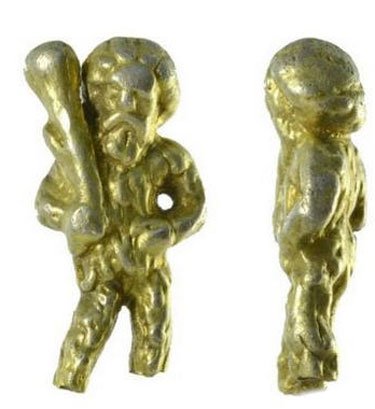
Wild Man
BBC:
A 500-year-old artefact is one of the earliest depictions of a mythical figure from medieval Europe, an expert has claimed.
Metal detectorists found the spoon handle with an engraving of “Wild Man” near Woodbridge in Suffolk.
A leading historian has hailed the discovery as a “rare find”.
Some of the earliest writings about The Wild Man come from Spain in the 9th Century and he was described as “barbaric, chaotic and unrestrained”.
The 15th Century handle, found two years ago, was declared as treasure at an inquest in Ipswich this week.
Covered in leaves and brandishing a club, the hairy Wild Man was a popular medieval mythical figure mostly found in pictures and literature rather than on objects.
Professor of history Ronald Hutton, from the University of Bristol, said: “It’s certainly one of the earliest depictions of the Wild Man.
“There would have been earlier ones on manuscripts and tapestries but not like this.”
He said it would have been owned by someone “well-off” and from the “upper to middle class”.
People were fascinated by the creature who was “barbaric, chaotic and unrestrained”, he said.
15 Dec 2015
Herodotus’ Account of Origin of the Etruscans Confirmed By DNA Research
DNA, Etruscans, Herodotus

Etruscan sarcophagus lids
The Guardian:
[T]he Etruscans, whose descendants today live in central Italy, have long been among the great enigmas of antiquity. Their language, which has never properly been deciphered, was unlike any other in classical Italy. Their origins have been hotly debated by scholars for centuries.
Genetic research made public at the weekend appears to put the matter beyond doubt, however. It shows the Etruscans came from the area which is now Turkey – and that the nearest genetic relatives of many of today’s Tuscans and Umbrians are to be found, not in Italy, but around Izmir.
The European Human Genetic Conference in Nice was told on Saturday the results of a study carried out in three parts of Tuscany: the Casentino valley, and two towns, Volterra and Murlo, where important finds have been made of Etruscan remains. In each area, researchers took DNA samples from men with surnames unique to the district and whose families had lived there for at least three generations.
They then compared their Y chromosomes, which are passed from father to son, with those of other groups in Italy, the Balkans, modern-day Turkey and the Greek island of Lemnos, which linguistic evidence suggests could have links to the Etruscans.
“The DNA samples from Murlo and Volterra are much more highly correlated to those of the eastern peoples than to those of the other inhabitants of [Italy],” said Alberto Piazza of the University of Turin, who presented the research. “One particular genetic variant, found in the samples from Murlo, was shared only with people from Turkey.”…
The latest findings confirm what was said about the matter almost 2,500 years ago, by the Greek historian Herodotus. The first traces of Etruscan civilisation in Italy date from about 1200 BC.
About seven and a half centuries later, Herodotus wrote that after the Lydians had undergone a period of severe deprivation in western Anatolia, “their king divided the people into two groups, and made them draw lots, so that the one group should remain and the other leave the country; he himself was to be the head of those who drew the lot to remain there, and his son, whose name was Tyrrhenus, of those who departed”.
It was a Roman who muddied the waters. The historian Livy, writing in the first century BC, claimed the Etruscans were from northern Europe. A few years later, Dionysius of Halicarnassus, a Greek writer living in Rome, came up with the theory that the Etruscans were, on the contrary, indigenous Italians who had always lived in Etruria.
The Lydian empire had by then long since passed into history. Its inhabitants were said by Herodotus to have been the first people to make use of gold and silver coins and the first to establish shops, rather stalls, from which to trade goods. They gave the world the saying “as rich as Croesus” – Croesus was their last king.



14 Dec 2015
Cheetahs
Cheetahs, Pest Control, South Africa

The Atlantic tells us about airport pest control, South African-style.
This week, two cheetahs attacked an officer on a South African air-force base.
The officer was not seriously injured, and was treated for minor wounds on her shoulders and the back of her head. After that, the cheetahs got back to work.
Wait, what?
The cheetahs didn’t wander onto Makhado Air Force Base by accident. They were deployed there earlier this month as part of a program started in the 1990s that places cheetahs on military bases for animal-control purposes. The big cats roam the base freely, hunting small game that might run onto airplane runways from nearby nature reserves and pose risks to flight safety.
“As wild animals become habituated to noises from aircraft, they are no longer frightened off the airstrip at the sound of an oncoming plane,†explains the Hoedspruit Endangered Species Center, which donates cheetahs to the program. Makhado is located near three nature reserves.
Read the whole thing.
13 Dec 2015
The Victorians Were Probably Smarter Than People Today
Der Untergang das Abendlandes, Genetics, Intelligence, Victorian England

Benjamin Jowett 1817-1893
My name is Benjamin Jowett.
I am Master of Balliol College.
What there is to know, I know it,
And what I don’t know isn’t knowledge.
Nobody would write a poem like that about Yale’s current president Peter Salovey.
————————-
A recent paper in the journal Intelligence is titled:
Highlights
• Simple reaction time has slowed since 1889.
• Psychometric meta-analysis reveals a decline in g of − 1.16 points per decade.
• The decline between 1889 and 2004 is − 13.35 points.
• The decline between 1889 and 2004 is − 12.45 points.
• This is the first direct measurement of a probable dysgenic trend in IQ.
Abstract:
The Victorian era was marked by an explosion of innovation and genius, per capita rates of which appear to have declined subsequently. The presence of dysgenic fertility for IQ amongst Western nations, starting in the 19th century, suggests that these trends might be related to declining IQ. This is because high-IQ people are more productive and more creative. We tested the hypothesis that the Victorians were cleverer than modern populations, using high-quality instruments, namely measures of simple visual reaction time in a meta-analytic study. Simple reaction time measures correlate substantially with measures of general intelligence (g) and are considered elementary measures of cognition. In this study we used the data on the secular slowing of simple reaction time described in a meta-analysis of 14 age-matched studies from Western countries conducted between 1889 and 2004 to estimate the decline in g that may have resulted from the presence of dysgenic fertility. Using psychometric meta-analysis we computed the true correlation between simple reaction time and g, yielding a decline of − 1.16 IQ points per decade or − 13.35 IQ points since Victorian times. These findings strongly indicate that with respect to g the Victorians were substantially cleverer than modern Western populations.



