Death of John Talbot — Charles-Philippe Larivière, La bataille de Castillon, 1838, Galerie des batailles, Château de Versailles.
In Friedrich Schiller’s Die Jungfrau von Orleans, when the enchantress Joan of Arc preaching her visions and prophesies, inspires the French Army to heroic efforts and panics the English into flight, the dying English commander Talbot complains:
TALBOT.
„Unsinn, du siegst und ich muß untergehn!
Mit der Dummheit kämpfen Götter selbst vergebens.
Erhabene Vernunft, lichthelle Tochter
Des göttlichen Hauptes, weise Gründerin
Des Weltgebäudes, Führerin der Sterne,
Wer bist du denn, wenn du dem tollen Roß
Des Aberwitzes an den Schweif gebunden,
Ohnmächtig rufend, mit dem Trunkenen
Dich sehend in den Abgrund stürzen mußt!
Verflucht sei, wer sein Leben an das Große
Und Würdge wendet und bedachte Plane
Mit weisem Geist entwirft! Dem Narrenkönig
Gehört die Welt.
Folly, thou conquerest, and I must yield!
Against stupidity the very gods
Themselves contend in vain. Exalted reason,
Resplendent daughter of the head divine,
Wise foundress of the system of the world,
Guide of the stars, who art thou then if thou,
Bound to the tail of folly’s uncurbed steed,
Must, vainly shrieking with the drunken crowd,
Eyes open, plunge down headlong in the abyss.
Accursed, who striveth after noble ends,
And with deliberate wisdom forms his plans!
To the fool-king belongs the world.
—————————————–
Stupidity doesn’t always win, of course. It just wins most of the time.
—————————————–
Via John Brewer:
“Some scientists claim that hydrogen, because it is so plentiful, is the basic building block of the universe. I dispute that. I say there is more stupidity than hydrogen, and that is the basic building block of the universe.” — F. Zappa (a better guitar player than F. Schiller was)
Rush yesterday described a futile attempt by Ted Cruz in Indiana to reason with a “brain-dead” Trump supporter.
I cringed when I saw Cruz cross the street, ’cause I knew exactly what was gonna happen. And the reason I called the guy brain-dead is cause that’s how he acted. “Trump! Trump! Trump! Lyin’ Ted! Lyin’ Ted!”
He had no desire to engage Cruz. Cruz was being polite. He crossed the street, wanted to engage the guy in conversation about issues. I literally was cringing when it happened; I cringed when it was over. Because it wasn’t gonna work. And the audio was such that even if Cruz was trying to create something viral that could be on social media that would show him politely and graciously encountering a Trump supporter and explaining the issues (and hoping that that would go viral), it didn’t have much of a chance ’cause the audio wasn’t good enough for that to happen.
All the Trump people were shouting this or that, encouraging this guy. “Trump! Trump! Trump! Lyin’ Ted! Lyin’ Ted!” You know, Cruz was polite. He was everything that you would want somebody to be, and he’s being mocked and laughed at and made fun of as a square, as a nerd, as a loser or what have you, which is exactly right in line with what’s happening in our culture today. It is the renegades, and it’s been this way for a long time. The renegades and the — well, however you want to characterize them.
The people that do not stay within the guard rails of reality, they’re the ones that are celebrated and praised. They get rich. They’re made heroes. We’ve made celebrities out of them, and people that don’t do that are just dull and boring and dryballs and usually tagged as conservatives or what have you. So I was not calling all Trump supporters brain-dead. You’ve heard me talk about the Trump people. You’ve heard me lionize the Trump people. You’ve heard me, on this program, celebrate the Trump people and explain to people why certain people behind Trump support him.
This guy was no different than a Code Pink protester, and so that’s that. I’m sorry. I wasn’t able to separate the personal experiences I’ve had just like that over the course of my career, and I knew it was gonna work when I watched it happening and I watched the replay. I knew it wasn’t gonna work, and frankly there’s a part of me that still — even though I know the drill and I know the lay of the land and I know the reality and I’m the mayor of Realville.
It still bugs me when doofuses like that end up the winner in a circumstance like that. But welcome to America 2016, or whatever it is.
Plato, copy of a bust by Silanion, Musei Capitolini.
Andrew Sullivan is back, in New York magazine, telling us that the current election reminds him of something.
As this dystopian election campaign has unfolded, my mind keeps being tugged by a passage in Plato’s Republic. It has unsettled — even surprised — me from the moment I first read it in graduate school. The passage is from the part of the dialogue where Socrates and his friends are talking about the nature of different political systems, how they change over time, and how one can slowly evolve into another. And Socrates seemed pretty clear on one sobering point: that “tyranny is probably established out of no other regime than democracy.†What did Plato mean by that? Democracy, for him, I discovered, was a political system of maximal freedom and equality, where every lifestyle is allowed and public offices are filled by a lottery. And the longer a democracy lasted, Plato argued, the more democratic it would become. Its freedoms would multiply; its equality spread. Deference to any sort of authority would wither; tolerance of any kind of inequality would come under intense threat; and multiculturalism and sexual freedom would create a city or a country like “a many-colored cloak decorated in all hues.â€
This rainbow-flag polity, Plato argues, is, for many people, the fairest of regimes. The freedom in that democracy has to be experienced to be believed — with shame and privilege in particular emerging over time as anathema. But it is inherently unstable. As the authority of elites fades, as Establishment values cede to popular ones, views and identities can become so magnificently diverse as to be mutually uncomprehending. And when all the barriers to equality, formal and informal, have been removed; when everyone is equal; when elites are despised and full license is established to do “whatever one wants,†you arrive at what might be called late-stage democracy. There is no kowtowing to authority here, let alone to political experience or expertise.
The very rich come under attack, as inequality becomes increasingly intolerable. Patriarchy is also dismantled: “We almost forgot to mention the extent of the law of equality and of freedom in the relations of women with men and men with women.†Family hierarchies are inverted: “A father habituates himself to be like his child and fear his sons, and a son habituates himself to be like his father and to have no shame before or fear of his parents.†In classrooms, “as the teacher … is frightened of the pupils and fawns on them, so the students make light of their teachers.†Animals are regarded as equal to humans; the rich mingle freely with the poor in the streets and try to blend in. The foreigner is equal to the citizen.
And it is when a democracy has ripened as fully as this, Plato argues, that a would-be tyrant will often seize his moment.
He is usually of the elite but has a nature in tune with the time — given over to random pleasures and whims, feasting on plenty of food and sex, and reveling in the nonjudgment that is democracy’s civil religion. He makes his move by “taking over a particularly obedient mob†and attacking his wealthy peers as corrupt. If not stopped quickly, his appetite for attacking the rich on behalf of the people swells further. He is a traitor to his class — and soon, his elite enemies, shorn of popular legitimacy, find a way to appease him or are forced to flee. Eventually, he stands alone, promising to cut through the paralysis of democratic incoherence. It’s as if he were offering the addled, distracted, and self-indulgent citizens a kind of relief from democracy’s endless choices and insecurities. He rides a backlash to excess—“too much freedom seems to change into nothing but too much slavery†— and offers himself as the personified answer to the internal conflicts of the democratic mess. He pledges, above all, to take on the increasingly despised elites. And as the people thrill to him as a kind of solution, a democracy willingly, even impetuously, repeals itself.
Politico thought it would be good if everyone actually understood the reality of Donald Trump, so they convened some experts on Trump’s career and biography, five Trumpologists who covered him professionally: Wayne Barrett, a longtime Village Voice reporter; Gwenda Blair, a bestselling author; Pulitzer Prize-winning journalist Michael D’Antonio; Harry Hurt III, an author and videographer; and Timothy L. O’Brien, a writer and editor at Bloomberg.
Three Excerpts:
1:
Michael Kruse: I’d like to start talking about Donald by talking about Fred Sr. and going back to the very beginning, to Jamaica Estates [the Queens neighborhood where Donald grew up]. What do people need to know? What should we know about Donald because of his father, because of that relationship?
Harry Hurt III: I ran into Fred at Coney Island, with his secretary-mistress, one day, and he usually went to a place called Gargiulo’s down in that area. But that was closed that day, and so I was with my researcher and we tailed them over to the original Nathan’s hot dog stand. Donald was flying somewhere at the time, and we overheard Fred wipe some mustard off his lip, like this here, and he said, “I hope his plane crashes.†And I looked at my researcher, and I said, “Did you hear what I just heard?†He said, “Yes, I did.†I said, “Well, that’s my man. That’s Fred. The apple don’t fall far from the tree.â€
2:
Barrett: Well, you know, with all this Tea Party anger that he’s appealing to now, he was the original bailout. I mean, the banks could have put him under any day. They took tremendous losses in those negotiations and deals. So they saved him. He was too big to fail.
Hurt: He was the original “too big to fail.â€
Barrett: He’s the consummate example of what his voters rail against.
O’Brien: I remember Trump’s finance chief Steve Bollenbach, who worked through the debt for him, said he had this conversation one day where they were going to take the yacht. And they didn’t want to take the yacht. And the light suddenly went on in their heads: The banks actually don’t want to control all these assets. They want him to operate out of it, and they both thought, “Wow.†That was the moment when they realized they had leverage.
You know, everything he does now, he doesn’t need loans to do any of it. The golf courses are owned by the members. They pay fees that finance it. He gets a salary from NBC from The Apprentice, and he gets licensing fees for everything else. I mean, there’s some projects, like the Chicago hotel—he got bank debt for that. Deutsche Bank loaned into that one.
Barrett: But he’s gone from the 18th floor to the 18th hole.
[Laughter.]
Blair: It was branding. It was the early branding that kicked in for him. He spent the ’80s getting that brand going. So he buys the shuttle, he buys the yacht, he buys the Plaza Hotel, everything—
O’Brien: The Generals.
Blair: The New Jersey Generals, which gets him onto the sports pages, which gets him up to a national level. So the branding he had in place, so by the time the first bankruptcy comes up, the brand is the thing they don’t want to let go of. They don’t want to foreclose and not have the name, which is so counterintuitive that the mind boggles. Like, wait a minute. This guy is in corporate bankruptcy, but his name—but that’s how it was. He could get the over-the-barrel piece for the banks, and he’s been doing it ever since. It’s the over-the-barrel piece which he did with the Republican Party now. How do you get them so they can’t get rid of you, they can’t let you go? And he’s really good at that.
Barrett: Well, the thing was that the banks wouldn’t complain, either. When they cut the deal with him, if they didn’t go on to a prosecutor—I mean, all of the financials that he gave the banks were totally false.
Hurt: And they’re liable for that, for not doing their due diligence.
Barrett: Yes. They were so embarrassed that they never went to a prosecutor. Clearly, there could have been a case made.
3:
O’Brien: The other thing, too, that I think the media has to hold his feet to the fire on is he’s gotten away with this notion that he’s a superior deal-maker, and a very successful businessman. I thought about it after he went after the Iran deal. He said, “Obama negotiated this horrible deal with Iran. It’s a bad deal, and when I get to Washington, there won’t be bad deals anymore. I’m a great deal-maker.†And then the reality, the objective reality, is that he’s been a horrible deal-maker. His career is littered with bad deals. And yet, he’s essentially now a human shingle. He’s not someone who’s a particularly adept deal-maker, if you look at his whole career.
Kruse: A human shingle, because there were the bad deals that brought him down in the early to mid-’90s, right?
O’Brien: What he was left with was licensing his name. So he licenses his name on mattresses and underwear and vodka and buildings, among other products.
Kruse: He made this transition from being an actual businessman, a person who does deals, some of which were good, to a grand promoter of his own name.
O’Brien: And the reality TV version of a successful businessman.
Barrett: This is the ultimate promotion of his own name. This is the ultimate brand.
Kruse: But the fact is that there is a middle ground. There is, basically, 1990-ish to 1995 where he is a failure.
O’Brien: He’s in desperate straits. He almost had to go personally bankrupt.
Kruse: The success is that he didn’t die a business death. The success was survival.
O’Brien: And he was a survivor, to his credit. He survived.
Kruse: Why, though, wasn’t that failure?
O’Brien: Because of The Apprentice. I think singularly because of The Apprentice. But he was a joke in between 1993 and 2003.
Blair: You know that family legacy, that family culture of “never give up.†He never said he was a failure. Everybody else said, “This guy is going down. He’s filed for bankruptcy. This is terrible,†but he didn’t say that. He continued to say he was the best of the best, the biggest of the biggest, and he went on. I think that’s a huge piece of that.
Barrett: I tell the tale towards the end of the book about after the settlement with Ivana, he goes to meet with John Scanlon, who was a New York publicist of some skill, and tries to hire Ivana’s publicist to now represent him, and tells John, who is now dead, “I’m going to make a giant comeback, and I want to be on the cover of Time again, and I want you to handle it.â€
So he’s already thinking that way, in that very down moment of his life, but he knew he had bilked the banks. The banks put him back up on the pedestal. They didn’t have to, but it took a while to climb up that ladder.
D’Antonio: What about the fact that Fred died and that money became available?
O’Brien: Which totally insulated him from a lot of problems, that inheritance that he got from Fred. At one point, he needed his siblings to extend him a loan. I think it was the hard reality of family money.
D’Antonio: The first thing I think that you credit him with is this creation of himself, which is very American, this idea that I’m going to imagine what I’m going to be, I’m going to tell the world that I’m it before I am it, and then the world is going to help me become it. And he did it.
O’Brien: Think about the genesis of The Apprentice. The show got launched because Mark Burnett [the producer of The Apprentice], as an immigrant to the United States, is selling blue jeans in Venice, California, barely making it. He doesn’t have any faith in himself and reads this book called The Art of the Deal, and he thinks, “Wow, this is the bible of how you make it in America.†And then whatever it is, 25, 30 years later, he does Survivor. That’s a huge hit. He becomes a force in the TV industry, and he thinks, “I’m going to go back to the godfather of my success, Donald Trump, and I’m going to create a TV show that embodies the inspiration I felt from The Art of the Deal.†And that’s how The Apprentice gets launched, because The Art of the Deal, as Wayne knows, didn’t comport with reality, and The Apprentice is just a TV version of The Art of the Deal. It’s a total distortion of reality.
Glasser: So it’s a TV show about a book about a guy who was an invented character.
O’Brien: Yes.
Glasser: That’s now led to a campaign based on the TV show based on the book.
O’Brien: About a man who’s saying he’s a politician, who could probably never really deliver on everything he’s saying.
D’Antonio: So it’s all about this autobiography, which isn’t auto, and it isn’t a biography—which is, you know, only in America.
The Mirror: Donald Trump denies rape of teenage girl at ‘sex party’ with convicted paedophile Jeffrey Epstein
The real question is: How many more of these little stinkbombs has Hillary got stashed away waiting for the Fall? and Can any of the bimbos’ stories be proven true? Chances are…
Robert Zubrin, at Ricochet, talks Foreign Policy (and Ethics) with the great man.
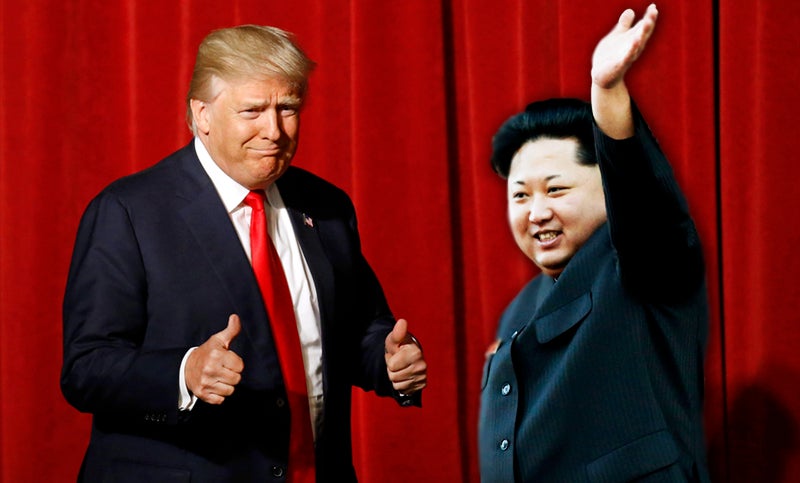
[D]id you hear the latest news? North Korea now says it has nuclear missiles that could hit the United States. What should we do about it?â€
Trump shrugged. “Just let me handle things.â€
This took me aback. “What? How?â€
The billionaire looked me in the eyes and pointed his finger at my nose. “Listen, kid. Success in life is about knowing people. If you want to be the top guy, you got to know the top people. I know the top guy over there. So everybody should just stop acting like a bunch of [expletive, plural] and relax. I got it covered.â€
Now I was really amazed. “You know the top guy in North Korea?†I stammered. “You know Kim Jong-un?â€
“Yeah, sure, I know Kim.†Trump smiled. “I built him a grand casino and strip joint in Pyongyang. He’s a swell guy, top drawer. Whenever we had a problem, he’d take care of it, so quick, you wouldn’t believe it. A bunch of squatters wouldn’t get out of their lousy little shacks so we could build a parking lot; bang, squash, pave, and in 24 hours flat, you’ve got the most beautiful parking lot you ever saw. When I’m President, that’s how we are going to do things here. No more of this go-to-court crap.â€
I hadn’t realized that there was a Trump grand casino and strip club in Pyongyang, and wanted to know more. “What’s the casino like?â€
“It’s wonderful, it’s magnificent, it’s yuge!†said Trump, spreading his arms expansively.“The carpets are all panda skins, the furniture is all made of ivory, the walls are solid gold, the dining room silverware is platinum, and the glasses are made from diamonds, freshly dug from the most exclusive mines in Africa. The menu is unmatched: Crimean caviar, Bolivian cocaine, Siberian tiger hearts, Pacific bottlenose dolphin liver pate, elephant balls. And the broads they got, wow. Top of the line, kid, top of the line. Not just a bunch of cute little oriental chicks like you might find in a lot of places out there, but top drawer Russian blonde bombshells chosen for us by Putin himself. And, let me tell you, my friend, Vlad really knows how to choose them.â€
I nodded. “Yes, you mentioned in one of the debates that you and Putin are good friends.â€
“Sure,†said Trump, smiling wickedly. “If you are looking for a good time in Moscow, he’s definitely the man to see.â€
“Yet,†I said, “Putin is also the guy whose bombs are stampeding our way all those Muslim refugees that you are making such a fuss about. Doesn’t that bother you?â€
Trump did a double take, looked at me like I had just revealed myself to be a born-yesterday idiot, then grinned knowingly. “You’re kidding, right? Anyway, he’s got this Olympic gymnast himself, and man, she is hot. The things she can do, you wouldn’t believe it. In all my travels, I have never known anyone like her.â€
The Donald closed his eyes, as if recalling a blissful memory, but my head was spinning. “I beg your pardon. Are you saying…?â€
Trump opened his eyes and held up his hand like a policeman telling a car to stop. “Sorry, I misspoke,†he said. “I didn’t mean to insult anyone. I should not have said I have never known anyone like her. I should have said ‘rarely.’ Not ‘never,’ but ‘rarely.’ There was also this nice piece of work who was married to the French president for a while, and maybe several others, whose names escape me at the moment. I love women, you know, and I’m really looking forward to meeting more of the world’s top broads once I’m President.†Trump suddenly looked puzzled. “I don’t know what I’m going to do with Merkel, though. I mean really, you call that a face? What do the krauts see in her? I just don’t get it.†He shook his head.
I decided to change the subject. “Returning to your friendship with Kim…â€
“Yes, great guy,†Trump nodded appreciatively. “I love his hairstyle. We use the same hairdresser, you know.†He playfully fluffed his hair up with his right hand.
“I see,†said I. “But aren’t you at all concerned about his ethics?â€
Trump frowned. “Ethics? What’s that?†Again he turned to me closely and pointed his finger in my face for emphasis. “Listen kid, in this world, there’s no such thing as right and wrong; there is just winning and losing. Kim’s a winner. I like that. He’s a real boss who knows what he is doing. You don’t see any North Korean companies leaving to set up their factories in Mexico, do you?â€
Brent Bozell implores his fellow Movement Conservatives to think seriously about what they are doing, and to dissociate themselves from Donald Trump’s candidacy before it is too late.
Even those of us who oppose Trump understand that he’s tapping into something that has exploded onto the national scene: disenchantment, even white-hot rage among the Republican base with the party’s establishment and the Washington status quo. You and I understand this because we were taking on the weak-kneed GOP leadership many, many years ago, back when Donald Trump was donating to Bill and Hillary Clinton.
Is Donald Trump the answer? That question’s on everyone’s mind. But there needs to be another question answered first: Does Donald Trump mean a word he says? Are conservative leaders supporting Trump prepared to live with the consequences if he doesn’t?
Many critics have outlined the innumerable left-wing positions and candidates Trump championed before he got in this race. It’s worth recalling some of them now: Trump not only supported but bankrolled amnesty. He supported taxpayer funding of Planned Parenthood. He supported not just abortion but partial-birth abortion. He was open to gay marriage. He supported government-funded universal healthcare.
He supported eminent domain for (his) private gain. He supported the Wall Street bailout. He supported “assault weapons†bans. He applauded President Obama for doing a “great job.†He congratulated Secretary of State Hillary Clinton for doing a “good job.†He financially helped the Democrats pass Obamacare. Trump was a registered Democrat when that party was being led by the likes of Rep. Nancy Pelosi (D-CA) and Sen. Harry Reid (D-NV), donating heavily during President Obama’s tenure. He’s bankrolled Democrats like Jimmy Carter, Rahm Emmanuel, Anthony Weiner, Terry McAuliffe, Chuck Schumer, Charlie Rangel, Ted Kennedy and John Kerry, to name a few.
But Trump said he’s changed. On everything. Overnight. Just in time for the GOP nomination fight.
Really?
Let’s look at Mr. Trump’s record during this campaign. He’s declared his support for single-payer healthcare. That puts him to the left of Obamacare. He’s re-declared his support for Planned Parenthood. He’s re-supporting tax increases. He’s supported crony capitalism. He’s endorsed “touchback†amnesty. He wants the U.S. to break the Geneva Convention. He’s “neutral†on Israel and Palestine. He wants South Korea and Japan to have nuclear arsenals.
Paul Krugman loves Trump’s big government economic plan for the simple reason that big government will remain under President Trump.
Two weeks ago, Mr. Trump took the left’s side in the North Carolina transgender bathroom controversy.
Last week Mr. Trump announced—guess what?—he’s not just pro-abortion, he wants the pro-life plank in the GOP platform removed, thus divorcing the Republican Party from the pro-life movement. Sarah, Ben, Mike, Phyllis: How can you still support this man? He has now thrown you under the bus, embracing an agenda you’ve spent your entire career opposing. Can you accept that betrayal?
What will you tell your supporters when the man you endorsed enacts an agenda that horrifies them?
As the Republican primaries draw to some sort of conclusion, right now Trump is surrounding himself with GOP establishment types, trying to assure them he doesn’t really mean many of the things he’s said, claiming that much of his campaign is just posturing.
Posturing to whom?
Top Trump aide Paul Manafort is telling GOP establishment bosses behind closed doors that his boss is “a real different guy.†His campaign openly touts his chameleon-like character as some sort of general election advantage.
Is someone with no discernible principles the candidate you want leading the Republican Party and taking on the Democrats in 2016?
Is someone who consistently lies about principles and positions he doesn’t hold worthy of your support?
If Trump becomes the nominee, and enacts the policies he’s now championing, will conservatives who chose to aid and abet Mr. Trump be able to live with their decision?
When it comes time to nominate a new Supreme Court Justice, and President Trump names his radically pro-abortion sister, as he’s suggested he would, or some other radically pro-abortion pro- Planned Parenthood jurist, as we know he will, will you accept that you helped him do that?
Asli Aydintasbas, a Turkish journalist, tells us that he is rooting for Trump, because he thinks we deserve him.
[W]hen my American friends ask what I think of Donald Trump, I tell them outright: “I sure hope he gets to be the president.†They tend to look at me with horror, and search my face for signs that I’m joking. “So you get a little taste of what we have all been going through in the rest of the world,†I add by way of explanation.
I really cannot wait to see the first bilateral meeting between Vladimir Putin and Trump, the initial handshake with Recep Tayyip Erdoğan or the sunny photo with Venezuela’s Nicolás Maduro. The meeting with South Africa’s Jacob Zuma will be fun and the White House visit with Azerbaijan’s Ilham Aliyev will undoubtedly be overshadowed by a next-door meeting of the glamorous first ladies.
Politics — and American politics particularly — has long been too scripted, too sanitized. Isn’t it time to inject some life into the boring song and dance of international diplomacy?
The majority of people on this planet live under corrupt and authoritarian regimes, some of which are close allies of Washington. So now you are getting yours too — what’s the big deal! I tell my panicked U.S. friends.
Besides, think of the upsides to a Trump presidency. What a breath of fresh air it would be to have an undiplomatic, swaggering U.S. president who could, for example, comment about Angela Merkel’s hair, joke about the robe of the Saudi king, or finally ask the French president Hollande about his love life. Politics — and American politics particularly — has long been too scripted, too sanitized. Isn’t it time to inject some life into the boring song and dance of international diplomacy?
But, of course, if the experiences of Turkey, Hungary, Venezuela and the rest of the world are anything to go by, the fun doesn’t end with diplomatic eccentricity — there will be laws to change, judges to appoint, newspapers to reckon with, elites to sacrifice at the altar, and businesses to shape up. At each and every turn, you would be surprised how many gather to watch the heads roll.
The Daily Wire finds very interesting the story that the Trump Campaign is now offering to voters.
Stage One of Donald Trump’s long con is almost over.
According to the Associated Press, Trump’s lackeys told Republican leaders on Thursday that Trump’s entire persona has been manufactured from wholecloth: he’s now about to turn into Winston Churchill, but more eloquent. They said that Trump has been “projecting an image†and that “the part he’s been playing is now evolving.†Paul Manafort, Trump’s new brain after the demise of Trump’s old brain, Corey Lewandowski, said that there are, in fact, two Donald Trumps. “When he’s out on stage,†said Manafort, “when he’s talking about the kinds of things he’s talking about on the stump, he’s projecting an image that’s for that purpose…You’ll start to see more depth of the person, the real person. You’ll see a real different guy.â€
Manafort continued:
He gets it. The part that he’s been playing is evolving into the part that now you’ve been expecting, but he wasn’t ready for, because he had first to complete the first phase. The negatives will come down. The image is going to change.
Ben Carson reiterated the same message: “He’s trying to moderate. He’s getting better.â€
This, of course, means that Trump has been lying.
Or it means that Trump is lying now in order to consolidate mainstream support.
Either way, he’s a liar.
Don’t like the vulgar, bullying, childish Donald Trump? Don’t worry! He’s now going to give you the sober, presidential Donald Trump. You don’t have to care that neither of them is evidently real.