Category Archive 'Archaeology'
19 Dec 2015


Mid-16th century Spanish artifacts discovered at the site of Tristan de Luna’s 1559 settlement in Pensacola. (photo: University of West Florida)
The Pulse reports that archaeologists have identified the site of the first European settlement in America.
For centuries, the exact location of Tristán de Luna y Arellano’s 1559 settlement in Pensacola — the first multi-year European settlement in the United States — has been a mystery.
Not anymore.
Archaeologists from the University of West Florida announced on Thursday the discovery of one of the most significant historical sites in the nation: the archaeological site of the de Luna settlement, hidden just beneath the surface in the city’s East Pensacola Heights neighborhood.
“Our archaeological team has discovered and can support the statement that the land settlement site of Tristan de Luna has been located within the city limits of Pensacola, Florida,†said Dr. Judy Bense, the university’s current president and founder of its archaeology program. “And we are telling the world today.â€
In October, Pensacola native Tom Garner discovered Spanish colonial and Native American artifacts at a privately owned residential lot within view of two previously discovered shipwrecks in Pensacola Bay. The so-called “Emmanuel Point shipwrecks,†located in 1992 and 2006, have also been linked to the de Luna expedition.
The artifacts Garner discovered are definitive evidence of de Luna’s settlement, which lasted from 1559 to 1561 — the earliest multi-year European colonial settlement ever archaeologically identified in the United States. De Luna’s Pensacola settlement predates the Spanish settlement in St. Augustine, Fla. by six years, and the English settlement in Jamestown, Va. by 48 years.
After collecting several artifacts, Garner brought them to the UWF archaeology lab on October 30. Dr. John Worth, associate professor of historical archaeology, is an archaeology and ethnohistory expert and focuses on the Spanish colonial era in the southeastern United States.
“What we saw in front of us in the lab that day was an amazing assemblage of mid-16th century Spanish colonial period artifacts,†said Worth. “These items were very specific to this time period. The University conducted fieldwork at this site in the mid-1980s, as have others since then, but no one had ever found diagnostics of the sort that Tom found on the surface. People have looked for this site for a long time.â€
Various artifacts, including Native American beads, have been discovered at the site of Tristan de Luna’s 1559 settlement in Pensacola. (University of West Florida/Special to the Pulse)
Various artifacts, including Native American beads, have been discovered at the site of Tristan de Luna’s 1559 settlement in Pensacola. (University of West Florida/Special to the Pulse)
With the cooperation and support of residents and property owners, UWF began test excavations at the site was able to recover other artifacts. Archaeologists recovered numerous shards of broken 16th century Spanish ceramics found undisturbed beneath the ground’s surface. They are believed to be pieces of assorted cookware and tableware, including liquid storage containers called olive jars. Small personal and household items were also among the findings — a lead fishing line weight, a copper lacing aglet, and wrought iron nail and spike fragments. Additionally, the team recovered beads known to have been traded with Native Americans. These items are consistent with materials previously identified in the shipwrecks offshore in Pensacola Bay.
The artifacts were linked to the Spanish expedition led by de Luna, who brought 1,500 soldiers, colonists, slaves, and Aztec Indians in 11 ships from Veracruz, Mexico, to Pensacola to begin the Spanish colonization of the northern Gulf Coast in 1559. One month after they arrived, the colony was struck by a hurricane, sinking many of their ships and devastating their food supplies. After two years, the remnants of the colony were rescued by Spanish ships and returned to Mexico.
15 Dec 2015
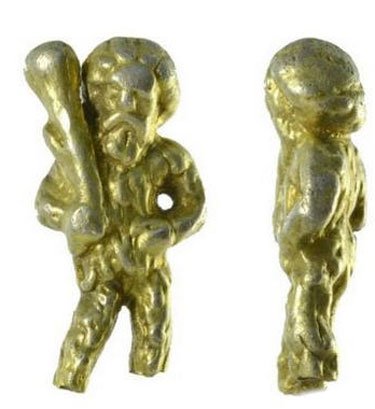
Wild Man
BBC:
A 500-year-old artefact is one of the earliest depictions of a mythical figure from medieval Europe, an expert has claimed.
Metal detectorists found the spoon handle with an engraving of “Wild Man” near Woodbridge in Suffolk.
A leading historian has hailed the discovery as a “rare find”.
Some of the earliest writings about The Wild Man come from Spain in the 9th Century and he was described as “barbaric, chaotic and unrestrained”.
The 15th Century handle, found two years ago, was declared as treasure at an inquest in Ipswich this week.
Covered in leaves and brandishing a club, the hairy Wild Man was a popular medieval mythical figure mostly found in pictures and literature rather than on objects.
Professor of history Ronald Hutton, from the University of Bristol, said: “It’s certainly one of the earliest depictions of the Wild Man.
“There would have been earlier ones on manuscripts and tapestries but not like this.”
He said it would have been owned by someone “well-off” and from the “upper to middle class”.
People were fascinated by the creature who was “barbaric, chaotic and unrestrained”, he said.
12 Dec 2015

Daily Mail:
Archaeologists claim to have proved that Julius Caesar set foot on what is now Dutch soil, destroying two Germanic tribes in a battle that left 150,000 people dead.
The tribes were massacred in the fighting with the Roman emperor in 55BC, on a battle site now known to be in Kessel, in the southern province of Brabant.
Skeletons, spearheads, swords and a helmet have been unearthed at the site over the past three decades – but until now have not been linked to Caesar’s battle. …
The two tribes, the Tencteri and the Usipetes, came from an area east of the Rhine and had asked Caesar for asylum.
But the Roman emperor refused and ordered his eight legions and cavalry to destroy them, the university said.
————————
27 Oct 2015

One of more than four dozen seal stones with intricate Minoan designs found in the tomb. Bulls were a common Minoan motif. (Photo: Department of Classics/University of Cincinnati)
Archaeologists from the University of Cincinnati excavating near Nestor‘s palace at Pylos found an intact shaft grave.
New York Times:
Remarkably, the burial was intact apart from a one-ton stone, probably once the lid of the grave, which had fallen in and crushed the wooden coffin beneath.
The coffin has long since decayed, but still remaining are the bones of a man about 30 to 35 years old and lying on his back. Placed to his left were weapons, including a long bronze sword with an ivory hilt clad in gold and a gold-hilted dagger. On his right side were four gold rings with fine Minoan carvings and some 50 Minoan seal stones carved with imagery of goddesses and bull jumpers. “I was just stunned by the quality of the carving,†Dr. Wright said, noting that the objects “must have come out of the best workshops of the palaces of Crete.â€
An ivory plaque carved with a griffin, a mythical animal that protected goddesses and kings, lay between the warrior’s legs. The grave contained gold, silver and bronze cups.
The warrior seems to have been something of a dandy. Among the objects accompanying him to the netherworld were a bronze mirror with an ivory handle and six ivory combs.
Because of the griffins depicted in the grave, Dr. Davis and Dr. Stocker refer to the man informally as the “griffin warrior.†He was certainly a prominent leader in his community, they say, maybe the pre-eminent one. The palace at Pylos had a king or “wanax,†a title mentioned in the Linear B tablets, but it’s not known if this position existed in the griffin warrior’s society.
Ancient Greek graves can be dated by their pottery, but the griffin warrior’s grave had none: His vessels are made of silver or gold, not humble clay. From shards found above and below the grave, however, Dr. Davis believes it was dug in the period known as Late Helladic II, a pottery-related chronology that corresponds to 1600 B.C. to 1400 B.C., in the view of some authorities, or 1550 B.C. to 1420 B.C., in the view of others.
Pappas Post
22 Oct 2015

CNN:
[A] man in Norway… recently stumbled across a 1,200 year-old Viking sword while walking an ancient route.
The find, which dates from approximately 750 AD and is in exceptionally good condition, was announced by Hordaland County Council.
County Conservator Per Morten Ekerhovd described the discovery as “quite extraordinary.”
“It’s quite unusual to find remnants from the Viking age that are so well preserved … it might be used today if you sharpened the edge,” he told CNN.
Outdoorsman Goran Olsen made the unusual find when he stopped for a rest in Haukeli, an area known for fishing and hunting about 150 miles (250 kms) west of capital, Oslo.
The rusted weapon was lying under some rocks on a well-known path across a high mountain plateau, which runs between western and eastern Norway.
The mountains are covered with frost and snow for at least six months of the year and not exposed to humidity in summer, which contributed to the sword’s exceptional condition, Ekerhovd said, adding that archaeological remains are often found along the paths.
He speculated that the sword could be from a burial site or may have belonged to a traveler who had an accident or succumbed to frostbite on the high pass.
The sword, which was found without a handle, is just over 30 inches long (77 centimeters) and made of wrought iron. From its type, archaeologists estimate it to be from around 750 AD — making it approximately 1,265 years old — but warn that this is not an exact date.
Swords like this were status symbols in Viking times because of the high cost of extracting iron, Ekerhovd said, and it’s likely this blade would have belonged to a wealthy individual.
17 Oct 2015
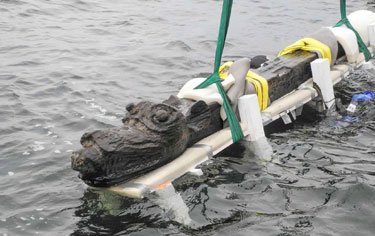
Daily Mail (8/11):
A wooden sea monster has emerged from the Baltic sea after lying on the ocean floor for more than half a millenium.
The creature, which has ‘lion ears and crocodile-like mouth’, is around 660lbs (300kg) and stood at the prow of a 15th-century Danish warship.
It was carefully lifted from the coast of Ronneby in southern Sweden [last August] by divers bringing up treasures from the wreck of the ‘Gribshunden’.
A sea monster has emerged from the Baltic sea after lying on the seabed for more than half a millenium
The Gribshunden, which belonged to Danish King John, is believed to have sunk in 1495 after it caught fire on its way from Copenhagen to Kalmar on Sweden’s east coast.
Although the hull suffered extensive damage, the remaining bits make it one of the best preserved wrecks of its kind, dating from roughly the same period as Christopher Columbus’s flagship, the Santa Maria.
06 Oct 2015
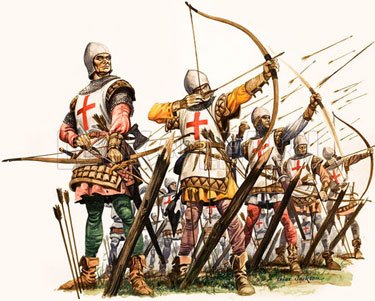
I missed the article at the time, but back in 2012, the Telegraph was reporting that forensic breakthroughs had even succeeded in identifying which of the skeletons of men drowned on Henry VIII’s sunken flagship were elite English archers.
Researchers have identified the elite archers who died alongside sailors on Henry VIII’s flagship, due to evidence of repetitive strain in their shoulders and spines.
The ship sank off Spithead in The Solent in 1545, while leading an attack on a French invasion fleet. It stayed on the seabed until it was raised in 1982 and put on public display.
Over the past two years, scientists from the University of Swansea have been working to identify almost 100 skeletons kept at the Mary Rose Museum, in Portsmouth. …
[N]ew DNA extraction technology has been developed to identify a skeleton’s origin and other personal features such as eye and hair colour.
Scientists have also tested how the bows were used by archers at that time, by using real-life archers.
They have uncovered evidence of repetitive stress injuries among the bowmen, the elite soldiers of their day, which they believe came from hours of longbow practice.
Nick Owen, a sport and exercise biochemist who is leading the work, said yesterday that the developments would help uncover more about the individuals who died with their ship.
The DNA breakthrough had enabled his team to embark on more detailed profiling.
“We know plenty about the Mary Rose but much less about the people on board,†said Mr Owen, from the university’s college of engineering.
“The archers were the elite but the longbows they used took a toll of their bodies and you can see signs of repetitive stress in the shoulders and lower spine.”
A Swedish expert is also working on facial reconstructions for the new Mary Rose Trust museum, which is due to open next year.
At the time, many archers were thought to have travelled from Wales and other areas in the south west of England and were considered the elite warriors of their day.
Previous studies have shown that they lived off a diet of salt beef and biscuits. Their diet also included flour, oatmeal, suet, cheese, dried pork, beer and salted cod.
“They were 6ft 2in or 6ft 3in, and strapping individuals,†Mr Owen said.
“A longbow was 6ft 6in and made from a particular part of a yew tree to generate incredibly efficient ‘spring’.
“It was mega hi-tech, and it gave England and Wales military superiority. These archers were the elite athletes of their day.â€
He added to the BBC: “It took years for these Archers to train to get to a level where they could use these very heavy bows.”
Alexzandra Hildred, the curator of ordnance at the Mary Rose Trust, has said the injuries could be the result of “shooting heavy longbows regularlyâ€.
“Many of the skeletons recovered show evidence of repetitive stress injuries of the shoulder and lower spine,†she said.
“Being able to quantify the stresses and their effect on the skeleton may enable us at last to isolate an elite group of professional archers from the ship.”
02 Oct 2015
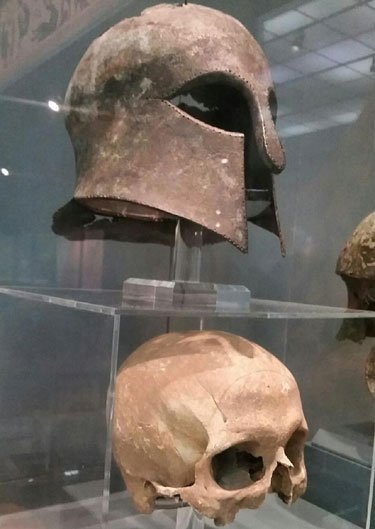
photo via Belacqui.
Royal Ontario Museum description:
The Corinthian helmet type is one of the most immediately recognisable types of helmet, romantically associated with the great heroes of Ancient Greece, even by the Ancient Greeks themselves who rapidly moved to helmet types with better visibility, but still depicted their heroes in these helmets. …
This specific helmet (ROM no.926.19.3) was purchased by the Royal Ontario Museum in 1926 [at] Sotheby’s (auction of 22 July 1926, lot 160). A skull (ROM No. 926.19.5) was said at one stage to be inside it, and in this condition was excavated by George Nugent-Grenville, 2nd Baron Nugent of Carlanstown, on the Plain of Marathon in 1834.
07 Sep 2015
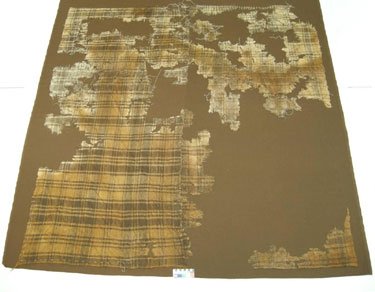
Skjoldehamn Blanket – this heavy, two-tone plaid blanket was part of a find that included an entire costume. Dated to the 11th century.
Wandering Elf reviews archaeological evidence (to help reenactors make correct costumes) and finds that Vikings tended to like plaids and stripes.
The examples strike me as not terribly different from the sort of tweeds used in British country suits.
27 Jul 2015

Armored skull from Visby Skeletal Collection in the Fornsalen Museum
Strange Remains:
The Visby skeletal collection at the Fornsalen Museum contains the remains of 1185 people who died at the Battle of Visby in 1361 and is the largest battlefield skeletal collection in Europe. Anthropologists from all over the world come to examine these battered bones to study medieval battlefield injuries. Here’s how these bodies ended up in a museum.
In July of 1361 the Danish king Valdemar IV decided to invade the island of Gotland, Sweden because it had a diverse population that included Danes, was populated with wealthy inhabitants, and was strategically located in the Baltic Sea. A legion of Swedish peasants tried to repel the Danish invasion near the city of Visby, but the inexperienced Gotlanders were no match for the Danish soldiers and many of them were slaughtered during the battle. The fallen Gotland soldiers were buried in three large mass graves, with their armor and weapons, near the city walls. After the Gotlanders surrendered, the island became a part of the Danish kingdom for a short period of time, until the Swedish crown reclaimed it in the early 15th century.
In 1905 Dr. Oscar Wennersten exhumed one of the graves and unearthed 300 bodies. Archaeologists Bengt Thordeman and Poul Nørlund recovered more bodies during additional excavations from two mass graves between 1912 and 1928, bringing the total bodies recovered to 1185.
22 May 2015

Christophe
Vikings have made the headlines this week across the globe after a surprising announcement from scholars at the University of York, in the U.K. Researchers claim they have found evidence that the Viking Age may have begun long before the academically accepted date of 793—the sack of Lindisfarne. According to researchers, they have found deer antlers fashioned into various tools, most notably a comb, which date to as early as 725 A.D. These artifacts were uncovered in the port town of Ribe, in Denmark, and indicate strong trade ties between the Danes and the Norwegians far earlier than previously thought. …
technicalities aside, the news of the finds in Ribe are of course tremendously exciting for scholars in the field of Scandinavian studies. The finds raise more questions than they answer, but at least we have now confirmed what scholars have theorized for several decades: the Vikings were traveling the world as merchants long before they began to raid. This reinforces several leading theories on why the Viking Age began. Traditionally, scholars blamed a rising population and a changing climate for the exodus of the young male population from the North. However, competing theories have suggested that the massacre on the Elbe (read about it HERE) and the closing of ports to non-Christians by Charlemagne may have contributed to the increasing violence carried out by the Vikings. If they had been trading with the South as early as 725, it now stands to reason that the Danes and Norwegians had grown dependent on foreign trade for much of their livelihood, and closing off trade would have brought about immediate economic woes and later…very well known history.
20 May 2015

Antoninus Pius AE32 Orichalcum Sestertius, 138-161 A.D.
Discovery News:
Gleaming cast metal called orichalcum, which was said by Ancient Greeks to be found in Atlantis, has been recovered from a ship that sunk 2,600 years ago off the coast of Sicily.
The lumps of metal were arriving to Gela in southern Sicily, possibly coming from Greece or Asia Minor. The ship that was carrying them was likely caught in a storm and sunk just when it was about to enter the port.
“The wreck dates to the first half of the sixth century,” Sebastiano Tusa, Sicily’s superintendent of the Sea Office, told Discovery News. “It was found about 1,000 feet from Gela’s coast at a depth of 10 feet.”
He noted that the 39 ingots found on the sandy sea floor represent a unique finding.
“Nothing similar has ever been found,” Tusa said. “We knew orichalcum from ancient texts and a few ornamental objects.”
Indeed orichalcum has long been considered a mysterious metal, its composition and origin widely debated.
According to the ancient Greeks, it was invented by Cadmus, a Greek-Phoenician mythological character. The fourth century B.C. Greek philosopher Plato made orichalcum a legendary metal when he mentioned it in the Critias dialogue.
Describing Atlantis as flashing “with the red light of orichalcum,” he wrote that the metal, second only in value to gold, was mined in the mythical island and was used to cover Poseidon’s temple interior walls, columns and floors.
Today most scholars agree orichalcum is a brass-like alloy, which was made in antiquity by cementation. This process was achieved with the reaction of zinc ore, charcoal and copper metal in a crucible.
Analyzed with X-ray fluorescence by Dario Panetta, of TQ – Tecnologies for Quality, the 39 ingots turned to be an alloy made with 75-80 percent copper, 15-20 percent zinc and small percentages of nickel, lead and iron.
Via Fred Lapides.
Your are browsing
the Archives of Never Yet Melted in the 'Archaeology' Category.
/div>

Feeds
|




