Category Archive 'Archaeology'
16 May 2015
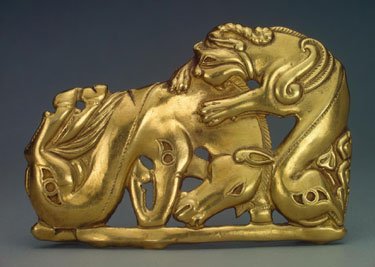
Period: Early Iron Age
Date: Sakae Culture (Scythian). 5th – 4th century BC
Archaeological site: Siberia
Material: gold
State Hermitage Museum, St. Petersburg
Hat tip to Ratak Monodosico.
09 Apr 2015

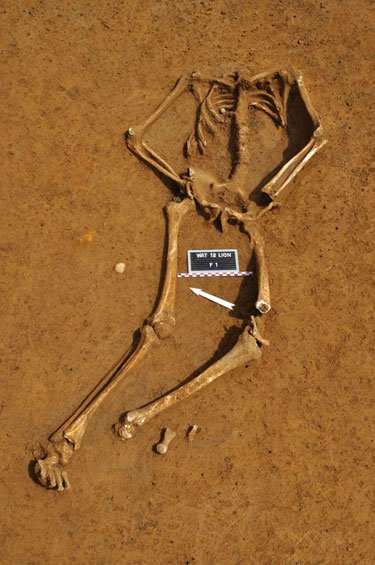
Archaeology tells us that more recently the Waterloo skeleton has been identified as a member of the King’s German Legion
[
A]rchaeologist Dominique Bosquet of the Université libre de Bruxelles… found the soldier while excavating before construction near the battle monument known as the Lion’s Mound. … “I think this is a unique case,†he says. “We excavated 120 trenches in this area, covering more than half an acre, and found almost nothing and no other remains.  Although the soldier’s head and one of his knees were destroyed by a bulldozer, and some of the bones of his hands and feet were damaged either by a plow—the area has long been a wheat field—or perhaps by a battlefield explosion that tore them away, the skeleton is remarkably intact. Bosquet is able to say that he was between 20 and 29 years old, about five feet three inches tall, with a slender frame.
But, in some ways, the artifacts the archaeologist has recovered are able to tell even more of the soldier’s story than his remains can. At his hip, where his pocket would have been, Bosquet uncovered a spoon, a belt buckle, and 22 coins, as well as small pieces of fabric that probably belonged to the soldier’s uniform. Hoping it would have a mark that would enable him to identify the soldier’s regiment, Bosquet took X-rays of the spoon but, disappointingly, no such marks were visible. Bosquet holds out hope that the buckle, which is currently being conserved, may have some identifying marks. It was found near the soldier’s right leg and Bosquet suggests it could be from a belt used as a tourniquet to stop the bleeding from a battlefield wound, possibly the one that damaged his feet and hands. And among the coins, most of which are still awaiting cleaning and identification, there is a French half franc dating to 1811. “Perhaps in Belgium, English soldiers paid in French money in cabarets,†says Bosquet. “Or he may have stolen it from a dead French soldier’s pocket.
The archaeologist was able to identify the soldier as British not only by his position behind the British lines—in the chaos of the battlefield soldiers could easily find themselves on the wrong side—but by the musket ball still lodged in his rib cage. “According to its weight and diameter, the bullet is definitely French,†says Bosquet. Two flints the soldier carried in his pocket also mark him as a member of Wellington’s forces, as they are dark gray and of dimensions corresponding to the Brown Bess musket, the typical weapon of British troops. By contrast, the flints used to fire the French muskets were light yellow.
Sometimes a soldier’s story ends with his death on the battlefield. But for Bosquet, there are still parts of this narrative that he hopes to finish. First and foremost he would like to know the soldier’s name.
Next to the body the archaeologist found a piece of wood with the initials “C.B.†It is possible that the wood was part of the soldier’s gun, but Bosquet isn’t certain, and admits the initials could be those of another man to whom the object originally belonged. With the regimental insignia that Bosquet hoped to get from the spoon, or that may still come from the buckle, it may be possible to search for a “C.B.†among the British rolls. Without these pieces of evidence, giving the soldier a name is unlikely. But the absence of a name doesn’t make the story any less affecting. “After we uncovered him, I could almost see the guy dying before my eyes,†says Bosquet. “It was very touching and evocative of the cruelty of battle. For me, this was very hard.†Bosquet plans to contact the British embassy and army to ask whether they wish to give the remains a proper burial at Waterloo or have them returned to Britain for interment there. The archaeologist also wants to include the discovery in a new memorial at the site, ensuring that the soldier’s story, once told, will never be forgotten.
18 Mar 2015

Guardian:
Archaeologists and anthropologists say they have positively identified fragments from the body of literary giant who died in 1616 in Madrid.
The remains of literary giant Miguel de Cervantes have been found nearly four centuries after his death, a team of Spanish researchers has said.
“He’s there,†historian Fernando de Prado told the Guardian on Tuesday, referencing fragmented bones found in the floor of the crypt. “We know that some of these bones belong to Cervantes.â€
The high-profile search for the remains of one of western literature’s most famous figures began last April, with a team of nearly 30 people peering under the soil of Madrid’s Convento de las Monjas Trinitarias Descalzas with infrared cameras, 3D scanners and ground-penetrating radar.
Born near Madrid in 1547, Cervantes had requested to be buried in the modest redbrick convent after the religious order helped secure his release from pirates. When he died in 1616 – just a year after publishing the second part of Don Quixote: The Ingenious Gentleman of La Mancha – records show his wish was granted. But the exact location of his burial place was lost after the convent was rebuilt in the late 17th century.
During their search, researchers identified 33 alcoves where the bones could have been stored. Their quest began to look less quixotic earlier this year when part of a casket bearing the author’s initials was found in the convent’s crypt.
Read the whole thing.
10 Mar 2015

“The biggest find at the site was a huge wine cauldron. Standing on the handles of the cauldron, is the Greek god Acheloos. The river deity is shown with horns, a beard, the ears of a bull and a triple mustache.”
Daily Mail:
The tomb of an Iron Age Celtic prince has been unearthed in a small French town.
The ‘exceptional’ grave, crammed with Greek and possibly Etruscan artefacts, was discovered in a business zone on the outskirts of Lavau in France’s Champagne region.
The prince is buried with his chariot at the centre of a huge mound, 130 feet (40 metres) across, which has been dated to the 5th Century BC.
A team from the National Archaeological Research Institute, Inrap has been excavating the site since October last year. …
Its discovery could shed light on Iron Age European trade, researchers say.
Read the whole thing.
03 Mar 2015

The gorget found February 13, 2015, in Newtown, Ohio is engraved with an image that appears to be half bird and half cat.
WVXU reports the recent discovery of a rare Native American pendant dating to the 5th Century A.D. in Ohio. Only 8 examples of the same style and period have ever been found.
Contractors digging a trench for a fiber optic box north of Newtown’s administrative hall earlier this month found human remains. They called police who quickly realized it was a burial site and not a crime scene. They, in turn, called the Cincinnati Museum Center. …
“When the police department actually called us, when I talked to them, he said they found some human remains and he said there was a plate with it. And I kind of knew exactly what he meant because we had found these other two back in 1981,†says Rieveschl Curator for Archeology Bob Genheimer.
Genheimer says the plate is actually a gorget, a decorative seashell, with the image of an animal carved on it.
“A gorget is an ornamental item. These gorgets have three holes in them. They have two at the top for suspension and there’s one in the middle where they possibly could have been attached to clothing or something else,†he says. “And on the inside, they are engraved.â€
Two other gorgets found in Newtown had images of an opossum and a panther carved on them. This one had a hybrid: part bird, part cat.
“Anywhere else in the world, you would refer to this as a griffin. But that’s not something that’s very viable in the Americas.
“We believe that the bird may be a Carolina Parakeet. Which, as many people know, is now an extinct bird, but used to be prevalent in the southern United States and as far north as here,†Genheimer says.
23 Jan 2015

Nebra sky disc
The National Post describes, with grossly naive exaggeration and the worst kind of statist prejudice, an interesting, rather pretty Bronze Age artifact with an outrageously offensive history.
The Nebra disc was found in 1999 along with two bronze swords, two hatchets, a chisel, and fragments of spiral bracelets, by Henry Westphal and Mario Renner using a metal detector.
The government of the German state of Saxony-Anhalt claims to own everything in the ground and, as knowledge of the find gradually became known to the public, confiscated all the artifacts found and charged the discoverers with “looting.” Westphal and Renner were convicted and sentenced to prison, as a reward for their discovery, for four months and ten months in 2003. When they appealed, the appeal court raised their sentences to six and twelve months.
Thus, as the National Post reports, the precious artifacts were “saved from the black market” and transferred to the custody of bureaucratic officialdom and the all-knowing administrative state.
The disc has been dated on the basis of the style of the bronze swords buried with it to the mid 2nd millennium BC. Radiocarbon dating of a bit of birchbark found on one of the swords was dated to between 1600 and 1560 BC confirming the former estimate.
The author of the article was scarcely able to breathe while describing the totally astonishing alleged scientific significance of the disc. Why, the Nebra disc represents the earliest human depiction of the cosmos!
Saxony-Anhalt’s house prehistorian & archaeologist Harald Meller (who personally confiscated the horde on behalf of the Leviathan state) has interpreted the disc as a tool used for determining when a thirteenth month – the so-called intercalary month – should be added to a lunar year to keep the lunar calendar in sync with the seasons. When certain prominent constellations, particularly the Pleiades, lined up with the sun and moon as displayed on the disc, every 2-3 years, it would be time to add an extra month in order to bring the lunar and solar calendars into agreement.
Or maybe it was simply made as a piece of decorative art, depicting the most prominent constellations in the night sky.
There is, of course, no real reason, beyond arrogance and brute force, why any state should be entitled to lay claim to ownership of all undiscovered archaeological finds, and there is also no particular reason to believe that immediate state ownership is essential to their preservation. Art objects have been collected and preserved historically most commonly privately since Antiquity. In the modern world, art objects privately owned have a strong tendency to make their way via philanthropy into institutional collections.
These days, we read frequently of absolutely fascinating finds made by hobbyist metal collectors in Britain. In Saxony-Anhalt, I expect we will be reading about fewer of those, since the reward for discovery there is imprisonment for looting.
Wikipedia article
Meller’s theory explained
21 Jan 2015

The only library surviving from Classical Antiquity is that found in the Villa of the Papyri in Herculaneum, thought to have belonged to Julius Caesar’s father-in-law, Lucius Calpurnius Piso Caesoninus.
1,785 papyrus scrolls were found, packed carefully in cases and ready to be moved to safety, which were nonetheless overtaken by a 1,000 °C (1,830 °F) cloud of hot gas and rocks emanating from the eruption of Mount Vesuvius in 79 A.D. The scrolls were charred black, but preserved under 20-25 meters (22-27 yards) of hardened volcanic ash.
New techniques apparently are beginning to permit scholars to read the scrolls.
io9 quotes a recently published paper in Nature Communications:
In recent years, new imaging techniques have been developed to read the texts without unwrapping the rolls. Until now, specialists have been unable to view the carbon-based ink of these papyri, even when they could penetrate the different layers of their spiral structure. Here for the first time, we show that X-ray phase-contrast tomography can reveal various letters hidden inside the precious papyri without unrolling them. This attempt opens up new opportunities to read many Herculaneum papyri, which are still rolled up, thus enhancing our knowledge of ancient Greek literature and philosophy.
Smithsonian reports what has been discovered so far, no lost plays of Sophocles or Aeschylus, no poems of Sappho, no treatises of Plato or Dialogues of Aristotles, instead they’ve found lots of Philodemus.
Most of the scrolls that have been unwrapped so far are Epicurean philosophical texts written by Philodemus—prose and poetry that had been lost to modern scholars until the library was found. Epicurus was a Greek philosopher who developed a school of thought in the third century B.C. that promoted pleasure as the main goal of life, but in the form of living modestly, foregoing fear of the afterlife and learning about the natural world. Born in the first century B.C. in what is now Jordan, Philodemus studied at the Epicurean school in Athens and became a prominent teacher and interpreter of the philosopher’s ideas.
Modern scholars debate whether the scrolls were part of Philodemus’ personal collection dating to his time period, or whether they were mostly copies made in the first century A.D. Figuring out their exact origins will be no small feat—in addition to the volcano, mechanical or chemical techniques for opening the scrolls did their share of damage, sometimes breaking the delicate objects into fragments or destroying them outright.
08 Jan 2015

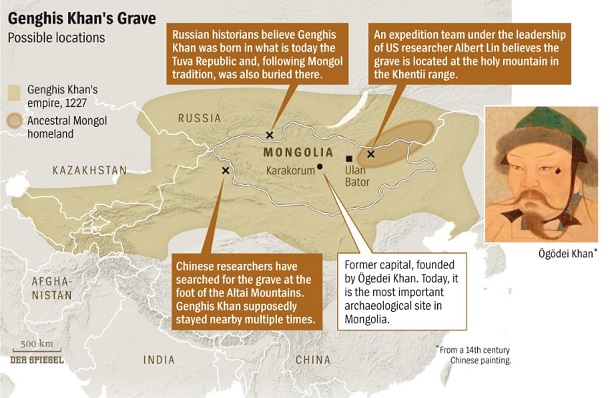
Unfortunately not everyone agrees on the probable location of the great khan’s tomb. (click on picture for larger image)
Motherboard has one of those stories that fires the imagination. We just have to hope they’re working on the right location.
Genghis Khan really, really didn’t want anyone to know where he was buried. The soldiers escorting his body to its final resting place killed everyone they passed, killed the people who built the tomb, and then were killed themselves. Some say Mongol troops grazed herds of horses over the site or even diverted a river over it to keep it hidden. The area where many suspect Genghis Khan is buried is one of Mongolia’s most sacred heritage sites—it’s name, Ikh Khorig, actually translates to “The Great Taboo.†For 800 years—until 1989—archeologists weren’t allowed in, and even then the first expedition was met with public protest.
“Mongolians detest any attempt to touch graves, or even wander around graveyards,†Mongolia Today explains. “According to ancient tradition, burial spots are forbidden areas in which no one is allowed.â€
Still, and perhaps for that very reason, this region is really interesting for archeologists. That first three-year expedition identified 1,380 underground cavities that could be the graveyards or tombs of Mongolian nobles, potentially even predating Genghis Khan.
Albert Yu-Min Lin, from the Center for Interdisciplinary Science in Art, Architecture, and Archaeology at the University of California, San Diego, devised a way to hunt for Genghis Khan’s tomb without touching or toppling anything: Have anyone who’s interested in doing so tag potential sites of investigation from the comfort of their own homes, on images taken from the respectful distance of satellite orbit.
“Explorers†were welcome to map rivers and roads, and flag modern structures, as well as potentially ancient structures on thousands of ultra-high resolution satellite images of the region. There was a lot of ground to cover—6,000 square kilometers, but there were also a lot of volunteers. The system was launched in June 2010, and in just its first 90 days, 5,838 people had contributed more than 1.2 million tags. By the end of the year, over 10,000 participants had generated 2.3 million tags—contributing a total of 30,000 hours of human visual analytics to the images, according to the study’s initial results, just published in the journal PLOS One.
The results have given future explorers plenty to chew on, too. “Of the top 100 accessible locations identified by the crowd,†the study states, “55 potential archaeological anomalies were verified by the field team, ranging from bronze age to Mongol period in origin.â€
Read the whole thing.
03 Jan 2015
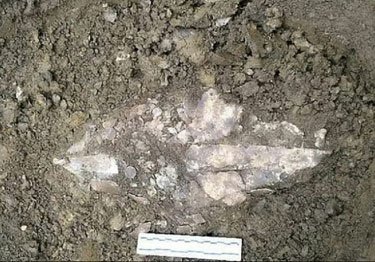
As metal detectors become widely owned and hobbyists take up treasure hunting, inevitably more and more major finds keep coming to light.
Daily Mail:
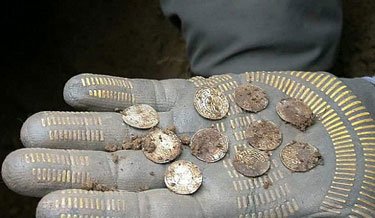
An amateur treasure hunter who uncovered one of the largest hoards of Anglo Saxon coins ever found in Britain – worth £1million – almost missed the dig because he couldn’t afford the petrol.
Paul Coleman, 59, persuaded his son and a friend to join him on the excavation on farmland in Lenborough, Buckinghamshire just before Christmas so he could split the £45 cost for the journey.
But the unemployed father-of-two hit the jackpot when he dug up the pristine collection of more than 5,000 silver coins made in the reigns of Ethelred the Unready (978-1016) and Cnut (1016-1035).
It is thought that the find could be connected to a mint established by Ethelred at nearby Buckingham and which remained active during the time of Cnut.
The 5,251 – and a half – coins were in a lead-lined container buried two feet under ground. Only some have been properly cleaned but all have proved to be in excellent condition.
The expedition – in Lenborough, Buckinghamshire – was an annual end-of-year Christmas rally for members of the Weekend Wanderers Detecting Club. …
[T]he find, which has been sent to experts at the British Museum for analysis, could be worth around £1million.
Simon Keynes, professor of Anglo Saxon at Cambridge University, said the collection ‘straddled an extraordinary period of history’ during which the Vikings took control of England.
He added: ‘The question is, how do we account for the composition of this hoard? Is it a hoard of a Viking – his accumulated wealth – or is it something else? Only half of the coins have been cleaned so far – the eventual date range could prove to be much more expansive.
‘Until then, the hoard could be difficult to explain, but it is certainly an extraordinary find.’
Read the whole thing.
29 Dec 2014

115 English colonists established a new colony on Roanoke Island, North Carolina on July 22, 1587. The first English child born in North America, Virginia Dare, was born on August 18th. Her grandfather, the colony’s governor, John White, left for England, later that year in search of aid and reinforcements for the new colony.
The arrival of the Spanish Armada and the consequent war with Spain delayed assistance and White’s return. He finally arrived back at Roanoke on August 18, 1590, his grand daughter’s third birthday. White found the colony deserted and the homes and fortifications dismantled. The only clue to the fate of the English colonists was the word “Croatoan” found carved in a tree.
World News Daily reports that recent archaeological investigations appear to have solved the mystery of what happened to the Lost Colony.
Archaeologists excavating an early 17th century Native American village near the Enoree River in Laurens County, North Carolina, have discovered seven contemporary Christian sepultures holding the skeletons of six males and one female of European origins. The bones have been proven through comparative DNA testing, to have belonged to members of the lost colony of Roanoke, established in 1585 on Roanoke Island, which disappeared mysteriously. …
The female skeleton has been identified thanks to DNA testing, as Virginia Dare, the first English child born in the Americas. The DNA of the skeleton which was found in October, was compared to that of modern day descendants of Governor John White, her grandfather. The test confirmed that the bones were indeed with more than 99.8% certainty, those of Ms. Dare. Four of the others corpses have also been identified through the same process by the scientists, including that of the girl’s father Ananias Dare, a tiler and bricklayer from London. The other identified skeletons are those of Arnold Archard and his son Thomas, as well as the young John Sampson. …
It is still unclear if the colonists were taken as prisoners or if they sought shelter with the Eno people, but Professor Monroe and his team believe that the colonists were most likely sold into slavery at some point in time and held captive by differing bands of the Eno tribe, who were known slave traders. They survived with the natives for many years, as Virginia Dare who was born in August 1587, was estimated to have been around twenty years old at the time of her death.
This astounding discovery seems to confirm the 17 th Century writings of William Strachey, a secretary of the Jamestown Colony. He wrote in his The historie of travaile into Virginia Britannia in 1612, that four English men, two boys and one girl had been sighted at the Eno settlement of Ritanoc, under the protection of a chief called Eyanoco. This mysterious settlement had however evaded discovery until now, as its location was not clearly mentioned by the author and no other mention of it or its chief have ever been recorded.
Strachey had reported that the captives were forced to beat copper for the natives. He explains that they had escaped an attack that had allegedly killed most of the other colonists. They would have fled up the Chaonoke river (the present-day Chowan River in Bertie County, North Carolina) only to be captured by Eno warriors.
Read the whole thing.
———————————————–
CORRECTION AND RETRACTION, later on 12/29:
This is only the second time in many years I fell for a fake story. (The first time was when I first came across Duffleblog and failed to recognize that the story was appearing on a satire site.
This Roanoke story looked good and had a very plausible ring to it. There was no obvious giveaway.
But, one commenter, Gray, called the story out, and he is perfectly correct. There is no Professor William J. Monroe at Johns Hopkins or anywhere else. This story is otherwise completely unreported. There is no Laurens County in North Carolina. And “World News Daily” is just a totally irresponsible Israeli tabloid that evidently thinks making up stories like this is fun.
Apologies to Free Republic and American Digest. I’m off to eat a large plate of crow.
05 Dec 2014
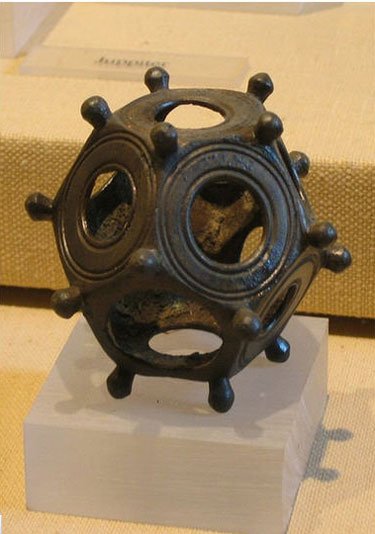
Since 1739, roughly a hundred of these Roman dodecahedra have been found in sites ranging from Wales to Hungary, but mostly in Germany & France. Some are bronze, and some are made of stone.
Wikipedia:
No mention of them has been found in contemporary accounts or pictures of the time. Speculated uses include candlestick holders (wax was found inside one example); dice; survey instruments; devices for determining the optimal sowing date for winter grain; gauges to calibrate water pipes or army standard bases. Use as a measuring instrument of any kind seems to be prohibited by the fact that the dodacahedrons were not standardised and come in many sizes and arrangements of their openings. It has also been suggested that they may have been religious artifacts of some kind. This latter speculation is based on the fact that most of the examples have been found in Gallo-Roman sites. Several dodecahedrons were found in coin hoards, providing evidence that their owners considered them valuable objects.
Hat tip to Karen L. Myers.
25 Nov 2014

The Rudham Dirk was found bent.
EDP24 has a great story.
The 3,500-year-old Rudham Dirk, a ceremonial Middle Bronze Age dagger, was first ploughed up near East Rudham more than a decade ago. But the landowner didn’t realise what it was and was using it to prop open his office door.
And the bronze treasure even came close to being thrown in a skip, but luckily archaeologists identified it in time.
Now the dirk has been bought for Norfolk for close to £41,000 and is now on display in Norwich Castle Museum.
Dr John Davies, Chief Curator of Norfolk Museums Service, said: “This is one of the real landmark discoveries.â€
The dirk – a kind of dagger – was never meant to be used as a weapon and was deliberately bent when it was made as an offering to the gods.
Only five others like it have ever been found in Europe – including one at Oxborough in 1988, which is now in the British Museum. But thanks to a £38,970 grant from the National Heritage Memorial Fund, following a £2,000 donation from the Norfolk and Norwich Archaeological Society, the Bronze Age treasure will now stay in the county.
Read the whole thing.
———————————-
The British Museum’s account of its discovery differs:
Stumbling upon antiquity
A man walking in woods near Oxborough literally stumbled across this dirk in 1988. It had been thrust vertically into soft peaty ground nearly 3,500 years ago, but erosion had exposed the hilt-plate, which caught his toe.
The ‘weapon’ respects the basic style of early Middle Bronze Age dirks, but it is ridiculously large and unwieldy, 70.9 cm long and 2.37 kg in weight. The edges of the blade are very neatly fashioned, but deliberately blunt and no rivet holes were ever provided at the butt for attaching a handle in the customary manner. The dirk was evidently never intended to be functional in any practical way. Instead, it was probably designed for ceremonial use, or as a means of storing wealth.
Although of an extremely rare type, and indeed the first example from Britain, there are four excellent parallels from continental Europe – two each from the Netherlands and France. Two of these earlier finds give the type the name Plougrescant-Ommerschans type. The five weapons are so similar, in style and execution, that it is possible that they were all made in the same workshop. However, on present evidence we cannot be sure whether this was in Britain, or the neighbouring parts of continental Europe.
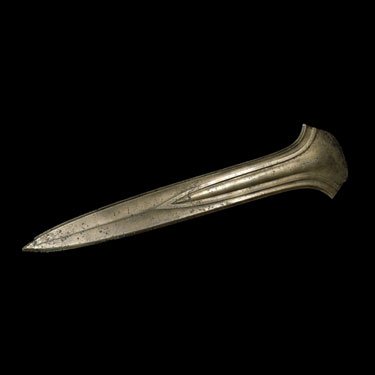
Ceremonial bronze dirk
Bronze Age, 1450-1300 BC
From Oxborough, Norfolk, England
Hat tip to Ratak Monodosico.
Your are browsing
the Archives of Never Yet Melted in the 'Archaeology' Category.
/div>

Feeds
|