Category Archive 'Books'
11 Nov 2014


In 1953, the Daughters of the American Revolution erected a plaque commemorating the discovery of America by Prince Madoc on the shores of Mobile Bay, Alabama. The plaque was removed by the Alabama Parks Service in 2008 and put in storage.
Roads and Kingdoms notes the rediscovery of the pre-Lewis-and-Clark Western journey of discovery by John Evans in search Welsh-speaking Indians via Evans’s descendant Gruff Rhys’s book, album, film and “investigative concert tour.â€
In 1792 John Evans, a 22-year-old farmhand and weaver from the village of Waunfawr in the mountains of Snowdonia, Wales, responded to a plea from the great Welsh cultural mischief-maker Iolo Morganwg to settle, for once and for all time, the quandary of whether there was indeed a tribe of Welsh-speaking Native Americans still walking the Great Plains, descendants of Prince Madog, who was widely believed (especially by Welsh historical revisionists) to have discovered America in 1170. With the aid of a loan from a gullible friend, Evans set sail to Baltimore to begin the greatest of adventures, whereupon he set off on foot and disappeared into the Allegheny Mountains with one dollar and seventy-five cents to his name, in search of the lost tribe.
Hat tip to Vanderleun.
07 Nov 2014

Nicolás Gómez Dávila (18 May 1913 – 17 May 1994)
Nicolás Gómez Dávila was a Colombian conservative intellectual, who deserves to be much better known in the United States.
Gómez Dávila was an aristocrat of independent means, who contemplated Modernity with distant contempt from the agreeable vantages of the jockey club and his own enormously large library. He declined either to lecture at the university or to express himself at length, preferring merely to express his criticism of contemporary delusions in the form of aphorisms which he called “escolios” (or “glosses”).
Some have described his aphorisms as “one part Nietszche, one part Ambrose Bierce.”
——————–
Some examples:
The reactionary today is merely a traveler who suffers shipwreck with dignity.
The Gospels and the Communist Manifesto are on the wane; the world’s future lies in the power of Coca-Cola and pornography.
Writing is the only way to distance oneself from the century in which it was one’s lot to be born.
It is not just that human trash accumulates in cities—it is that cities turn what accumulates in them into trash.
With the disappearance of the upper class, there is nowhere to take refuge from the smugness of the middle class and the rudeness of the lower class.
——————–
Chris Morgan, at the American Conservative, on “Don Colacho’s Epitaphs.”
Wikipedia article
A collection of his aphorisms in English translation.
05 Sep 2014

It happens. You walk into Griffin & Howe (or the real Abercrombie & Fitch decades ago) without the slightest intention of buying anything, and you wind up leaving with some English shotgun or Payne fly rod you couldn’t possibly afford, but which has suddenly become a cherished and essential component of your personal existence on the planet.
Women’s clothes work on women, we all understand, the same way best grade London shotguns work on men. Mary H. K. Choi, in New York magazine, delivers a quite amusing account of how it happened that an impecunious struggling writer (herself) wandered into a posh designer boutique and wound up buying a $4000 leather coat. (My God! woman, you can get a pretty decent grouse gun for that kind of money.)
I have no idea what possessed me to walk into the Rick Owens store. To call this flagship a store is hysterical. It’s a miniature fortress of solitude constrained by New York proportions that shrewdly offsets the stark, jagged cave-witch clothes inside. To the uninitiated, it’s uninviting and faintly hospital-ish. Entering is akin to arriving at the cafeteria of a new high school, where said high school is populated entirely by clones of Rihanna. It’s terrifying. You worry you might wet yourself a little.
The mystique of the store has mostly to do with the designer. Rick Owens is a tall, sinewy man with a thin nose, Old World teeth, and fantastic hair. He resembles an Egon Schiele subject and lives in a five-story Parisian mansion with his muse and business partner, Michèle Lamy. (Lamy doubles as Owens’s much older, pygmy-size, polyamorous goth wife.) Together they make $800 shirts that look like lice-infested shrouds worn by medieval serfs.
Their coats appear rough-hewn, essentially untreated hides cut into fascinating shapes of seemingly extraterrestrial origin. The moment you throw one on, however, the weight falls into a mysterious, life-affirming silhouette. The black suede, fur-lined Rick Owens motorcycle jacket I selected made me feel thinner, taller, and infinitely more interesting. I looked as if I were in on a secret. The coat was the distillation of everything I’ve ever found seductive about not only living in New York but the prospect of belonging there, too. …
I dared myself to buy that coat and then dared that coat to rebuke me. I wanted to prove that I could visit the apex of cool-rich-people New York (as opposed to the tacky, evil, overwrought rich-people New York), buy a souvenir, and not turn into a hobo. I know native New Yorkers complain all the time about how anesthetized the City is now. Still, I’ve always found living in New York deeply scary. Without a trust fund or famous parent (and even then, sometimes you need both), the odds of success are ludicrous. It’s not just the fact that you don’t have any money. It’s that money no longer makes sense. This is the part that took me forever to figure out.
Read the whole thing, which is apparently an excerpt from the young lady’s “How-I-Came-to-My-Senses-an-Got-the-Hell-Out-of-NYC” memoir (published as a quite inexpensive eBook).
10 Aug 2014
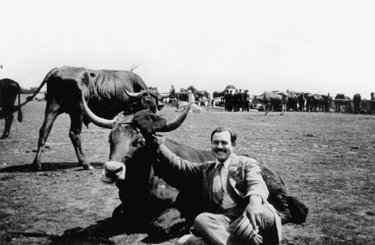
In Pamplona in 1927.
Scribner’s recently released “The Sun Also Rises: The Hemingway Library Edition”, an edition featuring bonus materials: two introductions by Hemingway family members; an essay on bull fighting in the ’20s; samples of early revisions; the discarded first chapters; possible titles considered by the author (such as RIVER TO THE SEA or TWO LIE TOGETHER); and some new photographs, including one of Hemingway’s ticket stub for the bull fights in Pamplona.
Ian Crouch tells us, at the New Yorker:
At the start, it seems, Hemingway was attempting to write a novel very different from what would become “The Sun Also Rises,†which made his name as one of “those ones with their clear restrained writing.†He imagined a book in which the “whole business†of life gets expressed, in all of its messy detours and associations. In the same draft chapter, Hemingway goes on: “Now when my friends read this they will say it is awful. It is not what they had hoped or expected from me. Gertrude Stein once told me that remarks are not literature. All right, let it go at that. Only this time all the remarks are going in and if it is not literature who claimed it was anyway.â€
This minor manifesto, embedded in a draft of his first novel, conceives of a book with greater intellectual and artistic ambitions than Hemingway ever produced—one akin to the more abstract fictions of the modernists. The line that he struck through—“It is not what they had hoped or expected from meâ€â€”becomes a potentially radical departure that Hemingway never realized, and that was nearly lost to history. Yet “The Sun Also Rises†is far from being a lesser thing, for all of its restrained clarity. It is partly a book of “literary signs,†perhaps against Hemingway’s own intentions. But it is also a book—Gertrude Stein be damned—of remarks, both in the elliptical declarations that the characters make to one another, and in the weighted silences that linger between them. “I mistrust all frank and simple people, especially when their stories hold together.†That line, which belongs to the narrator, and to the author, was there from the beginning. It is an echo of Hemingway’s more eager and brash equivocations in the drafts, a claim that there was an unseen depth to his plainspoken prose. It is an author’s note, a statement of purpose—subtly and skillfully absorbed into the art of storytelling.
————————————
Recently at HuffPo: 15 photos of Papa, with quotations. Amusingly, the version first published was loaded with spurious examples and had to be revised. Hemingway is laughing in Hell.
05 Aug 2014

Karen and I have been filling up our eReaders with free classics, forgotten novels, new releases, and classic pulp. After re-reading all of John D. MacDonald’s Travis McGee mysteries, I just started working my way through Ian Fleming’s James Bonds.
You can really feel the passage of time, reading these 60 years on. In Diamonds Are Forever, Bond stays at the Astor Hotel in New York (torn down in 1968). He rejoices that Felix Leiter is taking him to an air-conditioned restaurant: Sardi’s. Back in 1956, not all restaurants were.
Bond’s gracious host Felix proceeds to order Bond a special meal.
“… I’ve taken a chance and ordered you smoked salmon and Brizzola,” said Leiter. “This is one of the best places in town for beef, and Brizzola’s the best cut of that, straight cut across the bone. Roasted and then broiled. Suit you?” …
The smoked salmon was from Nova Scotia, and a poor substitute for the product of Scotland, but the Brizzola was all that Leiter said, so tender that Bond could cut it with a fork.
These days, of course, a fellow can look up Brizzola on the Internet, and not just wonder at Ian Fleming’s savoir faire versus one’s own ignorance.
And one finds that one is not alone in wondering about this mysterious dish.
Peter Morwood writes:
Bond writer Raymond Benson, in The James Bond Bedside Companion describes it as a fictional invention by Fleming. One thing it certainly is not, was the only Italian form of meat with a similar name that I was able to find. Bresaola, though looking and sounding close to Brizzola, is neither roasted nor broiled but air dried and served in thin slices as an antipasto starter or snack.
This could have been on Sardi’s menu along with some other beef main course, and Fleming mixed them up. He did that in several books, with food, wine and even guns (but carried off his mistakes with such verve that these are the Bondian aspects he’s supposed to have been most knowledgeable about!) I suspect we’re back to that fir-cone situation, where Fleming was told something he’d never heard of before, and described it in terms that seemed most familiar to him. …
The Brizzola business of double-cooking made me think of that memorable dinner, not only roasting beef, but broiling it afterwards. One would think that would end up with seriously overcooked meat, but from Bond’s reaction, it clearly did no such thing. More to the point, a consultation of our cookbooks – we have about 400, after the last cull – suggest that “broiling” isn’t just a way to cook food, but also to finish it after another, longer cooking method. You can see the elements falling into place…
Then I encountered an Italian dish called Brasato di Manzo al Barolo, which is beef braised in (very good) red wine, then served in thick slices – tranches, to use the old term. The slices are thick enough to pass under a seriously-hot commercial broiler to produce a burnt, crunchy finish without actually cooking the slice of braised meat any further, and whether this was done to the proper recipe or not, it sounded like a feasible way for a restaurant to put its individual spin on the dish.
Besides describing unfamiliar things in familiar terms, Ian Fleming, bless his little cotton socks, had (according to at least a couple of observers) no head for drink, and as a result his “research meals” for James Bond novels were often something of a mishmash of incorrect or illegible notes. I’ve even seen one source suggesting that Bond’s famous “shaken not stirred” Martini – which apparently contradicts the way in which every martini was made prior to that – was a result of Fleming sampling far too many martinis, getting the method wrong, and then sticking to his guns afterwards. It doesn’t hurt that in his essay How to Write a Thriller he elaborates on how someone going against the grain like that makes for a more interesting character, which works for me. The only place it doesn’t work is that such behaviour makes said character stand out and become memorable – both characteristics that a spy would do well to avoid.
It seemed to me that we’d found at least one likely candidate for “Brizzola.” Diane had other suggestions; that it might originally have been a deliberately-underdone rib roast cut between the ribs into individual portions like really large T-bone steaks, and finished on or under a grill. Alternately, it could have been a London broil sliced and finished in the same way, which is what I did to a fine piece of rump steak the other night, for my birthday dinner.
The meat had been marinating since Monday in olive oil, red wine, red wine vinegar, oregano, cracked pepper and crushed garlic. It was then slow roasted, frequently basted with the marinade, then cut into four thick slices and whizzed under the grill. Luckily our kitchen cooker has a very enthusiastic grill, if it’s allowed to preheat properly, so the end result was delicious.
And yes, you can cut it with a fork…!

13 Jul 2014

Michael Robbins, at Slate, reviews Nick Spencer’s Atheists: The Origin of the Species, which seems to constitute a well-deserved attack on the “New Atheists,” i.e., the smug, self-congratulatory secular materialists of the Richard Dawkins-ilk.
Nietzsche realized that the Enlightenment project to reconstruct morality from rational principles simply retained the character of Christian ethics without providing the foundational authority of the latter. Dispensing with his fantasy of the Ãœbermensch, we are left with his dark diagnosis. To paraphrase the Scottish philosopher Alasdair MacIntyre, our moral vocabulary has lost the contexts from which its significance derived, and no amount of Dawkins-style hand-waving about altruistic genes will make the problem go away. (Indeed, the ridiculous belief that our genes determine everything about human behavior and culture is a symptom of this very problem.)
The point is not that a coherent morality requires theism, but that the moral language taken for granted by liberal modernity is a fragmented ruin: It rejects metaphysics but exists only because of prior metaphysical commitments. A coherent atheism would understand this, because it would be aware of its own history. Instead, trendy atheism of the Dawkins variety has learned as little from its forebears as from Thomas Aquinas, preferring to advance a bland version of secular humanism. Spencer quotes John Gray, a not-New atheist: “Humanism is not an alternative to religious belief, but rather a degenerate and unwitting version of it.†How refreshing would be a popular atheism that did not shy from this insight and its consequences.
It is, I suppose, perversely amusing, and confirming of Chesterton’s prediction that, post Religion, people will not believe in nothing, but will believe in anything, that the typical contemporary enlightened elite position involves both the contemptuous rejection of traditional religion and the uncritical acceptance of an even-more-simplistic catechism composed of sentimental humanitarianism constituting a sort of attenuated Christianity, sexually-emancipated but even more enthusiastic about ressentiment.
06 Jul 2014

Jordan Ellenberg, in the Wall Street Journal, devises a methodology for calculating which of the summer’s best-selling titles will prove the least frequently finished. And the French commie envy-merchant wins.
It’s beach time, and you’ve probably already scanned a hundred lists of summer reads. Sadly overlooked is that other crucial literary category: the summer non-read, the book that you pick up, all full of ambition, at the beginning of June and put away, the bookmark now and forever halfway through chapter 1, on Labor Day. The classic of this genre is Stephen Hawking’s “A Brief History of Time,” widely called “the most unread book of all time.”
How can we find today’s greatest non-reads? Amazon’s “Popular Highlights” feature provides one quick and dirty measure. Every book’s Kindle page lists the five passages most highlighted by readers. If every reader is getting to the end, those highlights could be scattered throughout the length of the book. If nobody has made it past the introduction, the popular highlights will be clustered at the beginning.
Thus, the Hawking Index (HI): Take the page numbers of a book’s five top highlights, average them, and divide by the number of pages in the whole book. The higher the number, the more of the book we’re guessing most people are likely to have read.
02 Jul 2014

Matti Friedman gives a fascinating account of the history, and recent partial theft, of one of the oldest and most valuable books in the world.
The Aleppo Codex, a bound book of approximately 500 parchment pages, was compiled in Tiberias around the year 930 C.E., making it the oldest known copy of the complete Bible. It was moved to Jerusalem, stolen by crusaders in 1099, ransomed by the Jews of Cairo, and studied by the philosopher Maimonides, who declared it the most accurate version of the holy text. It was later taken to Aleppo, Syria, and guarded for six centuries. There it became known as the “Crown of Aleppo.â€
In 1947, in a riot that followed the United Nations vote on the partition of Palestine, the codex disappeared, surfacing 10 years later in mysterious circumstances in the new state of Israel. The codex is currently held in the Israel Museum, in the same building as the Dead Sea Scrolls. It is controlled not by the museum, however, but by a prestigious academic body, the Ben-Zvi Institute, founded by Israel’s second president, Yitzhak Ben-Zvi. Somewhere along the way in the mid-20th century, 200 priceless pages—around 40 percent of the total—went missing. These include the most important pages: the Torah, or Five Books of Moses.
There are two mysteries linked to the codex. The first: How did the book move to Israel from a grotto in Aleppo’s Great Synagogue and effectively become the property of the new state? And the second: How did its missing pages vanish, and where might they be now? …
The official version of the story, propagated by the academics in Israel who control the manuscript, claimed the pages vanished in Aleppo around the time of the 1947 riot. But we know now that the manuscript was seen whole as late as 1952, five years later. The first description of any significant damage to the codex dates, strikingly, only to 1958—after the manuscript reached the Ben-Zvi Institute in Jerusalem.
At around the same time, my investigation found, dozens of valuable books and manuscripts vanished from the library of the same institute. When I approached former officials at the institute with evidence of the other missing books, several went on record saying the man responsible for their disappearance was the institute’s director at the time, Meir Benayahu, a scholar who throughout a long and illustrious career studied, collected, bought, and sold rare Hebrew books. He left his post amid a legal battle over control of the institute in 1970.
Benayahu, who died in 2009, came from a powerful political family with roots in Iraq; he was the son of a Sephardic chief rabbi, Yitzhak Nissim, and brother of a senior Likud cabinet minister, Moshe Nissim. (As was common in those years, Benayahu adopted a more modern and Israeli-sounding last name.) This scandal has long been known in Israel’s small and insular academic world but was never made public. Legal proceedings were avoided at the time thanks to the direct intervention of Israel’s president, Zalman Shazar. Police were never summoned, no charges were filed, and no books were returned. Benayahu’s family denies any wrongdoing and says the accusations against him are a smear campaign aimed at covering up thefts by other people; they have asked, rightly, why no one went to the police at the time. Today Benayahu’s family owns a collection of Hebrew texts that is one of the world’s largest in private hands.
Whatever precisely happened at the Ben-Zvi Institute, the long-buried affair of the institute’s vanished books—whether it is connected or not to the disappearance of the codex pages—is arguably the worst corruption scandal in the history of the Israeli academy.
The Aleppo Codex web-site.
23 Jun 2014
 
Left: Standartenführer Joachim Peiper commanding 1st SS Panzer Regiment during WWII; Right: Peiper, aged 61, shortly before his murder in 1976.
For I am a man under authority, having soldiers under me: and I say to this man, Go, and he goeth; and to another, Come, and he cometh; and to my servant, Do this, and he doeth it.
–Matthew 8:9.
Reid Mitchell is a resident of New Orleans and author of a book on the history of Mardi Gras. He is best known as a Civil War historian. Mitchell taught American Studies at the University of Hong Kong as a Visiting Fulbright Professor during the 2005 academic year.
His only novel, A Man Under Authority, now out-of-print, was published in paperback by a small press publisher in 1997.
The man under authority is an aged, never specifically identified by name or nationality, Colonel (clearly directly modeled on Joachim Peiper), living in poverty in retirement in a former enemy country, eking out a modest living with translations.
The Colonel receives a letter (written, with characteristic American arrogance or linguistic ineptitude, in English) offering him a highly remunerative job as technical advisor to a film crew making a movie about his most famous battle, a battle in which he unsuccessfully led an armored assault force attempting to make a strategic breakthrough behind enemy lines.
Not unappreciative of the irony and implicit humiliation of his position, the elderly Colonel accepts the assignment, hoping to use the money to give a little pleasure to his wife.
Mitchell’s novel depicts the Colonel’s last campaign as another final desperate attempt, this time with self-awareness and the maintenance of personal dignity, rather than the Meuse River and the Allied fuel reserves, as his unreachable goal, with the infirmities of age, modern Philistinism, and his own historical status as the defeated as his adversaries.
Arriving at the production site, the Colonel finds that the film crew are using the same chateau, now a hotel, which had been his own headquarters during the famous operation. But the choice highest tower room in the oldest part of the castle this time belongs to the female director, not to him. His role, this time, will not be that of commander, but that of curiosity, ornamental credential, and bemused spectator. Nonetheless, the Colonel finds himself able to maintain his Stoicism and even, on occasion, to employ his long-disused habit of command.
/div>

Feeds
|





