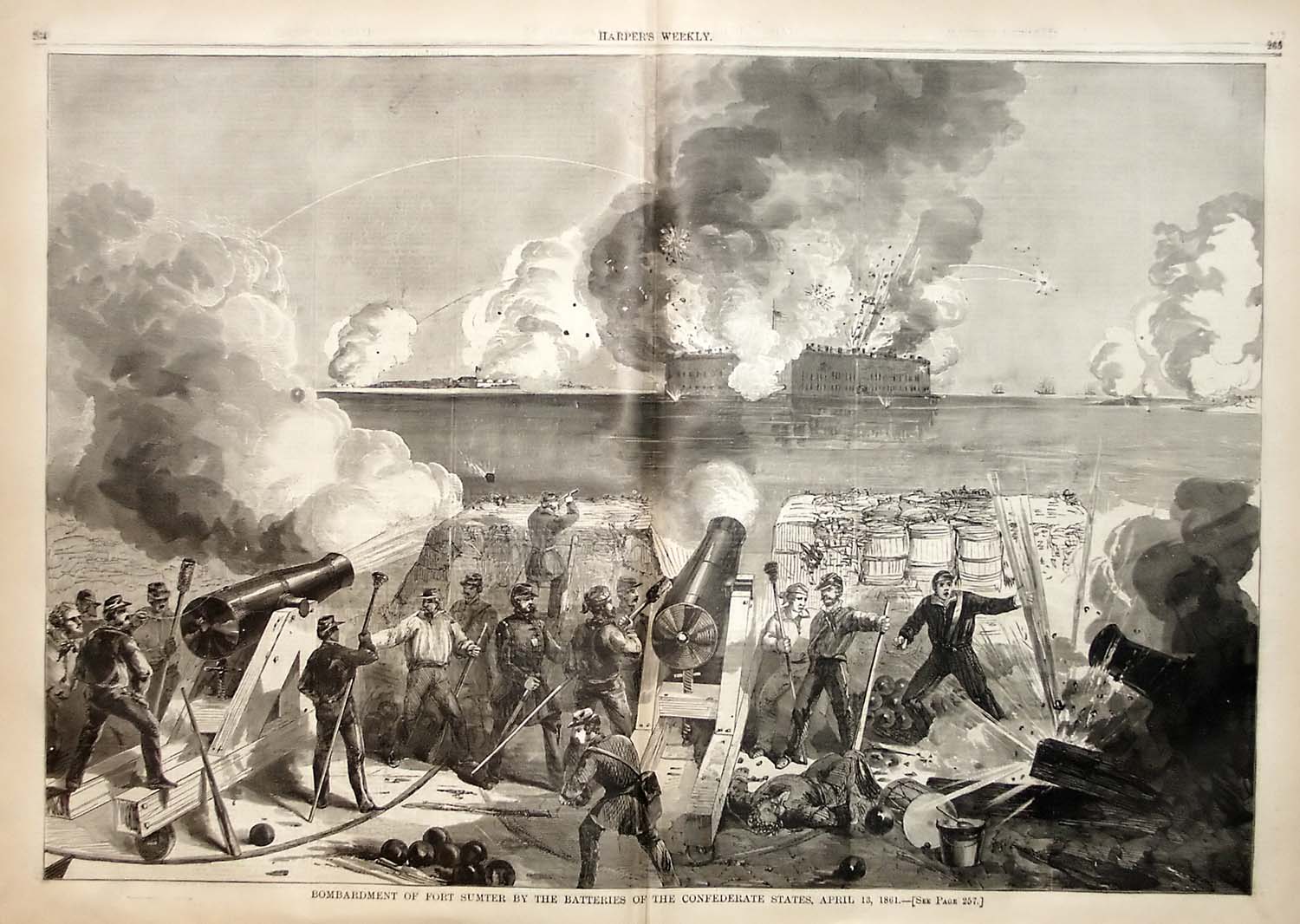
This morning at 6:45 AM (2 hours and 45 minutes late), a single mortar round was fired (from Fort Moultrie) marking the 150th Anniversary of the commencement of the bombardment of Fort Sumter in Charleston Harbor by Confederate forces under the command of General Pierre Gustave Toussaint Beauregard, the military action which both initiated the American Civil War and made practically possible the Confederate states’ conquest and defeat.
Decades of sectional rivalry, animosity, and ever-increasing friction provoked by Northern hostility toward, and demonization of, the Southern institution of Slavery were followed rapidly by, first, a terrorist attack on the civilian population of Virginia and the arsenal at Harper’s Ferry by a murderous fanatic armed and funded by some of the wealthiest and best-educated citizens of the Northern states, then by the minority election of a prominent Northern radical to the presidency.
Firebrand South Carolina responded with secession on December 20th, followed by Mississippi, Florida, Alabama, Georgia, and Louisiana in January, and Texas on February 1th. On the 8th and 9th of the same month, an Alabama convention of the seceded states adopted a Constitution forming a new Confederacy, and elected former Secretary of War and hero of the Mexican War, Jefferson Davis of Mississippi, as its president.
General Winfield Scott (who had had trouble with Davis over his expenses) remarked: “I am amazed that any man of judgment could hope for the success of any cause in which Jefferson Davis is a leader. There is contamination in his touch.”
Davis was an able man, intellectually gifted, honorable, and dignified, but prone to self-righteousness. He was, in almost every respect, his adversary Lincoln’s polar opposite. Abraham Lincoln was a cunning and flexible Machiavel, who skillfully concealed a razor-sharp, minutely calculating and selfish intelligence behind a populist masque of warmth and folksy humor. Davis was aristocratic, formal and austere. Sam Houston thought him “cold as a lizard.”
Seven states had left the union and formed a new government before Abraham Lincoln was even inaugurated.
As secession fever raged, back in December, William Tecumseh Sherman, A West Point graduate and Ohioan serving as superintendent of the Louisiana State Military Academy, exploded to a Southern guest at hearing of South Carolina’s secession:
You people of the South don’t know what you are doing. This country will be drenched in blood, and God only knows how it will end. It is all folly, madness, a crime against civilization! You people speak so lightly of war; you don’t know what you are talking about. War is a terrible thing!
You mistake, too, the people of the North. They are a peaceable people but an earnest people, and they will fight, too. They are not going to let this country be destroyed without a mighty effort to save it… Besides where are your men and appliance of war to contend with them? The North can make a steam engine, locomotive, or railway car; hardly a yard of cloth or a pair of shoes can you make. You are rushing into war with on of the most powerful, ingeniously mechanical and determined people on earth — right at your doors.
You are bound to fail. Only in your spirit and determination are you prepared for war. In all else you are totally unprepared, with a bad cause to start with. At first you will make headway, but as your limited resources begin to fail, shut out from the markets of Europe as you will be, your cause will begin to wane. If your people would stop and think, they must see that in the end you will surely fail.
Sherman resigned his post in February, came North, and was introduced to Lincoln in late March.
“How are they getting along down there?” inquired the recently inaugurated president.
“They think they are getting along swimmingly,” Sherman replied. “They are preparing for war.”
Lincoln’s expressed confidence was, however, at odds with his dilemma. If Lincoln moved to assert federal authority over the seceded states, he would test the limits of both his constitutional authority and of his political support. Moreover, any attempt to initiate force, to make war on the seven seceded states, would very probably precipitate the secession from the Union and addition to their numbers of Virgina and other slave-owning states outside the Deep South.
The only immediate, natural conflict between the new Confederacy and the government of the United States lay in the basically trivial territorial issue of sovereignty over four Federal forts located within Confederate territory: Fort Sumter in Charleston Harbor, Pickens off Pensacola Bay, Taylor at Key West, and Jefferson in the Dry Tortugas.
Possession of none of these was of vital necessity to anyone.
During mid-March, President Lincoln’s cabinet voted 5 to 2 to abandon Fort Sumter. Secretary of State Seward felt strongly that civil war might yet be averted, as long as a confrontation was avoided and passions allowed to cool. But second cabinet vote at the end of March tied 3-3, and Lincoln decided to employ the fort in Charleston Harbor as bait.
On April 8th, South Carolina’s governor was notified that the federal government would attempt to resupply Fort Sumter with provisions only.
When the Confederate cabinet in Montgomery debated, Robert Toombs of Georgia warned President Davis:
The firing on that fort will inaugurate a civil war greater than any the world has yet seen… Mr. President, at this time it is suicide, murder, and you will lose us every friend at the North. You will wantonly strike a hornets’ nest which extends from mountains to ocean. Legions now quiet will swarm out and sting us to death. It is unnecessary. It puts us in the wrong. It is fatal.
But President Davis ignored this counsel, trusting that the world would realize that President Lincoln was the real aggressor. Davis, of course, could hardly be more wrong.
Fort Sumter was reduced to defenselessness, its guns silenced, by the fire of more than 4000 rounds from 47 howitzers and mortar over a day and half. The only casualty occurred during the fort’s honorable capitulation, when a spark from the fifty gun salute to the descending US colors fell into a barrel of gunpowder producing an explosion which took the life of Private Daniel Hough, the first of more than 600,000 Americans to be killed in the Civil War.
Abraham Lincoln had his causus belli. He could call for 75,000 men to serve for 90 days against “combinations too powerful to be suppressed by the ordinary course of judicial proceedings.”
Virginia, Tennessee, Arkansas, and North Carolina seceded and joined in the defense of the Confederacy rather than participate in the conquest and subjugation of sister states. Kentucky and Missouri and Maryland were kept in the union by force.
Robert Toombs was perfectly correct. The decision of Jefferson Davis to assert Confederate authority by force made the Confederacy into the aggressor, infuriated the North, and freed Lincoln to act. In essence, Jefferson Davis’s unwise decision broke open a stalemated situation in which delay operated entirely in favor of the newly-formed Confederacy, providing it with a longer period to ready itself with supplies, training, and defensive preparations and making the new republic into ever more of a fait accompli, accepted by both foreign and domestic opinion.
Firing on Fort Sumter assured a Northern military response against an attack on US soldiers and the US flag, and transformed the role of its great adversary, Abraham Lincoln, from that of aggressor to defender.
This single bad decision represents a perfect metonymy for the differences in judgment and temperament between Davis and Lincoln explaining precisely why the latter was ultimately successful in overcoming enormous difficulties as a war leader, while the former led his cause to ruin.
Civilian spectators watched the bombardment from the Battery. (click on image to see larger version)
This week, on Tuesday, we will reach the 150th anniversary of the opening shots of the American Civil War. The left these days is continuing to fight that war at every opportunity. On the editorial page of yesterday’s Wall Street Journal, Fergus W. Bordewich offered a rather partisan interpretation of history.
Bordewich complains that Southern states “routinely denied freedom of speech, press and assembly” to abolitionists, but neglects to mention Abraham Lincoln’s forcible closure of dozens of newspapers, his illegal imprisonment (without warrant or trial) of thousands of Americans including elected officials, his unconstitutional suspension of habeus corpus and so on.
Bordewich goes on to extol the ultimate Northern victory, theorizing in the kind of leap that takes far too much for granted, that without the conquest and forcible reincorporation of the seceded states, the United States might not have intervened in WWI and WWII or won the Cold War.
Perhaps, on the other hand, one could equally easily argue, if the South had won and established the example of a successful aristocratic and conservative republic, European culture would have been moved in a better direction. There might have been no rise to power of the popular ideologies of Nationalism and Socialism and no Fascism or Communism at all. No rule by pseudo-intellectuals turning the 20th century into an abattoir. It is easy to spin that kind of theorizing in any direction you prefer.
The video below, featuring footage from 1913 to 1938 when veterans of the great conflict were still alive, represents the very different, once traditional, approach to the memory of the war, which emphasized recognition of the heroism and good faith of the men who fought on both sides of a war which only one side could win.
In the aftermath of Appomatox, the process of reunifying the country naturally came to include a chivalrous recognition by victorious Northerners that their Southern adversaries had fought bravely and honorably on behalf of a sectional political perspective which, though defeated in a decisive contest of strength, had been legitimately defended.
The academic left today, of which Christopher Clausen, writing in Wilson Quarterly, is a typical example, is determined to rewrite history and delegitimize the War for Southern Independence by insisting on reducing the Southern cause to a failed battle to preserve Slavery. Any sympathetic view of Southern motivations is dismissed as “Lost Cause-ism,” the Lost Cause being defined as a false post-War romantic narrative constructed to obfuscate Southern guilt for treason and unjustified revolution on behalf of the indefensible crime of slavery.
All this is arrant nonsense and radical agitprop, not history.
Slavery was certainly a cause for secession and the Civil War, but it was what Aristotle would have referred to as the material cause. The efficient cause of secession was States’ Rights and the cause for which most Southerners fought was merely defense of family, home, and fire-side against armed invasion.
Lincoln promised in his First Inaugural Address that he had “no purpose, directly or indirectly, to interfere with the institution of slavery in the States where it exists.” He assured Americans that he had “no lawful right to do so” as well as no inclination.
It is important to remember that, at that point, only seven states had seceded. It might be argued that the seven Deep South cotton states seceded on the basis of a determination to preserve a social and economic system including slavery, but Virginia, North Carolina, Tennessee, and Arkansas seceded only after Lincoln’s April 15 call for troops to invade and subjugate the states which had previously voted to leave the Union.
The most important states of the Confederacy in size of population, including Virginia which became the seat of the Confederate capital, did not secede for slavery at all, but to defend the right of self determination of the citizens of individual states against federal power.
—————————————-
The rather Goreyesque Civil War Monument in front of the courthouse in the nearby county where our fox hunt’s kennels is located says on its base:
ERECTED TO THE MEMORY OF THE SONS OF CLARKE WHO GAVE THEIR LIVES IN DEFENSE OF THE RIGHTS OF THE STATES AND OF CONSTITUTIONAL GOVERNMENT
There is no mention of slavery.
—————————————-
So demented with self-righteous infatuation with the politics of race have historians become, that the staggering corruption and misgovernment of the Reconstruction Era, in which suddenly-emancipated illiterate primitives in league with looting outsiders and corrupt locals were given control of the governments of conquered states at the point of the bayonet, has become a Golden Age of racial justice sadly ended by the electoral compromise of 1876.
When I was in school, so many decades ago, we still used to be informed of the staggering debt burdens piled up in a few short years by Reconstruction Era black governments, which kept many Southern states impoverished and unable to fund more than the most rudimentary educational systems right up to the time of WWII.
Today, we are advised by scholars like C. Vann Woodward that “the North had fought the war and imposed Reconstruction for three reasons: to save the Union, to abolish slavery, and, more equivocally, to bring about racial equality. The first two aims were achieved and soon accepted, however grudgingly, by the South. The third, seemingly assured by constitutional amendments and supporting legislation, was bargained away for most of another century.”
Most Union soldiers, certainly Grant (who tried to buy the island of Hispaniola to settle all the freed slaves upon) and Sherman (who was morally indifferent to slavery) and Lincoln himself (who intended to deport the emancipated slaves to Africa) would have been astonished to have ascribed to them the goal of racial equality. In so far as ending slavery was a major motivation to Northern soldiers, it most often took the form a desire to eliminate slavery and with it the presence of a colored population on US soil. One could argue that for a majority of Northern soldiers the Civil War was a war being fought to assure the future existence of a whites-only United States.
Clausen’s article is a disgrace, anachronistically contorting 19th century reality into a useful narrative for post-1960s racial politics.
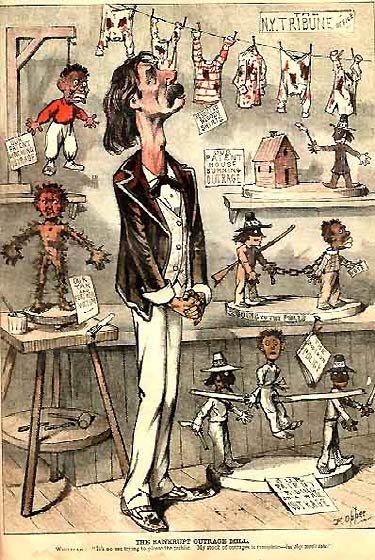
1880 Frederick Burr Opper Cartoon from Puck, titled: The Bankrupt Outrage Mill (showing bloody shirts, lynchings, and other forms of racial violence)
Virginia Governor Bob McDonnell’s break with political correctness and resumption of the practice avoided by two democrat party predecessors of declaring April to be “Confederate History Month” provoked the American left to open fire with all the batteries of the establishment media and the progressive blogosphere.
The contemporary left enthusiastically identifies with the 19th century radical abolitionist movement (which had so much to do with starting the Civil War) and is determined to ruthlessly suppress any expression of enthusiasm or affection for the Lost Cause.
The theoretical defense of the Southern political perspective and the rights of the states, remembrance of Confederate military victories, admiration for Confederate leaders, and any defense of the Southern Antebellum way of life are all treated as the gravest of thought crimes.
Jon Meacham, in the New York Times, lays down the liberal law, insisting on the absolute centrality of Slavery to any interpretation of Civil War history.
If the slaves are erased from the picture [of the Civil War], then what took place between Sumter and Appomattox is not about the fate of human chattel, or a battle between good and evil. It is, instead, more of an ancestral skirmish in the Reagan revolution, a contest between big and small government.
We cannot allow the story of the emancipation of a people and the expiation of America’s original sin to become fodder for conservative politicians playing to their right-wing base. That, to say the very least, is a jump backward we do not need.
In other words, if the issues of states rights, popular sovereignty, and Constitutional limitations on federal power going back one hundred and fifty years are allowed to be raised, discussed, and argued, there is no telling what might come of it. Who knows? Some more complex interpretation beyond a simple drama featuring wicked slave owners and oppressed darkies might interfere with universal acceptance of the American left’s self-justifying narrative of radical leadership first overthrowing Slavery, then marching on to deliver first Civil Rights, then National Health Care.
It is vital to enforce a politically correct, crudely simplified version of history, so that history can be used as a credential by those who claim to be enforcing History’s will and decrees on the rest of us.
Invoking racial politics and inflaming sectional animosity at the expense of the South is a very old political game, as the 1880 cartoon above testifies. Americans were already tired of the practice in the 19th century. In the immediate aftermath of the Civil War, the radical Benjamin Butler, then a Congressman, exhibited on the floor of the House of Representative a blood-stained shirt belonging to an Ohio carpetbagger who had been whipped by night riders in Mississippi. This kind of divisive and manipulative politics of accusation came to be referred to derisively as “waving the bloody shirt.”
Bob McDonnell is just the most recent victim of the left’s habit of waving the bloody shirt in order to bully and intimidate its opponents.
Like myself, John R. Guardino had no relatives in the United States at the time of the Civil War. He discusses at some length, quoting Senator James Webb along the way, why the attacks on Governor McDonnell are so dishonest.
And, just for the record, I’d like to note that Virginia obviously did not secede to defend Slavery. Virginia seceded in order to avoid supplying troops to be used to conquer and invade her fellow states. Virginia went to war only to defend herself and other fraternal states from invasion.
The Provisional Forces of the Confederate States, under the command of Brigadier General P.G.T. Beauregard, opened fire on Fort Sumter at 4:30 A.M. April 12, 1861.
Before the attack on Fort Sumter, President Lincoln had been in the uncomfortable position of seeking support in order to make war on fellow Americans. Opening fire on Fort Sumter was a disastrously bad idea. Offensive action initiated by the Confederacy placed the federal government in the position of the innocent victim wrongfully attacked and provided a compelling justification for President Lincoln’s call for 75,000 troops to defend the government.
It would have been far more difficult to obtain support to initiate a war of conquest of fraternal states. The majority of Northerners deplored secession, but initially favored allowing “the erring sisters to go in peace.”
Ironically, the South Carolina firebrands who insisted on asserting that state’s sovereignty over the forts in Charleston harbor inadvertently supplied the moral leverage to their own great adversary that allowed him to begin the process of defeating them.
President Lincoln’s call for troops resulted in the secessions of Virginia, North Carolina, Tennessee, and Arkansas, all of which chose to leave the Union rather than supply troops to be used to invade and occupy their fellow states.
In the part of Virginia I live these days, the memory of Mosby is still green, and his ferocious defense of the territories of Loudoun, Fauquier, and Clarke Counties against the far more numerous forces of the invader are remembered with appreciation and honored even today.
After Appomatox, Mosby negotiated a truce, which he desired to continue until General Joseph E. Johnston ceased the struggle in North Carolina. General Hancock of the Union Army declined to extend the truce, threatening to lay waste to the theater of Mosby’s operations if he failed to surrender immediately.
Unwilling to surrender, but also loath to inflict further suffering upon the civilian population, on April 21, 1865, Mosby disbanded the 43rd Battalion, 1st Virginia Cavalry rather than surrender to Union forces.
In his 1906 memoirs, John W. Munson of Company B wrote of that evening, “The outlook for the morrow was gloomy…. Colonel Mosby, like the rest of us, showed plainly that his heart was heavy. The blow had fallen with awful force and, though little was said, the gloomy faces of the Partisans told how tumultuous were the thoughts surging amid the memories of past achievements…” (Munson, John W., Reminiscences of a Mosby Guerilla, p. 269.)
The following morning, at Glen Welby, the home of Major Richard Henry Carter, Mosby requested writing material and composed his farewell order. (Munson, p. 269). He then rode to Salem, (now Marshall), Virginia where he had ordered his regiment to rendezvous. James J. Williamson, of Company A, described the scene in detail in his memoirs: “The men came in slowly. It had rained in the early part of the morning, and a thick fog hung like a pall over the face of the country. The damp, raw air did not strike the feelings with a more chilling influence than that which was sent to the heart by the gloomy aspect which every object seemed to wear. Not a smile was to be seen on any of the faces… all looked sad. Mosby was walking up and down the street, occasionally stopping to speak to one or another of the men as they rode in. About noon the order was given to mount, and the companies formed. The whole command was drawn up in line on the green… Well-mounted and equipped, the men presented a magnificent appearance, and… Mosby rode up and down the line… When all preliminaries were arranged, Mosby s Farewell to his command was read by the commander of each squadron to his men.” (Williamson, James Joseph, A Record of the Operations of the Forty-Third Battalion Virginia Cavalry…, pp. 391-393)
Williamson recalled, “While the address was being read, a profound silence reigned; and when the word ‘farewell’ was uttered, it fell like a knell upon the ears of the assembled band. They gave Mosby three hearty cheers and the order was given to break ranks. Then ensued a scene trying to all… The men pressed forward around their officers to bid them adieu, and soon hardly a dry eye could be seen. Strong men, who had looked unmoved on scenes which would have appalled hearts unused to the painful sights presented on the field of battle, now wept like little children. Mosby stood beside a fence on the main street and took the hands of those who gathered around him. His eyes were red, and he would now and then dash aside the struggling tears which he was unable wholly to suppress. Men would silently grasp each other’s hands and then turn their heads aside to hide their tears; but at last it became so general that no pains were taken to conceal them. It was the most trying ordeal through which we had ever passed. A number of ladies who had assembled to witness the disbanding of the command were apparently as much affected as we were.”
Mosby’s Farewell to his Command read:
Fauquier, April 21st 65
Soldiers! I have summoned you together for the last time. The vision we [have] cherished of a free & independent country has vanished and that country is now the spoil of a conqueror. I disband your organization in preference to our surrendering it to our enemies. I am no longer your commander. After an association of more than two eventful years. I part from you with a just pride in the fame of your achievements & grateful recollections of your generous kindness to myself. And now, at this moment of bidding you a final adieu, accept this assurance of my unchanging confidence & regard. Farewell!
Jno: S Mosby
Colonel
The original manuscript of Mosby’s Farewell to his Ranger Battalion is being auctioned by Heritage Galleries, February 12, 2010, Lot 5900 of Sale 6039.
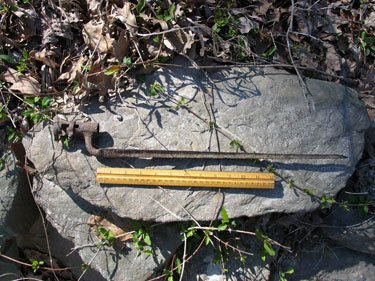
This Pattern 1853 Enfield Rifle-Musket bayonet was found by a neighbor of mine in 2004 lying on the west side of a stone wall in Snickers Gap overlooking the east entrance to the pass.
It is probably a Confederate bayonet since, though 1853 Enfield rifles were used by units on both sides during the American Civil War, the Enfield was much more widely used by Southern forces and represented the primary Confederate long arm.
From its position, it had to have been dropped by a soldier positioned behind the wall looking east, which means that, most likely, the bayonet was dropped by a Southerner defending the pass as the Union Sixth Corps under Horatio Wright, July 16-17, 1864, pursued Jubal Early‘s Army of the Valley District in its retreat through the pass following its victory at Monocacy on July 9th and unsuccessful probe of the defenses of Washington on July 11-12.
Its owner probably drew the bayonet, and not wanting to make his 55 inch (1.397 m.) long rifle even longer and more unwieldy in a brushy wooded location until necessary, placed it ready for rapid use on the wall by his firing position. But Northern infantry or Duffie‘s cavalry advanced faster and in greater numbers than he had anticipated, and the Confederate was forced to make a run for it so quickly that he did not have time to bother trying to pick up his bayonet.
His pursuers clambered over the wall, knocking the abandoned bayonet to the ground and dislodging several of the upper stones which fell down and covered it. Those fallen rocks protected it from the elements and significantly reduced the amount of oxidation that might have been expected over the 140 year interval before it was recovered.
Authorities remained on the scene Tuesday of a Chesterfield County neighborhood where munitions exploded and killed a homeowner who sold Civil War relics.
Chesterfield County Police said neighbors reported the explosion Monday afternoon after hearing the blast and then finding the victim fatally injured in his backyard near a detached garage.
Police identified the victim Tuesday as Samuel H. White, 53.
Authorities found other unexploded military ordnance at the house, and evacuated about two dozen homes nearby until authorities could determine the area was safe. Police spokeswoman Ann Reid said the evacuation would remain in effect indefinitely.
Tuesday afternoon, police continued to collect and detonate ordnance.
White ran a Web site called Sam White Relics. The site contains photos of various relics for sale, such as Civil War artillery shells, cannonballs, bullets and other artifacts.
White said on the site he “will disarm, clean, and preserve your Civil War period and earlier military ordinance” for about $35 a piece.
“I’ve done approx. 500 artillery projectiles and still have all my fingers (I must be doing something right, knock on wood)!” the site states.
Neighbor Brian Dunkerly told the Richmond Times-Dispatch that a chunk of the ordnance flew into the air and smashed through the front-porch roof of his home about one-quarter-mile away. The piece of metal — weighing close to 15 pounds — then shattered his glass front door, hit the interior wood floor and bounced to the ceiling before coming to rest in the center of his living room.
An accident occurred while disarming a Civil War projectile, long time collector Sam White, Chesterfield Va was killed in the accident. This is a horrible tragedy, Sam White was one of the good guys in this business, and I am very much saddened by his loss. I offer my prayers and condolence.
Sam had years of experience disarming and restoring Civil War ordnance and was highly respected. I believe that he used good techniques, but obviously something failed with this accident. The complete details are not known at this point, but it appears that he must have been drilling a large shell outside his house and did not use his remote rig. The news media showed pictures of a large fragment, likely from a round ball 8 inches or larger.
Notwithstanding recent accidents, Civil War ordnance is not dangerous to handle or display and is desirable to collect. All shells in a personal collection should be disarmed to ultimately be considered safe, but mere displaying or handling Civil War ordnance is not inherently dangerous. The two events that can cause danger are extreme heat or mechanical stimulus.
The black powder used in Civil War ordnance needs heat in the region of 500 degrees F to ignite, so it takes extreme heat such as a burning building, a fire or some other extreme heat to ignite black powder.
Mechanical stimulus can be hazardous, such as attempting to smash a shell with a sledge hammer or shooting a shell with a high powered modern rifle or something of the like. Drilling a shell to remove or wet the powder is the preferred method to render a shell inert, but the drilling process can create hazard. Ironically, the safest thing to do with a Civil War shell is to simply leave it alone. However ultimately it is good practice to disarm a shell to render it inert. This is done by drilling a hole into the chamber and wetting and removing the powder inside. Once the powder inside the cavity is wet or removed, the shell is inert and represents no continuing danger.
The accident with Sam White apparently occurred while drilling, although this is not fully confirmed yet.
In the American Scholar, David Bosco traces the roots of today’s Geneva Conventions to “Lieber’s Code” adopted by the US Army during the American Civil War from a paper on the treatment of insurgents and guerillas by Francis Leiber (1798-1872) a professor at Columbia University.
Unfortunately, the prospects for another “Lieber moment†appear slim. Many American leaders feel estranged from recent developments in international humanitarian and criminal law. The bewildering network of international conventions, courts, and commissions that is so inspiring to activists often appears menacing to those officials responsible for security policy. The ICC’s birth, for example, occasioned far more handwringing than applause in the Pentagon and the State Department. The pride Lieber felt about being part of the international effort at codification has all but dissipated in government circles.
This change of tone and tactics has much to do with the geometry of power. Lieber’s United States was weak, divided, and struggling to assure foreign observers that it could contribute to the civilizing goals of international law. Today’s United States has unparalleled power, and the international law that once signified membership in a rarefied club now threatens to hinder its freedom of action. Lieber also operated in a simpler legal age. His code, we should not forget, was a unilateral declaration; it was not negotiated with the Confederacy, let alone the rest of the world. The prospect today of amending the international rules governing warfare via negotiations with dozens of countries—some of them hostile—is daunting.
Yet the unwillingness to take up the task has had painful consequences. As the United States conducts its global campaign against terrorism, the Bush administration has often preferred to operate in the murky spaces between vague provisions of existing law. Bush officials have sometimes grumbled about the inadequacy of the existing framework but have proffered little to take its place. The effect on American legitimacy and reputation has been grievous; many foreigners, including close allies, have concluded that the world’s superpower now operates outside the law.
Sgt. Henry Wood (1841-1910) first served in the 14th Virgina Infantry; but was quickly transfered to the 18th Virginia Infantry, Pickett’s Brigade, in which he fought in the battles of First Manassas (1861), Williamsburg (1862), and Seven Pines (1862), where he was wounded in the leg. In 1864, he returned to service with the Fluvanna Light Artillery, fighting under Jubal Early in the Shenandoah Valley Campaign of 1864 in the Third Battle of Winchester, and in the battles of Fisher’s Hill, and Cedar Creek.
He acquired the pistol he wears in the photograph from a Yankee major he captured along with six privates at Cedar Creek, October 19, 1864.
The war in Iraq “is lost” and a US troop surge is failing to bring peace to the country, the leader of the Democratic majority in the US Congress, Harry Reid, said Thursday.
“I believe … that this war is lost, and this surge is not accomplishing anything, as is shown by the extreme violence in Iraq this week,” Reid said, on the same day US President George W. Bush was giving a speech at an Ohio town hall meeting defending the war on terror.
At the First Battle of Manassas, it is reported that General Barnard Bee, whose troops were beginning to break under the attack of superior Union forces, informed General Thomas Jonathan Jackson, “General, sir, the day is going against us,” to which Jackson replied: “If you think so, sir, you had better not say anything about it.”
Jackson kept his brigade standing there steady (like a stone wall), then attacked with the bayonet and won the day.
If Harry Reid had been commanding the First Virginia Brigade at the First Battle of Manassas, the American Civil War would have been very short.