Category Archive 'Japan'
03 Sep 2013


Daniel Greenfield suggests that we look at contemporary Japan as a kind of mirror for the post-modern, totally decadent and deracinated West.
Depressed post-industrial economy, low birth rate, social disintegration and a society obsessed with pop culture and useless tech toys? A country that has embraced pacifism to the extent that it can hardly defend its own borders? A nation where materialism has strangled spirituality leaving no sense of purpose?
We are Japan. And so is Europe. Or rather Japan is the place we all reach eventually.
Japan is strange because it aggressively hurled itself into a postmodern void without knowing what was on the other side. It did this with the same dedication that its soldiers once marched into machine gun fire.
Japan had been in a race with the West, as it had been ever since Commodore Perry showed up with a fleet to open up a closed nation. It wasn’t unique in that regard. A lot of countries tried to do the same thing. Most found that they couldn’t keep up with either our technology or our decline. Japan shot past us in both areas. It beat us technologically. And then it outpaced our decline.
In the 80s, there were dire predictions that the future would belong to Japan. America would be broken up and run by a bunch of Japanese corporations. There were even predictions that after the fall of the USSR, the next war would be with Japan. Some of those predictions came from some surprisingly high profile analysts.
The future doesn’t belong to Japan. It may not, at this rate, belong to anyone. Japan hurled itself into the future, but didn’t find anything there.
Korea hurled itself into that same future and found only emptiness. Now China’s elites are rushing into that same void and are beginning to discover that technocracy and materialism are hollow. That is why China is struggling to reassert Communist values even while throwing everything into making Walmart’s next product shipment. Like Japanese and Korean leaders, Chinese leaders are realizing that their technological and material achievements have left their society with a spiritual void.
That isn’t a problem unique to Asia. Asian countries were just less prepared for a rapid transition to the modern age. Europe and America, which had more time to prepare, are still on the same track. …
The thing we have in common with Japan, China and Europe is that we have all moved into a post-modern future while leaving our values behind and our societies have suffered for it. It is a future in which stores have robots on display but couples are hardly getting married, where there are high speed trains and a sense of lingering depression as the people who ride them don’t know where they are going, and where the values of the past have been traded for a culture of uncertainty.
Read the whole thing.
Hat tip to Karen L. Myers.
23 Aug 2013

Wiki:
YÅ«gen (幽玄) is an important concept in traditional Japanese aesthetics. The exact translation of the word depends on the context. In the Chinese philosophical texts the term was taken from, yÅ«gen meant “dimâ€, “deep†or “mysteriousâ€. In the criticism of Japanese waka poetry, it was used to describe the subtle profundity of things that are only vaguely suggested by the poems, and was also the name of a style of poetry (one of the ten orthodox styles delineated by Fujiwara no Teika in his treatises).
Yugen suggests that beyond what can be said but is not an allusion to another world. It is about this world, this experience. All of these are portals to yugen:
“To watch the sun sink behind a flower clad hill. To wander on in a huge forest without thought of return. To stand upon the shore and gaze after a boat that disappears behind distant islands. To contemplate the flight of wild geese seen and lost among the clouds. And, subtle shadows of bamboo on bamboo.” — Zeami Motokiyo
Zeami was the originator of the dramatic art form Noh theatre and wrote the classic book on dramatic theory (Kadensho). He uses images of nature as a constant metaphor. For example, “snow in a silver bowl†represents “the Flower of Tranquilityâ€. Yugen is said to mean “a profound, mysterious sense of the beauty of the universe… and the sad beauty of human sufferingâ€. It is used to refer to Zeami’s interpretation of “refined elegance†in the performance of Noh.
Via Ratak Monodosico.
01 Aug 2013
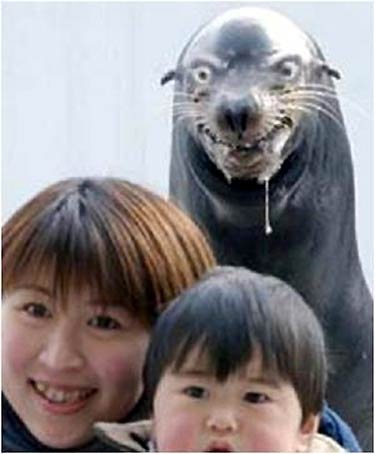
Hat tip to Karen L. Myers.
23 Jul 2013

Gendai-to made in 1929 by Ikkansai Kasama Shigetsugu, formerly owned by General Tomoyuki Yamashita, Conqueror of Singapore, “The Tiger of Malaya.”
Yesterday, one of the correspondents on a Japanese sword email list shared this current commercial offering.
The sword was once carried by General Tomoyuki Yamashita, one of the most successful Japanese commanders of WWII, who captured Malaya and Singapore and who received the largest surrender of British forces on history. General Yamashita was hanged in 1946 for war crimes committed under his command for which many thought he bore no real personal responsibility.
The sword was made in 1929 by Ikkansai Kasama Shigetsugu, arguably the most important and influential swordsmith of the Showa period.
Slightly edited excerpt from Paul Martin’s The Yoshihara Tradition:
Kurihara Hikosaburo (Akihide) [charged with reviving the craft of swordmaking by the Japanese Prime Minister] invited one of the most famous smiths of the period, Ikkansai Kasama Shigetsugu, to become the chief instructor of Nipponto Tanren Denshu Jo (Japanese Sword Forging Institute) on the grounds of his estate in Akasaka, Tokyo. Shigetsugubecame perhaps the most influential smith to teach there in its entire history, and had the greatest impact on students and teachers alike.
Shigetsugu, born Kasama Yoshikazu on April 1, 1886 in Shizuoka, started his apprenticeship under his uncle Miyaguchi Shigetoshi in 1899. In 1903 he entered the Tokiwamatsu Token Kenkyujo, on the estate of Toyama Mitsuru, to study under Morioka Masayosh. Later he went on to study metallurgy whilst collaborating with Dr. Tawara Kuniichi in formal research on the composition of
Japanese swords. Tazawa built a special laboratory in Tokyo University for the project. The results were published in a book called Nihonto no Kagakuteki Kenkyu (Scientific Research of the Japanese Sword), which remains to this day a definitive scientific work on the subject.
Shigetsugu worked mainly in the Bizen and Soshu traditions of swordmaking, which influenced many of the Denshujo’s students’ later work.
The sword has an origami (authentication paper) from the NBTHK (Nihon Bijutsu Token Hozon Kai), the premier Japanese sword preservation and study society, testifying to its correct attribution and awarding it a rank of HOZON – “Worthy of Preservation.”
Origami ranks are commonly awarded in a step-by-step process, and it seems likely to me that this sword could very possibly receive higher rankings if re-submitted.
The asking price is 2,800,000 JPY, roughly equal to $28,000.
21 Jul 2013
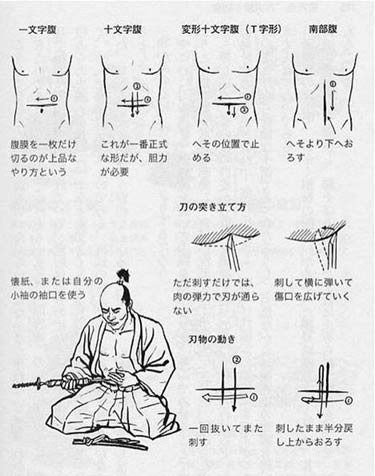
It’s important to do things right.
From Push the Movement.
08 May 2013
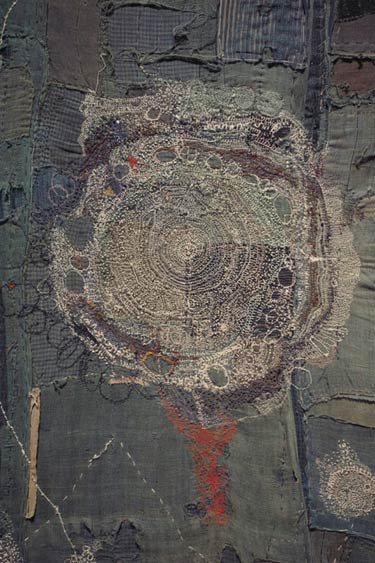
Seeing the above extraordinary image on Ka-Ching!, I was puzzled. Was this a strikingly interesting patch on a pair of blue jeans? some new kind of Amish quilt-making? Maybe I was looking at it wrong. Perhaps it was really some culture on a microscope slide. Or maybe it was some kind of geologic feature seen from Outer Space. No, it really did look like embroidery… What in hell was going on here?
So I looked and looked, and I found that this is a photograph of a piece of fibre art by the Japanese artist Junko Oki. She calls her work Woky Shoten, which name apparently refers to the “free movement of the line to make a simple repetition of workâ€, and relates to her grandfather’s memories.
She published a book in 2011 in which she describes her artistic vocation (quoted by Julie B. Boot):
(translation by Toshiaki Komuro)
Poesy
I have always dreamed of becoming a poet.
It is still my dearest wish.
Upon seeing one of my works one woman had tears in her eyes.
I had never come upon such a scene before.
What had made her cry?
“That is the power of poetry,†said a wise friend.
“You have become a poetâ€
When I have needles, threads, and other special materials in front of me, something stirs deep inside my unconscious mind in spite of myself,
and I am filled with strong emotion.
That is when I regain my true self.
When I was afraid to move forward,
I came upon a book of paintings by Antoni Tapies.
When I chant his name, I feel fully armored, even with a dagger in my belt.
In an instance I know clearly which way to go and I will my legs to move forward.
The joy of meeting and the sorrow of separation
have given me strength and courage.
Another day, another walk, I will resume my steps.
I will always be myself as a willow tree is true to its nature.
I will make today another good day.
July 2011
Junko Oki
————————————————
Poesy can apparently be ordered from the author via mmtukj@nifty.com.
————————————————-
Some more examples of her work can be seen here.
Junko Oki’s web-site.

14 Apr 2013

A standard cultural artifact in Japan is the darumaoki, the weighted and self-righting tumbler doll painted as a comical caricature of Daruma, aka Bodhidharma, the Buddhist monk who brought Zen (aka Ch’an) Buddhism to China in the 5th century and who founded at the Shaolin Temple the entire tradition of Oriental martial arts.
The dolls are visible embodiments of the Japanese slogan “Nanakorobi Yaoki,” “Seven times down, eight times up,” an admonition encouraging persistence, resilience, and the determination to overcome adversity.
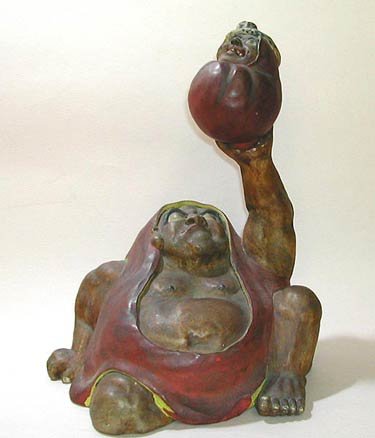
A disgruntled Daruma contemplates with visible dismay his own caricatured form as a darumaoki doll. 19th century ceramic, private collection.
23 Feb 2013

How do you demolish high-rise buildings in densely-constructed Japanese cities? Americans just use dynamite to bring them down, but the Japanese has a much subtler and stealthier approach.
2:11 video
25 Jan 2013
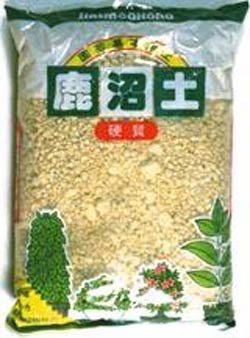
Kanuma potting soil
Chef Toshio Tanabe of the Ne Quittez Pas Restaurant in Tokyo’s Gotanda district, specializing in French Seafood, has captured a great deal of attention by incorporating kanuma dirt, a granular acidic clay from Tochigi Prefecture, commonly used as potting soil for bonsai (particulary for Azaleas, Camellias, Gardenias and other acid loving plants), as a key ingredient in his cuisine.
Chef Tanabe first won a cooking contest on the basis of a sauce made with kanuma dirt. He subsequently developed a series of dishes, including a soup, a salad dressing, rissotto, gratin, and even ice cream showcasing his new ingredient. Some dishes made with kanuma dirt cost as much as $110, and those who’ve tried them found them delicious.
Parfulla.net story
Oddity Central
Hat tip to Vanderleun.

Kanuma soil gratin
13 Nov 2012
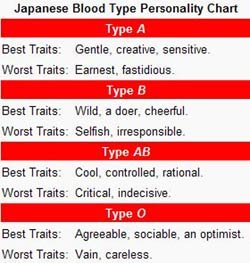
The BBC reports on the Japanese obsession with ketsueki-gata, a form of racialist junk science resembling astrology, which claims to be able to predict a person’s personality, temperament, and behavioral propensities from his blood type.
[In Japan,] a person’s blood type is popularly believed to determine temperament and personality. “What’s your blood type?” is often a key question in everything from matchmaking to job applications.
According to popular belief in Japan, type As are sensitive perfectionists and good team players, but over-anxious. Type Os are curious and generous but stubborn. ABs are arty but mysterious and unpredictable, and type Bs are cheerful but eccentric, individualistic and selfish.
About 40% of the Japanese population is type A and 30% are type O, whilst only 20% are type B, with AB accounting for the remaining 10%.
Four books describing the different blood groups characteristics became a huge publishing sensation, selling more than five million copies.
Morning television shows, newspapers and magazines often publish blood type horoscopes and discuss relationship compatibility. Many dating agencies cater to blood types, and popular anime (animations), manga (comics) and video games often mention a character’s blood type.
A whole industry of customised products has also sprung up, with soft drinks, chewing gum, bath salts and even condoms catering for different blood groups on sale.
—————————–
Types defined at length.
—————————–
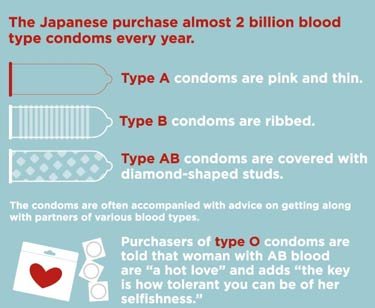
Condoms (accompanied by special romantic advice) and perfume are marketed by blood type.
/div>

Feeds
|




