Category Archive 'Statism'
23 May 2010

Brook trout fishing, filmed by F.S. Armitage on June 6, 1900 somewhere along the Grand Trunk Railroad. 1:15 video.
—————————————-
Who should replace Dennis Blair as National Intelligence Director? No one, proposes John Noonan at the Weekly Standard:
Unnecessary bureaucracy has a venomous effect on the national security establishment, whether it’s infantry or intelligence. The director of national intelligence, which has ballooned to a 1500-man supporting office, was a top down solution to a bottom up problem.
Admiral Blair was a casualty of Intelligence Community turf wars. Closing the DNI office would reduce unnecessary conflicts and duplication of effort. It’s too logical a course of action to be given serious consideration most likely though.
—————————————-
Bruce Fleming says that standards at US service academies have been lowered for affirmative action and to allow academy teams to compete in the NCAA top divisions. He thinks standards should be restored or all the service academies closed down.
—————————————-
Robin Hanson observes a unidirectional dynamic at work in progressive statism.
[I]n any area where we let humans do things, every once in a while there will be a big screwup; that is the sort of creatures humans are. And if you won’t decrease regulation without a screwup but will increase it with a screwup, then you have a regulation ratchet: it only moves one way. So if you don’t think a long period without a big disaster calls for weaker regulations, but you do think a particular big disaster calls for stronger regulation, well then you might as well just strengthen regulations lots more right now, even without a disaster. Because that is where your regulation ratchet is heading.
What if you can’t imagine ever wanting to weaken a regulation, just because it was strong and you’d gone a long time without a big disaster? Well then you apparently want the maximum possible regulation, which is probably to just basically outlaw that activity. And if that doesn’t seem like the right level of regulation to you, well then maybe you should reconsider your ratchety regulation intuitions.
Hat tip to the News Junkie.
—————————————-
Ann Althouse chides the Washington Post: If you’re going to criticize the new social studies curriculum adopted by the Texas Board of Education, you’d better quote it or link it, not paraphrase it inaccurately.
20 May 2010
Ross Douthat wonders aloud if any political movement, any reaction on the part of the electorate, can possibly overcome the one directional dynamic of Progressive Statism.
This feels like a populist moment. Americans are Tea Partying. Greeks are rioting. Incumbents are being thrown out; the Federal Reserve is facing an audit; Goldman Sachs is facing prosecution. In Kentucky, Ron Paul’s son might be about to win a Republican Senate primary.
But look through these anti-establishment theatrics to the deep structures of political and economic power, and suddenly the surge of populism feels like so much sound and fury, obscuring the real story of our time. From Washington to Athens, the economic crisis is producing consolidation rather than revolution, the entrenchment of authority rather than its diffusion, and the concentration of power in the hands of the same elite that presided over the disasters in the first place. …
Taken case by case, many of these policy choices are perfectly defensible. Taken as a whole, they suggest a system that only knows how to move in one direction. If consolidation creates a crisis, the answer is further consolidation. If economic centralization has unintended consequences, then you need political centralization to clean up the mess. If a government conspicuously fails to prevent a terrorist attack or a real estate bubble, then obviously it needs to be given more powers to prevent the next one, or the one after that.
The C.I.A. and F.B.I. didn’t stop 9/11, so now we have the Department of Homeland Security. Decades of government subsidies for homebuyers helped create the housing crash, so now the government is subsidizing the auto industry, the green-energy industry, the health care sector …
The pattern applies to personnel as well as policy. If Robert Rubin’s mistakes helped create an out-of-control financial sector, then naturally you need Timothy Geithner and Lawrence Summers — Rubin’s protégés — to set things right. After all, who else are you going to trust with all that consolidated power? Ron Paul? Dennis Kucinich? Sarah Palin?
This is the perverse logic of meritocracy. Once a system grows sufficiently complex, it doesn’t matter how badly our best and brightest foul things up. Every crisis increases their authority, because they seem to be the only ones who understand the system well enough to fix it.
But their fixes tend to make the system even more complex and centralized, and more vulnerable to the next national-security surprise, the next natural disaster, the next economic crisis. Which is why, despite all the populist backlash and all the promises from Washington, this isn’t the end of the “too big to fail†era. It’s the beginning.
30 Apr 2010

When Republicans are doing bad things, you can count on democrats to offer to go them one better.
The Hill:
Democratic leaders have proposed requiring every worker in the nation to carry a national identification card with biometric information, such as a fingerprint, within the next six years, according to a draft of the measure.
The proposal is one of the biggest differences between the newest immigration reform proposal and legislation crafted by late Sen. Edward Kennedy (D-Mass.) and Sen. John McCain (R-Ariz.).
The national ID program would be titled the Believe System, an acronym for Biometric Enrollment, Locally stored Information and Electronic Verification of Employment.
It would require all workers across the nation to carry a card with a digital encryption key that would have to match work authorization databases.
“The cardholder’s identity will be verified by matching the biometric identifier stored within the microprocessing chip on the card to the identifier provided by the cardholder that shall be read by the scanner used by the employer,†states the Democratic legislative proposal. …
Senate Democratic Whip Dick Durbin (Ill.), who has worked on the proposal and helped unveil it at a press conference Thursday, predicted the public has become more comfortable with the idea of a national identification card.
“The biometric identification card is a critical element here,†Durbin said. “For a long time it was resisted by many groups, but now we live in a world where we take off our shoes at the airport and pull out our identification.
“People understand that in this vulnerable world, we have to be able to present identification,†Durbin added. “We want it to be reliable, and I think that’s going to help us in this debate on immigration.â€
———————————–
Ezra Klein offers details of the democrat plan, and actually identifies the important irony. Note that all this does not give the ephebe Ezra any particular problem personally.
The Democrats’ immigration-reform proposal (pdf) is 26 pages long. Pages 8 through 18 are devoted to “ending illegal employment through biometric employment verification.” I don’t think the Democrats are going to like me calling this a biometric national ID card, as they go to great lengths to say that it is not a national ID card, and make it “unlawful for any person, corporation; organization local, state, or federal law enforcement officer; local or state government; or any other entity to require or even ask an individual cardholder to produce their social security card for any purpose other than electronic verification of employment eligibility and verification of identity for Social Security Administration purposes.”
But it’s still a biometric national ID card. It’s handed out by the Social Security Administration and employers are required to check it when hiring new employees. Essentially, if you want to participate in the American economy, you need this card. “Within five (5) years of the date of enactment, the fraud-proof social security card will serve as the sole acceptable document to be produced by an employee to an employer for employment verification purposes,” the bill says. “This requirement will exist even if the employer does not yet possess the capability to electronically verify the employee by scanning the card through a card reader.”
The theory here is simple: Illegal immigration is a problem because illegal immigrants can get jobs. As the bill says, “in order to prevent future waves of illegal immigration, this proposal recognizes that no matter what we do on the border, our ports of entry, and in the interior, we will not be completely effective unless we can prevent the hiring, recruitment, or referral of unauthorized aliens in America’s workplaces. Jobs are what draw illegal immigrants to the United States.” …
The oddity of this strategy, of course, is that anti-immigration sentiments run highest among the same communities that are most opposed to national ID cards. Now, it’s also the case that if you’re going to support citizenship searches for people with Hispanic-looking shoes, it’s a bit odd to worry about an ID card to verify employment. But even so, without Republicans on the bill to give this strategy cover, it’ll be interesting to see whether the anti-immigrant right embraces the ID card as a way of staunching the flow of illegal immigrants or assails Democrats for trying to create a biometric police state.

24 Apr 2010

Jonah Goldberg addresses in a serious essay the commonly heard debate on whether terms like Marxist and Socialist may be accurately applied to Barack Obama.
[I]s it correct, as an objective matter, to call Obama’s agenda “socialist� That depends on what one means by socialism. The term has so many associations and has been used to describe so many divergent political and economic approaches that the only meaning sure to garner consensus is an assertive statism applied in the larger cause of “equality,†usually through redistributive economic policies that involve a bias toward taking an intrusive and domineering role in the workings of the private sector. One might also apply another yardstick: an ambivalence, even antipathy, for democracy when democracy proves inconvenient.1 With this understanding as a vague guideline, the answer is certainly, Yes, Obama’s agenda is socialist in a broad sense. The Obama administration may not have planned on seizing the means of automobile production or asserting managerial control over Wall Street. But when faced with the choice, it did both. Obama did explicitly plan on imposing a massive restructuring of one-sixth of the U.S. economy through the use of state fiat—and he is beginning to do precisely that.
Obama has, on numerous occasions, placed himself within the progressive intellectual and political tradition going back to Theodore Roosevelt and running through Franklin Roosevelt. With a few exceptions, the progressive political agenda has always been to argue for piecemeal reforms, not instant transformative change—but reforms that always expand the size, scope, and authority of the state. This approach has numerous benefits. For starters, it’s more realistic tactically. By concentrating on the notion of reform rather than revolution, progressives can work to attract both ideologues of the Left and moderates at the same time. This allows moderates to be seduced by their own rhetoric about the virtues of a specific reform as an end in itself. Meanwhile, more sophisticated ideologues understand that they are supporting a camel’s-nose strategy. In an unguarded moment during the health-care debate in 2009, Representative Barney Frank confessed that he saw the “public option,†the supposedly limited program that would have given the federal government a direct role as an insurer in competition with private insurers, as merely a way station to a single-payer system in which the government is the sole provider of health care. In his September 2009 joint-session address to Congress on health care, President Obama insisted that “I am not the first President to take up this cause, but I am determined to be the last.†Six months later, when he got the health-care bill he wanted, he insisted that it was only a critical “first step†to overhauling the system. Arthur Schlesinger Jr. was one of the relatively few self-described moderates who both understood the tactic and supported it. “There seems no inherent obstacle,†Schlesinger wrote in 1947, “to the gradual advance of socialism in the United States through a series of New Deals.â€
Goldberg places Obama decidedly outside the Revolutionary Marxist “hot socialism” tradition and firmly in the Fabian tradition of incremental, gradual, “first step” subversion of liberty. Obama adroitly dismisses accuses of his being a socialist as evidence of his opponents’ ideological blindness. He is merely a pragmatist, committed to “solving problems.”
But whether one identifies Obama as a social-ist instead of a socialist, a neosocialist, or merely a progressive, there can be no doubt that Barack Obama’s political agenda is as thoroughly committed to expanding the regulatory authority and share of the economy controlled by government as the Romanovs were to the gathering of the Russian lands.
Denying that you are an ideologue is not the same thing as proving the point. And certainly Obama’s insistence that ideology is something only his critics suffer from is no defense when stacked against the evidence of his actions. The “pragmatic†Obama is only interested in “what works†as long as “what works†involves a significantly expanded role for government. In this sense, Obama is a practitioner of the Third Way, the governing approach most successfully trumpeted by Blair, who claimed to have found a “third way†that rejected the false premises of both Left and Right and thereby located a “smarter†approach to expanding government. The powerful appeal of this idea lies in the fact that it sounds as if its adherents have rejected ideological dogmatism and gone beyond those “false choices.†Thus, a leader can both provide health care to 32 million people and save money, or, as Obama likes to say, “bend the cost curve down.†But in not choosing, Obama is choosing. He is choosing the path of government control, which is what the Third Way inevitably does and is intended to do.
Still, the question remains, What do we call Obama’s “social-ismâ€? John Judis’s formulation—“liberal socialismâ€â€”is perfectly serviceable, and so is “social democracy†or, for that matter, simply “progressivism.†My own, perhaps too playful, suggestion would be neosocialism. …
In many respects, Barack Obama’s neo-socialism is neoconservatism’s mirror image. Openly committed to ending the Reagan era, Obama is a firm believer in the power of government to extend its scope and grasp far deeper into society. In much the same way that neoconservatives accepted a realistic and limited role for the government, Obama tolerates a limited and realistic role for the market: its wealth is necessary for the continuation and expansion of the welfare state and social justice. While neoconservatism erred on the side of trusting the nongovernmental sphere—mediating institutions like markets, civil society, and the family—neosocialism gives the benefit of the doubt to government. Whereas neoconservatism was inherently skeptical of the ability of social planners to repeal the law of unintended consequences, Obama’s ideal is to leave social policy in their hands and to bemoan the interference of the merely political.
“I would have loved nothing better than to simply come up with some very elegant, academically approved approach to health care, and didn’t have any kinds of legislative fingerprints on it, and just go ahead and have that passed,†he told CBS’s Katie Couric. “But that’s not how it works in our democracy. Unfortunately, what we end up having to do is to do a lot of negotiations with a lot of different people.â€
Whereas Ronald Reagan saw the answers to our problems in the private sphere (“in this present crisis, government is not the solution to our problem; government is the problemâ€), Obama seeks to expand confidence in, and reliance on, government wherever and whenever he can, albeit within the confines of a generally Center-Right nation and the “unfortunate†demands of democracy.
As with Webb’s Fabian socialism, one will never be able to say of Obama’s developing doctrine, “now socialism has arrived.†On the night the House of Representatives passed the health-care bill, Obama said, “This legislation will not fix everything that ails our health care system. But it moves us decisively in the right direction.†Then, speaking specifically of another vote to be taken in the Senate but also cleverly to those not yet satisfied with what had been achieved, he added, “Now, as momentous as this day is, it’s not the end of this journey.â€
Under Obama’s neosocialism, that journey will be endless, and no matter how far down the road toward socialism we go, he will always be there to tell the increasingly beleaguered marchers that we have only taken a “critical first step.â€
Read the whole thing.
21 Apr 2010
My liberal classmates rant and rave regularly about the nefarious behavior of Wall Street banks and big corporations, but in their eyes government can do no wrong (as long as Republicans are not in charge).
Coyote reflects on the strangeness of the statist perspective.
I have total sympathy with those who distrust corporations. Distrust and skepticism are fine things, and are critical foundations to individual responsibility. History proves that market mechanisms tend to weed out bad behaviors, but sometimes these corrections can take time, and in the mean time its good to watch out for oneself.
However, I can’t understand how these same people who distrust the power of large corporations tend to throw all their trust and faith into government. The government tends to have more power (it has police and jails after all, not to mention sovereign immunity), is way larger, and the control mechanisms and incentives that supposedly might check bad behavior in governments seldom work.
Hat tip to the Barrister.
19 Dec 2009

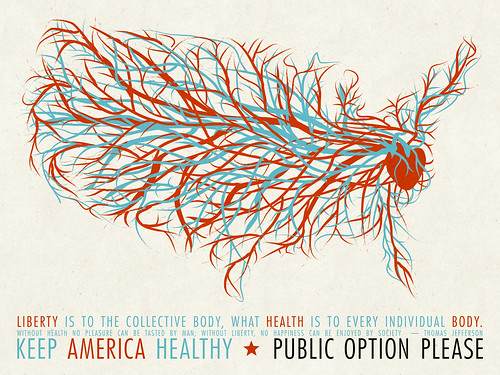
Extreme Left blogger Jane Hamsher of FireDogLake has her own socialize-American-health-care-now organization, called Public Option Please which recently had an art contest.
The winning entry (above, by Amy Martin), was a vivid expression of Statism, which Mark Kirokorian accurately describes: Washington is pictured as the heart of nation, where tired, oxygen-depleted blood is replenished and returned to the hinterland. It’s a perfect illustration of the worldview of the Left.
The image of the Heart of the Nation lit conservative fuses, and Gregory, at Moonbattery, posted the below Photoshopped rejoinder.

Hat tip to Will Wilson.
10 Dec 2009
Roger Scruton, in the American Spectator, discusses who really owns the moral high ground in the contemporary struggle between left and right.
What all conservatives know, however, is that it is they who are motivated by compassion, and that their cold-heartedness is only apparent. They are the ones who have taken up the cause of society, and who are prepared to pay the cost of upholding the principles on which we all — liberals included — depend. To be known as a social conservative is to lose all hope of an academic career; it is to be denied any chance of those prestigious prizes, from the MacArthur to the Nobel Peace Prize, which liberals confer only on each other. For an intellectual it is to throw away the prospect of a favorable review — or any review at all — in the New York Times or the New York Review of Books. Only someone with a conscience could possibly wish to expose himself to the inevitable vilification that attends such an “enemy of the people.” And this proves that the conservative conscience is governed not by self-interest but by a concern for the public good. Why else would anyone express it?
By contrast, as conservatives also know, the compassion displayed by the liberal is precisely that — compassion displayed, though not necessarily felt. The liberal knows in his heart that his “compassionating zeal,” as Rousseau described it, is a privilege for which he must thank the social order that sustains him. He knows that his emotion toward the victim class is (these days at least) more or less cost-free, that the few sacrifices he might have to make by way of proving his sincerity are nothing compared to the warm glow of approval by which he will be surrounded by declaring his sympathies. His compassion is a profoundly motivated state of mind, not the painful result of a conscience that will not be silenced, but the costless ticket to popular acclaim.
Why am I repeating those elementary truths, you ask? The answer is simple. The USA has descended from its special position as the principled guardian of Western civilization and joined the club of sentimentalists who have until now depended on American power. In the administration of President Obama we see the very same totalitarian sentimentality that has been at work in Europe, and which has replaced civil society with the state, the family with the adoption agency, work with welfare, and patriotic duty with universal “rights.” The lesson of postwar Europe is that it is easy to flaunt compassion, but harder to bear the cost of it. Far preferable to the hard life in which disciplined teaching, costly charity, and responsible attachment are the ruling principles is the life of sentimental display, in which others are encouraged to admire you for virtues you do not possess. This life of phony compassion is a life of transferred costs. Liberals who wax lyrical on the sufferings of the poor do not, on the whole, give their time and money to helping those less fortunate than themselves. On the contrary, they campaign for the state to assume the burden. The inevitable result of their sentimental approach to suffering is the expansion of the state and the increase in its power both to tax us and to control our lives.
As the state takes charge of our needs, and relieves people of the burdens that should rightly be theirs — the burdens that come from charity and neighborliness — serious feeling retreats. In place of it comes an aggressive sentimentality that seeks to dominate the public square. I call this sentimentality “totalitarian” since — like totalitarian government — it seeks out opposition and carefully extinguishes it, in all the places where opposition might form. Its goal is to “solve” our social problems, by imposing burdens on responsible citizens, and lifting burdens from the “victims,” who have a “right” to state support. The result is to replace old social problems, which might have been relieved by private charity, with the new and intransigent problems fostered by the state: for example, mass illegitimacy, the decline of the indigenous birthrate, and the emergence of the gang culture among the fatherless youth.
08 Dec 2009

Soon to be declared a hazard by the EPA
If democrats succeed in nationalizing health care, Barack Obama’s leftward offensive will certainly have reached its high watermark. it is unlikely that members of Congress worried about re-election will risk defying public opinion a second time in order to enact Cap and Trade.
But Obama has a way around the legislative roadblock. He intends, it has already been disclosed, to have the Environmental Protection Agency adopt the perspective of the craziest environmentalist extremists out there and declare the emissions of all living animals, the gaseous elements of the carbon cycle of organic life, “a danger to the environment and the health of Americans.”
It would be a lot more dangerous, of course, if there were no carbon dioxide. Then, plants could not apply solar energy to it during photosynthesis to release oxygen for us to breathe and produce sugars and starches to serve as the nutritional basis of all vegetable and animal life.
Government prospers by regulating and punishing, by charging fees and leveling fines and by trading regulatory exemption for political support. You have to give the liberals credit for taking their penchant for statism to its logical limit. Once the fundamental processes underlying organic life are declared a menace, government has been given the ultimate blank check, a pretext to regulate, assess, and ban whatever form of productive activity it pleases. All the state has to do is identify a relationship between any intended victim’s economic activity and compounds fundamental to organic life, and its representatives can begin writing up the violation. If you’re living, you’re guilty.
———————————————–
Wonderful as this is for expanding the reach of political power, as Iain Murray observes, there is always a crazy enviro group out there ready to go to court and some ultraliberal judge ready to rule in its favor forcing govenment to act contrary to its own (and everyone else’s) interest.
The Clean Air Act is potentially a lot more dangerous to the United States than any toxic emissions.
The EPA is about to announce that greenhouse gases endanger public health and welfare, something that has in many ways been inevitable since the boneheaded SCOTUS ruling in Mass. vs EPA (which essentially found that the Clean Air Act was always intended to be Kyoto-on-steroids.) With thanks to my colleague Will Yeatman, here’s a brief summary of what this means, and why you should be appalled.
Under the Clean Air Act, an “endangerment†finding means that the EPA will have to grant a waiver to those states (such as California) that want to regulate greenhouse-gas emissions from automobiles. The EPA has already agreed to do so. When “pollutants†that “endanger†human health and welfare are regulated, the EPA must expand its regulatory program to include “stationary†sources. The EPA has already announced that it will do so.
This is where Obama wants to get off the “endangerment†train, with the ability to regulate stationary and mobile sources (i.e., industry and cars) with almost complete discretion. These “endangerment†powers give the president tremendous leverage in a number of complex negotiations.
For example, the Obama administration already has told Congress that it will regulate greenhouse gases unless lawmakers deliver a cap-and-trade bill to his desk. The “endangerment†prerogatives also are the president’s bargaining chip in Copenhagen, where he plans on scoring his first diplomatic victory since his election night.
The problem is that the president can’t get off the train where he wants. He simply can’t stop what he has started. Under the statutory language of the Clean Air Act, the regulation of mobile sources tripwires regulations for all stationary sources that emit more than 250 tons of a designated pollutant. For greenhouse gases, that’s pretty much everything larger than a Gore-sized mansion. These stationary sources would have to get a Prevention of Significant Deterioration permit for any significant modification, as would any new source. They would also have to get operating permits. The upshot is that millions of buildings would be subject to regulations. Small businesses will similarly be affected, as millions of businesses emit that amount of greenhouse gases. Fast-food franchises, apartment blocks, hospitals — you name it — will find themselves subject to EPA bureaucracy.
To get around this, Obama’s EPA proposed a “tailoring rule†that would change the language of the CAA so that the threshold would be 25,000 tons. The legality of this is very much in doubt, as it amounts to the executive branch legislating, and is therefore a violation of the separation of powers. …
Taken to the extent mandated under the Clean Air Act, the EPA would probably have to order the shut-down of most industrial suppliers and users of conventional energy.
There’s only one remedy for this otherwise inevitable regulatory nightmare. The Congress must pass H. R. 391, legislation offered by Rep. Marsha Blackburn (R., Tenn.) that prohibits the EPA from using the Clean Air Act to regulate greenhouse-gas emissions.
12 Nov 2009

Bird Dog asks: If the ObamaCare proposal is so good, why do you have to imprison people who don’t want to participate?
Dick Morris identifies the relevant portions of the Bill.
The nonpartisan Joint Committee on Taxation reported that the House version of the healthcare bill specifies that those who don’t buy health insurance and do not pay the fine of about 2.5 percent of their income for failing to do so can face a penalty of up to five years in prison!
The bill describes the penalties as follows:
Section 7203 — misdemeanor willful failure to pay is punishable by a fine of up to $25,000 and/or imprisonment of up to one year.
Section 7201 — felony willful evasion is punishable by a fine of up to $250,000 and/or imprisonment of up to five years.†[page 3]
That anyone should face prison for not buying health insurance is simply incredible.
And how much will the stay-out-of-jail insurance cost? The Joint Committee noted that “according to a recent analysis by the Congressional Budget Office, the lowest-cost family non-group plan under HR 3862 [the Pelosi bill] would cost $15,000 by 2016.â€
06 Nov 2009
How dreadful are the curses which Mohammedanism lays on its votaries! Besides the fanatical frenzy, which is as dangerous in a man as hydrophobia in a dog, there is this fearful fatalistic apathy.
–Winston Churchill, The River War, 1899.
As the commentariat sharpens its pencils and waits for further information on the motives of the Army doctor responsible for the Fort Hood massacre to emerge, it seems safe to predict that the liberals will not identify Islam’s propensity to inculcate fanaticism, xenophobia, and murderous violence as the key factor.
Most likely, they will blame guns and, following several leading liberal social scientists, insufficient American domestication and statism. If Americans just bowed to Socialism and accepted the complete universal authority, supervision, and direction of the paternalist state along with Max Weber’s Gewaltmonopol des Staates, and gave up retarditaire habits of owning weapons and relying in extreme situations on self defense, then we would be civilized like Europeans.
Jill Lepore quotes some leading authorities in the New Yorker:
The United States has the highest homicide rate of any affluent democracy, nearly four times that of France and the United Kingdom, and six times that of Germany. Why? Historians haven’t often asked this question. Even historians who like to try to solve cold cases usually cede to sociologists and other social scientists the study of what makes murder rates rise and fall, or what might account for why one country is more murderous than another. Only in the nineteen-seventies did historians begin studying homicide in any systematic way. In the United States, that effort was led by Eric Monkkonen, who died in 2005, his promising work unfinished. Monkkonen’s research has been taken up by Randolph Roth, whose book “American Homicide†(Harvard; $45) offers a vast investigation of murder, in the aggregate, and over time. Roth’s argument is profoundly unsettling. There is and always has been, he claims, an American way of murder. It is the price of our politics. …
Pieter Spierenburg, a professor of historical criminology at Erasmus University, in Rotterdam, sifts through the evidence in “A History of Murder: Personal Violence in Europe from the Middle Ages to the Present†(Polity; $24.95). In Europe, homicide rates, conventionally represented as the number of murder victims per hundred thousand people in the population per year, have been falling for centuries. Spierenburg attributes this long decline to what the German sociologist Norbert Elias called the “civilizing process†(shorthand for a whole class of behaviors requiring physical restraint and self-control, right down to using a fork instead of eating with your hands or stabbing at your food with a knife), and to the growing power of the centralizing state to disarm civilians, control violence, enforce law and order, and, broadly, to hold a monopoly on the use of force. (Anthropologists sometimes talk about a related process, the replacement of a culture of honor with a culture of dignity.) In feuding medieval Europe, the murder rate hovered around thirty-five. Duels replaced feuds. Duels are more mannered; they also have a lower body count. By 1500, the murder rate in Western Europe had fallen to about twenty. Courts had replaced duels. By 1700, the murder rate had dropped to five. Today, that rate is generally well below two, where it has held steady, with minor fluctuations, for the past century.
The American homicide rate has been higher than Europe’s from the start, and higher at just about every stage since. It has also fluctuated, sometimes wildly. During the Colonial period, the homicide rate fell, but in the nineteenth century, while Europe’s kept sinking, the U.S. rate went up and up. In the twentieth century, the rate in the United States dropped to about five during the years following the Second World War, but then rose, reaching about eleven in 1991. It has since fallen once again, to just above five, a rate that is, nevertheless, twice that of any other affluent democracy.
What accounts for this remarkable difference? Guns leap to mind: in 2008, firearms were involved in two-thirds of all murders in the United States. Yet Roth, who supports gun control, insists that the prevalence of guns in America, and our lax gun laws, can’t account for the whole spread, and a few scholars have argued that laws allowing concealed weapons actually lower the murder rate, by deterring assaults. Some Europeans suspect that Americans haven’t undergone the same “civilizing process,†as if, unmoored from Europe, Colonial Americans went murderously adrift. Spierenburg speculates that democracy came too soon to the United States. By the time European states became democracies, the populace had accepted the authority of the state. But the American Revolution happened before Americans had got used to the idea of a state monopoly on force. Americans therefore preserved for themselves not only the right to bear arms—rather than yielding that right to a strong central government—but also medieval manners: impulsiveness, crudeness, and fidelity to a culture of honor. We’re backward, in other words, because we became free before we learned how to control ourselves.
Myself, I agree with Fred Boynton in Barcelona (1994):
0:25 into the 1:50 trailer
It’s not that Americans are more violent than Europeans. It’s just that we’re better shots.
09 Sep 2009
Camille Paglia (who is a rebel, and will never ever be any good) finds life within the holier-than-thou democrat party left increasingly uncongenial. They are so conformist, so complacent… and so statist.
Why has the Democratic Party become so arrogantly detached from ordinary Americans? Though they claim to speak for the poor and dispossessed, Democrats have increasingly become the party of an upper-middle-class professional elite, top-heavy with journalists, academics and lawyers (one reason for the hypocritical absence of tort reform in the healthcare bills). Weirdly, given their worship of highly individualistic, secularized self-actualization, such professionals are as a whole amazingly credulous these days about big-government solutions to every social problem. They see no danger in expanding government authority and intrusive, wasteful bureaucracy. This is, I submit, a stunning turn away from the anti-authority and anti-establishment principles of authentic 1960s leftism. …
(A)ffluent middle-class Democrats now seem to be complacently servile toward authority and automatically believe everything party leaders tell them. Why? Is it because the new professional class is a glossy product of generically institutionalized learning? Independent thought and logical analysis of argument are no longer taught. Elite education in the U.S. has become a frenetic assembly line of competitive college application to schools where ideological brainwashing is so pandemic that it’s invisible. The top schools, from the Ivy League on down, promote “critical thinking,” which sounds good but is in fact just a style of rote regurgitation of hackneyed approved terms (“racism, sexism, homophobia”) when confronted with any social issue. The Democratic brain has been marinating so long in those clichés that it’s positively pickled.
Throughout this fractious summer, I was dismayed not just at the self-defeating silence of Democrats at the gaping holes or evasions in the healthcare bills but also at the fogginess or insipidity of articles and Op-Eds about the controversy emanating from liberal mainstream media and Web sources. By a proportion of something like 10-to-1, negative articles by conservatives were vastly more detailed, specific and practical about the proposals than were supportive articles by Democrats, which often made gestures rather than arguments and brimmed with emotion and sneers. There was a glaring inability in most Democratic commentary to think ahead and forecast what would or could be the actual snarled consequences — in terms of delays, denial of services, errors, miscommunications and gross invasions of privacy — of a massive single-payer overhaul of the healthcare system in a nation as large and populous as ours. It was as if Democrats live in a utopian dream world, divorced from the daily demands and realities of organization and management.
But dreaming in the 1960s and ’70s had a spiritual dimension that is long gone in our crassly materialistic and status-driven time.
And, of course, they do. The supposed generosity of the bien pensants is really the purest selfishness. America’s pezzonovantes live limitlessly appetitive lives of aesthetic appreciation, worldly and even spiritual aspiration, of constant striving for success, power, personal advancement, and self affirmation. The sight of the poor, the uncomely, the disorderly, the untidied away aspects of cruel reality is disagreeable to them. Someone needs to do something about it. It is A PROBLEM. And all problems, from the viewpoint of the pseudogentsia, can be cleared away by simple transfer to the responsibility of the state with a generous allocation of other people’s tax dollars. Big Government is for the American left essentially just a larger-scale version of the building management they’re accustomed to calling upon to clean the elevator anytime someone has made a mess.
09 Jun 2009
Takuan Seijo (presumably using an alternative reading of the name of Takuan Soho as his pen name), at Brussels Journal, finding himself inflamed by haute bourgeois Boston-area friends responding to sneezes with the blessing “Barack you!”, delivers the sort of brilliant, linguistically prismatic rant that only well-educated Russians can produce.
He is pessimistic to a Spenglerian degree on the fate of the West, which he finds incapable of self defense either politically or culturally against the moral jui jitsu of ressentiment employed by the left to justify the erection of the socialist Leviathan.
It is fun to ridicule the sheer lunacy of the Body Snatchers. But in fact, the yin legumes (feminized contemporary pod people -DZ) are part of a motivated and cunning coalition phalanx. That phalanx has a masterly grasp of tactics, the morals of a wolverine and the size of Leviathan.
The Looter Coalition can run circles around its opposition because of its multiple, interlocking rings. The opposition is comprised of single-issue groups: counter-jihad, anti-socialists, traditionalists, anti-secularists etc. This is like Bruce Lee in Enter the Dragon trying to beat the evil Han in the hall of mirrors. Until the mirrors are broken, the underlying unity of the foe cannot be seen. The foe therefore cannot be defeated.
Those who are counter-jihad are pummeled not by jihadis but by socialists. Those who are anti-socialist are pummeled not by socialists but by immigrant demographics. Those who are traditionalists are pummeled not by nihilists but by global capitalists. Those who are social conservatives are pummeled not by libertines but by the very symbol of rectitude, the Law. Those who are declining fertility activists will be defeated even if they succeed, for any number of Western children would still be compelled to spend 12 – 18 years turning into Pods in the Snatchers’ zombie farms. It’s in light of all this that I see the tactical retreat of Exodus.
When Reality becomes taboo, and fiction becomes an official totem, civilization has driven itself into a swamp. From then on, it’s the flotation coefficient of the lying totem versus the suction force of Reality’s swamp. That is a contest with only one possible outcome, as gravity and entropy work for the swamp.
Read the whole thing.
/div>

Feeds
|