Whenever a murderous shooting spree like the recent movie theater massacre in Aurora, Colorado hits the news, liberals don their tall, pointed thinking caps and start prescribing more gun control.
It escapes the liberal thought processes that disarming peaceful law-abiding citizens is pointless, and anyone prepared to violate laws against homicide is going to be willing to ignore laws prohibiting firearms possession as well. Liberals theorize in an imaginary setting, completely different from the real world, in which it is only necessary to adopt a regulation or pass another law, and “So let it be written, so let it be done!” Pharoah’s will is totally effective and accomplished. No one simply ignores it.
In the real world, of course, banning things that people want, liquor, drugs, gambling, prostitution, cheap immigrant labor, or guns, never works at all because people then go and buy the illegal good or services on the black market. Large American cities with the strictest gun control laws typically also have the highest crime rates.
People like NYC Mayor Bloomberg believe that the problem is that their authority just isn’t wide enough. If their gun bans could only be spread across the country, then there wouldn’t be any guns. It escapes Mayor Bloomberg’s attention that drugs are banned across the country, and you can still find plenty of illegal drugs in NYC.
A universal gun ban would be widely resisted and evaded. People would hide guns in their houses and bury them in their backyards. You’d have to invade and search every house, office, factory, and garage in the country to search for and confiscate guns, and you’d still never successfully get them all.
Liberals do not seem to realize that you can make a primitive gun which will actually fire from an old automobile antenna, a board, a rubber band and a couple of nails. In Afghanistan, in primitive village operations, people successfully fabricate working copies of bolt action Mausers and Enfields, full-auto-capable M-16s and AK-47s, grenade launchers and full-sized machine guns using simple hand tools, producing most parts by hand filing. An American with a garage workshop and Dremel tool set could do even better.
Mark Gibbs, in Forbes, however, reports that notions of restricting access to guns by fiat have just lately become even more preposterous and out-dated than ever. We have reached the tipping-point of technology in which the ability to produce physical objects like the receiver of the AR assault rifle will soon become effectively within everybody’s reach.
A fellow writing as Have Blue used a readily-available and not-terribly-expensive 3D printer to produce the lower receiver (the part that counts as the machine gun, the part that you have to register and pay tax on to the BATFE) of an AR in plastic resin. His example was scaled down in size to .22 caliber, and he may only have printed the semi-auto version receiver not requiring the full-auto federal registration and tax, but the principle has been demonstrated.
We are momentarily going to be living in a world in which it will be perfectly possible for the private individual at home to produce the same fully automatic weapons which once required factories to manufacture using a personal computer, a 3D printer, and a few dollars worth of materials.
Hat tip to Glen Reynolds (who is still the best in the business).
One winces when one reads: “Recently the Yale University library unceremoniously junked its old card catalogue drawers, filling a large dumpster with them.”
David A. Bell, in the New Republic, describes how cataclysmic change is coming to libraries everywhere and discusses what all this is likely to mean.
For how long will providing access to physical books remain a central mission for libraries? Even as reading on screens becomes more and more common, the number of books easily available in electronic form seems likely to increase, and a consensus for allowing some form of free access to “library copies†of digital files seems likely to emerge. True, the legal wrangling over Google Books has shown worrisome signs of stretching out, Bleak House– fashion, toward the next century. But with the digital files of copyrighted books already in existence, and with money to be made from their distribution, it still seems probable that within twenty years or so, it will be possible to download virtually any book ever printed, anywhere, to any device. The chances will be better for readers with access to some sort of subscription service—most often through universities where they study, or have faculty positions. But even for those without this sort of privileged access, some form of free access may very well emerge. And then, what future for libraries?
One nightmare scenario is all too easy to imagine. The year is 2033, and the Third Great Recession has just struck. Although voters have finally turned the Tea Party out of office in Washington, the financial situation remains dire across the country. New York City in particular faces skyrocketing deficits as a result of the most recent Wall Street wipeout, and the bankruptcy of Goldman Chase. In City Hall, a newly elected mayor casts a covetous glance at the grand main branch of the New York Public Library. Think how much money the city could save by selling it, along with the thirty remaining branch libraries scattered throughout the five boroughs. After strenuous negotiations, the mayor announces a deal with Googlezon, under which the company will make fifty electronic copies of any book in its database available at any one time to city residents, for two-week free rentals on the reading device of their choice. Two years later, where the main branch library once stood, the mayor proudly cuts the ribbon at the opening of the Bryant Park Mall. As for the services once performed by actual librarians, these have now been replaced by a cloud software package, with customer service representatives standing by online in case of technical difficulties (most of them physically located in suburban Manila).
In truth, such a turn of events would hardly rank with the burning of the Great Library of Alexandria in the annals of cultural vandalism. If it came to pass, readers would still enjoy, between the new electronic “lending library†and the public domain titles accessible through the Digital Public Library of America, a larger and more complete library at their fingertips (literally!) than exists today in any single locality. It would not be the barbaric destruction of knowledge. It would be the democratization of knowledge on a scale unimaginable in the pre-Internet age. The benefits are not to be discounted.
Yet the sacrifices entailed—the loss of physical libraries, and of librarians—would still be massive and culturally tragic.
I don’t personally give a rat’s ass about those “library communities” of his, but I certainly agree that the transition is going to be revolutionary and not without losses and pain.
From my own viewpoint as a researcher and regular user of major libraries, I wonder if the experts and planners managing the Great Revolution transitioning us from printed paper to electronic files sufficiently appreciate the crucial importance of preserving and maintaining access to serial publications.
It is very common for enormously larger quantities and much more detailed information on many subjects to have been preserved in ephemeral articles and letters in newspapers and magazines than ever actually made it onward to be preserved between the covers of actual books.
Serial publications are additionally characteristically cheaply printed on rapidly deteriorating acid-filled paper and weekly publications are typically folio sized. Not only are serials prone to be overlooked as a relatively insignificant afterthought by professional librarians. Their preservation is more costly and more difficult than that of most books.
Jason Stewart (a self-described Apple addict) does not have much good to say about the current (incredibly expensive) MacBook Pro.
As Dan Ackerman at CNet noted, the Retina Mac “feels like a rest stop on the road to somewhere else,†a place where we truly get thin, light and beautiful. Already, the Samsung Series 9 is smaller and lighter. And many of the rest of the radical changes are more marketing hype than features. The asymmetrical fan blades that were going to revolutionize quiet laptop cooling? If you try real hard, you might hear a trivial difference. What about the “All Flash Architecture� In other words, whereas before you had a choice between a fast, but ridiculously expensive SSD drive, or a cheaper, larger capacity conventional hard drive, now you can only have the SSD drive. Only Apple could successfully market that limitation as a revolutionary feature.
Of course, if you need to connect an Ethernet cable you better shell out extra for a dongle and hope you can find it when you need it. Need to watch a movie on disc or load a program or content the old fashioned way? Apple has just the extra accessory to sell you for that, too, since it is no longer included.
The new MacBook Pro with Retina display is a nice computer. The screen is innovative at a cost of both dollars and features. Whether it’s worth the substantial premium (more than $4,000, fully loaded) is a personal decision. Apple has never been accused of catering to the wish lists of the masses, and this is no exception. It has staked its claim on a new display standard and if that means trade-offs, take it or leave it.
———————————-
Meanwhile, Harry McCracken contends that the Mac world and the PC world are already very different and may soon becoming even more so.
When I sat down to review Apple’s new Retina-display MacBook Pro, I instinctively wanted to compare it with similar Windows laptops. I wanted to discuss how the specs stacked up and whether the price seemed fair. I hoped to contrast its industrial design with those of its closest counterparts.
Then it dawned on me: there are no similar Windows laptops. …
while Apple remains the most influential computer maker in the business, the rest of the industry has chosen to ignore some of its design innovations. When it started sealing up its portables a few years ago — eliminating the ability to easily swap in batteries, RAM and hard drives — I thought that other hardware makers might follow along. For the most part, they haven’t. …
[I]f Microsoft has its way, PCs and Macs are about to get more different than they’ve been in decades. For all of the interesting things about the new MacBook Pro, it’s a straightforward notebook computer based on a form factor that’s been around for 30 years. Apple seems to be content to let Macs be Macs, while the iPad goes places that computing devices never have before.
With Windows 8, however, Microsoft is trying to reinvent the PC from scratch. The Metro interface has little to do with the basic concepts that Windows 7 and OS X share, and it’s conceivable that a bunch of long-standing form factors that have never quite worked, such as touchscreen PCs and laptops that convert into tablets, will finally take off. If they do, and Apple doesn’t push the Mac in the same direction, the average Windows PC could end up having very little in common with any Mac.
Fake electronic components from China have been discovered in thermal weapons sights delivered to the U.S. Army on mission computers for the Missile Defense Agency’s Terminal High Altitude Area Defense, or THAAD, missiles and on military aircraft, including several models of helicopters and the P-8A-Poseidon, according to federal investigators.
Suspected electronic parts were found in the Forward Looking InfraRed, or FLIR, Systems being used on the Navy’s SH-60-B. The counterfeit parts were delivered by Raytheon, which alerted the Navy.
The new evidence comes reports that the problem with faked Chinese electronic components being installed in U.S. military systems is far more widespread that originally thought. …
The Senate panel tracked some 1,800 cases of suspected counterfeit parts through the supply chain. It found that U.S. defense contractors had purchased many of the critical components from U.S. companies who in turn obtained them from Chinese firms but never subjected them to testing before handing them over to the U.S. military as part of their contract.
The Senate unit, whose investigators were denied access to Chinese firms by Chinese authorities, said that the evidence “consistently point(s) to China as the epicenter of the global trade in counterfeits.â€
To put the growing problem into perspective, Gen. Patrick O’Reilly, director of the U.S. Missile Defense Agency, said, “We do not want a $12 million missile defense interceptor’s reliability compromised by a $2 counterfeit part.
Variety tells us that Peter Jackson’s “The Hobbit” (2012), scheduled for release next December, is going to have a different look.
Exhibs and press gathered at Caesar’s Palace to see the debut of 10 minutes of “The Hobbit: An Unexpected Journey” at 48 frames per second, the format that James Cameron championed at the confab one year ago.
Exhibitors — all of whom would need projection upgrades to show the format — were not all enamored of the 48 frames-per-second look. The “Hobbit” reel looked distinctively sharper and more immediate than everything before it, giving the 3D smoother movement, while losing the cinematic detatchment from the motion blur of the longtime industry-standard 24 fps.
“Some of the closeup shots looked like an old soap opera on TV,” said one exhib, who added that his cinema already has a digital projector to accommodate the change. “But the wide vistas were pretty breathtaking. It will take some getting used to, for sure.”
Tom Socca writes the epitaph for Redmond’s increasingly annoying ultimate piece of bloatware.
Nowadays, I get [a] feeling of dread when I open an email to see a Microsoft Word document attached. Time and effort are about to be wasted cleaning up someone’s archaic habits. A Word file is the story-fax of the early 21st century: cumbersome, inefficient, and a relic of obsolete assumptions about technology. It’s time to give up on Word. …
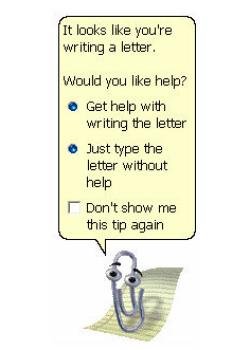
[Word] become an overbearing boss, one who specializes in make-work. Part of this is Microsoft’s more-is-more approach to adding capabilities, and leaving all of them in the “on” position. Around the first time Clippy launched himself, uninvited, between me and something I was trying to write, I found myself wishing Word had a simple, built-in button for “cut it out and never again do that thing you just did.” It’s possible that the current version of Word does have one; I have no idea where among the layers of menus and toolbars it might be. All I really know how to do up there anymore is to go in and disable AutoCorrect, so that the program will type what I’ve typed, rather than what some software engineer thinks it should think I’m trying to type.
Word’s stylistic preferences range from the irritating—the superscript “th” on ordinal numbers, the eagerness to forcibly indent any numbered list it detects—to the outright wrong. Microsoft’s inability to teach a computer to use an apostrophe correctly, through its comically misnamed “smart quotes” feature, has spread from the virtual world into the real one, till professional ballplayers take the field with amateur punctuation on their hats.
Even so, people can live with typos in their input. (Witness the boom in paraphasic email Sent From My iPhone.) What makes Word unbearable is the output. Like the fax machine, Word was designed to put things on paper. It was a tool of the desktop-publishing revolution, allowing ordinary computer users to make professional (or at least approximately professional) document layouts and to print them out. That’s great if you’re making a lot of church bulletins or lost-dog fliers. Keep on using Word. (Maybe keep better track of your dog, though.)
For most people now, though, publishing means putting things on the Web. Desktop publishing has given way to laptop or smartphone publishing. And Microsoft Word is an atrocious tool for Web writing. Its document-formatting mission means that every piece of text it creates is thickly wrapped in metadata, layer on layer of invisible, unnecessary instructions about how the words should look on paper.
Two boys debate attending the American Theater in Greenpoint, Brooklyn in 1938.
Roger Ebert explains why movie theater revenues are in free fall. Only blockbuster movies are currently keeping the whole system afloat.
I guess that’s just how things work.
You have the movie theater business, an industry whose pioneer days were a century ago. That business prospered and bloomed, but for decades now what was once a luxurious escape experience has been subjected to the careful ministrations of bean counters and corporate optimizers who have turned movie theaters, once palaces, into cheap industrial warehouse spaces operated robotically and understaffed with inadequate contingents of the bitter and indifferent working for the minimum wage.
It takes hundreds of millions for special effects, movie star salaries and blowing up all those expensive cars, but at the actual delivery end the industry has whittled every possible penny out of quality of service.
Their problems are compounded by the aging US population. Even hard-core cineastes like myself (I ran a film society at Yale) today feel out-of-place in today’s theaters. Adults buy videos or watch films on cable or the Internet these days. Teenagers go to movie theaters for the same reasons teenagers always went to movie theaters.
The film industry is being confronted by the same kinds of changes in technology and the arrival of handier and more competitive methods of product delivery that confronted the music industry, and it seems that these dinosaurs are no more able than the other dinosaurs to cope positively with new challenges and opportunities.
Old industries wind up being run by rentiers, but dramatic innovation requires visionaries and risk-takers. The motion picture industry today is run by corporations, what changing times need are the equivalent of the aggressive businessmen, recently off the boat from Poland and Lithuania, the Warners, the Zukors, the Goldwyns, and the Mayers, who created the studios and the industry in the first place. But that kind of leadership is not going to come from inside today’s industry establishment.
The Hodinkee blog recently reported that the Hublot watch company of Geneva is building a new ultra complication watch as a tribute to the Antikythera Mechanism.
The finished product, scheduled to be unveiled at a show in Basel next Spring, will combine a watch with the functions recently identified by archaeologists in the Antikythera device.
The fragment of leather on the broken bronze buckle was carbon-dated to 600 A.D.
A University of Colorado Bouilder archeology team excavating a 1000-year-old Inupiat Eskimo house at Cape Espenberg on Alaska’s Seward Peninsula found a partial bronze artifact resembling a buckle, which is apparently even older.
Bronze-casting is a technology not known ever to have existed in any New World culture, so the artifact was presumably made in Asia and reached Alaska by some unknown early system of trade.
Use your armed guards to make those children mine the Coltan faster.
Gamasutra reports that those corporate fascists over at Apple actually had the nerve to refuse to sell the game app Phone Story, by the sanctimonious Bolshie game design firm Molleindustria, via the iPhone App store, just because the app featured a series of left-wing smears directed specifically at smartphones, consumer products, and Apple.
One can picture the equivalent of Jeffrey Lebowski whining: Whatever happened to free speech, man?
[U]ntil now, few have been willing to turn the lens on this boom and examine what mass-market gadget lust is costing us ethically. Though we’ve since heard of suicides at Foxconn, deplorable working conditions and hazards to the environment involved in the manufacture of the latest hot smartphones, game developers were mostly silent — until now.
It seems natural that provocative serious games developer Molleindustria was the one to take the step. The studio, which has taken on forces like the Catholic church, McDonald’s and big oil with games like Operation Pedopriest, McDonald’s Video Game and Oiligarchy, never pulls its punches as it uses games to sharply deconstruct the social and economic constructs most people take for granted.
Its latest title, Phone Story, uses a series of minigames with voice-over narration to shed light on the human cost and high environmental impact of smartphone development. In one minigame, while the narrator explains that most electronic devices require the mining of coltan, a conflict mineral in Congo whose demand spurs war and child labor, the player must use the touch screen to guide armed soldiers to bark at exhausted child miners in order to meet the goal in time.
In another, the voice-over explains the suicides at electronics manufacturers in China, and the facile solution of “prevention nets” — while the player must catch tumbling workers using a stretched trampoline.
Of course, Phone Story is more interesting for the fact that players must interact with these messages while holding one of the devices discussed. Imagine being served hamburgers on a tour of a slaughterhouse. And all of the developer proceeds — 70 percent of total App Store revenues, as per usual — will be pledged to organizations fighting corporate abuses, starting with Students and Scholars Against Corporate Misbehavior, which supports workers in abusive conditions internationally, including at Foxconn.
Or they would be, if Phone Story had been allowed to stay on the App Store. Apple yanked it just a few hours after the game was officially announced, citing four code violations: 15.2, which prohibits depictions of child abuse, and 16.1, which prohibits apps depicting “objectionable or crude” content. The other two, 21.1 and 21.2, pertain to Phone Story’s charitable bent — and they don’t seem to quite apply, intended instead for games that allow their users to make donations within a game, rather than a pledge by the developer to donate revenues.
Molleindustria makes an iPhone game to criticize the iPhone platform, and that Apple’s chosen to silence it is an interesting punctuation mark on the developer’s statement.
Gamasutra reached out to Molleindustria’s Paolo Pedercini about iPhone Story, who credits the game’s idea to recent international affairs graduate Michael Pineschi, to whom he spoke through creative activism group YesLab. At the time, Pedercini already had some unusual ideas in the works for projects that could act as commentary on gadget fetishism.
“One of them was a multi-touchable virtual-pet vagina, monologuing about technological lust and willful submission to consumerism,” he reflects. “Unfortunately, the flesh engine didn’t work as I hoped so I went for a straightforward educational game.”
But the intent was always to develop a game as commentary on the hardware industry. “Most of the adults in the Western world are somewhat aware that most of our objects are manufactured far away, in conditions that we would consider barbaric,” Pedercini says.
“A lot of tech-aware people heard about the story of the Foxconn suicides or about the issue of electronic waste,” he continues. “But with Phone Story, we wanted to connect all these aspects and present them in the larger frame of technological consumerism.”
He specifically wanted to highlight the goal that “must-have” consumer electronics culture plays in perpetuating these high-impact cycles; one of the levels of Phone Story tasks the players with tossing brand-new boxed phones to swarming would-be buyers rushing a storefront. In his view, the marketing machine that makes people believe they absolutely need an upgraded hardware device on the day it comes out is what causes extremism in the supply chain.
“We don’t want people to stop buying smartphones,” he notes, “but maybe we can make a little contribution in terms of shifting the perception of technological lust from cool to not-that-cool. This happened before with fur coats, diamonds, cigarettes and SUVs — I can’t see why it can’t happen with iPads.”
Pedercini says it was essential to use the platform itself to stage a critique of that platform. “Almost like the device itself was speaking to the user,” he suggests. “The idea was to make a sort of reminder that you can keep with you, like a way-less-permanent tattoo or a bumper sticker, something that you carry around and maybe show off as a conversation-starter.”
But although Apple’s immediate removal of Phone Story makes for an interesting conversation point, Pedercini says he never intended it to happen this way: “I’m very familiar with the App Store policy, and the game is designed to be compliant with it,” he asserts.
“If you check the guidelines, Phone Story doesn’t really violate any rule except for the generic ‘excessively objectionable and crude content’ and maybe the ‘depiction of abuse of children’. Yes, there’s dark humor and violence but it’s cartoonish and stylized – way more mellow than a lot of other games on the App Store.”
“What makes these depictions disturbing is the connection the player makes with the real-world situation,” adds Pedercini. “Of course, the goal was to sneak an embarrassingly ugly gnome into Apple’s walled garden, but not to provoke the rejection. If it was just a matter of provocation I would have gone way further.
If you’re a communist and have to have this App, you can buy it, and the rope you need to hang capitalists, via Android Market.