Dan Greenfield explains how the left turns a political vulnerability into an electoral asset: they frame the narrative.
A debate on the availability of contraception, no matter how well handled, only served the narrative of one side. No matter how well the debate was conducted, it meant that the right was now fighting on the battlefield that had been chosen by the left. All it took was a few sexual insults lobbed Fluke’s way for the diversion to be complete. The right was now either retreating from sexism charges or engaging in it. The social issue was framed in exactly the terms that fit the left’s narrative.
Limbaugh’s apology was nearly as bad of an idea as his original statement. The only time you advance into an enemy’s choice of terrain is when you are confident of being able to fight there and win. You do not give up the high ground just to take a few potshots at the enemy. After a temporary satisfaction, you end up losing the battlefield and being drawn into a battle that you never meant to fight. When that happens, you circle around and take back the high ground, you do not surrender because then there is nothing left to fight for.
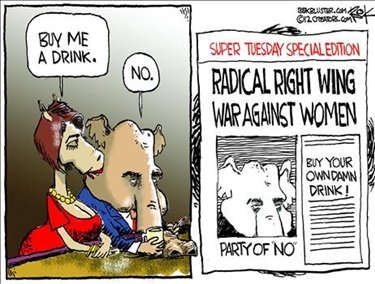
The left’s coalitions depend on portraying the other side as engaging in a war on their protected groups. Without that war, their whole feudal lordships suddenly become unnecessary. That means it is in their vital interest to define each policy conflict as a Republican war on a protected class. While it’s advantageous at times to confront them on this when their position is weakest and ridicule it, it wasn’t worth surrendering the coalition of religious freedom to take a few potshots at the absurdity of Fluke’s testimony. Fluke, like every organizer from a protected class, is there to represent an entire group. Attacking her quickly becomes a diversion into the left’s narrative of a war on women.
Religious institutions imposed the terms of the battle by rebelling against the mandate. That forced Obama and his cronies to try and dismiss the battle, refusing to fight on that terrain. But Republicans and even some Democrats insisted on rallying on the field anyway, calling for a battle. So Team Obama diverted the battle to the terrain of their choice. They set new terms of battle, an effort which initially failed, until Limbaugh gave them the talking point they needed.
It is now an uphill battle to return to the original battlefield. It’s possible, but the initial skirmish has gone to the left which was successfully able to dictate the terms of the engagement. Their narrative has no life though, until the right breathes life into it. The larger lesson though is about the terms of battle. It is about the strategy of political warfare.
To win in 2012, the left needs to mobilize its coalition. To do that it doesn’t necessarily need to win battles, it needs to successfully position them on its choice of terrain. It needs to be seen as the feudal lords protecting the rainbow peasantry from the hordes of the right. The purpose of the whole thing is to convince the peasants to support King Hussein, despite the disastrous economy and the general malaise, the abuses of power and all the other problems with his rule.
Both sides exploit a sense of vulnerability in the population during troubled times. The left excels at cross-sectioning the population into specific groups, dividing them up, and making them feel vulnerable as a class, as a group, as a gender, as a race. Organizers emphasize that victimization and offer them a sense of empowerment through the coalition. Or as Obama puts it, “Better Together.”
The path to victory lies in either gathering the largest coalition or in fragmenting the coalition of the other side. The left is not very good at the former, its own habits and tactics limit its scope, but it is quite good at the second. It gains power through disruption, through terror and intimidation, it plays on fears, pits groups against each other and then steps in as the mediator.
It would not be nearly as effective at this if it did not also control the culture’s narrative through the media, popular culture and academia, giving it control of highbrow and lowbrow narratives at the same time. This makes it more difficult to counter its narrative or to choose the field of battle and makes it that much more dangerous to abandon a strategic position for a target of opportunity.
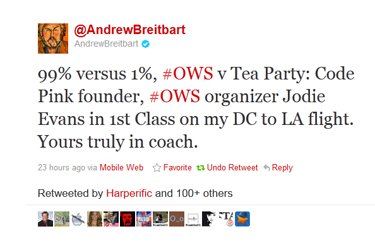
The American left responded with characteristic class yesterday when confronted with the sudden death of prominent conservative blogger Andrew Breitbart.
Twitter erupted with unconcealed expressions of liberal delight at news of the death of a political opponent.
Typical examples:
AlmightyBob †@AlmightyBoob : @AndrewBreitbart haha youre dead and in hell being a gay with hitler
Dave Lartigue †@daveexmachina : Andrew Breitbart has died. Honestly, good riddance. He helped poison the country where I live and we are better off without him.
DAC †@dac2527 : Satan calls Andrew Breitbart home… Good riddance!
The most prominent leftwinger to comment on Twitter was Matt Yglesias (@mattyglesias) who contributed: “Conventions around dead people are ridiculous. The world outlook is slightly improved with @AndrewBrietbart dead.”
———————-
The response on Twitter was pretty bad, but Rolling Stone’s Nicholas Kamm had a go at topping all that in a gleeful farewell piece titled: Death of a Douche.
So Andrew Breitbart is dead. Here’s what I have to say to that, and I’m sure Breitbart himself would have respected this reaction: Good! Fuck him. I couldn’t be happier that he’s dead.
I say this in the nicest possible way. I actually kind of liked Andrew Breitbart. Not in the sense that I would ever have wanted to hang out with him, or even be caught within a hundred yards of him without a Haz-Mat suit on, but I respected the shamelessness. Breitbart didn’t do anything by halves, and even his most ardent detractors had to admit that he had a highly developed, if not always funny, sense of humor.
———————-
Still, in many ways, an even more impressive example of seriously bad form was turned in by the perennial-critic-of-conservatism-pretending-to-reside-within-its-ranks Andrew Frum.
And this is where it becomes difficult to honor the Roman injunction to speak no ill of the dead. It’s difficult for me to assess Breitbart’s impact upon American media and American politics as anything other than poisonous. When one of the leading media figures of the day achieves his success by his giddy disdain for truth and fairness—when one of our leading political figures offers to his admirers a politics inflamed by rage and devoid of ideas—how to withhold a profoundly negative judgment on his life and career?
Andrew Breitbart died today. But he took David Frum’s last shred of credibility with him. …
David Frum exceeded Andrew Breitbart in one measure only, span of life.
But not in life.
David Frum will die as he lived, gray, timid, small, spiteful, cramped in thought and bent in spirit, slender of talent and obese in self-regard, unloved, unnoticed, unremembered and unread.
In the Wall Street Journal, James Taranto discusses Jeffrey Bell’s new book, which argues that the politics of the culture wars inevitably fuels Republican electoral victories.
Social issues have come to the fore on the GOP side in two of the past six presidential elections—in 1988 (prison furloughs, the Pledge of Allegiance, the ACLU) and 2004 (same-sex marriage). “Those are the only two elections since Reagan where the Republican Party has won a popular majority,” Mr. Bell says. “It isn’t coincidental.”
Mr. Bell, 68, is an unlikely tribune for social conservatism. His main interest has always been economics. He was “an early supply-sider” who worked on Ronald Reagan’s presidential campaigns of 1976 and 1980 and Jack Kemp’s in 1988. In 1978 he ran an anti-tax campaign for the U.S. Senate in New Jersey, defeating Republican incumbent Clifford Case in the primary but losing to Democrat Bill Bradley.
Even now his day job is to advocate for the gold standard at the American Principles Project. But he’s been interested in social issues since the 1980s, when “it became increasingly clear to me . . . that social issues were beginning to be very important in comparison to economic issues,” in part because “Reaganomics worked so well that the Democrats . . . kind of retired the economic issues.”
In Mr. Bell’s telling, social conservatism is both relatively new and uniquely American, and it is a response to aggression, not an initiation of it. The left has had “its center of gravity in social issues” since the French Revolution, he says. “Yes, the left at that time, with people like Robespierre, was interested in overthrowing the monarchy and the French aristocracy. But they were even more vehemently in favor of bringing down institutions like the family and organized religion. In that regard, the left has never changed. . . . I think we’ve had a good illustration of it in the last month or so.”
He means the ObamaCare mandate that religious institutions must provide employee insurance for contraceptive services, including abortifacient drugs and sterilization procedures, even if doing so would violate their moral teachings. “You would think that once the economy started looking a little better, Obama would want to take a bow . . . but instead all of a sudden you have this contraception flap. From what I can find out about it, it wasn’t a miscalculation. They knew that the Catholic Church and other believers were going to push back against this thing. . . . They were determined to push it through, because it’s their irreplaceable ideological core. . . . The left keeps putting these issues into the mix, and they do it very deliberately, and I think they do it as a matter of principle.”
Another example: “In the lame-duck session of the last Congress, when the Democrats had their last [House] majority . . . what was their biggest priority? Well, they let the Bush tax cuts be renewed for another couple of years, but what they did get through was gays in the military. . . . It keeps coming back because it’s the agenda of the left. They’re not going to leave these issues alone.”
American social conservatism, Mr. Bell says, began in response to the sexual revolution, which since the 1960s has been “the biggest agenda item and the biggest success story of the left.” That was true in Western Europe and Japan too, but only in America did a socially conservative opposition arise.
I’m an irreligious, libertine, libertarian conservative, personally completely and totally in favor of contraception and legal abortion, and I found myself recently defending the rights of Roman Catholic institutions, and even arguing with my Yale classmates that the perspective of Right-to-Lifers is morally serious and worthy of respect.
Liberal arrogance and intolerance is so great that I think it is true that a surprisingly large number of economic conservatives who have no close personal relationship whatsoever to Religion and Family Values can see themselves supporting Rick Santorum against Barack Obama very easily. The Left is the aggressor in the culture wars, and most Americans are basically decent people who reflexively side with the victim against the bully.
The stupid, backward, and sexually inadequate residents of China and Vietnam suffer from a delusion that consuming the horn of the rhinoceros (black or white) will increase, or restore, their potency. The usual associative sympathetic magical thinking is behind all this. Rhino horns are long, impressively stout protuberances, so their consumption is supposed to result in long, impressively stout et ceteras for Chinamen.
Stupid, backward, and ethically-challenged black African poachers kill rhinoceros for their horns which get to East Asia via totally illegal black market smuggling operations.
This is all very regrettable, of course.
So what do noble and idealistic left-wingers do about THE PROBLEM?
They modify popular videos that bourgeois residents of Western democracies watch, deceptively labeling new versions remixed with heart-wrenching images of dying and mutilated rhinos. Pirating somebody else’s content in order to mislead people into watching their own advertisements (they made 60 of these) is left-wingers’ idea of a clever intervention.
Watching their disgusting advertisements is intended to get you to start weeping big salty tears over all those poor dead rhinos and make you sign this petition.
This petition, as far as I can see, includes no specific proposals of any kind. So you would really be signing the equivalent of a kind of political blank check, indicating that you are oh-so-very concerned about poor rhinos and believe that Something Must Be Done.
What that Something might consist of is unknown. But if you are stupid enough to sign, you are indicating agreement with the theory that you (residing almost certainly in a location with no rhinos and being yourself a non-consumer of medications made from rhino-horn) nonetheless subscribe to the theory that you are personally responsible for the foolish and unethical actions of various Africans and Asians totally unknown to you, and believe that the Congress of the United States (despite its complete lack of authority over Africa & Asia) is also obliged to do something about all of this, beyond agreeing to the CITES treaty and all the other things Congress has already done.
That moron Andrew Sullivan and an advertising blogging asshole who calls himself copyranter both thought deceiving Internet video watchers into accessing agitprop crap was clever and worthy of commendation. Personally, I wish Vlad the Impaler were around today to punish Internet fraud, along with its encouragement and support, in his traditional old-fashioned way using some very long rhino horns.
Dan Greenfield unloads on the very same people with this superb essay:
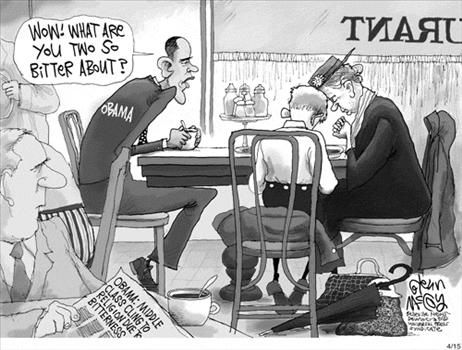
The American liberal is not a populist, he is still a New England preacher, but without a religion to preach. He has a great faith in the virtues of an ordered moral society, even if that ordered moral society would have been completely incomprehensible and unacceptable to his forebears. It is a society based on the virtues of tolerance and the rule of the enlightened.
The inflow of the European left has brought in a strain of power to the people populism, but that has not made the American liberal take seriously the notion that the people whose rights he defends are his intellectual or social equals, no more than the 19th century New York Republicans patting African-Americans on the head while stomping on the Irish viewed either group as equals.
American liberalism has traveled a slightly altered road to get to the same place. But its place is still at the top and everyone else’s place is still at the bottom. Its persistent denial of this basic truth leads to the perennial absurdity of millionaires like Elizabeth Warren playing class warrior when the only class they represent is the class of people who work for the government.
The oligarchy which is busy bleeding the country dry does not represent any group of working people anywhere in the country. Not Protestant or Catholic, black or white, or of any other creed or identity. Like every ideology incarnated in a system, it represents its own interests. The Democratic Party is the government party. It exists to create jobs in government, to dispense government subsidies and to expand the power and scope of its organization. It is not fundamentally any different than Putin’s United Russia or Israel’s Kadima or similar political creatures around the world.
The strange intermarriage of New England moralists, New York merchants and European radicals eventually led to a system of pushing immigrants into government service, mandating tolerance and running every aspect of human life through Washington D.C. It took a while to get there, but the system is a decade or two away from being complete. When it is complete then all our lives will be run in every possible way by the Elizabeth Warrens who will smile condescendingly at us, nudge us in the direction we are supposed to go, and when we don’t go there, then the fines and the tasers come out.
No matter how far back you go, the roots of American liberalism lie in a fear of the people, a distrust of the great unwashed. American liberals have championed voting rights, so long as they were confident that those voting were their inferiors and could be herded into voting the right way. They have always distrusted the instincts of the public, no matter how much pious ink they spilled fighting on their behalf.
That view of man’s sinful nature still informs their deepest thinkers, and the sins are still the same, the failure of fellowship, the refusal to consider the welfare of others and march in lockstep to create that ideal society. The New Jerusalem of universal brotherhood. Those ideas have been dressed up in modern clothing, transmitted as denunciations of racism and bigotry, immigration advocacy and hate crime laws, but underneath is the same notion that a society of good will to all can be forced through rigorous regimentation by the truly enlightened.
The populism of the American liberal is a cynical dumbshow where representatives of the oppressed gather in conclaves to demand more oppression by their liberal oppressors. This spectacle is at the heart of a political oligarchy, which like every oligarchy is built on government subsidies and special access to power for the privileged. And like all oligarchies it must disguise its nature by playing the protector of the people. Unlike them it must also disguise its true nature from itself.
The convergence of the ideal society and the government society was inevitable from the start. It took a while to overcome the technological and cultural barriers to running an entire country from a central point. Those barriers have never been truly overcome, but the technocratic mirage makes it seem as if they have been. And the ongoing faith in a perfectible society run by the saints makes it seem as if it must be.
The American liberal would still like to play at being humble, a 99 percenter fighting against the chimera of a 1 percent oligarchy. But the entire 99 percent theme is that the 1 percent isn’t paying enough taxes. And whom do those taxes go to but to the administration and employment of the professional class warrior millionaires.
It is the very Everest of hypocrisy for the members of the oligarchy to be bemoaning all the extra tax money that could be used to pay their six figure salaries, while passing off their naked greed as a crusade on behalf of the oppressed.
Mark Steyn takes at look at America’s situation at the beginning of the New Year, and concludes that the welfare state is self-destructing, but the establishment elites would rather save the planet than balance the national books.
At the end of 2011, America, like much of the rest of the Western world, has dug deeper into a cocoon of denial. Tens of millions of Americans remain unaware that this nation is broke — broker than any nation has ever been. A few days before Christmas, we sailed across the psychological Rubicon and joined the club of nations whose government debt now exceeds their total GDP. It barely raised a murmur — and those who took the trouble to address the issue noted complacently that our 100 percent debt-to-GDP ratio is a mere two-thirds of Greece’s. That’s true, but at a certain point per capita comparisons are less relevant than the sheer hard dollar sums: Greece owes a few rinky-dink billions; America owes more money than anyone has ever owed anybody ever.
Public debt has increased by 67 percent over the last three years, and too many Americans refuse even to see it as a problem. For most of us, “$16.4 trillion†has no real meaning, any more than “$17.9 trillion†or “$28.3 trillion†or “$147.8 bazillion.†It doesn’t even have much meaning for the guys spending the dough: Look into the eyes of Barack Obama or Harry Reid or Barney Frank, and you realize that, even as they’re borrowing all this money, they have no serious intention of paying any of it back. That’s to say, there is no politically plausible scenario under which the 16.4 trillion is reduced to 13.7 trillion, and then 7.9 trillion, and eventually 173 dollars and 48 cents. At the deepest levels within our governing structures, we are committed to living beyond our means on a scale no civilization has ever done.
Our most enlightened citizens think it’s rather vulgar and boorish to obsess about debt. The urbane, educated, Western progressive would rather “save the planet,†a cause which offers the grandiose narcissism that, say, reforming Medicare lacks. So, for example, a pipeline delivering Canadian energy from Alberta to Texas is blocked by the president on no grounds whatsoever except that the very thought of it is an aesthetic affront to the moneyed Sierra Club types who infest his fundraisers. The offending energy, of course, does not simply get mothballed in the Canadian attic: The Dominion’s prime minister has already pointed out that they’ll sell it to the Chinese, whose Politburo lacks our exquisitely refined revulsion at economic dynamism, and indeed seems increasingly amused by it. Pace the ecopalyptics, the planet will be just fine: Would it kill you to try saving your country, or state, or municipality? …
What indeed? In September, the tenth anniversary of a murderous strike at the heart of America’s most glittering city was commemorated at a building site: The Empire State Building was finished in 18 months during a depression, but in the 21st century the global superpower cannot put up two replacement skyscrapers within a decade. The 9/11 memorial museum was supposed to open on the eleventh anniversary, this coming September. On Thursday, Mayor Bloomberg announced that there is “no chance of it being open on time.†No big deal. What’s one more endlessly delayed, inefficient, over-bureaucratized construction project in a sclerotic republic?
Barely had the 9/11 observances ended than America’s gilded if somewhat long-in-the-tooth youth took to the streets of Lower Manhattan to launch “Occupy Wall Street.†The young certainly should be mad about something: After all, it’s their future that got looted to bribe the present. As things stand, they’ll end their days in an impoverished, violent, disease-ridden swamp of dysfunction that would be all but unrecognizable to Americans of the mid–20th century — and, if that’s not reason to take to the streets, what is? Alas, our somnolent youth are also laboring under the misapprehension that advanced Western societies still have somebody to stick it to. The total combined wealth of the Forbes 400 richest Americans is $1.5 trillion. So, if you confiscated the lot, it would barely cover one Obama debt-ceiling increase. Nevertheless, America’s student princes’ main demand was that someone else should pick up the six-figure tab for their leisurely half-decade varsity of Social Justice studies. Lest sticking it to the Man by demanding the Man write them a large check sound insufficiently idealistic, they also wanted a trillion dollars for “ecological restoration.†Hey, why not? What difference is another lousy trill gonna make?
Underneath the patchouli and pneumatic drumming, the starry-eyed young share the same cobwebbed parochial assumptions of permanence as their grandparents: We’re gayer, greener, and groovier, but other than that it’s still 1950 and we’ve got more money than anybody else on the planet, so why get hung up about a few trillion here and a few trillion there? In a mere half century, the richest nation on earth became the brokest nation in history, but the attitudes and assumptions of half the population and 90 percent of the ruling class remain unchanged.
Professor Stephen G. Bloom: “I’ve lived in many places, lots of them foreign countries, but none has been more foreign to me than Iowa.”
Stephen G. Bloom, a professor at the University of Iowa, in the Atlantic, describes with wonder and deep contempt the bizarre and backward culture of the state in which he disapprovingly resides.
Whether a schizophrenic, economically-depressed, and some say, culturally-challenged state like Iowa should host the first grassroots referendum to determine who will be the next president isn’t at issue. It’s been this way since 1972, and there are no signs that it’s going to change. In a perfect world, no way would Iowa ever be considered representative of America, or even a small part of it. Iowa’s not representative of much. There are few minorities, no sizable cities, and the state’s about to lose one of its five seats in the U.S. House because its population is shifting; any growth is negligible. Still, thanks to a host of nonsensical political precedents, whoever wins the Iowa Caucuses in January will very likely have a 50 percent chance of being elected president 11 months later. Go figure.
Maybe Ambrose Bierce described it right when he called the U.S. president “the greased pig in the field game of American politics.” For better or worse, Iowa’s the place where that greased pig gets generally gets grabbed first. …
Iowa is a throwback to yesteryear and, at the same time, a cautionary tale of what lies around the corner.
Which brings up my dog. And here’s why: My dog is a kind of crucible of Iowa.
What does Hannah, a 13-year-old Labrador, have to do with an analysis of the American electoral system and how screwy it is that a place like Iowa gets to choose — before anyone else — the person who may become the next leader of the free world?
For our son’s eighth birthday, we wanted to get him a dog. Every boy needs a dog, my wife and I agreed, and off we went to an Iowa breeding farm to pick out an eight-week-old puppy that, when we knelt to pet her, wouldn’t stop licking us. We chose a yellow Lab because they like kids, have pleasant dispositions, and I was particularly fond of her caramel-color coat. Labs don’t generally bite people, although they do like to chew on shoes, hats, and sofa legs. Hannah was Marley before Marley.
Our son, of course, got tired of Hannah after a couple of months, and to whom did the daily obligation of walking the dog fall?
That’s right. To me.
And here’s the point: I can’t tell you how often over the years I’d be walking Hannah in our neighborhood and someone in a pickup would pull over and shout some variation of the following:
“Bet she hunts well.”
“Do much hunting with the bitch?”
“Where you hunt her?”
To me, it summed up Iowa. You’d never get a dog because you might just want to walk with the dog or to throw a ball for her to fetch. No, that’s not a reason to own a dog in Iowa. You get a dog to track and bag animals that you want to stuff, mount, or eat.
That’s the place that may very well determine the next U.S. president.
Farhad Manjoo, Cornell ’00, is Slate’s Technology Columnist, so his take on toy guns, one would expect, ought to be well-informed, sophisticated, appreciative, and realistic.
A technology columnist really ought to be the sort of person who knows all about real guns. Firearms are an extremely important and interesting, downright fundamental, form of technology, after all.
But Farhad Manjoo’s holiday article in Stale this year is rather different from what one might have expected.
Nerf guns (which propel sponge rubber tipped plastic darts) frighten Manjoo and send him into a tizzy of anxiety. He describes the Nerf Barricade as “one of the most powerful toy weapons ever built, capable of sending a 3-inch foam dart hurtling 30 feet through the air, and then doing it again and again every half second.”
How does that compare, Mr. Technology Columnist, to the old Daisy Model 25 pump action BB-gun, my generation’s idea of a toy gun, which fired a copper-plated .177″ diameter BB at a velocity ranging from 375-450 fps (fast enough to break glass) from a tubular magazine as rapidly as you could pump the slide?
Shooting one’s friends in the face was regarded as verboten (you might put out an eye), but BB gun wars did regularly occur. The impact of a BB on human flesh stung smartly, even through clothing, and characteristically left a mark. It was a common form of deterrence to shoot oneself in the hand without flinching and then display the bruise. One’s interlocutor was thereby given to understand that you were not afraid of being shot with a BB gun, and was significantly less inclined to initiate hostilities.
Older generations of American boys additionally commonly played with home-made slingshots, a leather pad attached to two lengths of rubber strips cut from a discarded inner tube then affixed to a Y-forked branch. A good slingshot could propel much larger projectiles like marbles, ball bearings, or suitable rocks with good accuracy at very effectively damaging velocities.
We were bloodthirsty hunters in my boyhood, and we used to, I regret to say, kill the occasional incautious songbird with those BB guns. More becomingly, we also sometimes successfully nailed a rat found skulking in the open around the dump with our slingshots. (BBs just bounced off rats.) Try taking any variety of game with a Nerf gun.
But, it isn’t really the ballistic capabilities of the Nerf gun arsenal that sent Mr. Manjoo into a tailspin. It is, of course, the ethical considerations.
Over the past few weeks I’ve been playing with some of the new Nerf guns, and I’ve tied myself in knots thinking about whether ultrarealistic weapons are just harmless fun or whether they reveal something terribly wrong with modern American boyhood.
One feels bound to question the expertise and judgment of the technology expert who would describe the above Nerf Barricade as “ultrarealistic.” So few real firearms are made of yellow plastic, and when Mr. Manjoo expresses awed respect for a toy gun’s ability to propel a harmless foam rubber dart 30′, he seems to have lost completely any sense of proportion and relative capability between the real weapon and the toy.
Someone who finds a harmless toy “scary” is, by my standards, an incredible wimp. And the kind of people who have all these hyper-sensitivities and moral issues over boys playing at war are prigs and decadents. Our blue state pseudo-intelligentsia resides in a haute bourgeois dreamworld, perfectly safe and far removed from the ugly realities of human conflict and criminal predation, protected by rough men they neither know nor respect, in homogeneous enclaves in which they have created their own Eloi-style culture in which gross moral self-indulgence parallels their conspicuous material well being.
Why should he? People only enjoy doing what they are good at. Barack Obama obviously finds himself lacking the leadership skills and temperament needed to be a successful president. He isn’t good at his job. He isn’t successful at it, so it is consequently no fun.
Ace summarizes and talks back to the commentators.
There is a little more to all this, which I think needs to be noted. Obama’s failure doubtless has several causes, but I think his presidency is particularly interesting because Barack Obama is really demonstrating the failure of liberal economic policies publicly and emphatically because he so firmly believes in them.
Barack Obama is a classic product and representative of elite American academic culture. He knows what the consensus of the best people is. He believes in, and in fact personally embodies, that consensus. The American liberal elite comprises the best people with the best educations occupying the top positions in the most prestigious institutions. How could they possibly be mistaken or misinformed about anything?
Barack Obama has done exactly what he was supposed to do, on the basis of the consensus of the best people, and it hasn’t turned the economy around or even resulted in the masses rallying to his cause. No wonder he is depressed and at a loss.
Moe Lane marvels that, after so long a time, the Democrat Party’s New Deal coalition, consisting of “unions, city machines, blue-collar workers, farmers, blacks, people on relief, and generally non-affluent progressive intellectuals,” is being pronounced dead by the New York Times. The new coalition of the American left is simply writing off the white working class, period.
Whether you agreed with the New Deal program or not, you could always actually define it in terms that were internally self-consistent. Broadly speaking, it was a broad agreement among various groups that America’s most pressing problems could be managed and ameliorated on a broad scale through ‘expert’ and judicious government intervention; and that such intervention dampened the uncertainty and anxiety that might otherwise cause societal panics and economic dislocations. Again: you don’t have to agree with that (I don’t) to recognize that it existed as a coherent policy.
But now that has gone by the wayside, to be replaced with a system that . . . apparently plans to trade support for permanent government dependency programs for minorities, in exchange for legislating the fringe progressive morality of affluent urbanites. Aside from the utter lack of an unifying intellectual or moral framework to such an arrangement, it’s unclear exactly who benefits less from it; while it’s certainly not in minority voters’ long, medium, or short-term interests to become a permanent underclass, it’s not exactly clear that minority voters are even particularly ready to vote for a progressive social policy (as an examination of recent reversals in same-sex marriage movement in California and Maryland will readily attest). But then, that is not really the goal, is it? The goal is to re-elect President Obama — which is something that poor African-American and rich liberal voters both wish to do — and if that is accomplished, then anything else is extra. Which is just as well, because nobody really expects Obama to have much in the way of coat-tails this go-round.
Jim Geraughty, in his Morning Jolt email, responds:
Ah, but look, today’s Democratic party isn’t really about addressing economic opportunity or even dealing with America’s most pressing problems. For starters, many Democrats are not persuaded in the slightest that the annual deficit, accumulating debt, and ticking time bomb of entitlements are pressing problems at all. If Democrats really expected electing Obama would solve problems, they would be angrier with him than we are. No, for most Democrats, their political party is about a cultural identity. That identity is heavily based on not being one of those people — i.e., Republicans or conservatives. As far as I can tell, there are three inviolate principles in the modern Democratic Party:
Any form of consensual sexual behavior is to be accepted — if not celebrated. With that central belief comes the policies of abortion on demand for any woman at any age free, free contraceptives in schools, and gay marriage, and the insistence that Bill Clinton’s lying under oath about Monica Lewinsky didn’t matter because it was about sex. Complaining about explicit sexual content in pop culture reaching an audience that isn’t ready for it — e.g., Tipper Gore in the 1980s — is the sign of the square and the prude. As no less an expert political philosopher than Meghan McCain told us, “the GOP doesn’t understand sex” and has “an unhealthy attitude about sex and desire.” (Republicans are supposedly repressed and sexless, even though they generally have more children.)
America is a deeply racist country, even though you have to look far and wide to find anyone who openly expresses the belief that one race is superior to another. Everybody recoils when Imus says something snide and obnoxious about the Rutgers womens’ basketball team. Racism is never found in the central tenet of affirmative action, that minorities must be judged by a lower standard, or in the until-recently all-white lineup of MSNBC, or in the claims that Clarence Thomas and Herman Cain are Uncle Toms, or in the career of Robert Byrd. The fundamental belief of the Democratic party is that racism remains a serious problem in America today, and that the problem is found entirely in the GOP.
Credentials are to be respected, and any scoffing or skepticism at, say, the Ivy League is a sign of anti-intellectualism, ignorance, jealousy, and insecurity. Those who go there are indeed the best and the brightest; undergraduate and graduate degrees from those schools are key indicators of one’s intelligence, good judgment, and overall character. The success of dropouts Bill Gates, Steve Jobs, and Mark Zuckerberg are strange anomalies, and no serious reevaluation of the higher-education system is needed. As Rush Limbaugh observed, Bill Clinton said he wanted a cabinet that “looked like America” and declared he had achieved it after assembling a group that consisted almost entirely of Ivy League-educated lawyers.
Everything else is negotiable. For a while, it appeared that Democrats were organizing themselves around the principle that almost every dispute with every other nation and group can be resolved through “tough, smart diplomacy.” But now President Obama has started killing foreigners left and right, and not too many Democrats complain at all. Obama even used a drone to kill an American citizen, Anwar al-Alwaki, with nary a peep. Don’t get me wrong, Alwaki had it coming, but this is precisely the sort of don’t-bother-me-with-legal-details-I’m-fighting-a-war philosophy that Democrats spent seven years denouncing.
You think the Democratic party cares about wealth? Come on. In their minds, George Soros spending his money to help out his political views is noble, but the Koch Brothers are evil incarnate. Higher taxes are good, but no one will complain if Tim Geithner or Charlie Rangel cut corners on paying them. One might be tempted to argue that the righteousness of unions represent an inviolate principle to Democrats, but in New York, Democratic governor Andrew Cuomo is trimming here and there and living to tell the tale.
No, the party really is about identity politics now — us vs. them. And everybody knows which side they’re on.
James Taranto deconstructs the Occupy protest movement and concludes that the movement’s lack of rational goals and legitimate grievances is symptomatic of the position of the left in general. The left wants attention, the left wants to make a noise, but the left hasn’t actually got anything to say. Taranto asks: “[W]ith the exception of same-sex marriage, can you think of a single new idea that has come out of the left since Lyndon Johnson was president?”
“They paused to scream at the walls of a Citibank branch.”
To our mind, that sentence more than anything we’ve read encapsulates the spirit of Obamaville. It originally appeared in a San Francisco Chronicle story about an incident in which “dozens of college students” invaded a Bank of America Branch, “pitching a tent and chanting ‘shame, shame’ until they were arrested.” (The original Web version of the story is available here.)
What do we want? Uh . . .
On the way to B of A, they paused at Citi to scream at the walls. These are college students, acting like 2-year-olds throwing a tantrum. What does that tell you about their critical thinking skills–and about the standards of American higher education? The likes of the New York Times expect us to take such incoherent spasms of rage seriously as a political “movement.” What does that tell us about the standards of the liberal media?