T. Elliot Gaiser responds to the liberal desire to protect the innocent from the allegedly coercive power of marketing.
The progressive vision of the world seems to hold unshakable faith in expert studies as revealing the truth. This vision also assumes that people, being naturally good and rational after Rousseau’s doctrines, will always make the right choice if they have the right information. The progressive views supposedly false information that could lead people to choose something the experts have ruled the wrong choice (e.g. advertising by Pepsi, or Tobacco companies for that matter) as a dire threat to freedom. It’s like good marketing for something the experts don’t like is coercion in the progressive mind.
But a free society will not long endure if every time “studies” say particular behavior is harmful, the federal government is called in to curb free speech because it might influence people in a direction contrary to contemporary science. Even the most teeth-destroying sugar water supplier deserve to make an argument for their product. To paraphrase Voltaire’s phrase, I may disagree vehemently with your advertising, but I’ll defend to the death your right to advertise.
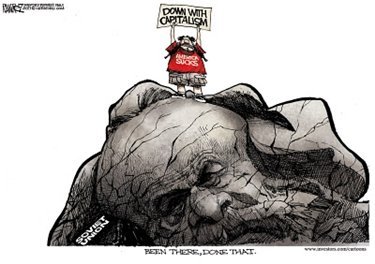
An announced visit to New York by former Polish President, and leader of the Solidarity movement, Lech WaÅ‚Ä™sa to stand with, and endorse, the Occupy Wall Street protests was slated to be a major coup for the International left. A hero of the anti-Communist labor movement which liberated Poland from the Soviet Empire endorsing OWS would prove, once and for all, that the demonstrations represented a legitimate, mainstream expression of protest, and that they were not simply astroturf, a fraudulent, artificially contrived, and unrepresentative collection of assemblies of bums, bohemians, and gullible students out for a good time, representing nothing in particular and with no rational agenda, arranged by the hard-core radical left to wave the red flag prominently as a form of agitation at a time in which the left’s grip on political power can be perceived imminently to be slipping away.
Matt Yglesias, in fact, was quick to have a go at hiding the commies behind the anti-Communist hero Wałęsa in his apologia for Occupy Wall Street in The New Republic.
The notion that Occupy Wall Street is a fundamentally radical anti-capitalist movement is completely without foundation. Not only is it odd for TNR to take a harder anti-communist line than, say, Lech Walesa, but this view misunderstands the basic nature of a fluid and rapidly growing movement. The participation of some radicals in the initial organization of the Zuccotti Park protest shouldn’t distract from the fact that the movement has grown by attracting a diverse set of adherents united primarily by an appropriate sense of grievance.
“See?” says Yglesias, “If Lech WaÅ‚Ä™sa is willing to stand with them, those protestors cannot possibly be anti-capitalist radicals, agitating for a Marxist revolution.”
But, sorry, Matt, what the American left failed to reckon with, when it tried pulling journalistic strings in Europe to secure a visit and endorsement from Wałęsa is the fact that a significant Polish community exists in the United States, particularly in Chicago, and educated, articulate, and responsible Poles live here, who have family, academic, and political ties to their Fatherland. Ethnic communities with roots in former communist dictatorships and captive nations. not surprisingly, loathe Communism. Poles feel about Marxism and the Left exactly the same way Cubans do. Communists? They hate those guys.
So, what do you know? It just so happened that, hearing reports of that proposed OWS endorsement, an Illinois businessman and political activist with Polish roots named Adam Andrzejewski made it a point to get in touch with people in the Old Country in contact with Wałęsa, to share with him some home truths about just who is who and what is what about those Occupy* protests.
Andrzejewski himself explains what happened at Big Government.
When Walesa’s comments hit the AP wire last week, my team immediately reached out to our Polish contacts. We made the point that the political themes of Occupy Wall Street may have started out with some of the principles that we share, but OWS themes were rapidly being morphed into anti-freedom and anti-liberty messages. At the core is the want for a big, powerful central government to dominate the lives of individual citizens.
Using biggovernment.com plus other news sources, rapidly we painted an accurate picture of the groups training, leading, and organizing the “movement.†The movement is organized by anarchists, Code Pink, the American Communist movement, jihadists, anti-Israel, socialist, and anti- free enterprise interests. OWS folks are politically to the left of President Barack Obama.
At the Lech Walesa Institute Foundation in Warsaw, they were thankful to receive this information.
Based on our discussion and intervention, President Walesa is not going to get involved with the OWS. He is not comfortable with the “organizations†behind the movement. It was not a difficult discussion.
The lifetime of good work exercised by President Walesa has lifted people around the world fighting tyranny. Through the Lech Walesa Institute Foundation in Warsaw, Walesa has supported freedom and liberty around the world. As a man primarily responsible for vanquishing communism in Poland, Walesa has a personal bent toward helping the underdog and the downtrodden.
This spring, when President Obama visited Poland, President Walesa refused to meet with him.
So, no, Mr. Yglesias, you guys did not succeed in bamboozling an aging anti-Communist hero into serving as a useful idiot, and, yes, your protest movement is “fundamentally a radical anti-capitalist” piece of communist agitprop. You lose.
Doug Schoen, Bill Clinton’s former pollster, in the Wall Street Journal, investigated just who is participating in the Occupy Wall Street protest and what they really represent.
[T]he Occupy Wall Street movement reflects values that are dangerously out of touch with the broad mass of the American people—and particularly with swing voters who are largely independent and have been trending away from the president since the debate over health-care reform.
The protesters have a distinct ideology and are bound by a deep commitment to radical left-wing policies. On Oct. 10 and 11, Arielle Alter Confino, a senior researcher at my polling firm, interviewed nearly 200 protesters in New York’s Zuccotti Park. Our findings probably represent the first systematic random sample of Occupy Wall Street opinion.
Our research shows clearly that the movement doesn’t represent unemployed America and is not ideologically diverse. Rather, it comprises an unrepresentative segment of the electorate that believes in radical redistribution of wealth, civil disobedience and, in some instances, violence. Half (52%) have participated in a political movement before, virtually all (98%) say they would support civil disobedience to achieve their goals, and nearly one-third (31%) would support violence to advance their agenda.
The vast majority of demonstrators are actually employed, and the proportion of protesters unemployed (15%) is within single digits of the national unemployment rate (9.1%).
An overwhelming majority of demonstrators supported Barack Obama in 2008. Now 51% disapprove of the president while 44% approve, and only 48% say they will vote to re-elect him in 2012, while at least a quarter won’t vote.
Fewer than one in three (32%) call themselves Democrats, while roughly the same proportion (33%) say they aren’t represented by any political party.
What binds a large majority of the protesters together—regardless of age, socioeconomic status or education—is a deep commitment to left-wing policies: opposition to free-market capitalism and support for radical redistribution of wealth, intense regulation of the private sector, and protectionist policies to keep American jobs from going overseas.
Sixty-five percent say that government has a moral responsibility to guarantee all citizens access to affordable health care, a college education, and a secure retirement—no matter the cost. By a large margin (77%-22%), they support raising taxes on the wealthiest Americans, but 58% oppose raising taxes for everybody, with only 36% in favor. And by a close margin, protesters are divided on whether the bank bailouts were necessary (49%) or unnecessary (51%).
Thus Occupy Wall Street is a group of engaged progressives who are disillusioned with the capitalist system and have a distinct activist orientation.
And, what do you know? These people are not the economically distressed and the unemployed. They are your rancid communists, the lunatic fringe of the activist left, the people yearning for socialist revolution and Marxist totalitarianism, people left of Barack Obama.
The baby boomers had everything – free education, free health care and remarkable personal liberties – but they squandered it all. Now their children are paying for it. —The New Statesman
Joseph Fouche first quotes Lex‘s reaction to the Occupy* protests:
My hatred of the Boomers, who have brainwashed and wasted these kids is boundless. There is nothing wrong with them. They have just never been taught anything but bullshit. They have been betrayed by their parents and their teachers. It is very depressing. The country has been shamefully dumbed down.
Reading all this with just a little partisan bias, I’d say that he then blames left-wing Baby Boomers for both the intellectual vacuity of their young epigones and for the country’s inability to reform its policies and effectively address the current crisis.
They say they want a revolution. To have a revolution, you must have a secular social catechism that accumulates the sort of strategic effects that will trigger a fatal split in our current set of societal elites. In the crisis so far, we’ve only seen dusty formulas trotted out by ancient and creaky Boomers yearning re-fight the glorious battles of youth.
Again.
And again.
Here’s an unintended side-effect of extended human lifespans: ideological stasis. To butcher Max Planck: a political notion does not triumph by convincing its opponents and making them see the light, but rather because its opponents eventually die and a new generation grows up that is familiar with it. Boomers, given unnaturally long biological life by historical developments they barely comprehend, give unnaturally long life to their foolishly destructive notions. Society may stagnate in some areas while progressing in others with unforeseen effects. This may make the process of sorting out of what’s needed to grapple with our current predicament prolonged, painful, and prone to triggering frustration and outbreaks of corrective violence.
Go tell the Boomers that, in the words of Oliver Cromwell and Leo Amery:
You have sat too long here for any good you have been doing. Depart, I say, and let us have done with you. In the name of God, go!
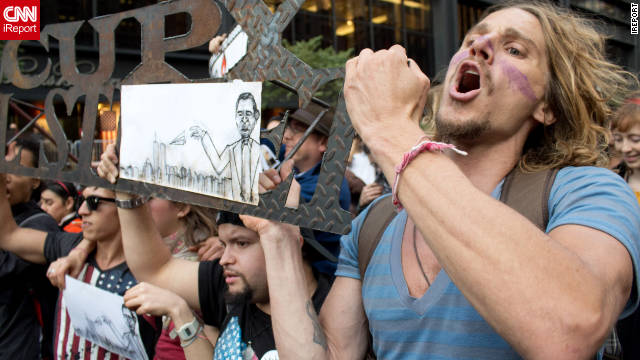
That’s what this Occupy Wall Street protestor learned in college, and he says that you should pay his tuition for him… just because that’s what he wants.
Besides, he knows that billionaires are getting a lot of money, just out of greed, and he’s learned on-line that “they pay twenty five cents in taxes for every dollar we’re taxed.” Except this young man undoubtedly doesn’t pay income taxes. But what does that matter, you can say whatever you want, he has his couple of sound bites and he wants free tuition.
There is a new Tumblr site responding to the people claiming to be the 99% featuring responses from members of the 53% who actually pay taxes. Some of the postings are pretty eloquent. Good going, Brittney.
Lawrence Myers explains the dynamic that makes people become grievance-afflicted members of the crowds demonstrating against the financial industry.
Unhappy people become Liberals. People seek out those that are similar. Birds of a feather flock together. An unhappy person looks around and sees two groups: happy people, and unhappy people. Rather than take a page out of the former group, enter the herd and ask for (and likely receive) help and guidance on how to become happy, the person is more likely to choose the path of least resistance — of instant acceptance. “Come to Mumsy, darling, you’re one of us.†And once in the herd, it becomes very, very difficult to leave it.
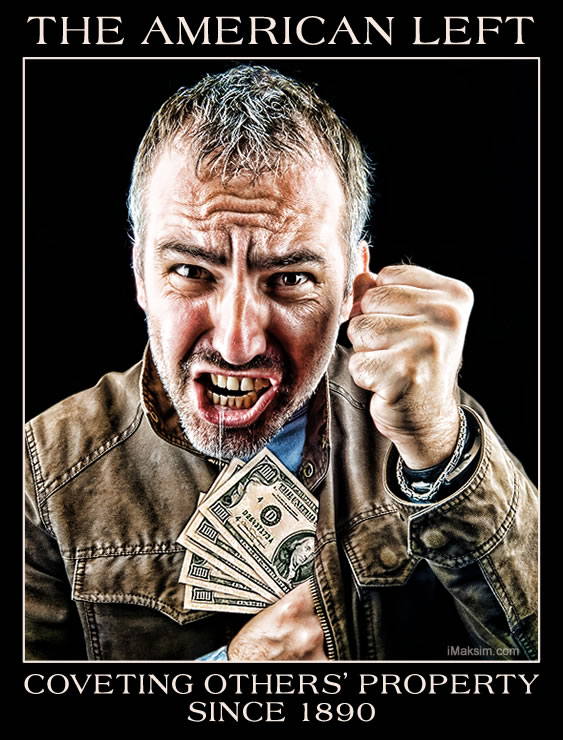
The Liberal, of course, will deny this pathology. No, they say, they are only trying to make things fair. Liberals are consumed with fixing the world. By eliminating what is unfair, by eliminating the evil banks and the greedy corporations, all the little people will receive what is rightfully theirs! (Subconsciously, then, nobody will be more successful than they are.) So twisted with hate, and so convinced of their own inefficacy, they cannot even rely on themselves to overthrow The Other. They hand over their own power to a third party — the government — to do their dirty work in the form of the confiscatory process of increased taxation and regulation.
Liberals, however, have got it turned around. They seek to heal the world before healing themselves first. They see this as somehow noble, great sacrifice. Well, it’s easy to make a sacrifice when you regard yourself as valueless. Beyond this, however, every major religion, and the mythology across almost every culture, instructs man to take care of himself first, and then attempt to heal the world.
Eratosthenes marvels at the way left-wing ideology makes the metrosexuals start talking tough.
What does it say about a so-called “man,†when he possesses certainty & conviction only when he discusses the deconstruction of some unknown stranger’s right to earn and own property? And on all other subjects he reverts, with all the reliability of gravity, right back to the dreaded emasculated tone of the American Castrati? What do we know about someone who is certain about the world in which he lives, only when he seeks to destroy things, along with people who built those things and might build other things?
Who is out there demonstrating against the American financial system?
J.D. Samson, a representative Boho artist, explains just how badly the capitalist system has failed her.
Like so many teenagers, I believed in the “American Dream,” that I could move to New York from the Midwest and become an artist. I would achieve both fame and success, and I would never have to think about money. The first half was true. I made art and lived activism, and I achieved amazing amounts of success that I feel incredibly proud of. The second half, not so much. I have been able to live well, eat well, invest in my arts and make my own schedule, but I forgot to save money and think about my future.
This summer I tried to rent an apartment in Williamsburg, Brooklyn. The process sent me into an emotional crisis and awakened me into a whole new realization of our economy, the music industry at large and, more specifically, what it means to be a queer artist in 2011.
I spent days trolling around Williamsburg, looking at shitty apartments with cockroaches lining the doorways, fighting neighbors, rats in the ceiling, bedbugs infesting the linoleum floors, fifth-floor walk-ups and cat-pee-soaked carpets. The rent was exorbitant, availability was scarce, and I was turned down by two different landlords for being “freelance.” To be honest, I don’t blame them. Not only am I freelance, but I’m lesbian freelance. Double whammy. What was the reason they turned me down? Because it was easier to rent to a rich, trust-fund, straight-guy banker who wants to live in the coolest borough in the world? Because when he met me he saw a tattooed gender outlaw who makes “queer electronic punk music” and isn’t sure when the next check is going to come in? Yeah, I don’t blame him. He doesn’t give a shit about how kids email me all the time thanking me for keeping them from committing suicide. It’s not part of his capitalist business practice.
I surround myself with amazing and talented people, people who have made it in every sense of those words. They buy apartments, invest in their futures successfully, have children, save money. How do they do it? How can I keep up with them?
So I have to ask myself: where did I go wrong? And I can only guess that the answer lies in a combinations of three things: 1) my family is not rich, 2) I am a queer woman, and 3) I am trying so desperately to keep up with my peers that I am living beyond my means. …
I’m so lucky to have gained so much from my life and my amazing career, but I’m ready to feel secure. I’m ready to build my future and save money so that I can have a family, so that I can enjoy making art and not trying to create a product out of it, so that I can spend more time being present and less time being a workaholic, frantically searching for the profitable answer. And if I need to, I’m ready to get a job, go to work in the morning, get a paycheck once a week, go to the dentist, get a check-up, bottom out to a boss and appreciate music without being worried that I can’t keep up.
We live in a society where people equate success with money. They see me on the pages of Vogue. They see me playing to an adoring crowd. They see me flying to gigs all across the world. And I’m not sure what people imagine, but I’m struggling, too. Over the past couple of weeks, I have realized how many other artists and musicians are in my position, people who are proud of their success but feel unable to continue, based on financial strain. Artists such as Spank Rock, Das Racist and the Drums have featured lyrics on their new records about struggling financially. My band MEN put out a record in February with similar tones. I know the economy is failing, but I think it is important to remember that it is failing for everyone. Even the people you think might have money. So here we go. Another reason to come together. Another reason to occupy Wall Street. Another reason for change.
Hat tip to Jonah Goldberg.
————————-
Frances Fox Piven (a government-salaried university professor) addresses the crowd.