To St. Stephen, the Proto-martyr, as he is generally styled, the honour has been accorded by the church of being placed in her calendar immediately after Christmas-day, in recognition of his having been the first to seal with his blood the testimony of fidelity to his Lord and Master. The year in which he was stoned to death, as recorded in the Acts of the Apostles, is supposed to have been 33 A.D. The festival commemorative of him has been retained in the Anglican calendar.
A curious superstition was formerly prevalent regarding St. Stephen’s Day — that horses should then, after being first well galloped, be copiously let blood, to insure them against disease in the course of the following year. In Barnaby Googe’s translation of Naogeorgus, the following lines occur relative to this popular notion:
Then followeth Saint Stephen’s Day, whereon doth every man
His horses jaunt and course abrode, as swiftly as he can,
Until they doe extremely sweate, and then they let them blood,
For this being done upon this day, they say doth do them good,
And keepes them from all maladies and sicknesse through the yeare,
As if that Steven any time tooke charge of horses heare.’
The origin of this practice is difficult to be accounted for, but it appears to be very ancient, and Douce supposes that it was introduced into this country by the Danes. In one of the manuscripts of that interesting chronicler, John Aubrey, who lived in the latter half of the seventeenth century, occurs the following record: On St. Stephen’s Day, the farrier came constantly and blouded all our cart-horses.’ Very possibly convenience and expediency combined on the occasion with superstition, for in Tusser Redivivus, a work published in the middle of the last century, we find this statement: ‘About Christmas is a very proper time to bleed horses in, for then they are commonly at house, then spring comes on, the sun being now coming back from the winter-solstice, and there are three or four days of rest, and if it be upon St. Stephen’s Day it is not the worse, seeing there are with it three days of rest, or at least two.’
In the parish of Drayton Beauchamp, Bucks, there existed long an ancient custom, called Stephening, from the day on which it took place. On St. Stephen’s Day, all the inhabitants used to pay a visit to the rectory, and practically assert their right to partake of as much bread and cheese and ale as they chose at the rector’s expense. On one of these occasions, according to local tradition, the then rector, being a penurious old bachelor, determined to put a stop, if possible, to this rather expensive and unceremonious visit from his parishioners. Accordingly, when St. Stephen’s Day arrived, he ordered his housekeeper not to open the window-shutters, or unlock the doors of the house, and to remain perfectly silent and motionless whenever any person was heard approaching. At the usual time the parishioners began to cluster about the house. They knocked first at one door, then at the other, then tried to open them, and on finding them fastened, they called aloud for admittance. No voice replied. No movement was heard within. ‘Surely the rector and his house-keeper must both be dead!’ exclaimed several voices at once, and a general awe pervaded the whole group. Eyes were then applied to the key-holes, and to every crevice in the window-shutters, when the rector was seen beckoning his old terrified housekeeper to sit still and silent. A simultaneous shout convinced him that his design was understood. Still he consoled himself with the hope that his larder and his cellar were secure, as the house could not be entered. But his hope was speedily dissipated. Ladders were reared against the roof, tiles were hastily thrown off, half-a-dozen sturdy young men entered, rushed down the stairs, and threw open both the outer-doors. In a trice, a hundred or more unwelcome visitors rushed into the house, and began unceremoniously to help themselves to such fare as the larder and cellar afforded; for no special stores having been provided for the occasion, there was not half enough bread and cheese for such a multitude. To the rector and his housekeeper, that festival was converted into the most rigid fast-day they had ever observed.
After this signal triumph, the parishioners of Drayton regularly exercised their ‘privilege of Stephening’ till the incumbency of the Rev. Basil Wood, who was presented to the living in 1808. Finding that the custom gave rise to much rioting and drunkenness, he discontinued it, and distributed instead an annual sum of money in proportion to the number of claimants. But as the population of the parish greatly increased, and as he did not consider himself bound to continue the practice, he was induced, about the year 1827, to withhold his annual payments; and so the custom became finally abolished. For some years, however, after its discontinuance, the people used to go to the rectory for the accustomed bounty, but were always refused.
In the year 1834, the commissioners appointed to inquire concerning charities, made an investigation into this custom, and several of the inhabitants of Drayton gave evidence on the occasion, but nothing was elicited to shew its origin or duration, nor was any legal proof advanced skewing that the rector was bound to comply with such a demand. Many of the present inhabitants of the parish remember the custom, and some of them have heard their parents say, that it had been observed:
‘As long as the sun had shone,
And the waters had run.’
In London and other places, St. Stephen’s Day, or the 26th of December, is familiarly known as Boxing-day, from its being the occasion on which those annual guerdons known as Christmas-boxes are solicited and collected. For a notice of them, the reader is referred to the ensuing article.
CHRISTMAS-BOXES
The institution of Christmas-boxes is evidently akin to that of New-year’s gifts, and, like it, has descended to us from the times of the ancient Romans, who, at the season of the Saturnalia, practiced universally the custom of giving and receiving presents. The fathers of the church denounced, on the ground of its pagan origin, the observance of such a usage by the Christians; but their anathemas had little practical effect, and in process of time, the custom of Christmas-boxes and New-year’s gifts, like others adopted from the heathen, attained the position of a universally recognised institution. The church herself has even got the credit of originating the practice of Christmas-boxes, as will appear from the following curious extract from The Athenian Oracle of John Dunton; a sort of primitive Notes and Queries, as it is styled by a contributor to the periodical of that name.
Q. From whence comes the custom of gathering of Christmas-box money? And how long since?
A. It is as ancient as the word mass, which the Romish priests invented from the Latin word mitto, to send, by putting the people in mind to send gifts, offerings, oblations; to have masses said for everything almost, that no ship goes out to the Indies, but the priests have a box in that ship, under the protection of some saint. And for masses, as they cant, to be said for them to that saint, &c., the poor people must put in something into the priest’s box, which is not to be opened till the ship return. Thus the mass at that time was Christ’s-mass, and the box Christ’s-mass-box, or money gathered against that time, that masses might be made by the priests to the saints, to forgive the people the debaucheries of that time; and from this, servants had liberty to get box-money, because they might be enabled to pay the priest for masses –because, No penny, no paternoster– for though the rich pay ten times more than they can expect, yet a priest will not say a mass or anything to the poor for nothing; so charitable they generally are.’
The charity thus ironically ascribed by Dunton to the Roman Catholic clergy, can scarcely, so far as the above extract is concerned, be warrantably claimed by the whimsical author himself. His statement regarding the origin of the custom under notice may be regarded as an ingenious conjecture, but cannot be deemed a satisfactory explanation of the question. As we have already seen, a much greater antiquity and diversity of origin must be asserted.
This custom of Christmas-boxes, or the bestowing of certain expected gratuities at the Christmas season, was formerly, and even yet to a certain extent continues to be, a great nuisance. The journeymen and apprentices of trades-people were wont to levy regular contributions from their masters’ customers, who, in addition, were mulcted by the trades-people in the form of augmented charges in the bills, to recompense the latter for gratuities expected from them by the customers’ servants. This most objectionable usage is now greatly diminished, but certainly cannot yet be said to be extinct. Christmas-boxes are still regularly expected by the postman, the lamplighter, the dustman, and generally by all those functionaries who render services to the public at large, without receiving payment therefore from any particular individual. There is also a very general custom at the Christmas season, of masters presenting their clerks, apprentices, and other employees, with little gifts, either in money or kind.
St. Stephen’s Day, or the 26th of December, being the customary day for the claimants of Christmas-boxes going their rounds, it has received popularly the designation of Boxing-day. In the evening, the new Christmas pantomime for the season is generally produced for the first time; and as the pockets of the working-classes, from the causes which we have above stated, have commonly received an extra supply of funds, the theatres are almost universally crowded to the ceiling on Boxing-night; whilst the ‘gods,’ or upper gallery, exercise even more than their usual authority. Those interested in theatrical matters await with consider-able eagerness the arrival, on the following morning, of the daily papers, which have on this occasion a large space devoted to a chronicle of the pantomimes and spectacles produced at the various London theatres on the previous evening.
In conclusion, we must not be too hard on the system of Christmas-boxes or handsets, as they are termed in Scotland, where, however, they are scarcely ever claimed till after the commencement of the New Year. That many abuses did and still do cling to them, we readily admit; but there is also intermingled with them a spirit of kindliness and benevolence, which it would be very undesirable to extirpate. It seems almost instinctive for the generous side of human nature to bestow some reward for civility and attention, and an additional incentive to such liberality is not infrequently furnished by the belief that its recipient is but inadequately remunerated otherwise for the duties which he performs. Thousands, too, of the commonalty look eagerly forward to the forth-coming guerdon on Boxing-day, as a means of procuring some little unwonted treat or relaxation, either in the way of sight-seeing, or some other mode of enjoyment. Who would desire to abridge the happiness of so many?
Born: Jesus Christ, Saviour of the world; Sir Isaac Newton, natural philosopher, 1642, Woolsthorpe, near Grantham; Johann Jacob Reiske, oriental scholar, 1716, Zorbig, Saxony; William Collins, poet, 1720, Chichester; Richard Person, Greek scholar, 1759, East Ruston, Norfolk.
and my wife, Karen.
Feast Day: St. Eugenia, virgin and martyr, about 257. St. Anastasia, martyr, 304. Another St. Anastasia.
Christmas Day
The festival of Christmas is regarded as the greatest celebration throughout the ecclesiastical year, and so important and joyous a solemnity is it deemed, that a special exception is made in its favour, whereby, in the event of the anniversary falling on a Friday, that day of the week, under all other circumstances a fast, is transformed to a festival.
That the birth of Jesus Christ, the deliverer of the human race, and the mysterious link connecting the transcendent and incomprehensible attributes of Deity with human sympathies and affections, should be considered as the most glorious event that ever happened, and the most worthy of being reverently and joyously commemorated, is a pro-position which must commend itself to the heart and reason of every one of His followers, who aspires to walk in His footsteps, and share in the ineffable benefits which His death has secured to mankind. And so though at one period denounced by the Puritans as superstitious, and to the present day disregarded by Calvinistic Protestants, as unwarranted by Scripture, there are few who will seriously dispute the propriety of observing the anniversary of Christ’s birth by a religious service. …
Towards the close of the second century, we find a notice of the observance of Christmas in the reign of the Emperor Commodus; and about a hundred years afterwards, in the time of Dioclesiaun an atrocious act of cruelty is recorded of the last named emperor, who caused a church in Nicomedia, where the Christians were celebrating the Nativity, to be set on fire, and by barring every means of egress from the building, made all the worshippers perish in the flames. Since the, end of the fourth century at least, the 25th of December has been uniformly observed as the anniversary of the Nativity by all the nations of Christendom.
Thus far for ancient usage, but it will be readily comprehended that insurmountable difficulties yet exist with respect to the real date of the momentous event under notice. Sir Isaac Newton, indeed, remarks in his Commentary on the Prophecies of Daniel, that the feast of the Nativity, and most of the other ecclesiastical anniversaries, were originally fixed at cardinal points of the year, without any reference to the dates of the incidents which they commemorated, dates which, by the lapse of time, had become impossible to be ascertained. Thus the Annunciation of the Virgin Mary was placed on the 25th of March, or about the time of the vernal equinox; the feast of St. Michael on the 29th of September, or near the autumnal equinox; and the birth of Christ and other festivals at the time of the winter-solstice. Many of the apostles’ days –such as St. Paul, St. Matthias, and others– were determined by the days when the sun entered the respective signs of the ecliptic, and the pagan festivals had also a considerable share in the adjustment of the Christian year.
To this last we shall shortly have occasion to advert more particularly, but at present we shall content ourselves by remarking that the views of the great astronomer just indicated, present at least a specious explanation of the original construction of the ecclesiastical calendar. As regards the observance of Easter indeed, and its accessory celebrations, there is good ground for maintaining that they mark tolerably accurately the anniversaries of the Passion and Resurrection of our Lord, seeing that we know that the events themselves took place at the period of the Jewish Passover. But no such precision of date can be adduced as regards Christmas, respecting which the generally received view now is, that it does not correspond with the actual date of the nativity of our Saviour. One objection, in particular, has been made, that the incident recorded in Scripture, of shepherds keeping watch by night on the plains of Bethlehem, could not have taken place in the month of December, a period generally of great inclemency in the region of Judea.
Though Christian nations have thus, from an early period in the history of the church, celebrated Christmas about the period of the winter-solstice or the shortest day, it is well known that many, and, indeed, the greater number of the popular festive observances by which it is characterized, are referable to a much more ancient origin. Amid all the pagan nations of antiquity, there seems to have been a universal tendency to worship the sun as the giver of life and light, and the visible manifestation of the Deity. Various as were the names bestowed by different peoples on this object of their worship, he was still the same divinity. Thus, at Rome, he appears to have been worshipped under one of the characters attributed to Saturn, the father of the gods; among the Scandinavian nations he was known under the epithet of Odin or Woden, the father of Thor, who seems after-wards to have shared with his parent the adoration bestowed on the latter, as the divinity of which the ‘sun was the visible manifestation; whilst with the ancient Persians, the appellation for the god of lights was Mithras, apparently the same as the Irish Mithr, and with the Phoenicians or Carthaginians it was Baal or Bel, an epithet familiar to all students of the Bible.
Concurring thus as regards the object of worship, there was a no less remarkable uniformity in the period of the year at which these different nations celebrated a grand festival in his honour. The time chosen appears to have been universally the season of the New Year, or, rather, the winter-solstice, from which the new year was frequently reckoned. This unanimity in the celebration of the festival in question, is to be ascribed to the general feeling of joy which all of us experience when the gradual shortening of the day reaches its utmost limit on the 21st of December, and the sun, recommencing his upward course, announces that mid-winter is past, and spring and summer are approaching. On similar grounds, and with similar demonstrations, the ancient pagan nations observed a festival at mid-summer, or the summer-solstice, when the sun arrives at the culminating point of his ascent on the 21st of June, or longest day.
By the Romans, this anniversary was celebrated under the title of Saturnalia, or the festival of Saturn, and was marked by the prevalence of a universal license and merry-making. The slaves were permitted to enjoy for a time a thorough freedom in speech and behavior, and it is even said that their masters waited on them as servants. Every one feasted and rejoiced, work and business were for a season entirely suspended, the houses were decked with laurels and evergreens, presents were made by parents and friends, and all sorts of games and amusements were indulged. in by the citizens. In the bleak north, the same rejoicings had place, but in a ruder and more barbarous form. Fires were extensively kindled, both in and out of doors, blocks of wood blazed in honour of Odin and Thor, the sacred mistletoe was gathered by the Druids, and sacrifices, both of men and cattle, were made to the savage divinities. Fires are said, also, to have been kindled at this period of the year by the ancient Persians, between whom and the Druids of Western Europe a relationship is supposed to have existed.
In the early ages of Christianity, its ministers frequently experienced the utmost difficulty in inducing the converts to refrain from indulging in the popular amusements which were so largely participated in by their pagan countrymen. Among others, the revelry and license which characterized the Saturnalia called for special animadversion. But at last, convinced partly of the inefficacy of such denunciations, and partly influenced by the idea that the spread of Christianity might thereby be advanced, the church endeavored to amalgamate, as it were, the old and new religious, and sought, by transferring the heathen ceremonies to the solemnities of the Christian festivals, to make them subservient to the cause of religion and piety. A compromise was thus effected between clergy and laity, though it must be admitted that it proved anything but a harmonious one, as we find a constant, though ineffectual, proscription by the ecclesiastical authorities of the favorite amusements of the people, including among others the sports and revelries at Christmas.
Ingrafted thus on the Romani Saturnalia, the Christmas festivities received in Britain further changes and modifications, by having superadded to them, first, the Druidical rites and superstitions, and then, after the arrival of the Saxons, the various ceremonies practiced by the ancient Germans and Scandinavians. The result has been the strange medley of Christian and pagan rites which contribute to make up the festivities of the modern Christmas. Of these, the burning of the Yule log, and the superstitions connected with the mistletoe have already been described under Christmas Eve, and further accounts are given under separate heads, both under the 24th and 25th of December.
The name given by the ancient Goths and. Saxons to the festival of the winter-solstice was Jul or Yule, the latter term forming, to the present day, the designation in the Scottish dialect of Christmas, and preserved also in the phrase of the ‘Yule log.’ Perhaps the etymology of no term has excited greater discussion among antiquaries. Some maintain it to be derived from the Greek, συλσι, or, ισυλσς, the name of a hymn in honor of Ceres; others say it comes from the Latin jubilum, signifying a time of rejoicing, or from its being a festival in honour of Julius Caesar; whilst some also explain its meaning as synonymous with ol or oel, which in the ancient Gothic language denotes a feast, and also the favorite liquor used on such occasion, whence our word ale. But a much more probable derivation of the term in question is from the Gothic giul or hiul, the origin of the modem word wheel, and bearing the same signification. According to this very probable explanation, the Yule festival received its name from its being the turning-point of the year, or the period at which the fiery orb of day made a revolution in his annual circuit, and entered on his northern journey. A confirmation of this view is afforded by the circumstance that in the old clog almanacs, a wheel is the device employed for marking the season of Yule-tide.
Throughout the middle ages, and down to the period of the Reformation, the festival of Christmas, ingrafted on the pagan rites of Yule, continued throughout Christendom to be universally celebrated with every mark of rejoicing. On the adoption of a new system of faith by most of the northern nations of Europe in the sixteenth century, the Lutheran and Anglican churches retained the celebration of Christmas and other festivals, which Calvinists rejected absolutely, denouncing the observance of all such days, except Sunday, as superstitious and unscriptural. In reference to the superstition anciently prevalent in Scotland against spinning on Christmas or Yule day, and the determination of the Calvinistic clergy to put down all such notions, the following amusing passage is quoted by Dr. Jamieson from Jhone Hamilton’s Facile Tractise:
‘The ministers of Scotland — in contempt of the vther halie dayes obseruit be England — cause their wyfis and seruants spin in oppin sicht of the people upon Yeul day; and their affectionnate auditeurs constraines their tennants to yok thair pleuchs on Yeul day in contempt of Christ’s Natiuitie, whilk our Lord has not left vnpunisit: for thair oxin ran wod [mad], and brak their nekis, and leamit [lamed] sum pleugh men, as is notoriously knawin in sindrie partes of Scotland.’
In consequence of the Presbyterian form of church-government, as constituted by John Knox and his coadjutors on the model of the ecclesiastical polity of Calvin, having taken such firm root in Scotland, the festival of Christmas, with other commemorative celebrations retained from the Romish calendar by the Anglicans and Lutherans, is comparatively unknown in that country, at least in the Lowlands. The tendency to mirth and jollity at the close of the year, which seems almost inherent in human nature, has, in North Britain, been, for the most part, transferred from Christmas and Christmas Eve to New-year’s Day and the preceding evening, known by the appellation of Hogmenay. …
The geniality and joyousness of the Christmas season in England, has long been a national characteristic. The following poem or carol, by George Wither, who belongs to the first-half of the seventeenth century, describes with hilarious animation the mode of keeping Christmas in the poet’s day:
‘So now is come our joyful feast;
Let every man be jolly;
Each room with ivy leaves is drest,
And every post with holly.
Though some churls at our mirth repine,
Round your foreheads garlands twine;
Drown sorrow in a cup of wine,
And let us all be merry.
Now all our neighbours’ chimneys smoke,
And Christmas blocks are burning;
Their ovens they with baked meat choke,
And all their spits are turning.
Without the door let sorrow lye;
And if for cold it hap to die,
We’ll bury’t in a Christmas-pie,
And evermore be merry.
Now every lad is wond’rous trim,
And no man minds his labour;
Our lasses have provided them
A bagpipe and a tabor;
Young men and maids, and girls and boys,
Give life to one another’s joys;
And you anon shall by their noise
Perceive that they are merry.
Rank misers now do sparing shun;
Their hall of music soundeth;
And dogs thence with whole shoulders run,
So all things then aboundeth.
The country-folks, themselves advance,
With crowdy-muttons out of France;
And Jack shall pipe and Jyll shall dance,
And all the town be merry.
Ned Squash hath fetcht his bands from pawn,
And all his best apparel
Brisk Nell hath bought a ruff of lawn
With dropping of the barrel.
And those that hardly all the year
Had bread to eat, or rags to wear,
Will have both clothes and dainty fare,
And all the day be merry.
Now poor men to the justices
With capons make their errants;
And if they hap to fail of these,
They plague them with their warrants:
But now they feed them with good cheer,
And what they want, they take in beer,
For Christmas comes but once a year,
And then they shall be merry.
Good farmers in the country nurse
The poor, that else were undone;
Some landlords spend their money worse,
On lust and pride at London.
There the roysters they do play,
Drab and dice their lands away,
Which may be ours another day,
And therefore let’s be merry.
The client now his suit forbears;
The prisoner’s heart is eased;
The debtor drinks away his cares,
And for the time is pleased.
Though others’ purses be more fat,
Why should we pine or grieve at that?
Hang sorrow! care will kill a cat,
And therefore let’s be merry.
Hark! now the wags abroad do call,
Each other forth to rambling;
non you’ll see them in the hall,
For nuts and apples scrambling.
Hark! how the roofs with laughter sound,
Anon they’ll think the house goes round,
For they the cellar’s depth have found,
And there they will be merry.
The wenches with their wassel-bowls
About the streets are singing;
The boys are come to catch the owls,
The wild mare in it bringing,
our kitchen-boy hath broke his box,
And to the dealing of the ox,
Our honest neighbors come by flocks,
And here they will be merry.
Now kings and queens poor sheepcotes have,
And mate with every body;
The honest now may play the knave,
And wise men play the noddy.
Some youths will now a mumming go,
Some others play at Rowland-ho,
And twenty other game boys mo,
Because they will be merry.
Then, wherefore in these merry daies,
Should we, I pray, be duller?
No, let us sing some roundelayes,
To make our mirth the fuller.
And, while thus inspired we sing,
Let all the streets with echoes ring;
Woods and hills and every thing,
Bear witness we are merry.’
At present, Christmas-day, if somewhat shorn of its ancient glories, and unmarked by that boisterous jollity and exuberance of animal spirits which distinguished it in the time of our ancestors, is, nevertheless, still the holiday in which of all others throughout the year, all classes of English society most generally participate. Partaking of a religious character, the forenoon of the day is usually passed in church, and in the evening the re-united members of the family assemble round the joyous Christmas-board. Separated as many of these are during the rest of the year, they all make an effort to meet together round the Christmas-hearth. The hallowed feelings of domestic love and attachment, the pleasing remembrance of the past, and the joyous anticipation of the future, all cluster round these family-gatherings, and in the sacred associations with which they are intertwined, and the active deeds of kindness and benevolence which they tend to call forth, a realization may almost be found of the angelic message to the shepherds of Bethlehem—’Glory to God in the highest, and on earth peace, good-will toward men.’
For a picture of Christmas Eve, in the olden time, we can desire none better than that furnished by Sir Walter Scott in Marmion:
On Christmas Eve the bells were rung;
On Christmas Eve the mass was sung;
That only night, in all the year,
Saw the stoled priest the chalice rear.
The damsel donned her kirtle sheen;
The hall was dressed with holly green;
Forth to the wood did merry-men go,
To gather in the mistletoe.
Then opened wide the baron’s hall
To vassal, tenant, serf, and all;
Power laid his rod of rule aside,
And Ceremony doffed his pride.
The heir, with roses in his shoes,
That night might village partner choose.
The lord, underogating, share
The vulgar game of “post and pair.”
All hailed, with uncontrolled delight,
And general voice, the happy night,
That to the cottage, as the crown,
Brought tidings of salvation down!
The fire, with well-dried logs supplied,
Went roaring up the chimney wide;
The huge hall-table’s oaken face,
Scrubbed till it shone, the day to grace,
Bore then upon its massive board
No mark to part the squire and lord.
Then was brought in the lusty brawn,
By old blue-coated serving-man;
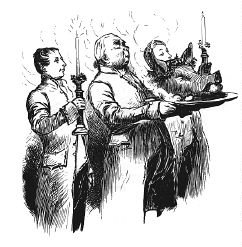
Then the grim boar’s-head frowned on high,
Crested with bays and rosemary.
Well can the green-garbed ranger tell,
How, when, and where the monster fell
What dogs before his death he tore,
And all the baiting of the boar.
The wassail round in good brown bowls,
Garnished with ribbons, blithely trowls.
There the huge sirloin reeked: hard by
Plum-porridge stood, and Christmas-eye;
Nor failed old Scotland to produce,
At such high-tide, her savoury goose.
Then came the merry masquers in,
And carols roared with blithesome din
If unmelodious was the song,
It was a hearty note, and strong.
Who lists may in their mumming see
Traces of ancient mystery;
White shirts supplied the masquerade,
And smutted cheeks the visors made;
But, oh! what masquers, richly dight,
Can boast of bosoms half so light!
England was merry England, when
Old Christmas brought his sports again.
‘Twas Christmas broached the mightiest ale;
‘Twas Christmas told the merriest tale
A Christmas gambol oft could cheer
The poor man’s heart through half the year.
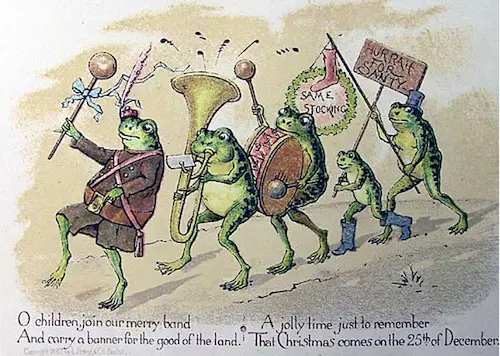
Louis Prang put Christmas cards into millions of American mailboxes and fine art into millions of American homes.
He arrived in Boston at the age of 26, a German revolutionary with a dream of democracy and equality. Over the course of his long career he evolved into an astute businessman and the leading color printer of his age.
From his factory in Boston he dominated the Christmas card industry in the decades following the Civil War. He also brought beautiful art to the masses, lucrative work to women artists and art education to children. Kids today still use the paints and crayons he developed more than a century ago.
Just before Louis Prang died in 1909, a contemporary paid a slightly overwrought tribute to him.
The Santa Claus of American art showered his greeting card favors alike upon the just and the unjust, the rich and the poor, the humble and the proud. Where have they not gone, those loose leaves from the world’s book of beauty! Everywhere! Into the homes of the poor, into the miner’s cabin, the invalid’s chamber, the nursery, the schoolroom, the drawing room. Millions of lives have been brightened by the fair and pleasant things that have been sown broadcast over the country by Mr. Prang.
St. Nicholas, bishop of Myra, d. 6 December 345 or 352
St. Nicholas was reportedly born in the city of Patara in Lycia in Asia Minor, heir to a wealthy family. He succeeded an uncle as bishop of Myra.
Nicholas left behind a legend of secret acts of benevolence and miracles (in Greek, he is spoken of as “Nikolaos o Thaumaturgos” — Nicholas the Wonder-Worker).
One of the saint’s prominent legends asserts that, in a time of famine, he foiled the crime of Fourth Century Sweeney Todd, an evil butcher who kidnapped and murdered three children, intending to market their remains as ham. St. Nicholas not only exposed the murder, but healed and resurrected the children intact.
Nicholas is also renowned for providing dowries for each of three daughters of an impoverished nobleman,who would otherwise have been unable to marry and who were about to be forced to prostitute themselves to live. In order to spare the sensibilities of the family, Nicholas is said to have secretly thrown a purse of gold coins into their window on each of three consecutive nights.
St. Nicholas’ covert acts of charity led to a custom of the giving of secret gifts concealed in shoes deliberately left out for their receipt on his feast day, and ultimately to the contemporary legend of Santa Claus leaving gifts in stockings on Christmas Eve.
St. Nicholas evolved into one of the most popular saints in the Church’s calendar, serving as patron of sailors, merchants, archers, thieves, prostitutes, pawnbrokers, children, and students, Greeks, Belgians, Frenchmen, Romanians, Bulgarians, Georgians, Albanians, Russians, Macedonians, Slovakians, Serbians, and Montenegrins, and all residents of Aberdeen, Amsterdam, Barranquilla, Campen, Corfu, Freiburg, Liverpool, Lorraine, Moscow, and New Amsterdam (New York).
His relics were stolen and removed to Bari to prevent capture by the Turks, and are alleged to exude a sweet-smelling oil down to the present day.
WWI came to an end by an armistice arranged to occur at the eleventh hour of the eleventh day of the eleventh month of 1918. The date and time, selected at a point in history when mens’ memories ran much longer, represented a compliment to St. Martin, patron saint of soldiers, and thus a tribute to the fighting men of both sides. The feast day of St. Martin, the Martinmas, had been for centuries a major landmark in the European calendar, a date on which leases expired, rents came due; and represented, in Northern Europe, a seasonal turning point after which cold weather and snow might be normally expected.
It fell about the Martinmas-time, when the snow lay on the borders…
—Old Song.
From Robert Chambers, The Book of Days, 1869:
St. Martin, the son of a Roman military tribune, was born at Sabaria, in Hungary, about 316. From his earliest infancy, he was remarkable for mildness of disposition; yet he was obliged to become a soldier, a profession most uncongenial to his natural character. After several years’ service, he retired into solitude, from whence he was withdrawn, by being elected bishop of Tours, in the year 374.
The zeal and piety he displayed in this office were most exemplary. He converted the whole of his diocese to Christianity, overthrowing the ancient pagan temples, and erecting churches in their stead. From the great success of his pious endeavours, Martin has been styled the Apostle of the Gauls; and, being the first confessor to whom the Latin Church offered public prayers, he is distinguished as the father of that church. In remembrance of his original profession, he is also frequently denominated the Soldier Saint.
The principal legend, connected with St. Martin, forms the subject of our illustration, which represents the saint, when a soldier, dividing his cloak with a poor naked beggar, whom he found perishing with cold at the gate of Amiens. This cloak, being most miraculously preserved, long formed one of the holiest and most valued relics of France; when war was declared, it was carried before the French monarchs, as a sacred banner, and never failed to assure a certain victory. The oratory in which this cloak or cape—in French, chape—was preserved, acquired, in consequence, the name of chapelle, the person intrusted with its care being termed chapelain: and thus, according to Collin de Plancy, our English words chapel and chaplain are derived. The canons of St. Martin of Tours and St. Gratian had a lawsuit, for sixty years, about a sleeve of this cloak, each claiming it as their property. The Count Larochefoucalt, at last, put an end to the proceedings, by sacrilegiously committing the contested relic to the flames.
Another legend of St. Martin is connected with one of those literary curiosities termed a palindrome. Martin, having occasion to visit Rome, set out to perform the journey thither on foot. Satan, meeting him on the way, taunted the holy man for not using a conveyance more suitable to a bishop. In an instant the saint changed the Old Serpent into a mule, and jumping on its back, trotted comfortably along. Whenever the transformed demon slackened pace, Martin, by making the sign of the cross, urged it to full speed. At last, Satan utterly defeated, exclaimed:
Signa, te Signa: temere me tangis et angis:
Roma tibi subito motibus ibit amor.’
In English—
‘Cross, cross thyself: thou plaguest and vexest me without necessity;
for, owing to my exertions, thou wilt soon reach Rome, the object of thy wishes.’
The singularity of this distich, consists in its being palindromical—that is, the same, whether read backwards or forwards. Angis, the last word of the first line, when read backwards, forming signet, and the other words admitting of being reversed, in a similar manner.
The festival of St. Martin, happening at that season when the new wines of the year are drawn from the lees and tasted, when cattle are killed for winter food, and fat geese are in their prime, is held as a feast-day over most parts of Christendom. On the ancient clog almanacs, the day is marked by the figure of a goose; our bird of Michaelmas being, on the continent, sacrificed at Martinmas. In Scotland and the north of England, a fat ox is called a mart, clearly from Martinmas, the usual time when beeves are killed for winter use. In ‘Tusser’s Husbandry, we read:
When Easter comes, who knows not then,
That veal and bacon is the man?
And Martilmass beef doth bear good tack,
When country folic do dainties lack.’
Barnaby Googe’s translation of Neogeorgus, shews us how Martinmas was kept in Germany, towards the latter part of the fifteenth century
‘To belly chear, yet once again,
Doth Martin more incline,
Whom all the people worshippeth
With roasted geese and wine.
Both all the day long, and the night,
Now each man open makes
His vessels all, and of the must,
Oft times, the last he takes,
Which holy Martin afterwards
Alloweth to be wine,
Therefore they him, unto the skies,
Extol with praise divine.’
A genial saint, like Martin, might naturally be expected to become popular in England; and there are no less than seven churches in London and Westminster, alone, dedicated to him. There is certainly more than a resemblance between the Vinalia of the Romans, and the Martinalia of the medieval period. Indeed, an old ecclesiastical calendar, quoted by Brand, expressly states under 11th November: ‘The Vinalia, a feast of the ancients, removed to this day. Bacchus in the figure of Martin.’ And thus, probably, it happened, that the beggars were taken from St. Martin, and placed under the protection of St. Giles; while the former became the patron saint of publicans, tavern-keepers, and other ‘dispensers of good eating and drinking. In the hall of the Vintners’ Company of London, paintings and statues of St. Martin and Bacchus reign amicably together side by side.
On the inauguration, as lord mayor, of Sir Samuel Dashwood, an honoured vintner, in 1702, the company had a grand processional pageant, the most conspicuous figure in which was their patron saint, Martin, arrayed, cap-Ã -pie, in a magnificent suit of polished armour; wearing a costly scarlet cloak, and mounted on a richly plumed and caparisoned white charger: two esquires, in rich liveries, walking at each side. Twenty satyrs danced before him, beating tambours, and preceded by ten halberdiers, with rural music. Ten Roman lictors, wearing silver helmets, and carrying axes and fasces, gave an air of classical dignity to the procession, and, with the satyrs, sustained the bacchanalian idea of the affair.
A multitude of beggars, ‘howling most lamentably,’ followed the warlike saint, till the procession stopped in St. Paul’s Churchyard. Then Martin, or his representative at least, drawing his sword, cut his rich scarlet cloak in many pieces, which he distributed among the beggars. This ceremony being duly and gravely performed, the lamentable howlings ceased, and the procession resumed its course to Guildhall, where Queen Anne graciously condescended to dine with the new lord mayor.
RPS ORDERS
No. 47 (Series 1921)
HEADQUARTERS U.S. MARINE CORPS
Washington, November 1, 1921
759. The following will be read to the command on the 10th of November, 1921, and hereafter on the 10th of November of every year. Should the order not be received by the 10th of November, 1921, it will be read upon receipt.
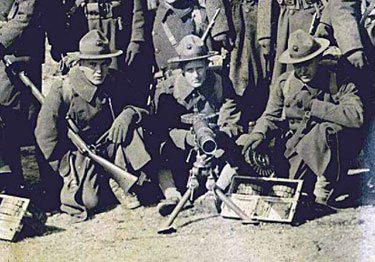
(1) On November 10, 1775, a Corps of Marines was created by a resolution of Continental Congress. Since that date many thousand men have borne the name “Marine”. In memory of them it is fitting that we who are Marines should commemorate the birthday of our corps by calling to mind the glories of its long and illustrious history.
(2) The record of our corps is one which will bear comparison with that of the most famous military organizations in the world’s history. During 90 of the 146 years of its existence the Marine Corps has been in action against the Nation’s foes. From the Battle of Trenton to the Argonne, Marines have won foremost honors in war, and is the long eras of tranquility at home, generation after generation of Marines have grown gray in war in both hemispheres and in every corner of the seven seas, that our country and its citizens might enjoy peace and security.
(3) In every battle and skirmish since the birth of our corps, Marines have acquitted themselves with the greatest distinction, winning new honors on each occasion until the term “Marine” has come to signify all that is highest in military efficiency and soldierly virtue.
(4) This high name of distinction and soldierly repute we who are Marines today have received from those who preceded us in the corps. With it we have also received from them the eternal spirit which has animated our corps from generation to generation and has been the distinguishing mark of the Marines in every age. So long as that spirit continues to flourish Marines will be found equal to every emergency in the future as they have been in the past, and the men of our Nation will regard us as worthy successors to the long line of illustrious men who have served as “Soldiers of the Sea” since the founding of the Corps.
Tun Tavern, Philadelphia, Pennsylvania, November 10th 1775
Captains Nicholas and Mullens, having been tasked by the 2nd Continental Congress to form 2 battalions of Marines, set up the Corps’ first recruiting station in the tavern.
The first likely prospect was, in typical recruiters fashion, promised a “life of high adventure in service to Country and Corps”. And, as an extra bonus: If he enlisted now he would receive a free tankard of ale….
The recruit gladly accepted the challenge and, receiving the free tankard of ale, was told to wait at the corner table for orders.
The first Marine sat quietly at the table sipping the ale when he was joined by another young man, who had two tankards of ale.
The first Marine looked at the lad and asked where he had gotten the two tankards of ale?
The lad replied that he had just joined this new outfit called the Continental Marines, and as an enlistment bonus was given two tankards of ale.
The first Marine took a long hard look at the second Marine and said, ” It wasn’t like that in the old Corps.”
Saint Hubertus was born (probably in Toulouse) about the year 656. He was the eldest son of Bertrand, Duke of Aquitaine. As a youth, Hubert was sent to the Neustrian court of Theuderic III at Paris, where his charm and agreeable address led to his investment with the dignity of “count of the palace”. Like many nobles of the time, Hubert was addicted to the chase. Meanwhile, the tyrannical conduct of Ebroin, mayor of the Neustrian palace, caused a general emigration of the nobles and others to the court of Austrasia at Metz. Hubert soon followed them and was warmly welcomed by Pepin of Herstal, mayor of the palace, who created him almost immediately grand-master of the household. About this time (682) Hubert married Floribanne, daughter of Dagobert, Count of Leuven.Their son Floribert of Liége would later become bishop of Liége, for bishoprics were all but accounted fiefs heritable in the great families of the Merovingian kingdoms. He nearly died at the age of 10 from “fever”.
His wife died giving birth to their son and Hubert retreated from the court, withdrew into the forested Ardennes, and gave himself up entirely to hunting. However, a great spiritual revolution was imminent. On Good Friday morning, when the faithful were crowding the churches, Hubert sallied forth to the chase. As he was pursuing a magnificent stag or hart, the animal turned and, as the pious legend narrates, he was astounded at perceiving a crucifix standing between its antlers, while he heard a voice saying: “Hubert, unless thou turnest to the Lord, and leadest an holy life, thou shalt quickly go down into hell”. Hubert dismounted, prostrated himself and said, “Lord, what wouldst Thou have me do?” He received the answer, “Go and seek Lambert, and he will instruct you.”…
Saint Hubertus (German) is honored among sport-hunters as the originator of ethical hunting behavior.
During Hubert’s religious vision, the Hirsch (German: deer) is said to have lectured Hubertus into holding animals in higher regard and having compassion for them as God’s creatures with a value in their own right. For example, the hunter ought to only shoot when a humane, clean and quick kill is assured. He ought shoot only old stags past their prime breeding years and to relinquish a much anticipated shot on a trophy to instead euthanize a sick or injured animal that might appear on the scene. Further, one ought never shoot a female with young in tow to assure the young deer have a mother to guide them to food during the winter. Such is the legacy of Hubert who still today is taught and held in high regard in the extensive and rigorous German and Austrian hunter education courses.
The legacy is also followed by the French chasse à courre masters, huntsmen and followers, who hunt deer, boar and roe on horseback and are the last direct heirs of Saint Hubert in Europe. Chasse à courre is currently enjoying a revival in France. The Hunts apply a specific set of ethics, rituals, rules and tactics dating back to the early Middle-Ages. Saint Hubert is venerated every year by the Hunts in formal ceremonies.
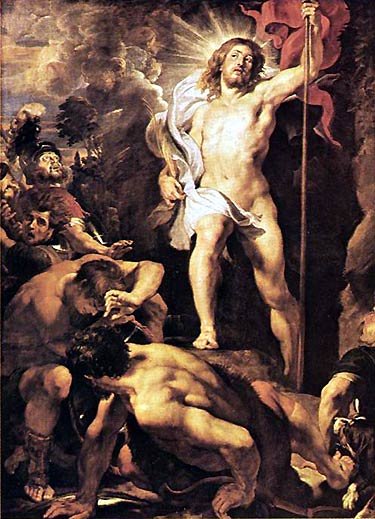
Peter Paul Rubens, The Resurrection of Christ, 1611-1612, Vrouwekathedraal, Antwerp
From Robert Chambers, The Book of Days, 1869:
Easter
Easter, the anniversary of our Lord’s resurrection from the dead, is one of the three great festivals of the Christian year,—the other two being Christmas and Whitsuntide. From the earliest period of Christianity down to the present day, it has always been celebrated by believers with the greatest joy, and accounted the Queen of Festivals. In primitive times it was usual for Christians to salute each other on the morning of this day by exclaiming, ‘Christ is risen;’ to which the person saluted replied, ‘Christ is risen indeed,’ or else, ‘ And hath appeared unto Simon;’—a custom still retained in the Greek Church. Easter retains many religious customs today but there are also many commercial aspects to the holiday. The Easter bunny, Easter candy and Easter baskets are all part of the celebration. Giving Easter baskets filled with candy is a joyous family activity, but it is important to remember the true meaning of the Easter holiday. Read the rest of this entry »
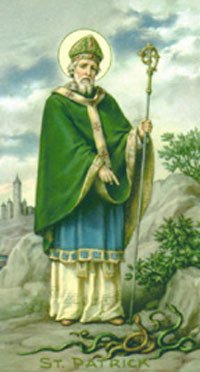
Almost as many countries arrogate the honour of having been the natal soil of St. Patrick, as made a similar claim with respect to Homer. Scotland, England, France, and Wales, each furnish their respective pretensions: but, whatever doubts may obscure his birthplace, all agree in stating that, as his name implies, he was of a patrician family. He was born about the year 372, and when only sixteen years of age, was carried off by pirates, who sold him into slavery in Ireland; where his master employed him as a swineherd on the well-known mountain of Sleamish, in the county of Antrim. Here he passed seven years, during which time he acquired a knowledge of the Irish language, and made himself acquainted with the manners, habits, and customs of the people. Escaping from captivity, and, after many adventures, reaching the Continent, he was successively ordained deacon, priest, and bishop: and then once more, with the authority of Pope Celestine, he returned to Ireland to preach the Gospel to its then heathen inhabitants.
The principal enemies that St. Patrick found to the introduction of Christianity into Ireland, were the Druidical priests of the more ancient faith, who, as might naturally be supposed, were exceedingly adverse to any innovation. These Druids, being great magicians, would have been formidable antagonists to any one of less miraculous and saintly powers than Patrick. Their obstinate antagonism was so great, that, in spite of his benevolent disposition, he was compelled to curse their fertile lands, so that they became dreary bogs: to curse their rivers, so that they produced no fish: to curse their very kettles, so that with no amount of fire and patience could they ever be made to boil; and, as a last resort, to curse the Druids themselves, so that the earth opened and swallowed them up. …
The greatest of St. Patrick’s miracles was that of driving the venomous reptiles out of Ireland, and rendering the Irish soil, for ever after, so obnoxious to the serpent race, that they instantaneously die on touching it. Colgan seriously relates that St. Patrick accomplished this feat by beating a drum, which he struck with such fervour that he knocked a hole in it, thereby endangering the success of the miracle. But an angel appearing mended the drum: and the patched instrument was long exhibited as a holy relic. …
When baptizing an Irish chieftain, the venerable saint leaned heavily on his crozier, the steel-spiked point of which he had unwittingly placed on the great toe of the converted heathen. The pious chief, in his ignorance of Christian rites, believing this to be an essential part of the ceremony, bore the pain without flinching or murmur; though the blood flowed so freely from the wound, that the Irish named the place St. fhuil (stream of blood), now pronounced Struill, the name of a well-known place near Downpatrick. And here we are reminded of a very remarkable fact in connection with geographical appellations, that the footsteps of St. Patrick can be traced, almost from his cradle to his grave, by the names of places called after him.
Thus, assuming his Scottish origin, he was born at Kilpatrick (the cell or church of Patrick), in Dumbartonshire. He resided for some time at Dalpatrick (the district or division of Patrick), in Lanarkshire; and visited Crag-phadrig (the rock of Patrick), near Inverness. He founded two churches, Kirkpatrick at Irongray, in Kireudbright; and Kirkpatrick at Fleming, in Dumfries: and ultimately sailed from Portpatrick, leaving behind him such an odour of sanctity, that among the most distinguished families of the Scottish aristocracy, Patrick has been a favourite name down to the present day.
Arriving in England, he preached in Patterdale (Patrick’s dale), in Westmoreland: and founded the church of Kirkpatrick, in Durham. Visiting Wales, he walked over Sarn-badrig (Patrick’s causeway), which, now covered by the sea, forms a dangerous shoal in Carnarvon Bay: and departing for the Continent, sailed from Llan-badrig (the church of Patrick), in the island of Anglesea. Undertaking his mission to convert the Irish, he first landed at Innis-patrick (the island of Patrick), and next at Holmpatrick, on the opposite shore of the mainland, in the county of Dublin. Sailing northwards, he touched at the Isle of Man, sometimes since, also, called. Innis-patrick, where he founded another church of Kirkpatrick, near the town of Peel. Again landing on the coast of Ireland, in the county of Down, he converted and baptized the chieftain Dichu, on his own threshing-floor. The name of the parish of Saul, derived from Sabbal-patrick (the barn of Patrick), perpetuates the event. He then proceeded to Temple-patrick, in Antrim, and from thence to a lofty mountain in Mayo, ever since called Croagh-patrick.
He founded an abbey in East Meath, called Domnach-Padraig (the house of Patrick), and built a church in Dublin on the spot where St. Patrick’s Cathedral now stands. In an island of Lough Deng, in the county of Donegal, there is St. Patrick’s Purgatory: in Leinster, St. Patrick’s Wood; at Cashel, St. Patrick’s Rock; the St. Patrick’s Wells, at which the holy man is said to have quenched his thirst, may be counted by dozens. He is commonly stated to have died at Saul on the 17th of March 493, in the one hundred and twenty-first year of his age. …
The shamrock, or small white clover (trifolium repens of botanists), is almost universally worn in the hat over all Ireland, on St. Patrick’s day. The popular notion is, that when St. Patrick was preaching the doctrine of the Trinity to the pagan Irish, he used this plant, bearing three leaves upon one stem, as a symbol or illustration of the great mystery. To suppose, as some absurdly hold, that he used it as an argument, would be derogatory to the saint’s high reputation for orthodoxy and good sense: but it is certainly a curious coincidence, if nothing more, that the trefoil in Arabic is called skamrakh, and was held sacred in Iran as emblematical of the Persian Triads. Pliny, too, in his Natural History, says that serpents are never seen upon trefoil, and it prevails against the stings of snakes and scorpions. This, considering St. Patrick’s connexion with snakes, is really remarkable, and we may reasonably imagine that, previous to his arrival, the Irish had ascribed mystical virtues to the trefoil or shamrock, and on hearing of the Trinity for the first time, they fancied some peculiar fitness in their already sacred plant to shadow forth the newly revealed and mysterious doctrine. …
In the Galtee or Gaultie Mountains, situated between the counties of Cork and Tipperary, there are seven lakes, in one of which, called Lough Dilveen, it is said Saint Patrick, when banishing the snakes and toads from Ireland, chained a monster serpent, telling him to remain there till Monday.
The serpent every Monday morning calls out in Irish, ‘It is a long Monday, Patrick.’
That St Patrick chained the serpent in Lough Dilveen, and that the serpent calls out to him every Monday morning, is firmly believed by the lower orders who live in the neighbourhood of the Lough.
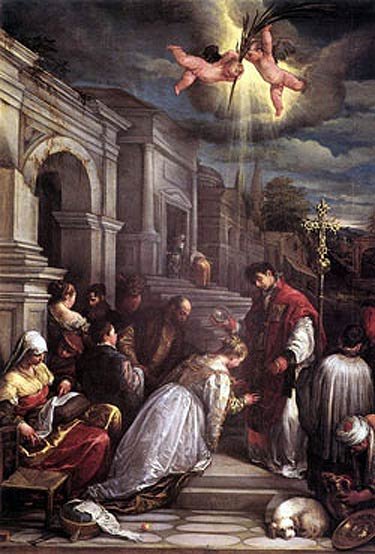
Jacopo Bassano, St Valentine Baptizing St Lucilla, 1575, oil on canvas, Museo Civico, Bassano del Grappa
The popular customs associated with Saint Valentine’s Day undoubtedly had their origin in a conventional belief generally received in England and France during the Middle Ages, that on 14 February, i.e., half way through the second month of the year, the birds began to pair. Thus in Chaucer’s Parliament of Foules we read:
For this was sent on Seynt Valentyne’s day
Whan every foul cometh ther to choose his mate.
For this reason the day was looked upon as specially consecrated to lovers and as a proper occasion for writing love letters and sending lovers’ tokens. Both the French and English literatures of the fourteenth and fifteenth centuries contain allusions to the practice. Perhaps the earliest to be found is in the 34th and 35th Ballades of the bilingual poet, John Gower, written in French; but Lydgate and Clauvowe supply other examples. Those who chose each other under these circumstances seem to have been called by each other their Valentines.
In the Paston Letters, Dame Elizabeth Brews writes thus about a match she hopes to make for her daughter (we modernize the spelling), addressing the favoured suitor:
And, cousin mine, upon Monday is Saint Valentine’s Day and every bird chooses himself a mate, and if it like you to come on Thursday night, and make provision that you may abide till then, I trust to God that ye shall speak to my husband and I shall pray that we may bring the matter to a conclusion.
——————————————–
From Robert Chambers, The Book of Days, 1869: Feast Day: St. Valentine, priest and martyr, circ. 270.
ST. VALENTINE’S DAY
Valentine’s Day is now almost everywhere a much degenerated festival, the only observance of any note consisting merely of the sending of jocular anonymous letters to parties whom one wishes to quiz, and this confined very much to the humbler classes. The approach of the day is now heralded by the appearance in the print-sellers’ shop windows of vast numbers of missives calculated for use on this occasion, each generally consisting of a single sheet of post paper, on the first page of which is seen some ridiculous coloured caricature of the male or female figure, with a few burlesque verses below. More rarely, the print is of a sentimental kind, such as a view of Hymen’s altar, with a pair undergoing initiation into wedded happiness before it, while Cupid flutters above, and hearts transfixed with his darts decorate the corners. Maid-servants and young fellows interchange such epistles with each other on the 14th of February, no doubt conceiving that the joke is amazingly good: and, generally, the newspapers do not fail to record that the London postmen delivered so many hundred thousand more letters on that day than they do in general. Such is nearly the whole extent of the observances now peculiar to St. Valentine’s Day.
At no remote period it was very different. Ridiculous letters were unknown: and, if letters of any kind were sent, they contained only a courteous profession of attachment from some young man to some young maiden, honeyed with a few compliments to her various perfections, and expressive of a hope that his love might meet with return. But the true proper ceremony of St. Valentine’s Day was the drawing of a kind of lottery, followed by ceremonies not much unlike what is generally called the game of forfeits. Misson, a learned traveller, of the early part of the last century, gives apparently a correct account of the principal ceremonial of the day.
‘On the eve of St. Valentine’s Day,’ he says, ‘the young folks in England and Scotland, by a very ancient custom, celebrate a little festival. An equal number of maids and bachelors get together: each writes their true or some feigned name upon separate billets, which they roll up, and draw by way of lots, the maids taking the men’s billets, and the men the maids’: so that each of the young men lights upon a girl that he calls his valentine, and each of the girls upon a young man whom she calls hers. By this means each has two valentines: but the man sticks faster to the valentine that has fallen to him than to the valentine to whom he is fallen. Fortune having thus divided the company into so many couples, the valentines give balls and treats to their mistresses, wear their billets several days upon their bosoms or sleeves, and this little sport often ends in love.’
St. Valentine’s Day is alluded to by Shakespeare and by Chaucer, and also by the poet Lydgate (who died in 1440).
The origin of these peculiar observances of St. Valentine’s Day is a subject of some obscurity. The saint himself, who was a priest of Rome, martyred in the third century, seems to have had nothing to do with the matter, beyond the accident of his day being used for the purpose. Mr. Douce, in his Illustrations of Shakespeare, says:
“It was the practice in ancient Rome, during a great part of the month of February, to celebrate the Lupercalia, which were feasts in honour of Pan and Juno. whence the latter deity was named Februata, Februalis, and Februlla. On this occasion, amidst a variety of ceremonies, the names of young women were put into a box, from which they were drawn by the men as chance directed. The pastors of the early Christian church, who, by every possible means, endeavoured to eradicate the vestiges of pagan superstitions, and chiefly by some commutations of their forms, substituted, in the present instance, the names of particular saints instead of those of the women: and as the festival of the Lupercalia had commenced about the middle of February, they appear to have chosen St. Valentine’s Day for celebrating the new feast, because it occurred nearly at the same time.”
—————————————————-
February 14th, prior to 1969, was the feast day of two, or possibly three, saints and martyrs named Valentine, all reputedly of the Third Century.
The first Valentine, legend holds, was a physician and priest in Rome, arrested for giving aid to martyrs in prison, who while there converted his jailer by restoring sight to the jailer’s daughter. He was executed by being beaten with clubs, and afterwards beheaded, February 14, 270. He is traditionally the patron of affianced couples, bee keepers, lovers, travellers, young people, and greeting card manufacturers, and his special assistance may be sought in conection with epilepsy, fainting, and plague.
A second St. Valentine, reportedly bishop of Interamna (modern Terni) was also allegedly martyred under Claudius II, and also allegedly buried along the Flaminian Way.
A third St. Valentine is said to have also been martyred in Roman times, along with companions, in Africa.
Due to an insufficiency of historical evidence in the eyes of Vatican II modernizers, the Roman Catholic Church dropped the February 14th feast of St. Valentine from its calendar in 1969.