Last year’s races encountered both a hailstorm and gusts of high wind powerful enough to knock over a porta-potty containing at the time a prominent local physician. Nature, by way of compensation, this year delivered a day that seemed like summer.
As the Winchester Star reports, close to 3000 spectators attended the Blue Ridge Hunt’s traditional Spring Races at Woodley Farm near Berryville.
The meet featured 9 races, flat and over timber, and attracted competitors from Maryland, Pennsylvania, and Virginia.
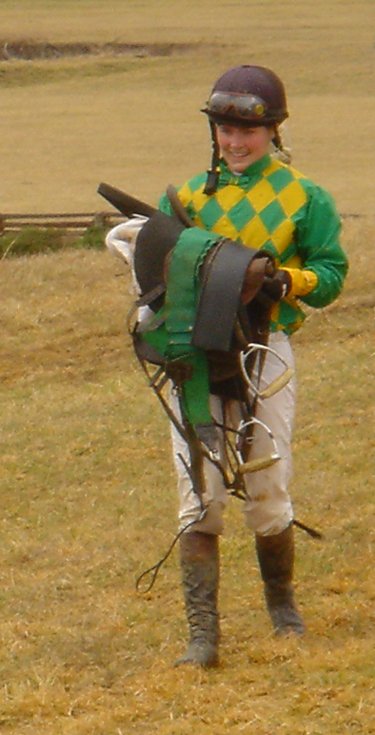
The scariest moment came early in the 4th Race for the Clarke Courier Cup when Tap Tap, a nine-year-old bay gelding, mistimed his takeoff and stumbled over a hurdle, causing jockey Anna McKnight of Monkton, Maryland to come off.
The fall resulted in a broken wrist and a compressed vertebrae and McKnight needed to be taken to Winchester Medical Center, but happily is expected to make a full recovery, and will soon be resuming riding.
Earlier in the day, Sam Cockburn, who won in his first ride last weekend at Casanova, riding the 8 year-old chestnut gelding Old Fellow in the 2nd Race One Mile Seven Furlong Amateur/Novice Hurdle also suffered a fall, and he too suffered a broken wrist. Cockburn is expected to be sidelined from racing for four weeks.
———————————-
Correction 3/11: I had originally identified the rider who suffered the broken wrist as Anna McKnight, but my wife Karen assured me that I was wrong and that she had heard officials identifying the victim otherwise, so I re-wrote my posting.
Anna McKnight’s mother, Mrs. H. Turney McKnight, MFH of Maryland’s Elkridge-Harford Hunt, however, read the posting, and wrote a comment informing me that it was indeed her daughter who experienced the more serious injury last Saturday.
———————————–
Further correction, 3/11:
A commenter informs me that Sam Cockburn, the jockey who fell in the Second Race, contrary to the Winchester Star report, also fractured a wrist.
———————————–
My apologies for all the mistakes and confusion and best wishes to both riders for a speedy recovery.
In 1619, two years before the colonists arrived in Massachusetts, a band of English settlers landed in Virginia, at what is now known as the Berkeley plantation. History says the travelers immediately fell to their knees to thank God for their safe arrival. Here is a closer look at the role these settlers had in shaping what we know today as Thanksgiving.
Most people think of the Pilgrims on Thanksgiving day: 1622, the Mayflower, Squanto and his tribe sharing a feast with the Puritans at Plymouth Rock.
But the children at Stonebridge School in Virginia present a different picture. With colonial hats and feathered headbands, these children re-enact what it must have been like back in the 1600s, marking the events surrounding the first Thanksgiving at a very different time and place.
It all began on the shores of Cape Henry in Virginia. In 1607, the first English colonists arrived: 105 English men and boys, and 39 sailors, among them the Reverend Robert Hunt. He was the first minister in America. According to Jamestown site historian, Dianne Stallings, he was instrumental in establishing the protestant faith in the new world.
Following a mandate from the king of England, Hunt pitched a cross and led the men in prayer on the beaches of Cape Henry.
“Reverend Hunt would have had the Book of Common Prayer as well as the Bible,†says Stallings. “And this would be a general prayer of thanksgiving that would have been read at that period of time.â€
Titled simply, the “General Thanksgivingâ€, this prayer, in one of it’s various versions , reads as follows:
“Almighty God, Father of all mercies, we thine unworthy servants do give thee most humble and hearty thanks for all thy goodness and loving-kindness to us and to all men.
We bless thee for our creation, preservation, and all the blessings of this life; but above all for thine inestimable love in the redemption of the world by our Lord Jesus Christ, for the means of grace, and for the hope of glory.â€
For two weeks the men combed the shores of the James River, scouting out the perfect place for their new settlement. Finally they decided on Jamestown.
And according to Stallings, the settlers came for three reasons: God, glory, and gold.
“England was very concerned that the protestant faith be established in the new world, and, of course, they were dedicated to the fact that they wanted to Christianize the Indians,†she says.
Perhaps the most famous Indian at the settlement was Pocahontas. Through her the Powhatan Indians and the colonists made peace. She would bring the colonists food, and some historical accounts say she even saved Captain John Smith’s life from her own people. Eventually, Pocahontas was held hostage by the colonists. It was then that she converted to Christianity and married one of the Jamestown leaders, John Rolfe. She was baptized into the Christian name, Rebecca.
Through Pocahontas, the settlers saw their goal of spreading the protestant faith begin to come to fruition. Years later she returned to England with her husband. Sadly, at just 22 years old, she died. It was two years after Pocahontas’ death that another group of English colonists landed in Virginia. After ten weeks at sea, they finally landed here at the Berkeley Plantation. Virginia Historians claim that this is where the real first Thanksgiving took place. The plantation sits just a few miles from the original Jamestown settlement.
“The Virginia Company had directives given to the settlers and the directives were that upon landing, they were to give thanks and every year thereafter make it an annual celebration in thanks to the Lord for a safe passage,†says Barbara Awad, president of the Virginia Thanksgiving Festival.
This was about seventeen months before the pilgrims landed in Plymouth. And while the Pilgrims celebrated with a feast, much like the traditional meal Americans eat on Thanksgiving, the settlers at Berkeley Plantation had a meager meal.
“It wasn’t quite the abundant festival, the cornucopia that we usually see on Thanksgiving,†says Awad.
Historians say their feast included bacon, peas, cornmeal cakes, and cinnamon water. But regardless of the menu, to these settlers, the first Thanksgiving was much more than turkey and pumpkin pie. It was all about prayer.
We’ve spent much of the last two days attending the Spring Trial Pack Competitions of the National Beagle Club at the Institute in Aldie.
The Wolver Beagles returning from competing in the Three-Couple.
Karen and I follow the two packs illustrated above, who did not win.
Friday’s Three-Couple Pack competition was won by the York County, Pennsylvania’s Holly Hill Beagles, who ran a cottontail for 45 minutes and then captured the quarry, alive! People are still talking about that one.
John Borsa, Master of Beagles, holds the captive safely, Whip Amy Burke stands by his side. (Photo: Russell Wagner)
Melanie Williams, winner of the Sheila Baldwin Burke Memorial, looked happy yesterday.She rode to victory on Flying Horse Farm’s Analyze, whose trainer was Jazz Napravnik.
Racing was temporarily interrupted in mid-afternoon by a thunderstorm featuring lightning and hail. Spectators, horses, and riders scurried for shelter. Fortunately, the storm passed fairly quickly, and it was possible to complete the final races.
Authorities remained on the scene Tuesday of a Chesterfield County neighborhood where munitions exploded and killed a homeowner who sold Civil War relics.
Chesterfield County Police said neighbors reported the explosion Monday afternoon after hearing the blast and then finding the victim fatally injured in his backyard near a detached garage.
Police identified the victim Tuesday as Samuel H. White, 53.
Authorities found other unexploded military ordnance at the house, and evacuated about two dozen homes nearby until authorities could determine the area was safe. Police spokeswoman Ann Reid said the evacuation would remain in effect indefinitely.
Tuesday afternoon, police continued to collect and detonate ordnance.
White ran a Web site called Sam White Relics. The site contains photos of various relics for sale, such as Civil War artillery shells, cannonballs, bullets and other artifacts.
White said on the site he “will disarm, clean, and preserve your Civil War period and earlier military ordinance” for about $35 a piece.
“I’ve done approx. 500 artillery projectiles and still have all my fingers (I must be doing something right, knock on wood)!” the site states.
Neighbor Brian Dunkerly told the Richmond Times-Dispatch that a chunk of the ordnance flew into the air and smashed through the front-porch roof of his home about one-quarter-mile away. The piece of metal — weighing close to 15 pounds — then shattered his glass front door, hit the interior wood floor and bounced to the ceiling before coming to rest in the center of his living room.
An accident occurred while disarming a Civil War projectile, long time collector Sam White, Chesterfield Va was killed in the accident. This is a horrible tragedy, Sam White was one of the good guys in this business, and I am very much saddened by his loss. I offer my prayers and condolence.
Sam had years of experience disarming and restoring Civil War ordnance and was highly respected. I believe that he used good techniques, but obviously something failed with this accident. The complete details are not known at this point, but it appears that he must have been drilling a large shell outside his house and did not use his remote rig. The news media showed pictures of a large fragment, likely from a round ball 8 inches or larger.
Notwithstanding recent accidents, Civil War ordnance is not dangerous to handle or display and is desirable to collect. All shells in a personal collection should be disarmed to ultimately be considered safe, but mere displaying or handling Civil War ordnance is not inherently dangerous. The two events that can cause danger are extreme heat or mechanical stimulus.
The black powder used in Civil War ordnance needs heat in the region of 500 degrees F to ignite, so it takes extreme heat such as a burning building, a fire or some other extreme heat to ignite black powder.
Mechanical stimulus can be hazardous, such as attempting to smash a shell with a sledge hammer or shooting a shell with a high powered modern rifle or something of the like. Drilling a shell to remove or wet the powder is the preferred method to render a shell inert, but the drilling process can create hazard. Ironically, the safest thing to do with a Civil War shell is to simply leave it alone. However ultimately it is good practice to disarm a shell to render it inert. This is done by drilling a hole into the chamber and wetting and removing the powder inside. Once the powder inside the cavity is wet or removed, the shell is inert and represents no continuing danger.
The accident with Sam White apparently occurred while drilling, although this is not fully confirmed yet.
The wife and I attended today the Old Dominion Hounds’ Joint Meet with the Casanova Hunt (to which numerous other Northern Virginia Hunts –including our own Blue Ridge Hunt– were invited).
The joint meet was a fund raiser undertaken to support efforts to oppose Dominion Power’s plan to build 16-story 500-kv electrical transmission towers through scenic and historic Frederick, Warren, Rappahannock, Culpeper, Fauquier, Prince William and Loudoun counties.
And for what? To bring more electrical power to the District of Columbia to illuminate federal offices whose functionaries are busily employed drafting new regulations and spending more tax dollars.
If the evil federal government wants more power, let ’em build nuclear power plants in the District, or do without and borrow some cardigan sweaters from Jimmy Carter.
Not in my backyard, and not in my neighboring fox hunt’s backyard, say I.
We did not get our fair share of abuse, actually. But we did see some fine riding and some lovely scenery. The Blue Ridge really is blue down there in Fauquier County. And the natives are as charming and hospitable as in the rest of the Commonwealth of Virginia.
In 1619, two years before the colonists arrived in Massachusetts, a band of English settlers landed in Virginia, at what is now known as the Berkeley plantation. History says the travelers immediately fell to their knees to thank God for their safe arrival. Here is a closer look at the role these settlers had in shaping what we know today as Thanksgiving.
Most people think of the Pilgrims on Thanksgiving day: 1622, the Mayflower, Squanto and his tribe sharing a feast with the Puritans at Plymouth Rock.
But the children at Stonebridge School in Virginia present a different picture. With colonial hats and feathered headbands, these children re-enact what it must have been like back in the 1600s, marking the events surrounding the first Thanksgiving at a very different time and place.
It all began on the shores of Cape Henry in Virginia. In 1607, the first English colonists arrived: 105 English men and boys, and 39 sailors, among them the Reverend Robert Hunt. He was the first minister in America. According to Jamestown site historian, Dianne Stallings, he was instrumental in establishing the protestant faith in the new world.
Following a mandate from the king of England, Hunt pitched a cross and led the men in prayer on the beaches of Cape Henry.
“Reverend Hunt would have had the Book of Common Prayer as well as the Bible,” says Stallings. “And this would be a general prayer of thanksgiving that would have been read at that period of time.”
Titled simply, the “General Thanksgiving”, this prayer, in one of it’s various versions , reads as follows:
“Almighty God, Father of all mercies, we thine unworthy servants do give thee most humble and hearty thanks for all thy goodness and loving-kindness to us and to all men.
We bless thee for our creation, preservation, and all the blessings of this life; but above all for thine inestimable love in the redemption of the world by our Lord Jesus Christ, for the means of grace, and for the hope of glory.”
For two weeks the men combed the shores of the James River, scouting out the perfect place for their new settlement. Finally they decided on Jamestown.
And according to Stallings, the settlers came for three reasons: God, glory, and gold.
“England was very concerned that the protestant faith be established in the new world, and, of course, they were dedicated to the fact that they wanted to Christianize the Indians,” she says.
Perhaps the most famous Indian at the settlement was Pocahontas. Through her the Powhatan Indians and the colonists made peace. She would bring the colonists food, and some historical accounts say she even saved Captain John Smith’s life from her own people. Eventually, Pocahontas was held hostage by the colonists. It was then that she converted to Christianity and married one of the Jamestown leaders, John Rolfe. She was baptized into the Christian name, Rebecca.
Through Pocahontas, the settlers saw their goal of spreading the protestant faith begin to come to fruition. Years later she returned to England with her husband. Sadly, at just 22 years old, she died. It was two years after Pocahontas’ death that another group of English colonists landed in Virginia. After ten weeks at sea, they finally landed here at the Berkeley Plantation. Virginia Historians claim that this is where the real first Thanksgiving took place. The plantation sits just a few miles from the original Jamestown settlement.
“The Virginia Company had directives given to the settlers and the directives were that upon landing, they were to give thanks and every year thereafter make it an annual celebration in thanks to the Lord for a safe passage,” says Barbara Awad, president of the Virginia Thanksgiving Festival.
This was about seventeen months before the pilgrims landed in Plymouth. And while the Pilgrims celebrated with a feast, much like the traditional meal Americans eat on Thanksgiving, the settlers at Berkeley Plantation had a meager meal.
“It wasn’t quite the abundant festival, the cornucopia that we usually see on Thanksgiving,” says Awad.
Historians say their feast included bacon, peas, cornmeal cakes, and cinnamon water. But regardless of the menu, to these settlers, the first Thanksgiving was much more than turkey and pumpkin pie. It was all about prayer.
AJStrata watches the map of Virginia change from red to purple, and wonders when the GOP is going to wise up and realize that Nativism has always been a losing political strategy in the United States.
We have had GOP Congressman in my areas of Northern Virginia for as long as I can remember, and now we don’t. It is not just the Iraq war. Northern VA has an enormous (and sometimes troublesome) immigrant population from below our southern border. But the area has people from all over the world, given the work done in downtown DC. So immigration and diversity of cultures and traditions is the norm overall. Herndon, one of the most visible flash points in the illegal immigration issue, is now possibly a very democrat place.
So how is being hardlined on long term immigrants benefitting the GOP here? We all agree we need to boot the criminals ASAP, get the rest background checked and processed into the above-the-table economy, and restrict all future immigration to be truly temporary and enforceable. Conservatives implode (and get nasty and testy) when we discuss the option of having long term, crime free immigrants pay fines and stay. Seems to be some sort of emotional issue with some. But I can see the results. Democrats win.
Democrats just took away decades-long GOP seats in areas of VA rife with illegal immigrants. If the GOP hardline won’t work here it won’t work in a lot of places. Not all, but too many to consider a governing majority. The problem is the long term illegals are interwoven into our society. They are neighbors or friends and teammates of our kids. They sit next to us in Church (OK, they would if I attended church). They are not usually or obviously criminals.
The GOP is attacking and maligning friends and neighbors to too many people who will vote against such posturing and are in sufficient numbers to move 5-8% of the vote and tip seats into Democrat hands. 5-8% of the population is not a large number, but when they switch sides or are repulsed away from one side that shift in voting can be like a political earth quake.
The same lemming-like strategy of political self-destruction worked marvelously in California. In Ronald Reagan’s day, California was a Republican bastion. Today, the largest block of electoral votes in the country can be relied upon to belong to the democrats and California sends two democrat senators to Washington. All because the GOP chose to make illegal immigration its key issue, thoroughly alienating working-class Hispanic voters.

 photo: Karen L. Myers