Archive for January, 2008
04 Jan 2008


George McDonald Fraser, author of the Flashman novels, a series of comic historical novels typically revolving around one of the best-known military disasters of the Victorian era and featuring as their hero a later-in-life version of the cad and bully Flashman from Tom Brown’s Schooldays, has died at age 82 of cancer.
Fraser had resided on Man as a political (and tax) exile from socialist Britain for many years.
He served during WWII in the Border Regiment and, after being commissioned an officer, in the Gordon Highlanders. Upon leaving the Army, he worked as a journalist for the Glasgow Herald. In 1969, he published the first of the Flashman novels which soon became a lucrative success.
As the London Times observes:
He had hit on a deceptively simple idea that proved to be a bestselling formula at the end of the Swinging Sixties. The public still wanted to sit down with a good rip-roaring yarn — but did not want heroes. So why not make the central character a cad? A cad the reading public already knew about — Harry Flashman, the bounder of Tom Brown’s Schooldays?
What happened to Flashman after the good Doctor Arnold expelled him from Rugby? Fraser decided that he must have gone into the Army. Bully, liar and coward he may still have been, but the Victorian military authorities did not mind. Or perhaps they were simply too stupid to notice, as he whored and cheated his way around the British Empire. The resulting stories became one of the great tongue-in-cheek achievements of popular fiction.
The standing joke between Fraser and his readers was that these were genuine memoirs: they had been discovered, “wrapped in oilskin†and stuffed into a tea chest, during a house sale at Ashby, Leicestershire, in 1965. They described how, after a long, eventful life, loved by the ladies and lauded by the Establishment — Flashman was a brigadier-general, a VC, a Knight of the Bath, a Chevalier of the Legion d’Honneur and, amusingly, holder of the San Serafino Order of Purity and Truth — the old scoundrel mused in old age about how he had got away with it: “The ideal time to be a hero,†he wrote, “is when the battle is over and the other fellows are dead, God rest ’em, and you take the credit.â€
It was all rollicking nonsense; but it had a sterling quality that went to the heart of many sophisticated readers who like to relax with a rubbishy book provided it is well written rubbish.
The Guardian identifies another basis of the series’ success.
Fraser was intending amusing travesty, but, underneath it all, the author really believed in Britishness. When the chips are down (when sepoys, for example, are murdering women and children in the Indian Mutiny) Flashman is a gallant and decent fellow (and no racist). Flashy, not unflashy Tom, embodies what made the empire work.
The Flashman novels spoke eloquently to the British reader. They articulated that mixture of cynicism, shame, and pride that contemporary Britons felt about Victorian values and Great Britain.
04 Jan 2008
Iowa, in my view, is the ultimate dreadful flat Midwestern fly-over state with a name beginning with a vowel. Beyond producing lots of corn, Iowa’s only apparent raison d’etre seems to me to consist of making crossing Indiana seem not so bad.
The MSM is agog over Huckabee and Obama’s triumph. Some serious chin-stroking is underway this morning as the punditocracy unlimbers its powers of divination and starts explaining what it all means.
But Michael Judge was probably right yesterday, when he suggested in the Wall Street Journal that we all just Ignore Iowa.
in 2004 just 6% of the state’s eligible voters attended a caucus, according to a study by Prof. Michael McDonald of George Mason University. Many Iowans say that number is deceptively low, because President Bush ran unopposed and most Republicans stayed home. With a big turnout year as 2008 is expected to be, caucus organizers still will be lucky to get one in five voters to make the effort. …
You’ll have to forgive us Iowans; we’ve been bombarded by innumerable pamphlets, polls, phone calls, television ads, text messages, etc. And our borders have been compromised by a press corps that’s pounced on every story, however mundane, as if it were a talking pig. (Go to CNN.com to see streaming video of the elderly Iowa woman who carved a bust of Obama from 23 pounds of butter.)
Is all this hoopla really justified? In 1988, then New Hampshire governor John Sununu famously said, “The people of Iowa pick corn, the people of New Hampshire pick presidents.” He was right, at least about Iowans not picking presidents. The winner of the Iowa Caucus, incumbents excluded, has never — well, almost never — won the presidency (Jimmy Carter being the exception to the rule).
04 Jan 2008

RifleGear.com responds to so-called assault weapon phobia, leading so frequently to state and municipal bans on ugly military-looking long arms, with a new design: the California-legal “Hello, Kitty” AR-15.
04 Jan 2008
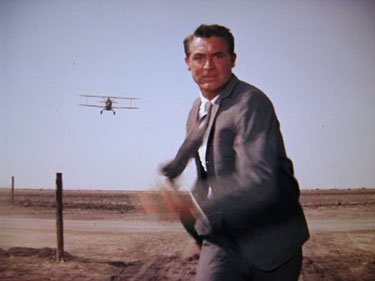
Todd McEwen discusses ‘by far the best suit in the movie, in the movies, perhaps the whole world.”
North By Northwest isn’t a film about what happens to Cary Grant, it’s about what happens to his suit. The suit has the adventures, a gorgeous New York suit threading its way through America. The title sequence in which the stark lines of a Madison Avenue office building are ‘woven’ together could be the construction of Cary in his suit right there — he gets knitted into his suit, into his job, before our very eyes. Indeed some of the popular ‘suitings’ of that time (‘windowpane’ or ‘glen plaid’) perfectly complemented office buildings. Cary’s suit reflects New York, identifies him as a thrusting exec, but also arms him, protects him: what else is a suit for? Reflects and Protects. a slogan Cary’s character, Roger Thornhill, might have come up with himself. …
The suit, Cary inside it, strides with confidence into the Plaza Hotel. Nothing bad happens to it until one of the greasy henchmen grasps Cary by the shoulder. We’re already in love with this suit and it feels like a real violation. They’ve mistaken Roger Thornhill for a federal agent called George Kaplan. They bundle him into a cab and shoot out to Long Island, not much manhandling yet. In fact Martin Landau is impressed: ‘He’s a well-tailored one, isn’t he?’ He loves the suit. But next moment Cary tries to escape… there’s a real struggle, they force all that bourbon down his throat. (He later thinks they’ll find liquor stains on the sofa, but if there was that much violence why aren’t there any on the suit?) Cut to Cary being stuffed into the Mercedes-Benz — he’s managed to get completely pissed without even ‘mussing’ his hair. On his crazy drink-drive, the collar of his jacket is turned the wrong way round. That’s all. He gets arrested, jerked around by the cops, conks out on a table and appears before the judge next morning, and the suit and the shirt both look great. But this is the point in the picture where you start to worry about Cary’s personal hygiene. Start to ITCH. Cops aren’t generally too open-handed with showers.
It’s back to the bad guy’s house, then back to the Plaza, looking good. I always hope he’ll grab a quick shower in the hotel room — he keeps gravitating towards the bathroom. There’s a good suit moment when he tries on one belonging to Kaplan, the guy he’s looking for, who doesn’t exist. Kaplan’s suits are stodgy, old-fashioned, unbelievably heavy for a summer in New York with turn-ups on the trousers. So much for the sartorial acumen of the US government. ‘I don’t think that one does anything for you,’ says Cary’s mom, and boy is she right. She also jokes that Kaplan maybe ‘has his suits mended by invisible weavers’, which is what happens to Cary’s suit throughout the picture! His suit is like a victim of repeated cartoon violence in the next shot it’s always fine.
Off to the United Nations, where the Secretariat looks even more like Cary than his own office building. He sublimely matches a number of modern wall coverings and stone walls here and throughout the picture. He pulls a knife out of a guy, but doesn’t get any blood on himself. There’s a curious lack of blood in North By Northwest; it must be all to save the suit, though there must be ten or even twenty of them in reserve, no? Cary evades the bad guys again and scoots over to Grand Central Station, where they have, or had, showers, but he’s too busy.
This is what’s ingenious about this picture, at least as far as the SUIT goes — Cary’s able to travel all over the country in just this one beautiful suit because the weather has been planned for the suit by Ernest Lehman! It’s the perfect weather for an adventure in this suit, and that’s why it happens. At the same time, there’s a CREEPINESS about the whole escapade generated by our own fears that in some situation Cary will be inappropriately dressed (Cary GRANT?) and this will hinder him; or that the thin covering of civilization the suit provides him with will be pierced and here he is, thousands of miles from home, with not so much as a topcoat. Men ought to admit that they can experience suit-fear: the fear of suddenly being too cold in the suit you thought would do (in Glen Cove, Long Island, even on a summer night) or too hot (the prairie, to come). Exposed, vulnerable. Cary does have some money though, we know that, so he could buy something to wear if he had to, assuming his wallet isn’t destroyed along with the suit. But it would be too traumatic to see this suit getting totaled, that would be way beyond Hitchcock’s level of sadism. This feeling of exposure, the idea of having suddenly to make a desperate journey in just the clothes you have on, comes up in The Thirty-Nine Steps (book and movie): Richard Hannay is alone in a desolate landscape in inappropriate town clothes when a menacing autogiro spots him from the air.
In the suit are a number of subtle tools for Cary. It’s so well cut you can’t tell if he’s even carrying a wallet (turns out he is). Here’s what he’s got in that suit! He goes all the way from New York to Chicago to the face of Mount Rushmore with: a monogrammed book of matches, his wallet and some nickels, a pencil stub, a hanky, a newspaper clipping and his sunglasses, but these are shortly to be demolished when Eva Marie Saint folds him into the upper berth in her compartment. (Really this is a good thing, because Cary Grant in dark glasses looks appallingly GUILTY.) All this stuff fits into the pockets of the most wonderful suit in the world. Does the suit get crushed in the upper berth as his Ray-Bans are smashed? No. Cary keeps his jacket on in the make-out scene that follows. The suit defines him, he’s not going to take off that jacket. I know this feeling.
Complete article

But, is it really a New York suit?
Richard Torregrossa, in Cary Grant and the Secrets of the Perfect Suit, also identifies a number of its points of excellence, but I was persuaded that he is wrong in identifying THE SUIT as having been tailored by Kilgour, French & Stanbury, an old Savile Row firm most familiar to Americans simply as a licensed label of Barney’s used on suits made domestically as one of their house brands from the 1980s to around 2000.
The correct tailor is most likely identified in this Ask Andy Forum thread, which links to four pages of definitive discussion on the valuable resource on this subject area, LondonLounge.Net

The answer? A subtle glen plaid, probably in 13 oz flannel or 10 oz fresco tropical weave, tailored by Quintino of Beverly Hills.
————————————-
Hat tip to Karen L. Myers.
03 Jan 2008
George Friedman‘s latest from the Stratfor subscription service.
The endgame of the U.S.-jihadist war always had to be played out in Pakistan. There are two reasons that could account for this. The first is simple: Osama bin Laden and the al Qaeda command cell are located in Pakistan. The war cannot end while the command cell functions or has a chance of regenerating. The second reason is more complicated. The United States and NATO are engaged in a war in Afghanistan. Where the Soviets lost with 300,000 troops, the Americans and NATO are fighting with less than 50,000. Any hope of defeating the Taliban, or of reaching some sort of accommodation, depends on isolating them from Pakistan. So long as the Taliban have sanctuary and logistical support from Pakistan, transferring all coalition troops in Iraq to Afghanistan would have no effect. And withdrawing from Afghanistan would return the situation to the status quo before Sept. 11. If dealing with the Taliban and destroying al Qaeda are part of any endgame, the key lies in Pakistan.
U.S. strategy in Pakistan has been to support Pakistani President Pervez Musharraf and rely on him to purge and shape his country’s army to the extent possible to gain its support in attacking al Qaeda in the North, contain Islamist radicals in the rest of the country and interdict supplies and reinforcements flowing to the Taliban from Pakistan. It was always understood that this strategy was triply flawed.
First, under the best of circumstances, a completely united and motivated Pakistani army’s ability to carry out this mission effectively was doubtful. And second, the Pakistani army was — and is — not completely united and motivated. Not only was it divided, one of its major divisions lay between Taliban supporters sympathetic to al Qaeda and a mixed bag of factions with other competing interests. Distinguishing between who was on which side in a complex and shifting constellation of relationships was just about impossible. That meant the army the United States was relying on to support the U.S. mission was, from the American viewpoint, inherently flawed.
It must be remembered that the mujahideen’s war against the Soviets in Afghanistan shaped the current Pakistani army. Allied with the Americans and Saudis, the Pakistani army — and particularly its intelligence apparatus, the Inter-Services Intelligence (ISI) — had as its mission the creation of a jihadist force in Afghanistan to fight the Soviets. The United States lost interest in Afghanistan after the fall of the Soviet Union, but the Pakistanis did not have that option. Afghanistan was right next door. An interesting thing happened at that point. Having helped forge the mujahideen and its successor, the Taliban, the Pakistani army and ISI in turn were heavily influenced by their Afghan clients’ values. Patron and client became allies. And this created a military force that was extremely unreliable from the U.S. viewpoint.
Third, Musharraf’s intentions were inherently unpredictable. As a creature of the Pakistani army, Musharraf reflects all of the ambivalences and tensions of that institution. His primary interest was in holding on to power. To do that, he needed to avoid American military action in Pakistan while simultaneously reassuring radical Islamists he was not a mere tool of the United States. Given the complexity of his position, no one could ever be certain of where Musharraf stood. His position was entirely tactical, shifting as political necessity required. He was constantly placating the various parties, but since the process of placation for the Americans meant that he take action against the jihadists, constant ineffective action by Musharraf resulted. He took enough action to keep the Americans at bay, not enough to force his Islamist enemies to take effective action against him. …
the United States now faces its endgame under far less than ideal conditions. Iraq is stabilizing. That might reverse, but for now it is stabilizing. The Taliban is strong, but it is under pressure and has serious internal problems. The endgame always was supposed to come in Pakistan, but this is far from how the Americans wanted to play it out. The United States is not going to get an aggressive, anti-Islamist military in Pakistan, but it badly needs more than a Pakistani military that is half-heartedly and tenuously committed to the fight. Salvaging Musharraf is getting harder with each passing day. So that means that a new personality, such as Pakistani military chief Gen. Ashfaq Kayani, must become Washington’s new man in Pakistan. In this endgame, all that the Americans want is the status quo in Pakistan. It is all they can get. And given the way U.S. luck is running, they might not even get that.
Read the whole thing.
03 Jan 2008
Quinn Hilyer looks at John McCain, who has been garnering endorsements in new Hampshire recently, and shudders.
As truly horrific as it would be for the liberal and unethical Mike Huckabee to win the Republican presidential nomination, many Republicans still believe it would be almost as difficult to stomach the nomination of John McCain.
Huckabee, of course, would utterly destroy the old Reagan coalition, as even his campaign chief Ed Rollins has acknowledged. Huckabee’s bizarre propensity for letting criminals return early to freedom, combined with his utter cluelessness about foreign policy, also means that he would get absolutely crushed by the Democrats in a general election contest.
But McCain’s problems are almost as great, which is why reports of a comeback by the Arizona senator have so many conservatives scratching their heads.
McCain is, and looks, more than two years older than Ronald Reagan was when Reagan was elected president, and a poll last year showed that 42 percent of respondents said they would not vote for somebody who is 72 years old. That is a far higher percentage than that of people who would not vote for a Mormon (24 percent), a woman (11 percent), or a black person (5 percent).
McCain is not a tax cutter in a party that has made tax cuts one of its most basic tenets for nearly 30 years. Not only did he vote against President George W. Bush’s tax cuts in 2001 and 2003 — cuts that clearly are responsible for the booming economy of the past four-plus years — but just last week he told National Review’s Rich Lowry that he was correct not to vote for those tax cuts.
03 Jan 2008
Damian Thompson reports another victory for human rights at the United Nations.
the General Assembly of the United Nations ended the year by passing a disgusting resolution protecting Islam from criticism of its human rights violations.
Lots of non-Muslims voted for it – a sign that more and more corrupt Third World governments are identifying with the ideology of Islam, even if they don’t accept its doctrines.
The resolution goes under the innocuous title “Combating defamation of religions” – but the text singles out “Islam and Muslims in particular”. It expresses “deep concern that Islam is frequently and wrongly associated with human rights violations and terrorism”.
Wrongly associated? As of today, terrorists have carried out 10,277 separate attacks since September 11, 2001. They all belong to the same religion, and it ain’t Methodism.
The resolution (which of course makes no mention of the vicious persecution of Christians) was pushed through by the 57-nation Organisation of the Islamic Conference (OIC), which has been agitating for it for years. Naturally every Muslim country was among the 108 supporters, but it’s interesting to note how other countries lined up.
Cuba, China, North Korea and Zimbabwe all voted the same way. I’ll give you one guess.
03 Jan 2008
Lee Siegel reviewing Peter Gay’s Modernism — The Lure of Heresy From Baudelaire to Beckett and Beyond.
if the French provided the most extreme assaults on Western rationality — Rimbaud’s “disorientation of the senses,†André Breton’s celebration of primal instincts stored in the unconscious, André Gide’s enthusiasm for the “motiveless†crime, Antonin Artaud’s “Theater of Cruelty,†Maurice Blanchot’s declaration of the death of the author — the reason was simple. … In France, civilization is invincible and eternal. Its immutable stability makes opposition to it all the more cheerfully ferocious. You can hurl the most incredible rhetorical and intellectual violence against French custom and convention and still have time for some conversation in the cafe, un peu de vin, a delicious dinner and, of course, l’amour. And in the morning, you extricate yourself from such sophisticated coddling — the result of centuries of art and artifice — and rush back to the theoretical barricades.
02 Jan 2008
Liberal legal blog QuizLaw has pulled slightly ahead of conservative legal blog Overlawyered in the polling for ABA Journal’s best general law blog contest ending today. Evidently, the liberals have been beating the bushes for votes to win this won.
Ruin a trial lawyer’s week, vote for Walter Olson‘s Overlawyered for best general legal blog.
Vote here.
02 Jan 2008
Neal Boortz has some choice words for the left.
Sorry, I’m not in the mood for all of this Happy New Year nonsense. This is getting to be about as phony as the 4th of July. (Freedom … right. Like the people of this country are still in love with the idea of liberty.) This is 2008. This is an election year. We’re choosing a new House of Representatives, about one-third of the Senate and a president. This is not the type of New Year you launch with the traditional expressions of optimism. We’re in trouble. An election is coming in 11 months and millions of parasites, led by single females, are getting ready to accelerate the destruction of the concepts of individuality, private property rights, self-reliance, and this very country by putting a hideous, power-hungry, big-government socialist into the White House.
I think I’ve made a bit of a mistake over the past few months. Trying to be a bit to nice to the people I think are destroying this country. I’ve been trying to cut them some slack .. be a little understanding. You know, the compassion thing. Well, something must have clicked during the last two weeks off. No more free passes. Identify the leeches. Call them out. They’re destroying the greatest system of governance this world has ever known, and they should not be allowed to go unchallenged.
If you squandered every opportunity for an education to end up an unemployable semi-literate loser, that’s your problem, not mine. If you’ve destroyed your health with cigarettes and fast food … then by what right do you demand that people who lived their lives more responsibly than you cover the cost of your medical care. You cry about your “right” to health care. You dare to claim a right to the services of another human being to correct problems you created for yourself? Further, if it is more important for you to spend your money on a cell phone, flat-screen televisions, the best new car, meals at expensive restaurants and fancy vacations than it is to spend your money on a health insurance policy .. then you should be on your own. Don’t beg the government to steal from someone else so that you don’t have to change your lifestyle.
02 Jan 2008

CNN describes a revealing campaign moment, in which Mike Huckbee chose to deflect press criticism of his own tardy awareness of a breaking story by echoing democrat-style criticism of Bush Administration foreign policy.
Huckabee’s comments came in an interview with Iowa’s Quad City Times, in which a reporter asked him why, last month, he was at first unaware of a National Intelligence Estimate detailing the threat posed by Iran, despite the fact the report had been made public for several hours.
“That was released at 10 o’clock in the morning,” Huckabee said. “At 5:30 in the afternoon, somebody says, ‘Have you read the report?’ Maybe I should’ve said, ‘Have you read the report?’ President Bush didn’t read it for four years; I don’t know why I should read it in four hours.â€
Romney said Tuesday the comments were in ‘bad taste,” and lifted from the “Democratic playbook.”
02 Jan 2008

The Washington Post reports on Christmas Day activities in the Orkneys:
William Thomson’s family had played this sport for centuries, so he understood that he needed to choose between two strategies for the annual Christmas day ba’ game.
The scrawny 17-year-old could fight for the ball in the center of the riotous scrum, where more than 300 men would function as a human juicer, turning his face red, then purple. He would be scratched, punched, kneed and bitten. His ribs might break. He could pass out unconscious.
Or, Thomson could follow convention for players his size and stay near the edge of the scrum, pushing the pile. This would work well unless the ball popped out and the mob changed direction. Cars, gravestones, houses, strollers, hotel lobbies — all had been kicked, shoved or trampled in pursuit of the ball during previous games. Anticipating such a stampede, business and homeowners in town had nailed wooden planks across their doors and windows. “If you’re on the edge of the scrum and it turns on you,” one veteran player said, “then you might as well be dead.”
This, Thomson decided, was his safest option.
He never considered not participating. The men in the Thomson family — like the men in most families here — have played this game since at least the mid-1600s. It is one of the oldest and most physical sports, and it’s almost certainly the most simple. Half of the men in Kirkwall, called Doonies, try to push a small ball into the sea using any means necessary. The other half, called Uppies, work to push the ball to a wall one mile across town. The ba’, which refers to both the game and the ball with which it is played, can last anywhere from four minutes to nine hours in freezing temperatures and hurricane-force winds.
The ba’ is played nowhere else. It has persisted in Kirkwall because its basic tenets are congruent with life on these Orkney Islands in northern Scotland. If you’re tough enough to survive in this old Viking territory, in a frostbitten town of around 6,000 bordered by whitecapped seas, then you don’t worry about relaxing on Christmas and New Year’s Day. You put on steel-toe boots and a rugby shirt and walk downtown to the almost 900-year-old St. Magnus Cathedral, ready for hell.
Complete article
slideshow
Hat tip to Matthew MacLean.
/div>

Feeds
|



