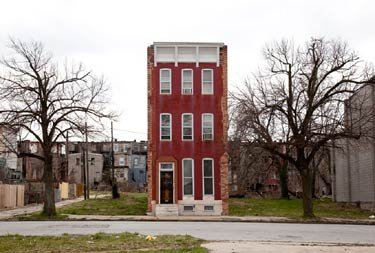
According to an article in the Baltimore Sun, there are roughly 16,000 vacant homes in Baltimore that the city plans to restore or destroy to replace with green spaces and housing redevelopment over the next 10 years. Many of the homes to be torn down are row homes, built in the late 1800s.
Photographer Ben Marcin lives in a Baltimore row house with his wife, Lynn. Several years ago, Marcin, a self-taught photographer who bought his first camera at 27, began noticing lone row houses in the blighted sections of the city. “For me it was a fascinating sight: a solitary structure, well over 100 years old, sometimes 40 feet tall and less than 20 feet wide,†he wrote via email. “An amputee shorn of its former neighbors, yet still retaining architectural details and other touches, proclaiming the heights of an earlier era.â€
Manson H. Whitlock, proprietor of the last prominent typewriter repair and sales shop in the United States, and the last of Bethany, Connecticut’s renowned Whitlock brothers passed away August 28 at the age of 96.
His elder brother, Reverdy Whitlock (Yale 1936), known to generations of Yale students as the third-generation proprietor of the used book shop on Broadway, died in April of 2011 a little more than a month shy of 98.
The other two brothers, who managed the famous Whitlock Book Barn on the grounds of the former family dairy farm in Bethany, Everett and Gilbert, left us only slightly earlier: Everett in September 2003, aet. 91, and Gilbert in March of 2004, aet. 88.
The four Whitlock brothers represented, on the essential commercial fringe of University life, a kind of charming survival of indigenous local Yankeedom, preserving in their personalities, manners, and accents an otherwise long-vanished rural Connecticut.
All the Whitlock brothers were stubborn and opinionated, but formal in manner, and taciturn and restrained in speech. All of them were also careful and precise in business and notoriously thrifty. I can still remember Reverdy reaching into his pocket and taking out an old-fashioned farmer’s change purse when the store register came up short as he was making change for a book purchase. When he opened the clips on top, a moth flew out, and I’ve always suspected that all the buffaloes on the nickels inside blinked.
All the Whitlock brothers clearly experienced a characteristic kind of quiet glee in personally approximating so perfectly all the classic New England Yankee stereotypes.
At one time, Manson Whitlock probably owned the most lucrative, if not the most prestigious, of the Whitlock businesses. Before the personal computer came along, every Yale student had to own a typewriter and every typewriter, sooner or later, needed new ribbons, and occasional cleanings and repairs.
The Whitlocks were competitive, and I suspect the other brothers quietly gloated when technology rendered Manson’s formerly vibrant typewriter shop obsolescent. But Manson didn’t care. He had put away his competence decades earlier, and he stubbornly continued to open his shop every day and contently passed away his time repairing and maintaining individual specimens of his extensive store collection. Once in a blue moon, some superannuated fossil who had declined to change over to computers would show up for a typewriter servicing or repair. Even more occasionally, a collector would descend to conduct fierce negotiations with Manson over a particularly desirable early example. One thing never changed, Manson Whitlock’s typewriters, despite the changing times, did not get any cheaper.
And Yale and New Haven will never be the same without the Whitlock Brothers. Their passing from the local scene leaves the kind of painful gap that the vanishing of Yale fence along Chapel Street and the perishing of the stately elms overlooking the Old Campus and the Green once did. Some crucial and beloved landmarks have been lost.
An alligator is such a bizarre, unusual sight in the waters of the Upper Mud River that even seeing isn’t necessarily believing.
“I didn’t even tell my wife,†says Jack Stonestreet, who was fishing on the river last Thursday. “I didn’t tell her because, to be honest, I didn’t think anyone would believe me.â€
Fishermen over the past several days contacted the West Virginia Division of Natural Resources to tell them of the gator sighting. On Saturday, Nick Huffman, a field superintendent with the DNR, saw the scaled reptile with his own eyes.
“I would say he’s a half grown alligator, a total measurement of 67 inches,†Huffman says. “That’s big enough I knew not to get on him in hand-to-hand combat.â€
The DNR shot the alligator and pulled it out of the water.
The alligator will now be dissected. Opening the alligator’s stomach may give the DNR some insight as to where it may have come from and how long it was in the river.
West Virginia has almost no regulations on alligator ownership– probably because most people have sense enough not to own one!
But I have seen alligators and caimans available at pet stores, and every once in a while, someone releases a pet alligator into a river or lake in hopes that it will survive in the wild (I guess).
The problem is that alligators live only as far north as northeastern North Carolina. There is some debate about about them having an historical range into southeastern Virginia. I’ve always heard that the Great Dismal Swamp was the northern boundary, but I’ve also heard that alligators once ranged into the James River. In North Carolina, they are found only in the coastal plain, where the winters are comparatively mild. My guess is if they were found in Virginia at one time, they were never found out of the extreme southeastern part of the state, and if they did occur in the James River, my guess is they were found only near the coast.
If they aren’t found outside of North Carolina’s coast plain, how on earth could they survive in West Virginia?
When moose began showing up, for the first time since Colonial times, in the 1980s in Connecticut, the authorities immediately responding by shooting every one. Government just naturally abhors any novelty.
Personally, I don’t think a single gator represents that much of a hazard, and I think his presence made that river a lot more interesting. If I were in charge, I’d have simply encouraged alligator watching and proposed changing the mascot of the local high school team to an alligator.
The journalist Jacques Mortane had the whole event filmed and photographed. Articles have been published in many newspapers. The film screening was banned by the Commissioner of Police. Godefroy stayed officially in the background, but his name could not be kept secret for long. The authorities disapproved of the event and were afraid of it being imitated, but Godefroy escaped with only a warning.
The Awl describes an originalist approach to Shakespearian performance.
The language of Queen Elizabeth I’s England is often described as the most beautiful English ever spoken. It is an idealized tongue, synonymous with a golden age that followed the barbarism of the Middle Ages, preceded the chaos of the English Civil Wars, and shaped our understanding of what came after. As the historian Jack Lynch details in The Age of Elizabeth in the Age of Johnson, this idealization caught on during the 1700s, when writers and other thinkers were stricken with unprecedented self-consciousness about their native tongue. The language, Jonathan Swift wrote in 1712, had fallen victim to such evils as “Enthusiastick Jargon†and “Licentiousnessâ€; Samuel Johnson denounced its “Gallick structure and phraseology.†The British sought pure linguistic ancestors to emulate and found them in the Elizabethans—especially Shakespeare. “In our Halls is hung / Armoury of the invincible knights of old,†William Wordsworth wrote. “We must be free or die, who speak the tongue / That Shakespeare spake.â€
A fixation on Shakespeare’s English also emerged, later but no less fervently, in the United States. As interest in his plays surged throughout the 1800s, “American writers emphasized the ‘Anglo-Saxon’ roots of American culture and celebrated ‘our Shakespeare’ as a figurehead behind which a nation made increasingly diverse by immigration could unite,†the scholar Helen Hackett has written. “In particular, American English was claimed to be purer and closer to the English of Shakespeare’s time than was the language spoken in Victorian Britain.â€
Still, professional directors and producers didn’t embrace what became known as Original Pronunciation, even as they sometimes resurrected other aspects of historical performances. Perhaps they considered it an archaic curiosity—but it is more likely that they didn’t know of it at all, or feared, as London’s reconstructed Shakespeare’s Globe Theatre did, that it would sound so primitive that people wouldn’t understand it.
That all changed in late 2003, when a linguist named David Crystal offered to help the Globe put on three OP performances of Romeo and Juliet. A white-bearded Irishman who retired from the University of Reading in 1985 to lead a life of independent scholarship, Crystal, the preeminent detective of the modern OP community, is the author of more than 100 books—enough, and in enough editions, that even he has lost track of exactly how many—including The Cambridge Encyclopedia of the English Language.
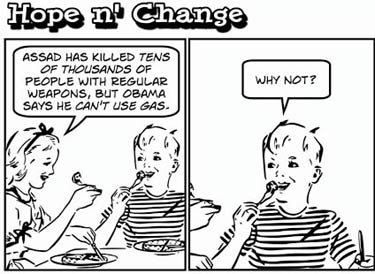
The Obama Administration’s rationale for wanting to bomb Syria makes little sense and their arguments are failing to win the American public’s support. Can it be that the Administration finds itself forced to rely on such bad arguments because identifying what is really going on would be completely unacceptable?
A number of commentators are suggesting that the truth of the matter is: the Obama Administration is following the same course as the Bush Administration and essentially hiring out American military power to the Saudis, who are in reality the fons et origo of Sunni extremism and jihadism.
There is underway a struggle over Syria between Shia Iran’s Hezbollah and the Sunni Saudis’ al Qaeda, and we are about to sell our services as Air Force for al Qaeda in some kind of backroom deal which probably won’t do much good for Europe or America, but which will probably make some American politicians very, very rich.
“Could it be because Qatar is the largest exporter of liquid natural gas in the world and Assad won’t let them build a natural gas pipeline through Syria? Of course. Qatar wants to install a puppet regime in Syria that will allow them to build a pipeline which will enable them to sell lots and lots of natural gas to Europe.â€
Well, it turns out that Saudi Arabia intends to install their own puppet government in Syria which will allow the Saudis to control the flow of energy through the region. On the other side, Russia very much prefers the Assad regime for a whole bunch of reasons. One of those reasons is that Assad is helping to block the flow of natural gas out of the Persian Gulf into Europe, thus ensuring higher profits for Gazprom.
————————–
There is no possible doubt of the basic fact that the Obama Administration wants to agree to sell American military services as mercenaries to the Saudis (and their Sunni allies). Just the other day, Secretary of State John Kerry explained that our Arab friends have offered to pick up the tab for all our military activities against Syria.
Secretary of State John Kerry said at Wednesday’s hearing that Arab counties have offered to pay for the entirety of unseating President Bashar al-Assad if the United States took the lead militarily.
“With respect to Arab countries offering to bear costs and to assess, the answer is profoundly yes,†Kerry said. “They have. That offer is on the table.â€
Asked by Rep. Ileana Ros-Lehtinen (R-Fla.) about how much those countries would contribute, Kerry said they have offered to pay for all of a full invasion.
“In fact, some of them have said that if the United States is prepared to go do the whole thing the way we’ve done it previously in other places, they’ll carry that cost,†Kerry said. “That’s how dedicated they are at this. That’s not in the cards, and nobody’s talking about it, but they’re talking in serious ways about getting this done.