Scott Grannis calculates just how much economic growth we’ve lost, for some unknown reason, over the course of the last six years.
Real GDP growth in the first quarter was weaker than expected (0.2% vs. 1.0%), but it wasn’t much of a surprise. It’s now been almost six years that the economy has managed only meager growth—about 2 ¼% per year on average. As a result, by my calculations, real GDP is a little over 10% below its long-term trend potential. That’s more than $2 trillion in lost income every year, and it’s getting worse. …
The chart above compares the level of real GDP to a long-term trend growth rate of 3.1%. This confirms once again that we are stuck in the slowest recovery ever. It’s my belief that the persistence of slow growth is largely the result of bad policies, though demographics likely plays a part too. Corporate profits have been very strong, but business investment has been very weak. Without new investment and risk-taking, we are not going to see a pickup in productivity which is, at the end of the day, what drives stronger growth and higher living standards. Investment has been weak probably because marginal tax rates and regulatory burdens have increased significantly in the past six years. In a sense, and expansion of government has suffocated the private sector.
Things are not going to change much for the better until policies become more pro-growth.
Whether the persistence of relatively weak growth is a reason for the Fed to continue to keep short-term interest rates extraordinarily low is one of the key questions of our time. I don’t see how low interest rates stimulate investment or enhance productivity. Only private initiatives can do that.
On the bright side, if policies do become more favorable, there is tremendous upside potential to look forward to. Closing the GDP gap would be nothing short of exhilarating.
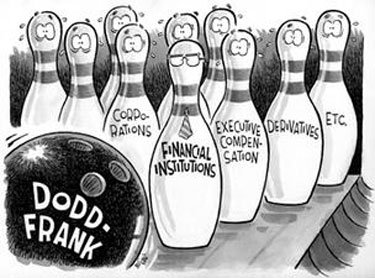
Douglas Holtz-Eakin attempts to calculate the impact of the 2010 Dodd–Frank Wall Street Reform and Consumer Protection Act (Dodd-Frank) on the growth of the economy.
What did Dodd-Frank do to the effective tax rate on banks? Consider, first, the burden of complying with the new regulations. The American Action Forum’s analysis of the Federal Register indicates that the cumulative burden (including the market value of paperwork hours for compliance) is roughly $14.8 billion annually. Notice that after-tax income in the presence of the burden is:
[rL – C – Burden](1-tB)
where r is interest on loans (L), C is the cost of acquiring funds and other operations, and tB is the tax rate on banks. Suppose that instead of a burden, the same after-tax income was generated by simply raising the tax rate to t’. Then, by definition:
[rL – C – Burden](1-tB) = [rL – C](1-t’)
[which] can be re-arranged to yield:
t’ = tB + (1-tB)[Burden/(rL-C)]
To put some empirical meat on [this], the Federal Deposit Insurance Corporation’s (FDIC) Quarterly Banking Profile (QBP) provides information on taxes ($67.5 billion) and net income ($151.2 billion) that permit one to compute an initial tax rate of 31 percent. Using the AAF burden data and (11) yields an increase to 37.8 percent from compliance burdens.
A similar approach can be used to transform the roughly 2 percentage point rise in the leverage ratio of the banking sector (from 7.5 to 9.5 percent) from 2008 to 2014 into a rise in the effective tax rate. The banking sector responded to Dodd-Frank by holding more equity capital, thus require it to have greater earnings to meet the market rate of return – the same impact as raising taxes. In this case, the higher leverage ratio translates into a further increase in the effective tax rate to 40.3 percent, for a total rise of 9.2 percent.
Collecting results, the impact on economic growth is a decline in the per capital growth rate of 0.059 percentage points annually. Is this a big deal? Consider lowering the growth rate in the Congressional Budget Office baseline projections by exactly this amount between 2016 and 2025. The lower rate of economic growth translates into a total loss of $895 billion in GDP or $3,346 for every member of the working age (16 and older) population over those 10 years.
Zman listens to David Brooks bloviating about the Baltimore rioting at the Times, and marvels at how much money and liberty was wasted on the effort to make the American underclass equal, how futile it all seems and just how much has been destroyed in the process.
As the Boomers begin falling into the abyss, they have to look around and wonder if it was worth it. If you were born in 1950, for example, you grew up in America that is vastly different than today. It’s one your grandchildren will never enjoy. The trillions spent knocking down what you inherited could maybe have been spent more wisely. …
Put another way, the organic ways in which society managed the unproductive classes were blasted to bits by a bunch of people convinced they knew better than the dozens of generations that came before them. The proposed replacement for those ways have utterly failed, meaning everything guys like Brooks grew up believing was nonsense after all. Meathead is learning that Archie was mostly right.
They’ve devoted the last 50 years to improving the condition of the black underclass, now they’re beginning the project of making being Gay equal, too.
“It’s free speech if the left hates the target.
It’s hate speech if the left favors the target.
That’s really all they mean. They have no principle of free speech that they support independent of a group identity. Thus:
Criticizing Christianity is free speech
Criticizing Islam is hate speech
Burning an American Flag is free speech
Burning a Gay Pride Flag is hate speech
It’s not the nature of the criticism, it’s only the favor of the target. You can’t argue the legitimacy or severity of the attack. That’s irrelevant. It’s all determined up front by who the target is.
So burning the American Flag is free speech. If you retort that it’s hateful to Americans they’ll say that they are complaining about the system and not the people.
If you burn the Gay Pride (rainbow) flag it’s hate speech. If you retort that you are only complaining about the system of the gay activist elite and their heavy handed tactics, and not gay people, the left will simply dismiss that as a lame excuse to hide your hatred.
Christ in Urine is free speech.
Flushing a Koran is hate speech.
It’s not the act or type of speech. The distinction free speech or hate speech is just determined by whether the left favors the target. That all. Then they make up indignant rationales to justify their position.
If they hate the target, then it’s free speech to criticize them and censorship to stop the criticism… If they love the target then It’s hate speech to criticize them and an act of protection to stop the criticism.”
Joe Gelonesi, at ABC (Australia), talks with two sophisters who are “investigating the problem.”
So many disputes in our liberal democratic society hinge on the tension between inequality and fairness: between groups, between sexes, between individuals, and increasingly between families.
The power of the family to tilt equality hasn’t gone unnoticed, and academics and public commentators have been blowing the whistle for some time. Now, philosophers Adam Swift and Harry Brighouse have felt compelled to conduct a cool reassessment.
Swift in particular has been conflicted for some time over the curious situation that arises when a parent wants to do the best for her child but in the process makes the playing field for others even more lopsided.
Swift and Brighouse needed to sort out those activities that contribute to unnecessary inequality from those that don’t.
Swift and Brighouse grudgingly concede that we probably shouldn’t simply abolish the Family. Private school, on the other hand…
What we realised we needed was a way of thinking about what it was we wanted to allow parents to do for their children, and what it was that we didn’t need to allow parents to do for their children, if allowing those activities would create unfairnesses for other people’s children’.
The test they devised was based on what they term ‘familial relationship goods’; those unique and identifiable things that arise within the family unit and contribute to the flourishing of family members.
For Swift, there’s one particular choice that fails the test.
‘Private schooling cannot be justified by appeal to these familial relationship goods,’ he says. ‘It’s just not the case that in order for a family to realise these intimate, loving, authoritative, affectionate, love-based relationships you need to be able to send your child to an elite private school.’
In contrast, reading stories at bedtime, argues Swift, gives rise to acceptable familial relationship goods, even though this also bestows advantage.
‘The evidence shows that the difference between those who get bedtime stories and those who don’t—the difference in their life chances—is bigger than the difference between those who get elite private schooling and those that don’t,’ he says.
This devilish twist of evidence surely leads to a further conclusion—that perhaps in the interests of levelling the playing field, bedtime stories should also be restricted. In Swift’s mind this is where the evaluation of familial relationship goods goes up a notch.
‘You have to allow parents to engage in bedtime stories activities, in fact we encourage them because those are the kinds of interactions between parents and children that do indeed foster and produce these [desired] familial relationship goods.’
Swift makes it clear that although both elite schooling and bedtime stories might both skew the family game, restricting the former would not interfere with the creation of the special loving bond that families give rise to. Taking the books away is another story.
‘We could prevent elite private schooling without any real hit to healthy family relationships, whereas if we say that you can’t read bedtime stories to your kids because it’s not fair that some kids get them and others don’t, then that would be too big a hit at the core of family life.’
So should parents snuggling up for one last story before lights out be even a little concerned about the advantage they might be conferring?
‘I don’t think parents reading their children bedtime stories should constantly have in their minds the way that they are unfairly disadvantaging other people’s children, but I think they should have that thought occasionally,’ quips Swift.
No, Donald Trump doesn’t put his hair on a big leaf when he goes to bed. This crazy, hairpiece-looking clump of yellow fluff is actually a rare caterpillar that only looks like Donald Trump’s hair.
And for that reason, this flannel moth caterpillar photographed in the Amazon has been nicknamed the Donald Trump Caterpillar.
It was spotted and photographed recently by Phil Torres of Posada Amazonas Rainforest Expeditions while leading a photography tour in a Peru rainforest. He posted the photo online and immediately people began commenting about how it looks like Donald Trump’s hair.
“We didn’t see the resemblance when we first saw the caterpillar, but looking at the photo, it’s certainly similar to his hair,†Torres told the UK Daily Mail. “It was pretty funny, people went mad for the photo comparing it to his toupee.â€
Interestingly, and coincidentally, approaching the Donald Trump Caterpillar (scientific name: Megalopyge opercularis) can be very dangerous, particularly if you come in contact with the business end of its yellow mane.
“If you touch that thing, it would seriously hurt,†Torres, a field biologist, told the UK Daily Mail. “It has these little hairs that can poke into your skin and release a venom.â€