Jar Jar Binks apparently does not appear in The Force Awakens.
But Murdock Motion used software to add one of the most hated characters in cinematic history into the trailer of the highly anticipated new Star Wars film. It’s a great reminder to fans of the horror that could have been.
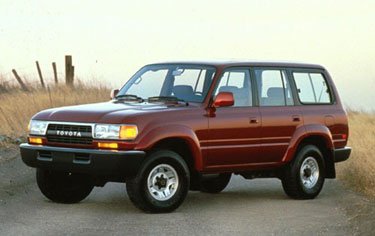
1992 Toyota Land Cruiser. The paint on ours is a little rougher, and I’ve mounted a 1920s Alvis Hare hood ornament on it.
Sam Smith, in Wired, explains why many enthusiasts are collecting old pieces of crap, instead of buying new cars.
[A]s far as I can tell, this affliction is rooted in what we’ve lost. Call it simplicity or purity, maybe even character, born not of wear or time, but of freedom of design. And an obsession with the fundamental quirks that give a car personality. Things like floor-hinged pedals, gated shifters, or doors whose latches feel deeply mechanical, like the cocking of a gun. And if you drive a lot of new cars, you realize that stuff is growing rarer by the minute.
It is a byproduct of progress. On paper, a new BMW M3 is superior to any before it. The modern car accelerates harder, stops quicker, and is quieter and more comfortable than an M3 built in the 1990s. Any engineer will point to it as a less compromised product. But compromise is character. The older car is simpler and smaller. It was built to less aggressive crash standards, so it has thinner pillars and weighs less. You can see out of it easily, and the lack of weight helps the car give you feedback, so it’s more fun to drive at legal speed. The new one feels like a city bus by comparison.
Modern can be better, but it isn’t necessarily.
This isn’t a unique opinion, and these aren’t new arguments. Twenty years ago, people were looking to the vehicles of decades prior and bemoaning the increase in weight and complexity. In the late 1800s, the first automobiles were viewed as atrocities, far less civilized and romantic than horses. Rose-tinting the past while moving forward is human nature.
But looking back still has value. Many analysts, for example, now believe that the recent boom in classic-car values is due to the arc of new-vehicle development. Take the current Porsche 911 GT3: a fantastic car, but complex by the standards of even ten years ago. The electrically assisted power steering is distant. The car’s newly elongated wheelbase improves stability and ride, but at the expense of a cozy cabin and compact footprint. It’s also available only with an automatic transmission—a piece of equipment that takes an engaging job out of the driver’s hands.
Previous GT3s were deeply involving to drive and only available with manuals. When the new car was announced, older examples—even relatively recent models—saw a noticeable increase in value.
What have we gained? Everyone knows that restrictive legislation killed the grossly unsafe or heavily polluting car. That is inarguably good. As is the glut of durable, crashable and recyclable vehicles filling showrooms. We are living in something of a golden age of automobiles—more performance and relative fuel economy than ever before. And while new cars still break, statistically, they’re more reliable and efficient than at any point in history. The inevitable march toward perfection has given us direct-injected, turbocharged engines with fantastic performance and wonderful fuel economy, dual-clutch transmissions that deliver shifts in the blink of an eye, and electric cars virtually free of excuses.
Part of this is simply time. Computer-controlled engines have been common for over 30 years. Crash safety has been a science for longer than NASA’s Apollo program existed. Even the simple rubber tire is over a century old. Those are just three pieces of a complex machine, but cumulatively speaking, each has received more development hours than the Manhattan Project. Given similar time and engineering attention, anything would evolve to be good.
But if humanity is an assemblage of flaws, we’re slowly engineering the human out of the automobile. And the more new cars I drive, the more I find myself drawn to the “bad†old ones.
We bought the faster, most loaded 3-series BMW a few years back. The bloody thing actually came without a spare tire. BMW was cooperating with Big Brother and saving energy. The driver, you see, was supposed to not need a spare anyway, because BMW thoughtfully provided original equipment run-flat tires.
Those tires, mind you, were noisy and had an extremely bad grip on wet roads and dirt roads, and wore out after 10,000 miles, and cost a fortune to replace (I bought non-run-flat replacements), but you’re supposed to be happy that you’re saving the planet.
The car is fast as hell, but it has a lousy first gear. You really have to crank the revs up, or you will stall out. BMW included a new sort of turn signal switch as well. Move it left or right, and you don’t get a positive setting. You get a mushy sort of feel, and it blinks a few times and then goes back to off. You have to move it again to get it completely on. This, too, is supposed to be an improvement.
The radio, of course, was designed by some 13-year-old Oriental. You poke your finger at various illuminated bits, all of which do multiple things potentially.
What really torched me off was going out to check the oil, and finding that this car was built without a dipstick. The owner is intended to rely on his computer, the same computer (which if the battery ever get a little low) warns him emphatically that the car is dying and will momentarily blow up, the same computer which issues constantly all sorts of emoji symbols telling you that a bulb is out somewhere or your tire pressure is under 25 lbs.
My reaction was to swear a great oath that I’ll never buy a new BMW again. But, really, I don’t like being told what to do, and I’m coming to the conclusion that I may never buy a new car, period, again.
In the good old days, before we were born, a chap could go to Morris Garages in Oxford, England, and tell the nice men what sort of car he wanted: what kind of engine, supercharged or not, what kind of body style, what color, and he could specify all the little conveniences and accessories he desired. “I’ll have Brooklands windscreens, please!”
Today, federal cabinet departments conspire with enormous car manufacturing corporations to make all our decisions for us, for our own good.
Who would voluntarily pay several thousand dollars to put explosive airbags all over his car, knowing that there is an inevitable hazard that one of them might go off and knowing that one of those infernal devices might injure you or kill a kid? Possibly some mental defective living in California, but not you or me. But we have no choice. Some bureaucratic committee in Washington decided for us, and we get to pay. Next, we will be getting a grand or so worth of rear video camera and backing-up-to-park assistance.
And, that’s why a decent new car today costs $40,000-$50,000. My father used to go out, circa 1960, and get a shiny new car for $2000.
Karen had an unfortunate encounter with an oak tree atop the Blue Ridge, trying to come home in a howling blizzard a few years ago, and she totalled our SUV. I thought about it and bought an ancient (1992) Toyota Land Cruiser off of Ebay for $4000. That Land Cruiser was precisely what Sam Smith would describe as “a piece of crap.” Just about everything that could be wrong with a car was wrong with it, except for the body and the engine which were both just fine. Naturally, I had to drop a few more thousand into it immediately, but it runs, and it is spectacular at lumbering its way through mud and snow. I’m basically planning to keep it forever.
On a street not far from here lives a man. I do not know him, but I have waved and said hello. He is salubrious in a way I admire. He has lived here forever and a day, I imagine, and watched his town disintegrate. He refuses to go along. His house is conspicuous. It is so yellow that Van Gogh would throw in the towel and go back to the store and start shopping for raw umber. He crawls up and down it, and all around it, and it is as neat as a pin. He does everything himself. He put up a big fence around his yard, an enormous undertaking, and never flagged until he was done. Every surface is clean and bright and in good repair, everywhere you can see. It is the only structure in this town I can describe in that way.
We stopped walking down his street a while back because his neighbors were disreputable. On one side was a house gone to seed for forty years or more. The denizens had approximately 150 snot-nosed urchins who played in the street, which I rather enjoyed seeing, but they kept two, hair-trigger pitbulls the size of donkeys, and you could never tell if they were tied up or not. These animals represented a desire to publicly contract ebola so you could get your own seat on the subway of life. Fine by me.
On the other side of the neat house was a two-family affair that looked in rather better shape, but that’s not to say good. There were no obvious structural issues visible to my eye at two hundred yards, which is more than I can say about my house. The house had been occupied by a series of Hatfields and McCoys, cars by the dozens, but somehow never with an even number of tires, abandoned toys everywhere, stray cats outside and stray people inside. I never saw an actual person who lived there outside, a mark of the breed. One minute the window curtain would be a confederate flag, then the rental merry-go-round would spin and a Sponge-Bob beach towel would take its place. The stray cats were the only constant.
The man in the perfect yellow house persevered. He painted his driveway and waxed his lawn and dusted his roof shingles. He polished his trees and chromed the inside of his mailbox. He was adamantine. He was, and is, a species of wonderful.
He must have gotten weary of the noise, and the trouble, and the endless low-rent hubbub. I testify to you, with God as my witness, that when the houses on both sides of him decided to spin the wheel of occupancy one more time, he bought them both, and he gave them the delenda est. Flattened them. There was a pile of lead-painted pickup sticks on one side, waiting for the next round of dumpsters, and the one on the other side was nothing but a patch of straw with the first hint of grass yet to poke through.
That man knows something. Something important. It’s not that he knows exactly what would show up in the two houses when the For Sale or For Rent signs came down. He’s not pretending to tell fortunes at the fair. What he knew, for a dead cert, was that there was no chance of any change bringing anything but: Worse.
Is there really something terrible about the rich getting much richer, as long as the less rich are not getting any poorer, and indeed are seeing their standards of living rising over the long term, thanks to such things as Walmart, Amazon, iPhones, GPS, etc.?) …
[Kristof, in the end,] comes up with a list of possible ways to correct what might very well not need correcting, but would definitely put more money into the hands of the political class that Kristof represents (to be used, of course, strictly for the good of the poor and the downtrodden). Among these are: More government vigilance regarding monopolies and competition, strong trade unions, public-sector jobs at the minimum wage for such things as elderly care (has he checked with the unions for their opinion on this?), restrain pay at the highest levels (i.e. maximum-wage legislation), and a personal income tax that tops out at 65 percent.
Is there a single idea in there that post dates FDR, who died 70 years ago in a completely different economic universe? Indeed, most of them antedate the 20th century. Steeply progressive income taxes are straight out of the Communist Manifesto, published in 1848.
So here’s my list of ideas to lower the income inequality between rich and poor. They would actually help everyone except the political class:
Break up government monopolies, such as Medicare, the Veterans Administration, and, most important public school systems. Introducing competition into these areas of the economy is vital to improving them, because competition, and competition alone, produces hard work and innovation. Monopolies—private and governmental—are always fat, dumb, lazy, and devoted to maintaining the monopoly. The shortest route to prosperity for the poor and downtrodden is a good education and the inculcation of good work habits. They don’t get that today and liberals don’t give a damn. (One of the first things President Obama tried to do as president was end the school voucher program in Washington, D.C., as a thank you to the teachers unions, while sending his two daughters to a very expensive, and very good, private school: welcome to modern-day liberalism).
Introduce a flat tax, so that the private jet owners of the world can’t finagle special deals with their congressional pals.
Abolish the corporate income tax. I wrote about the extraordinary benefits of doing this in the Wall Street Journal a few months ago. At least 90 percent of the tax fiddles and crony-capitalism government favors are hidden in the corporate income tax. Get rid of it and 60,000 lobbyists in Washington would need to go out and get wealth-creating jobs. Do you think private jet owners own their private jets personally? Of course not, their corporations own them and get a slew of deductions thereby.
Modern-day liberalism is about talking about helping the poor and downtrodden, while espousing policies that will only help the narrow and ever-more privileged elite of which liberals are the most vocal supporters.
The Thinking Housewife contemplates the highly profitable and continually popular black grievance industry.
What is the real purpose of “Black History Month� Apologists for the cultural left (Republicans and Democrats alike) would have us believe that its purpose is entirely-benign – i.e., education, inclusion, diversity of thought, the elevation of a people whose history has in the past been neglected, etc. – the standard rationale offered up by the left for so many of its initiatives and programs. The real purpose of “Black History Month†isn’t racial healing or education; instead, it is to keep the grievances and resentments of black people (and their supporters, whatever their race) simmering and ready at a moment’s notice to come to a boil in places like Ferguson and Baltimore.
There is a vast and profitable racket based upon the narrative that black folks are victims of white oppression – and the continued success/profitability of the racial grievance industry depends on keeping blacks not only angry, but feeling alienated from mainstream culture to the extent possible. Booker T. Washington, himself a black man, foresaw this over a century ago when he said,
“There is a class of colored people who make a business of keeping the troubles, the wrongs, and the hardships of the Negro race before the public. Some of these people do not want the Negro to lose his grievances, because they do not want to lose their jobs. There is a certain class of race-problem solvers who don’t want the patient to get well. 
Of course, one of the most-interesting and disturbing aspects of the whole phenomenon is that present-day blacks are angry about injustices committed not against them, but acts which may (or may not) have been committed against their ancestors. Whites and others who aren’t black are expected to feel guilt for acts they did not even commit. Inherited anger and/or guilt for acts in which one did not even participate is obviously a logical fallacy, but that doesn’t seem to matter to the race-hustlers and their enablers. Over the last half-century, the nation has spent billions in taxpayer funds on redressing racial grievances and blacks – as a demographic cohort – have been the beneficiaries of a vast menu of privileges and special programs available to no one else. None of this seems to have mattered – race-relations are at an very low ebb, and militant blacks are angrier than ever.
Nick Valencia (CNN Reporter):”What is it like, explain to our viewers exactly what it’s like to be a young, black man, growing up in Baltimore.”
Jamal: “We gotta struggle. We gotta grind. You know, everything that you get, you gotta earn it. Nobody…”
Nick: “What does that mean? What does that mean? Explain, don’t speak in abstract.”
Jamal: “You gotta earn it. Like… like if there’s food over there, and they’re saying you can’t have it, you gotta take it. Sometimes, you gotta… if it’s yours, you gotta take it.”