Archive for July, 2016
02 Jul 2016


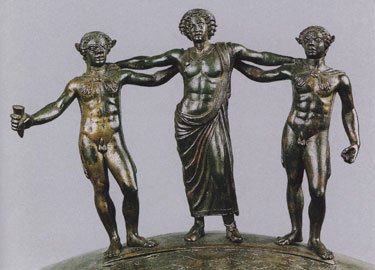
The Ficoroni Cista, Bronze, Late 4th century BC, National Etruscan Museum of Villa Julia, Rome.
Maddalena Paggi, Department of Greek and Roman Art, The Metropolitan Museum of Art, October 2004:
Praenestine cistae are sumptuous metal boxes mostly of cylindrical shape. They have a lid, figurative handles, and feet separately manufactured and attached. Cistae are covered with incised decoration on both body and lid. Little studs are placed at equal distance at a third of the cista’s height all around, regardless of the incised decoration. Small metal chains were attached to these studs and probably used to lift the cistae.
As funerary objects, cistae were placed in the tombs of the fourth-century necropolis at Praeneste. This town, located 37 kilometers southeast of Rome in the region of Latius Vetus, was an Etruscan outpost in the seventh century B.C., as the wealth of its princely burials indicates. Excavations conducted at Praeneste in the nineteenth and beginning of the twentieth century were primarily aimed at the recovery of these precious-metal objects. The subsequent demand for cistae and mirrors caused the systematic plundering of the Praenestine necropolis. Cistae acquired value and importance in the antiquities market, which also encouraged the production of forgeries. Four Praenestine cistae, out of a total of 118 specimens so far recovered, are in New York City (three in the Metropolitan Museum and one in the collection of the Pierpont Morgan Library).
Cistae are a very heterogeneous group of objects, but vary in terms of quality, narrative, and size. Artistically, cistae are complex objects in which different techniques and styles coexist: engraved decoration and cast attachments seem to be the result of different technical expertise and traditions. Collaboration of craftsmanship was required for their two-stage manufacturing process: the decoration (casting and engraving) and the assembly.
The most famous cista and the first to be discovered is the Ficoroni presently in the Museum of Villa Giulia in Rome, named after the well-known collector Francesco de’ Ficoroni (1664–1747), who first owned it. Although the cista was found at Praeneste, its dedicatory inscription indicates Rome as the place of production: NOVIOS PLVTIUS MED ROMAI FECID/ DINDIA MACOLNIA FILEAI DEDIT (Novios Plutios made me in Rome/ Dindia Macolnia gave me to her daughter). These objects have often been taken as examples of middle Republican Roman art. However, the Ficoroni inscription remains the only evidence for this theory, while there is ample evidence for a local production at Praeneste.
The high-quality Praenestine cistae often adhere to the classical ideal. The proportions, composition, and style of the figures indeed present close connections and knowledge of Greek motifs and conventions. The engraving of the Ficoroni cista portrays the myth of the Argonauts, the conflict between Pollux and Amicus, in which Pollux is victorious. The engravings on the Ficoroni cista have been viewed as a reproduction of a lost fifth-century painting by Mikon. Difficulties remain, however, in finding precise correspondences between Pausanias’ description of such a painting and the cista.
The function and use of Praenestine cistae are still unresolved questions. We can safely say that they were used as funerary objects to accompany the deceased into the next world. It has also been suggested that they were used as containers for toiletries, like a beauty case. Indeed, some recovered examples contained small objects such as tweezers, make-up boxes, and sponges. The large size of the Ficoroni cista, however, excludes such a function and points toward a more ritualistic use.
01 Jul 2016

35th Berlin Marathon
John McWhorter, in the Atlantic, compares the complexity of several languages.
When a language seems especially telegraphic, usually another factor has come into play: Enough adults learned it at a certain stage in its history that, given the difficulty of learning a new language after childhood, it became a kind of stripped-down “schoolroom†version of itself. Because all languages, are, to some extent, busier than they need to be, this streamlining leaves the language thoroughly complex and nuanced, just lighter on the bric-a-brac that so many languages pant under. Even today, Indonesian is a first language to only one in four of its speakers; the language has been used for many centuries as a lingua franca in a vast region, imposed on speakers of several hundred languages. This means that while other languages can be like overgrown lawns, Indonesian’s grammar has been regularly mowed, such that especially the colloquial forms are tidier. Lots of adult learning over long periods of time is also why, for example, the colloquial forms of Arabic like Egyptian and Moroccan are somewhat less elaborated than Modern Standard Arabic—they were imposed on new people as Islam spread after the seventh century.
In contrast, one cannot help suspecting that not too many adults have been tackling the likes of sÇq’ayÇÆ›aaÉ£wÇaÉ£hasÌ. Kabardian has been left to its own devices, and my, has it hoarded a lot of them. This is, as languages go, normal, even if Kabardian is rather extreme. By contrast, only a few languages have been taken up as vehicles of empire and imposed on millions of unsuspecting and underqualified adults. Long-dominant Mandarin, then, is less “busy†than Cantonese and Taiwanese, which have been imposed on fewer people. English came out the way it did because Vikings, who in the first millennium forged something of an empire of their own in northern and western Europe, imposed themselves on the Old English of the people they invaded and, as it were, mowed it. German, meanwhile, stayed “normal.â€
/div>

Feeds
|





