The Hurricane of 1900, also known as the Great Galveston Hurricane, made landfall on September 8, 1900, in Galveston, Texas, in the United States. It had estimated winds of 145 miles per hour (233 km/h) at landfall, making it a Category 4 storm on the Saffir–Simpson Hurricane Scale. It was the deadliest hurricane in US history, and the second costliest hurricane in U.S. history based on the dollar’s 2005 value (to compare costs with those of Hurricane Katrina and others).
The hurricane caused great loss of life with a death toll of between 6,000 and 12,000 people; the number most cited in official reports is 8,000. …
At the end of the 19th century, the city of Galveston, Texas, was a booming town with a population of 36,000 residents. Its position on the natural harbor of Galveston Bay along the Gulf of Mexico made it the center of trade and one of the biggest cities in the state of Texas. With this prosperity came a sense of complacency. …
At the time of the 1900 storm the highest point in the city of Galveston was only 8.7 feet (2.7 m) above sea level. The hurricane brought with it a storm surge of over 15 feet (4.6 m),[22] which washed over the entire island. The surge knocked buildings off their foundations and the surf pounded them to pieces. Over 3,600 homes were destroyed and a wall of debris faced the ocean. The few buildings which survived, mostly solidly built mansions and houses along the Strand District, are today maintained as tourist attractions.
The highest measured wind speed was 100 miles per hour (160 km/h) just after 6 p.m., but the Weather Bureau’s anemometer was blown off the building shortly after that measurement was recorded. The eye passed over the city around 8 p.m. Maximum winds were estimated at 120 mph (190 km/h) at the time, though later estimates placed the hurricane at the higher Category 4 classification on the Saffir–Simpson Hurricane Scale. The lowest recorded barometric pressure was 28.48 inHg (964.4 hPa), considered at the time to be so low as to be obviously in error. Modern estimates later placed the storm’s central pressure at 27.49 inHg (930.9 hPa), but this was subsequently adjusted to the storm’s official lowest measured central pressure of 27.63 inHg (935.7 hPa).
As severe as the damage to the city’s buildings was, the human toll was even greater. Because of the destruction of the bridges to the mainland and the telegraph lines, no word of the city’s destruction was able to reach the mainland. At 11 a.m. on September 9, one of the few ships at the Galveston wharfs to survive the storm, the Pherabe, arrived in Texas City on the western side of Galveston Bay. It carried six messengers from the city. When they reached the telegraph office in Houston at 3 a.m. on September 10, a short message was sent to Texas Governor Joseph D. Sayers and U.S. President William McKinley: “I have been deputized by the mayor and Citizen’s Committee of Galveston to inform you that the city of Galveston is in ruins.” The messengers reported an estimated five hundred dead; this was considered to be an exaggeration at the time.
The citizens of Houston knew a powerful storm had blown through and had made ready to provide assistance. Workers set out by rail and ship for the island almost immediately. Rescuers arrived to find the city completely destroyed. It is believed 8,000 people—20% of the island’s population—had lost their lives. Estimates range from 6,000 to 12,000. Most had drowned or been crushed as the waves pounded the debris that had been their homes hours earlier. Many survived the storm itself but died after several days being trapped under the wreckage of the city, with rescuers unable to reach them. The rescuers could hear the screams of the survivors as they walked on the debris trying to rescue those they could. A further 30,000 were left homeless.
The dead bodies were so numerous that burying all of them was impossible. The dead were initially weighted down on barges and dumped at sea, but when the gulf currents washed many of the bodies back onto the beach, a new solution was needed. Funeral pyres were set up on the beaches, or wherever dead bodies were found, and burned day and night for several weeks after the storm. The authorities passed out free whiskey to sustain the distraught men conscripted for the gruesome work of collecting and burning the dead.[20] More people were killed in this single storm than the total of those killed in all the tropical cyclones that have struck the United States since. This count is greater than 300 cyclones, as of 2009. The Galveston Hurricane of 1900 remains the deadliest natural disaster in U.S. history.
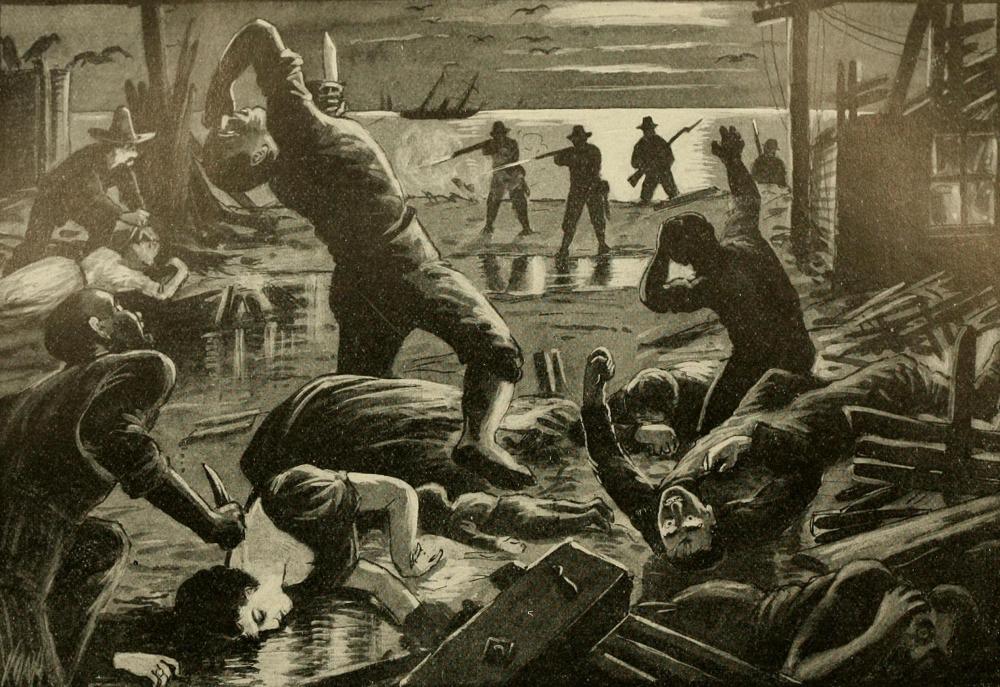
According to reports, at least 125 were shot for desecrating bodies of victims. Amateur photographers, according to the September 14, 1900 issue of the Dallas News, met the same fate:
Word received from Galveston today indicates that Kodak fiends are being shot down like thieves. Two, it is stated, were killed yesterday while taking pictures of nude female bodies.
If you were caught stooping [looting], you might be shot. There was one man that when they took him he had his pockets full of ears and fingers. He didn’t take time to take the earrings out of ears, he just cut a piece off. Of course by that time the fingers would be swollen. He just cut the fingers off and stuffed then in his pocket. He would have been shot, but his wife was pregnant and she begged for him. So they didn’t shoot him.
“Shooting Vandals at Work on the Dead Bodies in Galveston after the Disaster,†from The Complete Story of the Galveston Horror, Written by the Survivors, 1900.
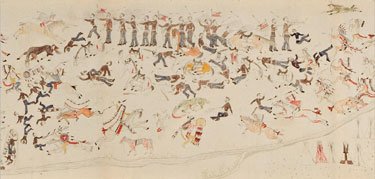
Decades after the 1876 Battle of the Little Bighorn, Stephen Standing Bear, who participated in the tumultuous engagement, recalled its chaos: “I could see Indians charging all around me. Then I could see the soldiers and Indians all mixed up and there were so many guns going off that I couldn’t hear them.†He also illustrated the battlefield as he saw it in large-scale muslin pictographs, with the largest surviving example currently on view in First Person: Remembering Little Bighorn at the Philbrook Museum of Art’s downtown branch in Tulsa, Oklahoma.
“The number one question I’m asked about this muslin is: ‘which one is Custer?’ And you don’t see Custer on the muslin,†Christina Burke, Philbrook’s curator of Native American and non-Western art, told Hyperallergic. “If you look closely at the figures, all of the soldiers look exactly the same, and that’s from the Lakota perspective. The details were in identifying the warriors, their shields, their headdresses, the paraphernalia, all of those are real three-dimensional people. The enemies all look the same because it didn’t matter which one Custer was, they were all enemies encroaching on Lakota territory and their way of life.â€
For those who can’t make it to Tulsa, an online interactive allows users to scroll through the muslin and click on points of interest, which highlight this detail of individual warriors. Two Lakota members of the Stokà Yuhà (Bare Lance) Society hold crooked lances in their right hands, while a member of the Miwátani Society has his red sash staked in the earth, a sign that he was going to stay and fight to the death. A member of the Brave Heart Society is “counting coup†with his eagle feather lance, an act of bravery that required a person to get close enough to hit an enemy by hand.
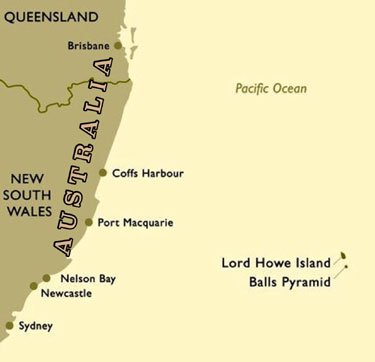
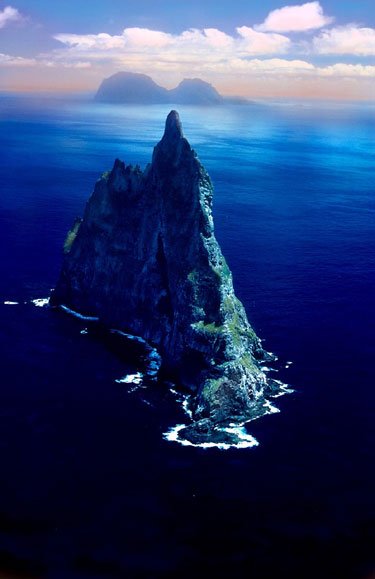
Ball’s Pyramid is an erosional remnant of a shield volcano and caldera that formed about 6.4 million years ago. It lies 20 kilometres (12 mi) southeast of Lord Howe Island in the Pacific Ocean. It is 562 metres (1,844 ft) high, while measuring only 1,100 metres (3,600 ft) in length and 300 metres (980 ft) across, making it the tallest volcanic stack in the world. Ball’s Pyramid is part of the Lord Howe Island Marine Park in Australia.
Like neighboring Lord Howe Island and the Lord Howe seamount chain, Ball’s Pyramid is based on the Lord Howe Rise, part of the submerged continent of Zealandia. It is positioned in the center of a submarine shelf. The shelf is 20 kilometres (12 mi) in length and averages 10 kilometres (6.2 mi) in width and lies under an average depth of 50 metres (160 ft) of water. It is separated by a 500 metres (1,600 ft) deep submarine canyon from another shelf on which Lord Howe Island is located. The cliffs of the stack continue under the water surface to the level of the shelf.
A shock example of anti-Trump media censorship was caught on tape when Reuters ordered its cameraman to cut live footage of Trump receiving praise from African-American Bishop Wayne T. Jackson in Detroit.
The incident occurred as Jackson presented Trump with a shawl, a bible, and offered his prayers as the black audience cheered and clapped.
Perhaps aware of the devastating impact the optics of this moment would have on the media’s efforts to demonize Trump as a racist bigot, a voice is heard off-camera saying, “He’s getting a shawl!â€
The cameraman then says, “I’m shooting this, I don’t care what they say….I’ll take a demotion for this…. you?â€
“Shut it down,†insists the director,†followed by another voice asking, “Shut this down?â€
“Yes Michael, do it,†orders the director.
We then hear the word “blackout†and the camera shakes before the live feed is cut.
“My culture is a very dominant culture, and it’s imposing and it’s causing problems. If you don’t do something about it, you’re going to have taco trucks on every corner.â€
With the sale of elephant tusks under close scrutiny, “ethical ivory†from the extinct woolly mammoth is now feeding an insatiable market in China. This rush on mammoth ivory is luring a fresh breed of miner – the tusker – into the Russian wilderness and creating dollar millionaires in some of the poorest villages of Siberia.
On condition that he not reveal names or exact locations, RFE/RL photographer Amos Chapple gained exclusive access to one site where between bouts of vodka-fueled chaos and days spent evading police patrols, teams of men are using illegal new methods in the hunt for what remains of Siberia’s lost giants.
MessyNessy has been reading “the world’s first Science Fiction periodical.”
Frank Reade dime-novels had helicopters and airships before Jules Verne , but while the famous French adventure novelist is still considered a major literary author around the world today, who’s ever heard of Frank Reade?
Published under the anonymous pseudonym, “No Nameâ€, during the 19th century boom of boys’ cheap fiction, the series followed the adventures of the Reade family: Frank Reade; his son, Frank Reade Jr., and grandson Frank Reade III. While the first five stories starred Frank Reade, Sr, adventurer and inventor of steam-robots, most of the 184 stories featured the second generation of the Reade clan, a teenage hero-inventor who travelled the globe in his electric machines.
Frank Reade Jr. was a busy guy, usually off fighting sea monsters with his machines, discovering lost gold or killing an astonishing amount of Native Americans. Yep, Frank Reade Jr., was not just a brilliant “superhero†inventor, he was also an unashamed imperialist. And while the adventures and the inventions themselves are the most important parts of the stories, there are strong undertones of imperialism and white supremacy throughout the series. Reade behaves a bit like a bull in a colonial china shop; crash-landing in foreign territories, using his machines to bulldoze through native tribes and then claim their treasure.
While the stories are credited to “No Nameâ€, the author was in fact Luis Senarens, a Brooklynite of Cuban descent who began writing for the series at the age of just sixteen. When he was seventeen, he received a letter of praise from Jules Verne himself. The two would spend the rest of their careers stealing ideas from each other. It was only Verne, however, who would become a titan of science fiction. Of course, it didn’t help that Senarens’ stories were only published in dime-novels, a form of popular fiction typically blamed for the criminal behaviour of young men in the same way that video games are blamed today.
Frank Reade, Sr. stories started appearing in Boys of New York, February 28 through April 24, 1876. The Frank Reade series ran roughly contemporaneously with the post-1870 (Twenty Thousand Leagues Under the Sea) height of Jules Verne’s career. Verne began writing, though, in 1851, so describing the Frank Reade series as “before Jules Verne” generally would not be accurate.
Thomas Cole, The Course of Empire — Destruction, 1836, New York Historical Society
Richard Fernandez pessimistically compares the current governing styles of Russia and the United States.
Russia is pretty representative of many states which are simply collections of informal power groups. Whether these groups are called cartels, clans, sects or Communist parties, they may essentially be described as what James Madison called factions. He regarded them as both a danger to democracy and the natural forge of leadership and so spent a lot of time figuring out how to control them.
in the fall of 1787, when he was still in his mid-30s, [Madison] began collaborating with Alexander Hamilton and John Jay to write a series of 85 newspaper essays explaining the U.S. Constitution and urging the people of New York to adopt it. …
Given the talismanic power the word “democracy†has to modern ears, it is worth reminding ourselves that the U.S. Constitution was largely an effort to curb or trammel democracy. Democracies, Madison wrote in Federalist 10, the most widely read and cited of the essays, “have in general been as short in their lives as they have been violent in their deaths.†Why? A mot often attributed to Benjamin Franklin explains it in an image. “Democracy is two wolves and a lamb voting on what to have for lunch.†…
The biggest threat to “popular†governments, he wrote in Federalist 10, are “factions,†interest groups whose operations are “adverse to the rights of other citizens†or the “permanent…interests of the community.†Factions are thus not accidental. They are—famous phrase—“sown in the nature of man.†Why? Because freedom and the unequal distribution of talent inevitably yield an unequal distribution of property, the “most common and durable source of faction.†…
Madison’s solution was the creation of a large republic in which a scheme of representation and a large variety of interests “make it less probable†that they will be able to “invade the rights of other citizens†successfully. … Madison’s central insight was that power had to be dispersed and decentralized if it was to serve liberty and control faction.
The paradox that Putin exemplifies is that while factions breed formidable conspirators, they also create poisonous leaders. They succeed in themselves but cause the society around them to fail. That is because they dispense a favoritism which is ultimately ruinous for the nation. The result is a self-vetoing enterprise. Marian Tupy observed that Chile began to succeed at the moment when its junta began to allow economic freedom while Venezuela started to fail by going the other way. But few ruling elites have the sense to get themselves out of the way. Usually they have to be shoved aside.
The question is whether Madison’s defenses failed and the factions are inside the wire. America for a long time beat the odds but recently things have taken a turn for the worse. It is no accident that many of America’s troubles have coincided with the growth of identity politics, special interest groups, foreign lobbying and corruption. If so they have spread their poison and created an American version of the “informal networks” that proved so fatal in other countries, as Madison feared.
Moreover, the American factional system operates in the worst possible way. The Clinton Foundation and private email scandal is a portrait of venality without competence. The peculiar characteristics of American factionalism have bred something singular; a phenomenon at once cunning yet stupid, both corrupt and inept. America is no longer exceptional, just another bum in the ring. Yet while Putin can often outwit Obama (and Hillary when she was in State), the Russian cannot seem to turn anything to lasting advantage. The outcome is a kind of impotence afflicting both sides.
2016 should have been an election charged with passion, but it is atmospherically deadening, as if many voters wished the candidates would just go away. If the 20th century was one in which people believed government could solve all the world’s problems, the 21st century is fast developing into one where government has become like the weather: chaotic, capricious and ultimately arbitrary — something everyone talks about but no one can do anything about.
Petrified objects hang outside the entrance to Knaresborough’s well.
The Vintage News reports that they don’t allow you to drink the water today.
One of the most notable examples of petrifying wells is in Knaresborough, England. The Knaresborough petrifying well was first opened to the public in 1630 and still amazes people by its ‘abilities’ to this day.
For many centuries, locals believed that this Petrifying Well was cursed by the devil – a myth fueled by the fact that the side of the well looks like a giant’s skull. They constantly lived with the fear that if they touched the well’s water, they would be turned to stone too. …
History shows that the well wasn’t always known for its petrifying qualities. The earliest written reference to the well was by John Leyland, antiquary to Henry VIII, who visited the well in 1538. He wrote that the well was very well-known and visitors drank and showered under its falling waters, as they were believed to have miraculous healing powers. Around this time, the legendary prophetess Ursula Southeil, who is better known as Mother Shipton, began to gain popularity.
According to popular legend, Mother Shipton was a Yorkshire witch, born in the cave, who prophesied about future events in the form of poems. As Mother Shipton’s notoriety grew, so did the fame of the petrifying well.
In the early 1600’s medical physicians examined the waters, and pronounced that they could cure any malady that the body might have. Then, in 1630, King Charles I sold the land that the well sits on to Sir Charles Slingsby. Sir Slingsby must have been able to recognize a business opportunity when he saw one because he immediately put the well on exhibition and charged money for guided tours around his new property. The well and its surrounding area have been in continuous operation as an attraction since then.
It is often described as the UK’s first official tourist attraction. The cave and dropping well, together with other attractions, remain open to visitors.