Archive for 2016
20 Oct 2016


Rod Dreher last month quoted an email he had received from Catholic philosopher Michael Hanby on the state of the American politics.
I really think there is a pervasive, but unarticulated sense that liberalism is exhausted, that we are at the mercy of systematic forces, difficult to name, which can be manipulated by the powerful but not governed by them, and that our problems are unsolvable. The reasons for this anxiety are manifold and cannot be reduced to politics or economics, though there are obvious political and economic dimensions that defy easy demographic categorization. In other words, the fact that we are in civilizational crisis is becoming unavoidably apparent, though there is obviously little agreement as to what this crisis consists in or what its causes are and little interest from the omnipresent media beyond how perceptions of crisis affect voter behavior. This seems to me a crucial part of the point and a key to understanding the sudden collapse of ‘movement conservatism’ on the one hand, and the increasingly shameless sophistry and cynicism of progressivism on the other hand. Part of what it means to say that liberalism is exhausted is that liberal order–which is more fundamentally a technological order–cannot even supply the conceptual categories and thought forms necessary for understanding our predicament.
In fact, I doubt we any longer possess enough of a ‘civilization’ to understand what a ‘civilizational crisis’ would really mean. We would not see it as a crisis of soul, but a crisis of management, in other words, another technical problem to be solved. We would no doubt think of it as something to be diagnosed by a battery of journalists, economists, evolutionary psychologists, and sociologists, who could then show us what levers to pull in order to fix it.
But if this is anywhere close to correct, then it seems to me that what we have in this election is fundamentally a contest between two forms of despair: Hillary represents despair in the form of cynicism and resignation, as evidenced by the fact that neither she, nor her surrogates, nor even her flacks in the press really pretend to believe in what she is selling. There is obvious cynicism within Trumpism as well; his supporters, on those rare occasions when he makes sense, seem to know that he is lying to them. But Trump represents despair in the form of anger and desperation, the willingness to embrace a strongman and a charlatan in the (false) hopes of regaining some kind of control over ‘the system’, whatever it is (which is a fascinating question, by the way.) Both are absolutely awful, indeed unthinkable, albeit in different ways, and yet this is what liberal order has come to.
Read the whole thing.
I do not agree, by the way, that “the conservative movement collapsed.” I think it became startlingly apparent that a significant portion of the American electorate was furiously angry at the left, but at the same time was not in the least conservative in the traditionally understood meaning of the term. That portion of the electorate proceeded to select Trump as its leader, rebelling against elite establishment liberalism but at the same time rejecting the ideological constraints and intellectual leadership of the post-war conservative movement.
Since Trump seems destined to lose catastrophically, I would be disinclined to read too much into the failure of intellectual conservatism to connect with a suddenly coagulated group of unhappy, dissatisfied low-information voters with a demonstrable preference for noise, excitement, and insulting behavior over substance and serious ideas.
Support for the Trump candidacy could be looked upon as intrinsically frivolous. Trump voters have good reason to recognize that Trump is lying about everything and that Trump is perfectly capable of going back on any and all of his promises. They also have plenty of evidence that Trump is not winning and they had to recognize all along that the election of a political outsider with all of Donald Trump’s deficiencies was an outside chance at best. But this group of voters plunged into Trumpism with all the uncritical emotionalism of the Highlanders charging English cannons at Culloden. They wanted to give the finger to the coastal establishment elite so badly that it seems the gesture was enough for them. They could just get by on denial as to the ultimate result.
19 Oct 2016

Atlas Obscura:
Earlier this October, at a ceremony at the Royal Courts of Justice, London paid its rent to the Queen. The ceremony proceeded much as it had for the past eight centuries. The city handed over a knife, an axe, six oversized horseshoes, and 61 nails to Barbara Janet Fontaine, the Queen’s Remembrancer, the oldest judicial position in England. The job was created in the 12th century to keep track of all that was owed to the crown.
In this case, the Remembrancer has presided over the rent owed on two pieces of property for a very long time—since 1235 in one case, and at least 1211 in the other. Every year, in this Ceremony of Quit Rents, the crown extracts its price from the city for a forge and a piece of moorland.
No one knows exactly where these two pieces of land are located anymore, but for hundreds of years the city has been paying rent on them. The rate, however, has not changed—the same objects have been presented for hundreds of years. …
These two “quit rents†are not the only ones owed to the crown. London also owes a yearly token rent of 11 pounds on the “town of Southwark,†now a high-end area where Shakespeare’s Globe and the Tate Modern are located. Outside of London, landowners are on the hook for a variety of quit rents: a bucket of snow on demand, three red roses, a small French flag, a salmon spear. Some rents only kick in only if the king or queen visits: the renter must provide the crown with a bed of straw, in one agreement, and in another, the renter must offer a single white rose.
One landholder keeps his place only on the condition that, if the monarch shows up, he must “ride his horse into the sea, until the water reached the saddle girths, to meet his sovereign,†the Southam News Service reported. Another has to fight anyone the king wants him to. Possibly the best quit-rent ever conceived is this one: “three glasses of port on New Year’s Eve for the ghost of the King’s grandmother.â€
Read the whole thing.
19 Oct 2016

Stabil says: “I’m a fat, bald, short guy whose only quality is that he isn’t an ax murderer.” He’s lying about all that. As the photo shows, he isn’t fat, bald or short, and he is the founder of a “multi-cloud management platform” company, which ought to make him something of a catch.
Sebastian Stabil claims that he went on 150 dates in four months, meeting girls and inviting them out via Tinder using an automated app to swipe and exchange messages.
I decided to hack the system and go for volume instead of personalization. To hell with romance — I needed to play my odds even if it meant right-swiping the whole Bay Area.
You need a certain number of candidates to be able to benchmark what quality means, and humans are really difficult to assess. In computer science, this is known as the optimal stopping algorithm, aka the secretary problem.
A few lines of code later, my app was born. An abstraction layer capable of managing online dating for me:
Automatic swiping
Automatic messaging
Automatic date scheduling
I quickly got hundreds of matches, and hundreds of messages.
My first problem was solved: getting leads into the pipeline. I had a new problem now: volume. So I decided to industrialize the process.
I had to qualify each lead — see with which girl there was a fit and with which there wasn’t, to maximize my chances. So, I automated everything. Openers, follow-up messages, swiping, bookmarking, text messages and phone number recording. The machine was well-oiled.
I assumed canned messages wouldn’t work well, but after sending more than 10,000 I discovered wasn’t a significant response-rate difference between personalized and generic messages. At least, that’s what the data said. I became an online dating magician who knew how to optimize a profile with  A/B picture-testing and messages. If I changed my profile picture and got more “likes” as a result, that meant it was better. I was tracking data, which made it easy to see what performed best.
Conversion rates increased: more matches, more leads, more dates to schedule. A new match would receive up to seven follow-up messages to maximize response rates. To give you ballpark numbers, 43% responded after the first message, 21% after the second, 14% after the third, 9%, 3%,1%, 1%. The rest sent me a message first.
Here is the standard sequence of messages I used.
Bonjour ! Care to meet over coffee some time next week?
Perhaps I can tempt you with some pastries instead? I know of place with fruit tarts, chocolate pies, and macaroons. :)
Can I interest you in a chai latte then? Better than coffee, and we can still get the pastries!
Fine, if you don’t like coffee nor pastries nor chai, we can do tea. How does tea sound?
Yeah, you are right. Tea is a little boring. We should get ice cream! How about the Bi-Rite Creamery?
Ice cream is too cliché anyway. We should do something no one else does on a first date, like meet at a gas station and get beef jerky! Think of the stories we could tell our grandkids!
Alright, I’ll admit that meeting at a gas station isn’t the most romantic. And let’s be honest: American food portions are so large we don’t need more calories. How about a boat ride on Stow Lake? We can get a nice pedal boat and get fresh air and plenty of exercise. How about that?
As soon as it got an answer, the program would prompt for a phone number, leading sometimes to disjointed conversations.
The number would then be recorded in my custom CRM and automated texts would be sent with Twilio. I also had some tricks ,  like subscribing to premium services to make my messages more visible. It worked well to get attention… but not always interest.
I was now dating at scale.
Read the whole thing.
18 Oct 2016

A man is driving down the road and breaks down near a monastery. He goes to the monastery, knocks on the door, and says, “My car broke down. Do you think I could stay the night?†The monk graciously accepts him, feeds him dinner, and even fixes his car. As the man tries to fall asleep, he hears a strange sound. The next morning, he asks the monks what the sound was, but they say, “We can’t tell you. You’re not a monk.†The man is disappointed but thanks them anyway and goes about his merry way. Some years later, the same man breaks down in front of the same monastery. The monk accepts him, feeds him, and even fixes his car. That night, he hears the same strange noise that he had heard years earlier. The next morning, he asks what it is, but the monks reply, “We can’t tell you. You’re not a monk.†The man says, “All right, all right. I’m dying to know. If the only way I can find out what that sound was is to become a monk, how do I become a monk?†The monk reply, “You must travel the earth and tell us how many blades of grass there are and the exact number of sand pebbles. When you find these numbers, you will become a monk.†The man sets about his task. Forty-five years later, he returns and knocks on the door of the monastery. He says, “I have traveled the earth and have found what you have asked for. There are 145,236,284,232 blades of grass and 231,281,219,999,129,382 sand pebbles on the earth.†The monk reply, “Congratulations. You are now a monk. We shall now show you the way to the sound.†The monk leads the man to a wooden door, where the head monk says, “The sound is right behind that door.†The man reaches for the knob, but the door is locked. He says, “Real funny. May I have the key?†The monks give him the key, and he opens the door. Behind the wooden door is another door made of stone. The man demands the key to the stone door. The monks give him the key, and he opens it, only to find a door made of ruby. He demands another key from the monks, who provide it. Behind that door is another door, this one made of sapphire. So it went until the man had gone through doors of emerald, silver, topaz, and amethyst. Finally, the monks say, “This is the last key to the last door.†The man is relieved to no end. He unlocks the door, turns the knob, and behind that door he is amazed to find the source of that strange sound. But I can’t tell you what it is because you’re not a monk.
18 Oct 2016
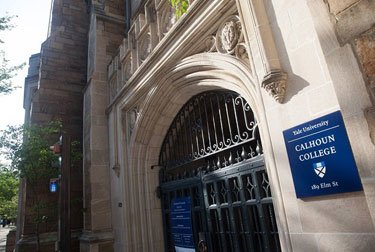
When Yale established the residential college system in emulation of the independent colleges of Oxford and Cambridge, one of the then ten colleges established was named for Class of 1804 alumnus and one-time Vice President, Secretary of State, Secretary of War, illustrious Senator and political theorist John C. Calhoun.
Wikipedia puts it blandly:
Because of his political, military, and intellectual achievements, Calhoun was venerated as an illustrious Yale alumnus beginning in the mid-nineteenth century. He was the only Yale graduate to be elected to a federal executive office in the school’s first two centuries, until the election of U.S. President William Howard Taft in 1909.
But the reality is, Southerner and intellectual father of the Lost Cause though he was, John C. Calhoun, in the era preceding the radical left’s Long March through the Culture and the Universities, was universally regarded as one of the three all-time giants of the Senate, and the single most important American statesman and political thinker to have ever graduated from Yale.
Last April 27th, Yale President Salovey announced that the University was declining to comply with demands from snowflakes of color that Calhoun College be renamed. This rebuff was, however, accompanied by other payoffs: the traditional title of “Master” for the distinguished senior faculty member who presided over a Yale residential college would be henceforward changed to “Head,” lest some dimbulb darkie confusing an ancient academic title with a reference to Antebellum Slavery be offended, and one of the two new residential colleges under construction would be named for some African-American leftist dyke whom no non-communist had ever previously heard of.
The fate of John C. Calhoun’s college seemed to be settled, but, no! it turned out that Salovey was a welsher. Just a few months later, when August rolled around, Salovey announced the formation of an Orwellian “Committee to Establish Principles of Renaming.”
The membership of that committee included a variety of individual SJWs, all obviously keenly committed to contemporary political perspectives intensely hostile to the culture and institutions of the Antebellum Southern United States and passionately opposed to the sectional and anti-egalitarian views of the late Senator Calhoun. There will be found on that committee not one single conservative, one defender of the Southern perspective, one admirer of Calhoun, or even one Old Blue traditionalist. The renaming committee is still currently holding meetings, but to say that its ultimate report is a foregone conclusion would be an massive understatement.
1997 alumnus Alexander Zubatov is the kind of graduate who ought to be in charge, but is not. Zubatov writes indignantly:
[T]he very name, “Committee to Establish Principles on Renaming,†…sounds like something Josef Stalin would have come up with while attempting to whitewash Soviet history of references to tsars, saints and that sort of thing. The act of erecting a one-issue litmus test for whitewashing American universities of references to slavery is equally myopic and dystopian. Undoubtedly, those immersed in the committee’s mission would believe the difference is that they are doing the good Lord’s work in furtherance of a just cause, and yet, wouldn’t they have to concede that Soviets visionaries and bureaucrats surely shared that view?
This nation has become obsessed with race, racism, slavery, discrimination and the cancer of regressive, zero-sum, winner-take-all identity politics, with the result that ideologues on the left and right are ensuring Americans are divided, polarized and pitted against each other based on their most superficial identifications. Yale, like many institutions of higher education in America, appears to have lost sight of the fact that part of the mission of an educational institution should be to avoid trend-hopping and to remain above the fray, to stand back from the dust cloud of our present-day turmoil and avail itself of the more nuanced and distanced vantage points conferred by academic disciplines such as history and philosophy, which further deep reflection rather than shallow proclamations and knee-jerk actions. By contrast, a university that is constantly bobbing and weaving in fear as a response to every whim of impulsive students who have not yet acquired the ability to stand back and think is a university that has lost sight of its educational mission. It is a university being run by spineless technocrats and cynical profiteers afraid of losing a few dollars for a few days on account of being branded “racist†in some hysterical student screed, YouTube video, or viral Tweet.
I have no doubt whatsoever that those who act most rashly today will be judged most harshly by history tomorrow. What we need today is not the renaming of buildings but a re-framing of the entire debate so that the question is not under what conditions we should or should not rename buildings, but rather, why it is that we have come to a point in our culture where so many people have become so over-determined by what Max Weber referred to as their “status groups†(races, gender affiliations, sexual proclivities, etc.) that they are blinded to the common good of our society as a whole.
Read the whole thing and shed a tear for Yale and another for the late Senator from South Carolina.
18 Oct 2016

Spartan helmet on display in the Olympia Archaeological Museum, Peloponnese – Greece.
One can almost make out the inscription. Almost.
UPDATE: Commenter Rick Hamilton offers the correct reading: “‘Sparta’, along the eye opening, and, ‘Miltiades dedicates to Zeus’ along the bottom.”
And he’s dead right. This is the helmet of Miltiades, the same Miltiades who devised the strategy that won the Battle of Marathon.
17 Oct 2016

I am currently in residence at my farm in the foothills of the Allegheny Mountain in Central Pennsylvania. My neighbor, Bud, just stopped by to visit and chat. Like just about everybody else in these parts, Bud has been an enthusiastic Trump supporter.
Today, though, Bud seemed a bit discouraged by the ineffectiveness of The Donald’s campaign effort. When I inquired how he was enjoying following the campaign contest, Bud replied bitterly: “Who wants to watch a drowning rat?”
/div>

Feeds
|