Do you see common ground between you and Michel Houellebecq, with his critique of Western liberal societies, combined with no justification for reactionary alternatives like Islamist or Russian ones?
Yes, definitely. Crazy as it may sound, I have much respect for the honest liberal conservatives like Houellebecq, Finkielkraut, or Sloterdijk in Germany. One can learn from them much more than from progressive liberal like Habermas: honest conservatives are not afraid to admit the deadlock we are in. Houellebecq’s Atomised is for me the most devastating portrait of the sexual revolution of the 1960s. He shows how permissive hedonism turns into the obscene superego universe of the obligation to enjoy. Even his anti-Islamism is more refined than it may appear: he is well aware how the true problem is not the Muslim threat from the outside, but our own decadence. Long ago Friedrich Nietzsche perceived how Western civilization was moving in the direction of the Last Man, an apathetic creature with no great passion or commitment. Unable to dream, tired of life, he takes no risks, seeking only comfort and security, an expression of tolerance with one another:
A little poison now and then: that makes for pleasant dreams. And much poison at the end, for a pleasant death. They have their little pleasures for the day, and their little pleasures for the night, but they have a regard for health. “We have discovered happiness,†— say the Last Men, and they blink.
Some people celebrate the Fourth of July with beer, barbecue, and fireworks. Others prefer more unconventional forms of celebration — like stealing a $14 million subsonic attack aircraft and taking it out for a spin in the skies above California.
That’s how Marine Lance Cpl. Howard A. Foot Jr. spent America’s birthday on July 4th, 1986, when the then-21-year-old mechanic clambered into the cockpit of an A-4M Skyhawk at El Toro Marine Corps Air Station and took off on the joyride of his life.
Despite never having flown a fighter jet before, Foote managed to pull off a pretty badass flight. ..
This wasn’t a youthful prank, like, say, riding dirty through the streets of Virginia in an M577 Armored Personnel Carrier. Rather, Foote’s airborne antics were a last-ditch effort to, as Los Angeles Times put it, “[fulfill] his lifelong dream of being at the throttle of a fighter jet, albeit a stolen one.â€
The previous February, Foote had apparently suffered an aerial embolism during an attempt to set a glider altitude record — and just a few days after he was informed by military doctors that the incident would preclude him from ever sitting behind the throttle of a Marine Corps fighter jet, he absconded with the Skyhawk.
Foote was discharged from the Marine Corps, but all charges against him were dropped. This was likely thanks to his close relationship with retired El Toro chief Gen. William A. Bloomer, a mentor of Foote’s who had encouraged him to participate in the gliding challenge that dashed his dreams.
And while we’re not exactly sure what Foote is up to now, the Los Angeles Times catch-up with him some 15 months after the incident revealed a man eager to get back in the air.
“I’m waiting to hear if the Israeli Air Force will take me,†Foote, then a pilot for a charter airline, told the Los Angeles Times in 1988. “And if that doesn’t work out, I’m going to see if I can fly for Honduras. I’ve heard they recently got some Skyhawks.â€
Here’s to you, Foote, for celebrating America’s birthday the way God intended: by fulfilling your dreams, consequences be damned.
For every Southern boy fourteen years old, not once but whenever he wants it, there is the instant when it’s still not yet two o’clock on that July afternoon in 1863, the brigades are in position behind the rail fence, the guns are laid and ready in the woods and the furled flags are already loosened to break out and Pickett himself with his long oiled ringlets and his hat in one hand probably and his sword in the other looking up the hill waiting for Longstreet to give the word and it’s all in the balance, it hasn’t happened yet, it hasn’t even begun yet, it not only hasn’t begun yet but there is still time for it not to begin against that position and those circumstance which made more men than Garnett and Kemper and Armistead and Wilcox look grave yet it’s going to begin, we all know that, we have come too far with too much at stake and that moment doesn’t need even a fourteen-year-old boy to think This time. Maybe this time with all this much to lose than all this much to gain: Pennsylvania, Maryland, the world, the golden dome of Washington itself to crown with desperate and unbelievable victory the desperate gamble, the cast made two years ago.
Last Saturday, Eugene, Oregon Antifa members tried shutting down forcibly a permitted march by a right-wing group calling itself Patriot Prayer in downtown Portland. NPR story.
This Antifa member swung a weapon at one of the conservatives and got his clock cleaned.
Fidel Castro was an admirer of the native Cuban predatory reptile, but his conservation efforts, like most of hos grandiose schemes, were mired in contradictions.
The island of Cuba, some say, is shaped like a crocodile, though you need a highly developed imagination to see it. The hatchery, located on one of its webbed feet—whether front or back depends on which way you tilt your head—has been solely dedicated to the conservation of the Cuban crocodile since 1974. The mission is straightforward in theory: secure the Cuban crocodile for the future and learn about the natural history of the little-understood species along the way. Yet as geneticist Yoamel Milián-GarcÃa of the University of Havana and others peer into the crocodile’s cellular secrets, they’re revealing that there’s a lot more that needs to be considered when it comes to conserving Castro’s croc.
In the wild, the Cuban—one of the world’s rarest crocodiles—is found almost exclusively within the 300-square-kilometer freshwater interior of the Zapata Swamp. The saltier stretches along the coast are the domain of Cuba’s other native crocodile—the widely distributed American (Crocodylus acutus), also found in coastal areas across Cuba and other Caribbean islands, and on the mainland from Mexico and southern Florida down to northern Peru and Venezuela. The Cuban is bolder and hunts during the day. It has a stubby snout, a reputation for jumping, and a tendency to walk with its belly high off the ground. The American is bigger, more apt to hide, searches for prey at night, sports dark bands on its back and sides, and has a long, pointed snout and extra webbing on its hind toes. The differences are as distinct as red from blue. Yet when Milián-GarcÃa analyzed their genetics a few years ago, he confirmed what zookeepers and scientists had already suspected: the two species are skinny-dipping in the same gene pool. …
By the time Castro had taken power, Zapata Swamp had already been altered by human ambition. Land reclamation projects here date back to the 19th century. And as researcher Claudia MartÃnez Herrera from Cuba’s national archive explains in a report, in the 1940s, the sugar industry arrived in the swamp—trees were cleared to make way for crops and mills and to power production. Loggers also cut swaths of royal ebony, mahogany, and white oak for export and for coal production. The sediment released from logging changed the area’s hydrology, causing four distinct areas to merge together into one giant swamp. Inhabitants drove artificial channels deep into the interior to access remaining trees. When Fulgencio Batista was in power, he had even taken steps to slash a canal all the way from the swamp’s south coast to Havana, bisecting the country, as a shortcut for ships traveling between the United States and the Panama Canal, though it never materialized.
Castro embraced the notion of bringing economic development to the sparsely inhabited and impoverished region. In The Real Fidel Castro, the late former British ambassador to Cuba Leycester Coltman says that from the beginning, the leader—who has been heralded as an environmentalist—“showed a fatal attraction to gigantic schemes to conquer nature and change the landscape, the sort of projects that appealed to other modern pharaohs such as Mussolini and Stalin.†Castro wanted to drain the swamp, a “virtually unpopulated region, infested with mosquitoes and crocodiles,†and convert it into “a rich area for rice-growing and tourism,†Coltman writes. Under his watch, Funes-Monzote confirms, more water was siphoned away and more artificial channels were driven deep into the swamp, into Cuban crocodile habitat.
Aspiring to save endemic species while simultaneously degrading their habitat is clearly contradictory, though awareness about the importance of saving ecosystems rather than focusing on specific species had not yet become part of the zeitgeist, and land reclamation was still generally viewed as a good idea, says Funes-Monzote. Plus, Castro was perfectly comfortable with contradictions. …
[A]lthough they look and behave differently, Cuban crocodiles and American crocodiles in Cuba are almost genetically the same to begin with. Only a 0.9 percent genetic difference exists between them—which makes American crocodiles here much more closely related to Cuban crocodiles than to members of their own species elsewhere in their range. Perhaps considering them two species was a taxonomic miscalculation and they should be treated as one. Or, maybe the American crocodile in Cuba needs to be designated a second crocodile species entirely unique to Cuba. In that case, could allowing two separate but wholly Cuban species to hybridize prove more palatable from a social perspective?
Post-modernist leftists have a habit of invoking Nietzsche as an authority justifying their nihilist rejection of the natural order and conventional morality, but, as Brian Leiter, writing in the Times Literary Supplement clearly understands, Nietzsche is not on the side of Ameliorism, Social Justice, or Egalitarianism in the least. Nietzsche is not a Leftist at all. Nietzsche is the most extreme aristocrat.
The German philosopher Friedrich Nietzsche (1844–1900) pursued two main themes in his work, one now familiar, even commonplace in modernity, the other still under-appreciated, often ignored. The familiar Nietzsche is the “existentialistâ€, who diagnoses the most profound cultural fact about modernity: “the death of Godâ€, or more exactly, the collapse of the possibility of reasonable belief in God. Belief in God – in transcendent meaning or purpose, dictated by a supernatural being – is now incredible, usurped by naturalistic explanations of the evolution of species, the behaviour of matter in motion, the unconscious causes of human behaviours and attitudes, indeed, by explanations of how such a bizarre belief arose in the first place. But without God or transcendent purpose, how can we withstand the terrible truths about our existence, namely, its inevitable suffering and disappointment, followed by death and the abyss of nothingness?
Nietzsche the “existentialist†exists in tandem with an “illiberal†Nietzsche, one who sees the collapse of theism and divine teleology as tied fundamentally to the untenability of the entire moral world view of post-Christian modernity. If there is no God who deems each human to be of equal worth or possessed with an immortal soul beloved by God, then why think we all deserve equal moral consideration? And what if, as Nietzsche argues, a morality of equality – and altruism and pity for suffering – were, in fact, an obstacle to human excellence? What if being a “moral†person makes it impossible to be Beethoven? Nietzsche’s conclusion is clear: if moral equality is an obstacle to human excellence, then so much the worse for moral equality. This is the less familiar and often shockingly anti-egalitarian Nietzsche. …
Nietzsche’s central objection to morality is more radical and illiberal: any culture dominated by Judeo-Christian morality, or other ascetic or life-denying moralities, will be one inhospitable to the realization of human excellence. What if, as he says in On the Genealogy of Morality, “morality itself were to blame if the highest power and splendor possible to the type man was never in fact attained? So that morality itself was the danger of dangers?â€
Consider his objection to moral views that demand that we eliminate suffering and promote happiness. In Dawn, he writes, “Are we not, with this tremendous objective of obliterating all the sharp edges of life, well on the way to turning mankind into sand? Sand! Small, soft, round, unending sand! Is that your ideal, you heralds of the sympathetic affections?†In Beyond Good and Evil a few years later, he objects to utilitarians that, “Well-being as you understand it – that is no goal, that seems to us an end, a state that soon makes man ridiculous and contemptible . . . . â€
Does a focus on happiness really make people “ridiculous and contemptible� Nietzsche offers a more ambitious explanation in Beyond Good and Evil:
The discipline of suffering, of great suffering – do you not know that only this discipline has created all enhancements of man so far? That tension of the soul in unhappiness which cultivates its strength, its shudders face to face with great ruin, its inventiveness and courage in enduring, persevering, interpreting, and exploiting suffering, and whatever has been granted to it of profundity, secret, mask, spirit, cunning, greatness – was it not granted to it through suffering, through the discipline of great suffering?
Most suffering is nothing more than misery for its subject, and most happy “comfortable†people are not exemplars of human excellence. Nietzsche surely knew this. (He was no “tourist†when it came to suffering – even before his disability-related retirement from Basel in 1879 and continuing on until his final mental collapse in 1889, he suffered from excruciating physical maladies, probably due to untreated syphilis). What Nietzsche noticed is that suffering, at least in certain individuals (including himself), could be the stimulus to extraordinary creativity – one need only read a biography of Beethoven to see a paradigm example. But even if Nietzsche has correctly diagnosed the psychological mechanism at work, why should a morality of pity for suffering present an obstacle to sufferers realizing their creative potential? Nietzsche’s crucial thought is that in a culture committed to happiness and the elimination of suffering as its goal, nascent Nietzsches and Beethovens will squander their potential in pursuit of both those aims, rather than in pursuing creative work. After all, if it is bad to suffer, then all your efforts should be devoted to avoiding suffering; and if it is good to be happy, then, that should be the aim of everything you do. But human excellence is compatible with neither the pursuit of happiness nor the flight from suffering.
If Nietzsche’s speculative psychology is correct, then we arrive at a startling conclusion. In a hedonistic and sympathetic culture, which devalues suffering and prioritizes its relief, the glorious spectacle of human genius will be missing from the world: no Beethovens, Nietzsches or Goethes.
The last thylacine died in captivity in the zoo in 1936, or did it? People keep seeing them. Brooke Jarvis, in the New Yorker, wonders if the sightings are real, or if they simply represent expressions of the human hankering for the survival of a romantic critter.
Tasmania, which is sometimes said to hang beneath Australia like a green jewel, shares the country’s colonial history. The first English settlers arrived in 1803 and soon began spreading across the island, whose human and animal inhabitants had lived in isolation for more than ten thousand years. Conflict was almost immediate. The year that the Orchard farmhouse was built, the Tasmanian government paid out fifty-eight bounties to trappers and hunters who presented the bodies of thylacines, which were wanted for preying on the settlers’ sheep. By then, the number of dead tigers, like the number of live ones, was steeply declining. In 1907, the state treasury paid out for forty-two carcasses. In 1908, it paid for seventeen. The following year, there were two, and then none the year after, or the year after that, or ever again.
By 1917, when Tasmania put a pair of tigers on its coat of arms, the real thing was rarely seen. By 1930, when a farmer named Wilf Batty shot what was later recognized as the last Tasmanian tiger killed in the wild, it was such a curiosity that people came from all over to look at the body. The last animal in captivity died of exposure in 1936, at a zoo in Hobart, Tasmania’s capital, after being locked out of its shelter on a cold night. The Hobart city council noted the death at a meeting the following week, and authorized thirty pounds to fund the purchase of a replacement. The minutes of the meeting include a postscript to the demise of the species: two months earlier, it had been “added to the list of wholly protected animals in Tasmania.â€
Like the dodo and the great auk, the tiger found a curious immortality as a global icon of extinction, more renowned for the tragedy of its death than for its life, about which little is known. In the words of the Tasmanian novelist Richard Flanagan, it became “a lost object of awe, one more symbol of our feckless ignorance and stupidity.â€
But then something unexpected happened. Long after the accepted date of extinction, Tasmanians kept reporting that they’d seen the animal. There were hundreds of officially recorded sightings, plus many more that remained unofficial, spanning decades. Tigers were said to dart across roads, hopping “like a dog with sore feet,†or to follow people walking in the bush, yipping. A hotel housekeeper named Deb Flowers told me that, as a child, in the nineteen-sixties, she spent a day by the Arm River watching a whole den of striped animals with her grandfather, learning only later, in school, that they were considered extinct. In 1982, an experienced park ranger, doing surveys near the northwest coast, reported seeing a tiger in the beam of his flashlight; he even had time to count the stripes (there were twelve). “10 a.m. in the morning in broad daylight in short grass,†a man remembered, describing how he and his brother startled a tiger in the nineteen-eighties while hunting rabbits. “We were just sitting there with our guns down and our mouths open.†Once, two separate carloads of people, eight witnesses in all, said that they’d got a close look at a tiger so reluctant to clear the road that they eventually had to drive around it. Another man recalled the time, in 1996, when his wife came home white-faced and wide-eyed. “I’ve seen something I shouldn’t have seen,†she said.
“Did you see a murder?†he asked.
“No,†she replied. “I’ve seen a tiger.â€
As reports accumulated, the state handed out a footprint-identification guide and gave wildlife officials boxes marked “Thylacine Response Kit†to keep in their work vehicles should they need to gather evidence, such as plaster casts of paw prints. Expeditions to find the rumored survivors were mounted—some by the government, some by private explorers, one by the World Wildlife Fund. They were hindered by the limits of technology, the sheer scale of the Tasmanian wilderness, and the fact that Tasmania’s other major carnivore, the devil, is nature’s near-perfect destroyer of evidence, known to quickly consume every bit of whatever carcasses it finds, down to the hair and the bones. Undeterred, searchers dragged slabs of ham down game trails and baited camera traps with roadkill or live chickens. They collected footprints, while debating what the footprint of a live tiger would look like, since the only examples they had were impressions made from the desiccated paws of museum specimens. They gathered scat and hair samples. They always came back without a definitive answer.
In 1983, Ted Turner commemorated a yacht race by offering a hundred-thousand-dollar reward for proof of the tiger’s existence. In 2005, a magazine offered 1.25 million Australian dollars. “Like many others living in a world where mystery is an increasingly rare thing,†the editor-in-chief said, “we wanted to believe.†The rewards went unclaimed, but the tiger’s fame grew.
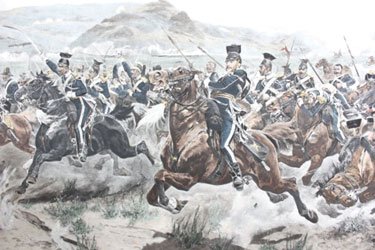
Richard Caton Woodville, The Charge of the Light Brigade, 1895.
—————————-
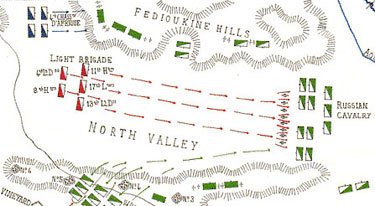
25 October 1854, due to a misunderstood order, the Light Brigade of the British cavalry, consisting of the 4th and 13th Light Dragoons, the 17th Lancers, and the 8th and 11th Hussars, roughly 670 men, under the command of Major General James Brudenell, 7th Earl of Cardigan, advanced three-quarters of a mile under heavy fire from three sides assaulting a battery of Russian artillery and cutting down the gunners.
The British survivors then proceeded to cut their way through a mass of over 5000 Russian cavalry, dispersed them, and returned down the valley through the same gauntlet of fire.
The Light Brigade sustained 40 percent casualties, approximately 120 killed, and at least 160 wounded. Fifty were taken prisoner. Also killed were 375 horses. Every officer, but one, in the first line, was either killed or wounded.
—————————-
“It is magnificent, but it is not war. It is madness.”
– French Marshal Pierre Bosquet,while observing the charge
——————————
Trumpeter Martin Leonard Lanfried (1834–1902), who was one of the buglers sounding the charge at Balaclava, with a bugle used at Waterloo (lent for the occasion by the First Life Guards) was recorded on August 2nd, 1890, sounding the same charge at Edison House, London.