Kevin D. Williamson puts the hundreds of newspaper editorials recently deploring Donald Trump’s criticisms of the establishment media into proper perspective.
If we want a culture of open and robust discourse, then we do not want a culture in which Brendan Eich is driven from his job for having an unpopular view on gay marriage. If we want a culture of open and robust discourse, then we do not want a culture in which there is an organized-campaign-style effort to have journalists dismissed from their positions for holding unpopular views, or a boycott every time the New York Times or the Washington Post (or, I suppose, The Atlantic) adds a columnist who is not likely to please the Bernie Sanders Campaign Historical Re-enactors Society at Reed College. It is true that none of these things is a formal violation of the First Amendment, because the First Amendment is a restriction on what kind of laws the federal government may enact. But calling CNN’s daily output “fake news†isn’t a violation of the First Amendment, either.
What’s actually at work here is a variation on “Heads I Win/Tails You Lose.†When the Left wants to stop an unpopular speaker from delivering remarks at Berkeley, then that’s just meeting speech with more speech and some firebombs. And, it’s true: There isn’t any First Amendment reason why you can’t have a riot at Berkeley every time Ann Coulter gets invited to speak there. But there are all sorts of other reasons.
If there is going to be more to freedom of speech than “Congress shall make no law†— which is what we should want — then that has to be true for everyone.
Freedom of the press is not some special license granted to organizations that incorporate as media companies. There is no intellectually defensible model of free expression that protects the editorial page of the New York Times but not Hillary: The Movie. Of course, it’s easy to think of a pretext for suppressing communication you don’t like: If you don’t like what Citizens United is saying, then you shut it down with “campaign finance reform,†which, we should remember, worked — until the Supreme Court stopped it. If you don’t like that oil companies fund organizations that criticize global-warming policies, then you claim that this amounts to “securities fraud.†If you don’t like that the NRA is an effective advocate for its positions, you use banking regulations to hamstring it financially. Don’t like somebody’s social or religious views? “Hate speech.†Easy as that.
We don’t need conjecture: We’ve seen how this goes. The Obama administration used the Espionage Act to punish whistleblowers, spy on journalists, and interfere with reporting it didn’t want done. Under Obama, the IRS targeted conservative nonprofits for harassment and more under the guise of enforcing the tax code — and it illegally disclosed private information about an advocacy group that irritated Democrats. The same people demand the power to set the terms for political debate, saying they want to “keep money out of politics,†a claim that it is impossible for any mentally functional adult to take very seriously.
Freedom of the press does not mean extending special privileges, legal or customary, to the New York Times and CNN. And freedom of speech means a lot more than the absence of formal censorship by the federal government. Formal protections for free speech are important and necessary, but they do not amount to very much without a free-speech culture to back them up.
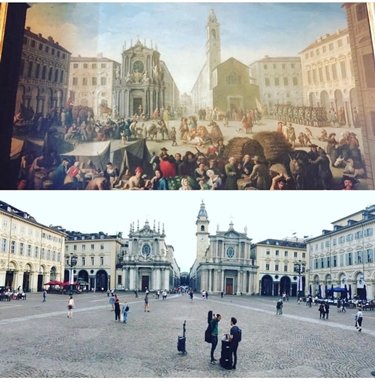
Turin, Piazza San Carlo: Giovanni Michele Graneri, Market at Piazza San Carlo, 1752, Museo Civico d’Arte Antica, Torino above Photograph 2017. (Click on image for larger version.)
GQ links a series of robberies of Chinese art from European museums with auction records for similar objects broken recently by Chinese billionaires bent on repatriating objects looted from China in the 19th Century, and wonders aloud if the burglaries were ordered by the Chinese Government or one of the billionaires?
The patterns of the heists were evident only later, but their audacity was clear from the start. The spree began in Stockholm in 2010, with cars burning in the streets on a foggy summer evening. The fires had been lit as a distraction, a ploy to lure the attention of the police. As the vehicles blazed, a band of thieves raced toward the Swedish royal residence and smashed their way into the Chinese Pavilion on the grounds of Drottningholm Palace. There they grabbed what they wanted from the permanent state collection of art and antiquities. Police told the press the thieves had fled by moped to a nearby lake, ditched their bikes into the water, and escaped by speedboat. The heist took less than six minutes.
A month later, in Bergen, Norway, intruders descended from a glass ceiling and plucked 56 objects from the China Collection at the KODE Museum. Next, robbers in England hit the Oriental Museum at Durham University, followed by a museum at Cambridge University. Then, in 2013, the KODE was visited once more; crooks snatched 22 additional relics that had been missed during the first break-in.
Had they known exactly what was happening, perhaps the security officials at the Château de Fontainebleau, the sprawling former royal estate just outside Paris, could have predicted that they might be next.
With more than 1,500 rooms, the palace is a maze of opulence. But when bandits arrived before dawn on March 1, 2015, their target was unmistakable: the palace’s grand Chinese Museum. Created by the last empress of France, the wife of Napoleon III, the gallery was stocked with works so rare that their value was considered incalculable.
In recent years, however, the provenance of those treasures had become an increasingly sensitive subject: The bulk of the museum’s collection had been pilfered from China by French soldiers in 1860 during the sack of Beijing’s Old Summer Palace.
In each case, the robbers focused their efforts on art and antiquities from China, especially items that had been looted by foreign armies. Many of these objects are well documented and publicly known, making them very hard to sell and difficult to display. In most cases the pieces have not been recovered; they seem to simply vanish.
After that first robbery, in Stockholm, a police official told the press that “all experience says this is an ordered job.†As the heists mounted, so did the suspicion that they were being carried out on instructions from abroad. But if that was true, an obvious question loomed: Who was doing the ordering?
John Davis reports that the Danish Government has been reduced to begging men, via advertising from the state travel agency, to have sex with Danish women.
Denmark, however, has fallen ill to a festering infection known as “feminism.†It is the same illness that has taken hold of the rest of Scandanavia, Western Europe and the UK. Because of this gender infirmity, Denmark’s birth rate, and, its population growth, has been plummeting (as is true with most of Western Europe).
Feminism has given women in Denmark an immunity from civility, and, license to openly hate and ridicule men. For example, it is not uncommon for girls to be sitting on a bus, in a group, and have them openly point to a man and discuss how unattractive he is. The Danish legal system is set up so that once a woman has “been impregnated†by a man, the man is completely disposable in divorce, and, the man’s role as a sperm donor is further degraded by requiring him to pay for the child for the rest of his life so that the impregnated woman may enjoy her fulfillment as a modern feminist.
Denmark still imposes all of the obligations of men that have survived medieval chivalry, yet, virtually sees men as nothing but completely disposable sperm donors (who are occasionally allowed to work in the Danish socialist job market).
Denmark’s feminist culture, laws and government view and treat men as nothing but disposable sperm donors.
The result is that only about 20% of Danish men are actively in the dating pool. Danish women are constantly complaining about not having enough men to satisfy their desires for sexual and social intercourse. Yet, Danish women will viciously guard their feminism, hatred of men, life plans to treat men as disposable, and the concept that men are irrelevant except to give the woman sperm, and, the child some semblance of legitimacy.
One with intellect, sensitivity, education (instead of the indoctrination that feminism requires) and human dignity might think that the solution to this problem would be to encourage women to learn something about human compassion, respect, human value beyond sex, and, the beauty of binding interpersonal relationships.
The Danish government doesn’t have any of those problems . . . . Here is the Danish government’s solution. This is just one advertisement of an intense propaganda campaign the Danish feminist government undertook to try to beg men to inseminate Danish women (for “Mom†and for “The Stateâ€).
Spies Rejser is the Danish state travel agency.
Note how the advertisement features a prominent man-hating feminist in the narrative in order to appease the fascist feminist lobby that controls the country’s social laws and norms.
Note how the advertisement relegates the man to a mere decoration and accessory and sperm donor.
Pajamas Media reports that, last Wednesday, the homies were dropping like flies all over the New Haven Green. It seems that a bad batch of synthetic pot recently arrived.
Residents watched in horror as more than 70 people collapsed near a city park in Connecticut Tuesday night into Wednesday, overdosing on what authorities believe was a tainted batch of synthetic marijuana. Vomiting and hallucinating drug users dropped like flies throughout the day as emergency crews raced to the New Haven Green to save lives.
“We have a guy laid out in the alleyway, unresponsive, eyes wide open. He’s out cold,†one bystander hollered, according to the New Haven Register. …
An emergency medical technician for the New Haven Fire Department told the Register that he’s never had such an abnormal day at work in the five years he’s been there.
“This was a particularly odd, rare occasion where (there was) call after call for man down, obviously with symptoms of some kind of overdose, and at the time of getting that patient packaged and transported to the hospital, we’d see another immediately fall down, right there,†Lt. Ernest Jones said. “At that point, we’d go help that patient, and while helping that patient, another person went down. So it became a domino effect.â€
What is striking about this is the fact that, within living human memory, Connecticut’s cities were truly extraordinary examples of ancient culture, high civilization, and prosperity. There would be found in each of them many of the wealthiest and most famous of American businesses and industries. Factory workers lived in homes that bankers in other states might envy.
Today, Connecticut cities still have government and universities, sitting there surrounded by the deserts created by the bad political policies of the former and the bad ideas of the latter. The old population descended from 17th Century Puritan founders has fled to the suburbs or out of state. Connecticut cities are populated by government-dependent blacks and Puerto Ricans.
H.W. Crocker III has written an alternative history novel in which George Armstrong Custer survives the Battle of the Little Bighorn and becomes a Western gunslinger, which demonstrates that he has some expert knowledge of the man’s political opinions, and he offers, in voice of the Alt-Right, American Greatness, eleven reasons why, if he were here and alive today, General Custer would be wearing a MAGA hat.
He liked hats, and though he was proud of his golden hair, it was thinning a bit. A hat could come in handy.
2. Red looked good on him—an essential part of his self-styled uniform in the Civil War was a red cravat. He didn’t care that such flash made him an easy target for snipers. Cutting a figure for the men was more important. And he wouldn’t have been intimidated from wearing a MAGA hat while walking the mean streets of Monroe, Michigan.
3. Custer was a conservative Democrat who would have been a prototypical Reagan Democrat and Trump Democrat, driven by deep-rooted patriotism.
He could be right. Custer was a Northern democrat, and had he survived the battle and returned east victorious as a national hero, he was angling for the Democratic Party’s nomination and could very possibly have won the nomination instead of Tilden.
Whether he could have done as well as Tilden did in the South, and decisively defeated Hayes, well, that is less clear. During the War, Custer was a brutal adversary, prone to insult his opponents, and there were good reasons for a Southern animus against him.
Would Custer have defended Confederate monuments, as Crocker claims? I’m less sure.
Armand D’Angour, an associate professor in classics and a fellow of Jesus College at the University of Oxford, in Aeon, claims to be able to reconstruct the music of Ancient Greece.
They told me, Heraclitus, they told me you were dead;
They brought me bitter news to hear and bitter tears to shed;
I wept as I remembered how often you and I
Had tired the sun with talking, and sent him down the sky.
And now that thou art lying, my dear old Carian guest,
A handful of grey ashes, long, long ago at rest,
Still are thy pleasant voices, thy nightingales, awake;
For Death, he taketh all away, but them he cannot take.
This epigram by Callimachus, in a moving translation by the Victorian poet William Johnson Cory, speaks of the timeless survival of Heraclitus’ songs. Ironically, the poem is the only evidence of their existence: the poet’s ‘pleasant voices’ must remain unsung. Most classical poetry, spanning around four centuries from the songs of Homer in the 8th century BCE to those Âof Aristophanes in the 4th century BCE, was in fact composed to be sung to the accompaniment of musical instruments such as the lyre and aulos (double-pipe). It was, in other words, music; but what did that music sound like?
Despite a wealth of ancient writings, archaeological remains of instruments, and even inscriptions with musical notation, the question has long been thought intractable. ‘Research into Ancient Greek music is pointless,’ pronounced Giuseppe Verdi in the 1880s. By the 1980s little had changed. Recently, however, the subject has experienced exciting developments, with credible realisations of musical scores and the remains of auloi being accurately reconstructed and beautifully played.
Nathanael Blake has a good editorial explaining that the yen for Socialism really amounts to a category mistake.
The surge in socialism’s popularity among young Americans has little to do with the actual merits (or demerits) of the system, or even what it actually entails. Most seem to think it means a larger welfare state and taxing “the rich†a bit more. Rather, socialism’s allure is due to the families that are broken, the communities that are atomized, and the churches that are empty — often, sadly, because they betrayed their responsibilities to God and man.
The needs and desires that are met only by faith, family, and friendship are still part of the human condition. The current half-baked socialist revival is a category error, as it attempts a political and economic solution to a cultural and spiritual problem. But part of our crisis is the loss of the ability to think clearly about such matters, as exemplified by a generation that relies on the Harry Potter books for a shared moral language. This poverty of moral imagination and expression illuminates the spiritual and cultural desolation that prior generations created and bequeathed to their children.
As people seek a political solution for their spiritual and psychological dismay and distress, we see pathologies that used to afflict religious entities become manifest in politics. The sudden popularity of ersatz socialism is not because it offers a realistic plan of improvement, but because it sounds fair and compassionate while promising to relieve anxiety over economic uncertainty. That socialism will deliver on none of these promises is beside the point.
The concerns and anxieties that beset our culture will not be addressed only by reminders of material abundance provided by free market economics. Man does not live on technological miracles alone. Wealth will not satisfy us and assuage our anxieties; affordable airfare and iPhones will not save our souls. But as we look for that which will, we must remember the bounty lavished upon us. Our unhappiness rarely results from real material deprivation, and a socialist redistribution will do little to increase the sum of human happiness.
Only by bearing our material blessings in mind will we be able to think clearly about our desires for cultural, relational, and spiritual satisfaction.