Archive for February, 2022
23 Feb 2022

British Defence Minister Ben Wallace.
“The Scots Guards kicked the backside of Tsar Nicholas I in 1853 in Crimea — we can always do it again.’
Defence Secretary Ben Wallace to defence officials in Westminster.
———————————————
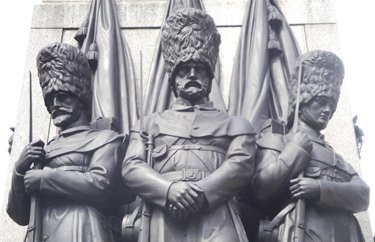
The Guards Crimean War Memorial in Waterloo Place, off Pall Mall.
21 Feb 2022

Hank the Tank likes leftover pizza.
NYT:
Since the summer, a black bear known as Hank the Tank has made a 500-pound nuisance of himself in South Lake Tahoe, Calif., breaking into more than two dozen homes to rummage for food and leaving a trail of damage behind.
So far, nobody has been able to deter Hank, said Peter Tira, a spokesman for the California Department of Fish and Wildlife. Department officials and the local police have tried to “haze” the bear with paintballs, bean bags, sirens and Tasers, but he is too drawn to humans and their food to stay away for long.
20 Feb 2022


Red State reports, however, that not all Finance and Tech fell obediently into line.
[W]hile banks like the TD Bank crumbled like a cheap suit, bitcoin companies gave some great responses to requests from the government to adhere with the new orders under the Emergencies Act.
Bitcoin wallet company Nunchuk announced that they’d gotten a request to freeze accounts from the government, “Yesterday, the Ontario Superior Court of Justice sent us a Mareva Injunction, ordering us to freeze and disclose information about the assets involved in the #FreedomConvoy2022 movement.” But Nunchuk explained to the clueless government that they don’t hold any money like a custodial financial institution, they don’t collect user information apart from emails, and they don’t hold the keys to any of the wallets — that it’s all private to the user, by design.
The Ontario Superior Court of Justice asked self-custody wallet provider @nunchuk_io to disclose user information and freeze user’s bitcoin.
This was the team’s response. pic.twitter.com/uyW9OWs1LS
— Pomp 🌪 (@APompliano) February 19, 2022
“Please look up how self custody and private keys work,” the company chided the government. “When the Canadian dollar becomes worthless, we will be here to serve you too.” Now, that’s gold. They even learned a lesson from this experience with the government, and now will be making it even more private by not even holding the email information in future updates.
Speaking of which, we will add a non-email login option and make it a priority in our roadmap.
— nunchuk_io (@nunchuk_io) February 19, 2022
Edge wallet had an even more direct response to the fascistic request from the government.
In the wake of ongoing turmoil taking place in the Canadian capital of Ottawa, Deputy Prime Minister Chrystia Freeland has requested, via the Emergencies Act, that various financial services companies freeze accounts of those linked to protesters occupying the region, as well as those providing funding to the protests, but not present physically.
Regardless of whether the protests resonate with individuals or not, financial seizure is an unprecedented action that must be taken seriously. It’s with great consideration that we would like to share our official response to the request that Canadian users’ Edge accounts be frozen:
They finished with this meme.
pic.twitter.com/msERObyJF0
— Dr. Nickarama (@nickaramaOG) February 19, 2022
“And most importantly, we can’t, even if we wanted to.”
Nicely done.
RTWT
20 Feb 2022

“Shot at some intruders last night.”
— Alan Clark
20 Feb 2022

Leighton Woodhouse notes how readily the Canadian state has employed the establishment’s alliance with Big Tech and Finance to deprive opponents not only of the means to protest and resist, but even of the means to live.
When Edward Snowden warned that the digital mass surveillance state built by tech corporations and government intelligence agencies amounted to a “turnkey tyranny,” what’s happening right now in Canada is exactly what he meant. Just as armed drones have made waging war as easy as playing a video game, information technology has taken the friction out of building an authoritarian state. It used to be hard to repress people. You’d have instill enough fear or distribute enough patronage to get the police and the military in line with your ambitions; you’d have to actually send the goons out to crack skulls; you’d have to control the judges and set up kangaroo courts to fill your prisons with your political enemies. It was all very ugly and messy and at every point along the way you’d be sure to meet stubborn and potentially violent resistance.
And in fact, Trudeau has sent the goons out to crack a few skulls, but that’s almost parenthetical to the real power the Canadian government is wielding against its citizens: the power to force consent by depriving families of their livelihoods. The Canadian government has directed financial institutions to freeze bank and credit card accounts not only of direct participants in the trucker convoy, but of those who have donated to them. It’s basically an old school starvation siege, but executed digitally instead of physically and with the aim of clearing out a city rather than conquering it. And Trudeau’s government has made clear that it won’t end with the truckers going home.
The power the Canadian government has arrogated to itself is both stupefying and technically easy to do. Per Snowden, that’s what sets this century apart from the last one: radically abridging the civil liberties of entire populations requires no particularly strenuous effort, just an audacious act of will. …
In the last century, what’s happening in Canada might have been described as a class war waged from above. That is, it’s a war of the ruling class on an organized and rebellious cadre of the working class. But in 2022, a more useful framework can be found in Martin Gurri’s conception of “the center” versus “the periphery” (actually, Gurri says “the border,” but for reasons I won’t bore you with, I prefer “periphery”). The “center” is the political, economic and cultural establishment, embodied by Justin Trudeau better than anyone in the world. The “periphery” is the anti-establishment riff-raff, organized loosely and spontaneously online, fusing together dissidents of all flavors: left, right, and neither. Occupy Wall Street, the Indignados, the Yellow Vests, the truckers — these are the postindustrial peasant revolts of the periphery.
In its confrontation with the center, the periphery uses instruments its opponent cannot control: the tools of memetic propagation and online mobilization. Culturally, the internet is a flat, decentralized and chaotic place, which bestows an inherent advantage on the anti-establishment public in its campaign of asymmetric warfare against the center. But structurally, the internet is the opposite: it’s a hierarchical, highly centralized and strictly ordered space where attention is channeled through a small number of colossal platforms and money flows through a half dozen giant payment processors. This concentration of power is a potent tool in the hands of the center: to shut down the periphery, it needs only to influence the actions of a handful of actors, each of whom are themselves high profile members in good standing of the establishment. All the center needs to do is apply sufficient political pressure on a few chummy corporate leaders and a rebellion can be suppressed without a single shot fired: much cleaner, safer and aesthetically inoffensive than bringing the full, naked power of the state down on dissidents like it was 1989 in Tiananmen Square. …
This is what we have to look forward to: surgical authoritarianism. In the twenty-first century, the brute coercive power of the state will not require the construction of a totalitarian apparatus to control our actions and thoughts at all times in all places, as it did in the last one. In normal times, dissent will be happily tolerated. But when the state feels truly threatened, it will merely log into the operating system of our digital society, switch to God Mode, hit a few keystrokes and nuke its opposition.
RTWT
16 Feb 2022

The great P.J. O’Rourke died yesterday of lung cancer. He was 74. I’m 73. Imagine how I feel.
You can read his biography in any of the MSM obituaries. Here is the NYT’s.
I suggest reading a few selections from his inimitable prose.
For example, from the introduction to Give War a Chance:
The principal feature of contemporary American liberalism is sanctimoniousness. By loudly denouncing all bad things — war and hunger and date rape — liberals testify to their own terrific goodness. More important, they promote themselves to membership in a self-selecting elite of those who care deeply about such things. People who care a lot are naturally superior to we who don’t care any more than we have to. By virtue of this superiority, the caring have a moral right to lead the nation. It’s a kind of natural aristocracy, and the wonderful thing about this aristocracy is that you don’t have to be brave, smart, strong or even lucky to join it, you just have to be liberal.
and
Liberals actually hate wealth because they hate all success. They hate success especially, of course, when it’s achieved by other people, but sometimes they hate the success they achieve themselves. What’s the use of belonging to a self-selecting elite if there’s a real elite around? Liberals don’t like any form of individual achievement. . . . Also wealth is, for most people, the only honest and likely path to liberty. With money comes power over the world. Men are freed from drudgery, women from exploitation. Businesses can be started, homes built, communities formed, religious practiced, educations pursued. But liberals aren’t very interested in such real and material freedoms. Liberals want the freedom to put anything into their mouths, to say bad words, and to expose their private parts in art museums.
And his famous how-to piece from Republican Party Reptile:
How to Drive Fast on Drugs While Getting Your Wing-Wang Squeezed and Not Spill Your Drink.
16 Feb 2022

You probably missed it. I did. Last Fall, Newsweek reported that 39 per cent of Gen Z-ers polled described themselves as LGBTQ.
Thirty percent of Millennials identify as LGBTQ, according to a soon-to-be released study that is based on scientific polling data. Among Christians the numbers were lower—but only slightly, with just under 30 percent of Millennial Christians identifying as LGBTQ.
The portion of the population that describes itself as gay has varied over the years, from 10 percent, based on research by Alfred Kinsey and widely promoted by the National Gay Task Force in 1977, to less than 6 percent in a recent Gallup poll. The pollster who worked on the new study, George Barna, attributes the unusually high number he found to social and news media coverage that makes it “safe and cool” for young Americans to identify as LGBTQ—whether or not it represents their actual sexual orientation.
“It’s a subset of a larger issue, that this is a generation where three out of four are searching for meaning. This is a group that doesn’t have a reason to get out of bed in the morning,” Barna says. “Therefore, the LGBTQ identity gives them comfort. A lot of this generation claim to be moving in that direction, but there’s a big difference between claiming the identity and living the lifestyle.”
Among Millennials, 30 percent identify as LGBTQ, more than three times that of the rest of the adult population, and when the researchers broke out the youngest of the group, ages 18-24 (which some call Gen Z), they found 39 percent called themselves LGBTQ.
RTWT
14 Feb 2022

Ogden Nash (1902-1971)
To My Valentine
More than a catbird hates a cat,
Or a criminal hates a clue,
Or an odalisque hates the Sultan’s mates,
That’s how much I love you.
I love you more than a duck can swim,
And more than a grapefruit squirts,
I love you more than commercials are a bore,
And more than a toothache hurts.
As a shipwrecked sailor hates the sea,
Or a juggler hates a shove,
As a hostess detests unexpected guests,
That’s how much you I love.
I love you more than a wasp can sting,
And more than the subway jerks,
I love you truer than a toper loves a brewer,
And more than a hangnail irks.
I love you more than a bronco bucks,
Or a Yale man cheers the Blue.
Ask not what is this thing called love;
It’s what I’m in with you.
14 Feb 2022
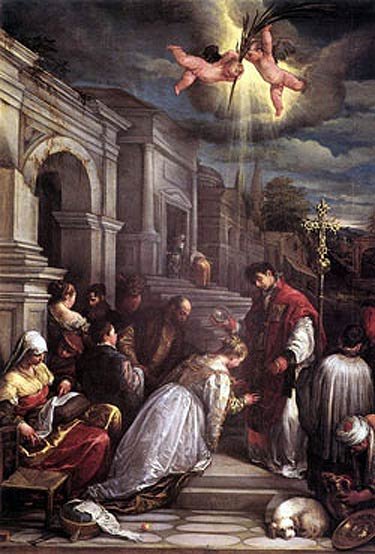
Jacopo Bassano, St Valentine Baptizing St Lucilla, 1575, oil on canvas, Museo Civico, Bassano del Grappa
The popular customs associated with Saint Valentine’s Day undoubtedly had their origin in a conventional belief generally received in England and France during the Middle Ages, that on 14 February, i.e., half way through the second month of the year, the birds began to pair. Thus in Chaucer’s Parliament of Foules we read:
For this was sent on Seynt Valentyne’s day
Whan every foul cometh ther to choose his mate.
For this reason the day was looked upon as specially consecrated to lovers and as a proper occasion for writing love letters and sending lovers’ tokens. Both the French and English literatures of the fourteenth and fifteenth centuries contain allusions to the practice. Perhaps the earliest to be found is in the 34th and 35th Ballades of the bilingual poet, John Gower, written in French; but Lydgate and Clauvowe supply other examples. Those who chose each other under these circumstances seem to have been called by each other their Valentines.
In the Paston Letters, Dame Elizabeth Brews writes thus about a match she hopes to make for her daughter (we modernize the spelling), addressing the favoured suitor:
And, cousin mine, upon Monday is Saint Valentine’s Day and every bird chooses himself a mate, and if it like you to come on Thursday night, and make provision that you may abide till then, I trust to God that ye shall speak to my husband and I shall pray that we may bring the matter to a conclusion.
——————————————–
From Robert Chambers, The Book of Days, 1869: Feast Day: St. Valentine, priest and martyr, circ. 270.
Valentine’s Day is now almost everywhere a much degenerated festival, the only observance of any note consisting merely of the sending of jocular anonymous letters to parties whom one wishes to quiz, and this confined very much to the humbler classes. The approach of the day is now heralded by the appearance in the print-sellers’ shop windows of vast numbers of missives calculated for use on this occasion, each generally consisting of a single sheet of post paper, on the first page of which is seen some ridiculous coloured caricature of the male or female figure, with a few burlesque verses below. More rarely, the print is of a sentimental kind, such as a view of Hymen’s altar, with a pair undergoing initiation into wedded happiness before it, while Cupid flutters above, and hearts transfixed with his darts decorate the corners. Maid-servants and young fellows interchange such epistles with each other on the 14th of February, no doubt conceiving that the joke is amazingly good: and, generally, the newspapers do not fail to record that the London postmen delivered so many hundred thousand more letters on that day than they do in general. Such is nearly the whole extent of the observances now peculiar to St. Valentine’s Day.
At no remote period it was very different. Ridiculous letters were unknown: and, if letters of any kind were sent, they contained only a courteous profession of attachment from some young man to some young maiden, honeyed with a few compliments to her various perfections, and expressive of a hope that his love might meet with return. But the true proper ceremony of St. Valentine’s Day was the drawing of a kind of lottery, followed by ceremonies not much unlike what is generally called the game of forfeits. Misson, a learned traveller, of the early part of the last century, gives apparently a correct account of the principal ceremonial of the day.
‘On the eve of St. Valentine’s Day,’ he says, ‘the young folks in England and Scotland, by a very ancient custom, celebrate a little festival. An equal number of maids and bachelors get together: each writes their true or some feigned name upon separate billets, which they roll up, and draw by way of lots, the maids taking the men’s billets, and the men the maids’: so that each of the young men lights upon a girl that he calls his valentine, and each of the girls upon a young man whom she calls hers. By this means each has two valentines: but the man sticks faster to the valentine that has fallen to him than to the valentine to whom he is fallen. Fortune having thus divided the company into so many couples, the valentines give balls and treats to their mistresses, wear their billets several days upon their bosoms or sleeves, and this little sport often ends in love.’
…
St. Valentine’s Day is alluded to by Shakspeare and by Chaucer, and also by the poet Lydgate (who died in 1440). …
The origin of these peculiar observances of St. Valentine’s Day is a subject of some obscurity. The saint himself, who was a priest of Rome, martyred in the third century, seems to have had nothing to do with the matter, beyond the accident of his day being used for the purpose. Mr. Douce, in his Illustrations of Shakspeare, says:
‘It was the practice in ancient Rome, during a great part of the month of February, to celebrate the Lupercalia, which were feasts in honour of Pan and Juno. whence the latter deity was named Februata, Februalis, and Februlla. On this occasion, amidst a variety of ceremonies, the names of young women were put into a box, from which they were drawn by the men as chance directed. The pastors of the early Christian church, who, by every possible means, endeavoured to eradicate the vestiges of pagan superstitions, and chiefly by some commutations of their forms, substituted, in the present instance, the names of particular saints instead of those of the women: and as the festival of the Lupercalia had commenced about the middle of February, they appear to have chosen St. Valentine’s Day for celebrating the new feast, because it occurred nearly at the same time.
This is, in part, the opinion of a learned and rational compiler of the Lives of the Saints, the Rev. Alban Butler.
It should seem, however, that it was utterly impossible to extirpate altogether any ceremony to which the common people had been much accustomed—a fact which it were easy to prove in tracing the origin of various other popular superstitions. And, accordingly, the outline of the ancient ceremonies was preserved, but modified by some adaptation to the Christian system. It is reasonable to suppose, that the above practice of choosing mates would gradually become reciprocal in the sexes, and that all persons so chosen would be called Valentines, from the day on which the ceremony took place.’
***********************************************
February 14th, prior to 1969, was the feast day of two, or possibly three, saints and martyrs named Valentine, all reputedly of the Third Century.
The first Valentine, legend holds, was a physician and priest in Rome, arrested for giving aid to martyrs in prison, who while there converted his jailer by restoring sight to the jailer’s daughter. He was executed by being beaten with clubs, and afterwards beheaded, February 14, 270. He is traditionally the patron of affianced couples, bee keepers, lovers, travellers, young people, and greeting card manufacturers, and his special assistance may be sought in conection with epilepsy, fainting, and plague.
A second St. Valentine, reportedly bishop of Interamna (modern Terni) was also allegedly martyred under Claudius II, and also allegedly buried along the Flaminian Way.
A third St. Valentine is said to have also been martyred in Roman times, along with companions, in Africa.
Due to an insufficiency of historical evidence in the eyes of Vatican II modernizers, the Roman Catholic Church dropped the February 14th feast of St. Valentine from its calendar in 1969.
13 Feb 2022
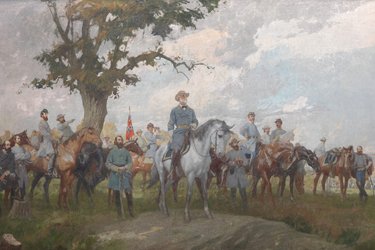
Charles C.J. Hoffbauer, Lee and His Generals, 1920.
This excerpt from Stephen Vincent Benet’s 1928 epic poem John Brown’s Body makes it clear why Americans, North and South, could set aside differences of politics and section, and look back together on Lee and other great Confederates as heroes.
Army of Northern Virginia, army of legend,
Who were your captains that you could trust them so surely?
Who were your battle-flags?
Call the shapes from the mist,
Call the dead men out of the mist and watch them ride.
Tall the first rider, tall with a laughing mouth,
His long black beard is combed like a beauty’s hair,
His slouch hat plumed with a curled black ostrich-feather,
He wears gold spurs and sits his horse with the seat
Of a horseman born.
It is Stuart of Laurel Hill,
“Beauty” Stuart, the genius of cavalry,
Reckless, merry, religious, theatrical,
Lover of gesture, lover of panache,
With all the actor’s grace and the quick, light charm
That makes the women adore him-a wild cavalier
Who worships as sober a God as Stonewall Jackson,
A Rupert who seldom drinks, very often prays,
Loves his children, singing, fighting spurs, and his wife.
Sweeney his banjo-player follows him.
And after them troop the young Virginia counties,
Horses and men, Botetort, Halifax,
Dinwiddie, Prince Edward, Cumberland, Nottoway,
Mecklenburg, Berkeley, Augusta, the Marylanders,
The horsemen never matched till Sheridan came.
Now the phantom guns creak by. They are Pelham’s guns.
That quiet boy with the veteran mouth is Pelham.
He is twenty-two. He is to fight sixty battles
And never lose a gun.
The cannon roll past,
The endless lines of the infantry begin.
A. P. Hill leads the van. He is small and spare,
His short, clipped beard is red as his battleshirt,
Jackson and Lee are to call him in their death-hours.
Dutch Longstreet follows, slow, pugnacious and stubborn,
Hard to beat and just as hard to convince,
Fine corps commander, good bulldog for holding on,
But dangerous when he tries to think for himself,
He thinks for himself too much at Gettysburg,
But before and after he grips with tenacious jaws.
There is D. H. Hill–there is Early and Fitzhugh Lee–
Yellow-haired Hood with his wounds and his empty sleeve,
Leading his Texans, a Viking shape of a man,
With the thrust and lack of craft of a berserk sword,
All lion, none of the fox. Read the rest of this entry »
11 Feb 2022

Pajama’s Media reports on a pretty remarkable Biden appointment.
Sam Brinton (“they/them”), had some “pretty BIG news” for his friends and followers on LinkedIn recently: “I have accepted the offer to serve as the Deputy Assistant Secretary of Spent Fuel and Waste Disposition in the Office of Nuclear Energy for the Department of Energy. In this role I’ll be doing what I always dreamed of doing, leading the effort to solve the nation’s nuclear waste challenges.” Brinton also noted proudly that he would “even be (to my knowledge) the first gender fluid person in federal government leadership.” He is much more than that. He is, to the best of my knowledge, the first drag queen and the first person to discuss his affinity for sex with animals to hold an office of the public trust.
Brinton identifies himself on his LinkedIn page as “Solving the World’s #NuclearWaste Challenges and Protecting LGBTQ Youth from #ConversionTherapy.” He combines these two concerns in his drag queen persona, “Sister Ray Dee O’Active,” in which guise he says: “I am the slutty one. And the nerdy one. #sexynerd.” He has also combined his life’s preoccupations in previous government work, according to the bio he provided to the “LGBTQ Religious Archives Network”: “Sam has worn his stilettos to Congress to advise legislators about nuclear policy and to the White House where he advised President Obama and Michelle Obama on LGBT issues.”
Brinton is also involved in “puppy play,” which apparently involves grown men putting on dog masks and behaving like animals for sexual kicks. In a 2016 article in Metro Weekly, a man named Sam, with no last name given, is interviewed at length; an accompanying photo makes it clear that Sam is Sam Brinton. Brinton is identified in the article as a “handler” of the men pretending to be puppies, and explains: “It’s the concept of the teacher and nurturer…. My job is to make sure that while he’s in headspace, I’m keeping him safe.” He says of one of his companions in this bizarre role-playing: “Pup and I have what I feel is one of the most ideally perfect connections between our personal and kink life. Both of us have other partners, so we come into this space, and then we come out of it, knowing the boundaries of where your kink and non-kink relationships begin and end.” Yeah, good to know.
RTWT
/div>

Feeds
|





