Category Archive 'Uncategorized'
06 Apr 2022

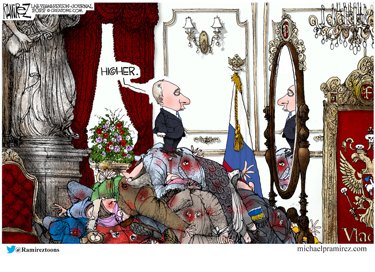
Lawrence Freedman has some thoughts on the war’s next stage.
This new stage of the war, however, promises to be much harder for Ukraine. Before considering Kyiv’s strategy we first need to consider Moscow’s options.
Russia’s forces have been badly depleted and so they must make choices about where to concentrate their efforts. Estimates vary about how many of the Battalion Tactical Groups (BTGs), the main unit with which the Russian army organises its operations, they have left. Of those involved in the first wave of the invasion, often elite units, some half, maybe more, have either been damaged beyond repair or can be repaired but are not usuable in the near future. The casualties – wounded and captured as well as killed – perhaps represents about 20 percent of the original force of 190,000.
We know from assiduous work that Russian equipment losses have been heavy. For example 425 tanks are known to have been destroyed, damaged, abandoned or captured. There are reports that many of the replacement weapons being brought out of storage suffer from the effects of age and corruption, lacking key components and with ordnance that does not work. Aircraft and helicopters have shown themselves to be vulnerable to air defences, and many have been shot down. The inability of Russian airpower to impose itself remains one of the remarkable features of this campaign.
Russian personnel reserves are also not in a good state. Moscow has been casting about for extra bodies – whether Syrian volunteers or the mercenary Wagner group. As already noted the Belarusian army is no longer available, while troops from South Ossetia, the breakaway enclave in Georgia, have decided, when asked to go to Ukraine, to decline the invitation. There is a huge new cohort of conscripts about to join the army. Conscripts have already been used (Putin claimed without his knowledge) but there can only be risks in putting unwilling young men into battle without training.
Of course, even half the original Russian force is still substantial and it now has fewer and more manageable tasks to accomplish. But its position is not straightforward. Having decided to concentrate their effort, the Russian high command still has choices to make about priorities. They do not yet appear to have wholly given up on Kharkiv. Meanwhile they have been shelling Mykolaiv, on the southern coast, on the road to the important city of Odessa. For some time there has been speculation about an encirclement operation that would enable them to trap the considerable, and capable, Ukrainian forces in the Donbas region. But these objectives are easier to accomplish by drawing red arrows on a map than in practice. And they carry risks. Are they prepared to relinquish their gains in Kherson, where Ukrainian troops have bene pushing them back? If Ukrainian forces can take back Melitopol might Russian forces to the south get caught?
Simplifying somewhat the Russians must work out what offensive operations they wish to complete before they feel that they can then move into a largely defensive stance so that they can hold on to what they have. An analysis from the Washington-based Institute for the Study of War suggests that the most immediate Russian objective will be to take the city of Sloviansk, with a population of 110,000. There is some irony in this city taking a pivotal role because exactly eight years ago a small force led by Igor Girkin, the subject of my last post, took this city, marking the start of military actions in the Donbas, until he was forced out by Ukrainian forces.
Evidence of this intention can be found in a rare Russian military success at the start of April when they took Izyum (southeast of Kharkiv), inflicting heavy losses on the Ukrainian defenders, and they have now advanced beyond that. According to the ISW, they
‘have conducted active preparations to resume offensive operations for the past three days—stockpiling supplies, refitting damaged units, repairing the damaged bridge in Izyum, and conducting reconnaissance in force missions toward the southeast. Russian forces will likely begin offensive operations towards Slovyansk, 50km southeast of Izyum, in the coming days.’
Taking Slovyansk would be a first step to a more ambitious objective of cutting off Ukrainian forces in eastern Ukraine, but to encircle the Ukrainian forces they will still need to meet up with Russian forces advancing from the South. Slovyansk is preparing for the battle, and many of its civilians have been evacuated. As the ISW note:
If Russian forces are unable to take Slovyansk at all, Russian frontal assaults in Donbas are unlikely to independently breakthrough Ukrainian defences and Russia’s campaign to capture the entirety of Luhansk and Donetsk oblasts will likely fail.
If this analysis is correct this new stage of the war could be critical. Another Ukrainian victory will not see the Russians pushed out of Ukraine but will make their position more difficult for the stage after that. Ukrainian losses have also been significant, both in personnel and equipment, although with the country now mobilised for war they are not short of committed and reasonably well trained soldiers. Their problem is with equipment. Their successes up to this point have largely been with judicious use of portable, light equipment, including drones, anti-tank weapons, and air defence systems. They have a shopping list that has been discussed with Western donors to fill some of their gaps. This means keeping up supplies of the equipment they already use, but also providing the extra armour, aircraft, and artillery to raise their game for the coming operations. Here there has to be balance between taking in aged kit from the former Soviet Union, which could be put to use quickly, or getting more modern kit, which may require more training.
Yet even if Russia does acquire the territory it seeks in the Donbas and prepares for a climactic defensive battle, there still remains the perplexing question about the nature of Putin’s end game. From the start the most baffling aspect of this war has been the incoherence of Russian strategy. The gap between stated aims and available capabilities was wide enough when it started but it has now widened even further, especially after being defeated in the war’s first round.
RTWT
05 Apr 2022

Strategy Page:
Ukrainian forces have captured a lot of modern Russian weapons and military equipment and made these discoveries available to Western countries that are supplying Ukraine with modern weapons and economic and diplomatic pressure on Russia.
This loot includes largely intact components of the Iskander short range ballistic missiles, new EW (Electronic Warfare) equipment that had proven effective in Syria and Ukraine, and new Azart combat radios and associated equipment. At least one defective Islander missile was recovered largely intact, which allowed close inspection of the missile design and the countermeasures Russia often spoke of but never provided details of. The countermeasures were, as expected, small decoys deployed as the Iskander came within range of the targets, as well as Western ABM (anti-ballistic missile) systems like Patriot, Thaad or the naval Standard missile defense system. Now that there were undamaged examples of these decoys available, Western ABM systems can be modified to defeat them.
RTWT
03 Apr 2022

John Hinderaker at Power-Line:
[L]ast month, a group of fascist Yale Law students successfully shouted down a Federalist Society program that featured a dialogue between a leftist and a representative of the Alliance Defending Freedom. The protest was rowdy enough that police were summoned to maintain order.
Now, more than 400 Yale Law students, representing over 60 percent of the student body, have signed a pathetically weak letter to the law school’s administration protesting the fact that law enforcement was called to keep the peace. The letter would be dumb if it came from a group of 7th graders. The fact that it comes from law students reflects the catastrophic decline of education in America.
RTWT
01 Apr 2022

Superman’s motto, since his first appearance in 1942, has been: “Truth, Justice, and the American Way.”
Well, the Gramscian Marchers through DC Comics have essentially retired the Superman we all knew and loved, sending him off to fight the good fight on a distant planet and replacing him as Superman here on Earth with the “Son of Kal-El,” Jon Kent, the offspring of Superman and Lois Lane. Supermillennial, we learn, has adopted a different, much more Progressive, motto: “Truth, Justice, and a Better World.”
Even worse, in Issue No. 5, Super Soy Boy is revealed to play for the other team, kissing one Jay Nakamura, a pink-haired news broadcaster.
Tree of Woe identifies exactly what’s going on here.
The official update to Superman’s slogan was exuberantly reported by virtually every media outlet in existence, as if it were a radical departure for hidebound pop culture, a bold step in bringing progressive values into reactionary Hollywood.
Such nonsense!
The update to Superman’s motto is simply another act of spoliation by the winners of the culture war.
Spoliation means “incorporating art into a setting culturally or chronologically different from that of its creation.”1 The term derives from Classical Latin word spolium, a singular noun which literally means “the skin or hide stripped from an animal.” The plural, spolia, came into figurative use by Latin writers such as Cicero to refer to plunder, from which we derive the English phrase “the spoils of war.”2 Whenever the Romans conquered a nation, they brought back war trophies as proof of their victory; and so spolia came to designate “building materials and artworks brought from conquered provinces and exhibited in official triumphs.”3 Over time, these materials were reused by conquerors for their own purposes, and so the word spolia came to mean any reused artwork designed to evidence the conquest, triumph, and dominion by the spoliators over those whose art they appropriated.4
In contemporary usage, spoliation is “a practice consisting of a transference of power from the past through a taking over of its cultural expressions and incorporating them into one’s own. The purpose of appropriation [is] to convert the object of appropriation to one’s own purposes; it [is] preceded by finding the most valuable expressions from the past.”5 It is part of an “appropriative loop in which the qualities of the appropriated object are transferred to the appropriator.”6
Spoliation, then, works like this:
A conqueror defeats a rival.
The conqueror identifies the defeated rival’s most valuable cultural expressions (artwork, artifacts, buildings, monuments, stories, etc.).
The conqueror appropriates those expressions and reuses them in its own cultural expressions, thereby transferring power to itself.
Does that process seem familiar? It should.
Your are browsing
the Archives of Never Yet Melted in the 'Uncategorized' Category.
/div>

Feeds
|