When Progressive Matt Taibbi at Rolling Stone says the Mainstream Media screwed up royally and Trump was in the right, that is really something remarkable!
You know what was fake news? Most of the Russiagate story. There was no Trump-Russia conspiracy, that thing we just spent three years chasing. The Mueller Report is crystal clear on this.
He didn’t just “fail to establish†evidence of crime. His report is full of incredibly damning passages, like one about Russian officialdom’s efforts to reach the Trump campaign after the election: “They appeared not to have preexisting contacts and struggled to connect with senior officials around the President-Elect.â€
Not only was there no “collusion,†the two camps didn’t even have each others’ phone numbers!
In March of 2017, in one of the first of what would become a mountain of mafia-hierarchy-style “Trump-Russia contacts†graphics in major newspapers, the Washington Post described an email Trump lawyer Michael Cohen sent to Kremlin press secretary Dmitry Peskov. They called it “the most direct interaction yet of a top Trump aide and a senior member of Putin’s government.â€
The report shows the whole episode was a joke. In order to further the Trump Tower project-that-never-was, Cohen literally cold-emailed the Kremlin. More than that, he entered the email incorrectly, so the letter initially didn’t even arrive. When he finally fixed the mistake, Peskov didn’t answer back.
That was “the most direct interaction yet of a top Trump aide and a senior member of Putin’s governmentâ€!
As outlined in his initial mandate, Mueller explored “any links†between the Russian government and the campaign of Donald Trump. His conclusion spoke directly to the question of whether there was any kind of quid pro quo between the two sides:
“The investigation examined whether these contacts involved or resulted in coordination or a conspiracy with the Trump Campaign and Russia, including with respect to Russia providing assistance to the Campaign in exchange for any sort of favorable treatment in the future.â€
In other words, all those fancy org charts were meaningless. Because there was no conspiracy, all those “walls are closing in†reports — and there were a ton of them — were wrong. We were told we’d hit “turning point†after “turning point†leading to the “the beginning of the end,†with Trump certain, soon, to either resign in shame, Nixon-style, or be impeached.
The “RNC platform†change story was a canard, according to Mueller. The exchanges Trump figures had with ambassador Sergei Kislyak were “brief, public, and non-substantive.†The conversations Jeff Sessions had with Kislyak at the convention didn’t “include any more than a passing mention of the presidential campaign.†Mueller added “investigators did not establish that [Carter] Page conspired with the Russian government.â€
There was no blackmail, no secret bribe from Rosneft, no five-year cultivation plan, no evidence of any kind of any relationship that ever existed between the Trump campaign and Russian officials. Michael Cohen “never traveled to Prague.â€
The whole Steele dossier appears to have been bunk, with even Bob Woodward now saying the “highly questionable†document “needs to be investigated.†The Times similarly is reporting, two-plus years late, that “people familiar†with Steele’s work began to have “misgivings about [the report’s] reliability arose not long after the document became public.â€
Reporters are going to insist all they did was accurately report the developments of a real investigation. They didn’t imply vast criminality that wasn’t there, or hoodwink audiences into thinking a Watergate-style ending was just around the corner, or routinely blow meaningless episodes like the Sessions-Kislyak meeting out of proportion, or regularly smear people who not only weren’t part of a conspiracy but had no connection to anything (see here for an example).
They’ll also claim they didn’t spend years openly rooting for indictment and impeachment via wish-casted predictions disguised as reporting and commentary, or denouncing people who doubted the conspiracy as spies and Putin apologists, or clearing their broadcast panels and op-ed pages of skeptics while giving big stages to craven conspiracy-spinners like Malcolm Nance and Luke Harding.
That’s fine. In the short term, a significant portion of the country will probably agree coverage was appropriate, probably the same sizable plurality of poll respondents who say they disagree on some level with Mueller’s findings. A lot of people out there despise Trump, and at least right now will be inclined to sympathy for broadcasters and editorialists who gave full quarter to the most damning theories of conspiracy and criminality in the Russia case.
… [N]ews audiences over time lose trust in news organizations that tell them what they want to hear politically, but get the substance of things wrong.
The Mueller report makes clear reporters were sold wolf whistles over and over, led by reams of unnamed official sources who urged them to see meaning in meaningless things and assume connections that weren’t there.
Reporters should be furious about being fed these red herrings. They should be outraged at all those people who urged them to publish the Steele report, which might have led to career-imperiling mistakes in print. They should be mad as hell at CIA chief Gina Haspel and the other unnamed officials who told them disclosing the name of already long-ago exposed government informant Stefan Halper would “risk lives.â€
More than anything, reporters should be furious at the many sources close to the various investigations who (it now seems clear) must have known pretty early there were serious holes in many areas of this story, and that a lot of these “dots†were dead ends, but didn’t warn their press counterparts. For instance, the papers should be mad those who supposedly had misgivings about the Steele report didn’t warn them earlier.
But they’re not mad, which makes it look like a case of intentional blindness, in which eyes and ears were shut among other things because the Trump-Russia conspiracy tale made a ton of money. Media companies earned boffo ratings while the Mueller probe still carried the drama of a potential spectacular ending, with blue-state audiences eating up all those “walls are closing in†hot takes.
This fiasco will surely end up being a net plus for Trump. The obstruction parts of the report make him look like a brainless goon and thug, but the absence of what Mueller repeatedly calls “underlying crime†make his ravings about an elitist mob out to get him look justified. This is not an easy thing to achieve, but we’re there, and the press is a big part of that picture.
I cannot help comparing the way this one came out with the Anti-Bush Intelligence Operations, the PlameGame (in which the Bush Administration was blamed for supposedly leaking the identity of CIA employee Valerie Plame, and Scooter Libby convicted of lying to prosecutors, when Prosecutor Patrick Fitzgerald knew all along that it was the disloyal-to-Bush Deputy Secretary of State Richard Armitage who revealed Plame’s identity to Robert Novak), and the “Bush-Lied-People-Died” Missing Iraqi WMDs view of the war, which successfully discredited both the Iraq War and the Bush Administration with the presently concluding “Stolen Election/Russian Collusion” attempted coup against Trump.
The difference is that Trump fought back, while George W. Bush stood there like a punching bag, taking every hit, and treating the hostile media and his Deep State opponents as if they were the legitimate authorities.
Trump may not be the ideal President in every respect, but at least he is a fighter.
Deana Chadwell points out that liberals are spoiled children living in their own self-indulgent fantasy land.
Leftlandians actually believe that the world’s climate is something they can control, that man is so much greater than the God Who created the world that humans can use so much toilet paper, or so much gasoline that they can undo creation. They also believe that using fossil fuels to generate electricity with which to run our cars is somehow more environmentally sensible than just using the fossil fuels directly. When someone points out the damage –- both human and environmental –- done by building all those lithium batteries, the Leftlandians just cover their eyes and holler La-La-La-La.
In their unicorn-inhabited world they can pass laws forbidding plastic straws and shampoo bottles and assume that this terrible sacrifice will clean the oceans of the trash dumped into it by billions of people in the third world.
They actually believe they can impose tax hikes on the wealthy and on corporations and said entities will just sit and take it. It doesn’t occur to the left that anyone smart enough to get rich in the first place will be smart enough to hide their money offshore, or move their business to a less onerous tax environment. Remember the little girl in your neighborhood who always wanted to boss everyone around and how mad she’d get when no one would obey her? That’s the left. “I’m the boss!â€
They continue to pretend that Marxism is a useful worldview. Evidence, preserved in gruesome history (and the current starvation of the Venezuelan and North Korean people) notwithstanding, they insist on the efficacy of the destruction of capitalism. And they do this while eating food produced by businessmen-farmers, driving cars manufactured by corporations, and wearing clothes created by designer-entrepreneurs. They fail to see the contradiction. Bernie Sanders, the consummate socialist, just declared that, “If you write a bestselling book, you can be a millionaire, too,†evidently unaware of the about-face he had just committed.
They believe they can tell doctors that they now work for the state and can only earn a state-approved salary. It never occurs to them that many of our doctors will just quit being doctors. Free healthcare is a delicious fable, but not if there is no healthcare to be found at any price. It’s not a magic bean.
They believe they can pretend to be a gender other than what they were born with and that if they can browbeat the rest of us into playing their game, that it will be true. They even believe they can make up new genders no one’s ever heard of before. They might as well imagine themselves to be unicorns as far as reality is concerned, but they’re not concerned with reality. It’s all play-acting.
They believe that they can fake their way into college, go there and spend four years sitting in classes like “Vegan Studies,†smoking dope and drinking beer at frat parties, then walk into the real world and get rich. They think they can do this with college loan debt in six figures and no practical skills. And they think that their plan to soak the rich won’t apply to them.
In Leftlandia, folks are comfortable with declaring women’s rights with half their words and supporting Islam, with its wife-beating, woman-hating, girl-mutilating way of life, with the other. They don’t find it weird that Linda Sarsour, outspoken proponent of Sharia law, should be leading a women’s rally.
They do have trolls and goblins in their world, but they aren’t real. Leftists are afraid of Christians, but not of Muslims — who clearly state they want to kill us all. They are scared of Jews, and white people and men. They evidently see infants as dangerous as well since they seem so comfortable about killing them.
They believe, all evidence to the contrary, that humans are all basically good — not including Christians, Jews, white people, and men. Therefore any failings they’re faced with are the fault of “society†or, in other words, the aforementioned groups –- and the NRA. Can’t forget that. As a corollary, they believe that war and crime can be erased by everyone “just getting along, “ which somehow doesn’t mean that they have to be kind to Christians, Jews, white people or men – especially men who belong to the NRA.
They are staunch defenders of license (not liberty), but even more staunch believers in equality, for which they are willing to ditch freedom –- especially freedom of speech. Speech is dangerous and can pop their balloons, so that’s got to go.
Speaking of language, in their postmodern, deconstructionist, intersectional world, words aren’t important. They can mean whatever a leftist wants them to mean. A white nationalist used to be a neo-Nazi skinhead, but now it refers to conservatives in general. A racist used to a person who based his opinion of people on the color of their skin. Now it means anyone who would write an essay like this. Words are bludgeons and no good leftist has any reverence for the sacred contract of language. In their fairytale world no actual truth exists and no moral code either, so there is no needs for honesty.
They believe that the color of their skin matters. They believe their country of origin is important and should be worn like a battle scar.
Which brings up another whole facet of their narrative –- they pretend that they aren’t really individuals, that they are nothing more than cogs in whatever gear they think they’ve been “oppressed†into. I suppose this saves the trouble of actually having to take responsibility for their own lives, but it also makes them slaves and they don’t seem to notice. They also think they can right the wrongs done to one group of long-dead people by taking from modern-day people who had nothing to do with the original transgression.
And they believe they can’t lose. The Trump win in 2016 cracked the magical snow-globe they live in and now the emptiness of the Mueller report has dealt it another terrible blow. Not to worry, though. The fantasy must go on. They are sure that if they yell, “Collusion!†loud enough, Trump will dissolve into a flurry of fairy dust and be gone.
Yesterday was the 500th Anniversary of the arrival of the Spanish conqueror of Mexico, the man who overthrew the Aztec Empire, bringing Christianity and European civilization to Mexico and putting an end to cannibalism and large scale human sacrifice.
It is typical of our insane and twisted times that no celebration of this hugely important anniversary has been scheduled, and that, last month, the president of Mexico sent letters to the Vatican and the King of Spain demanding apologies for Cortes’ Conquest of the Aztecs and the Conversion of Mexico to Christianity. (BBC — March 26)
The current Marxist lie is that the harmless and peaceful Aztecs were brutally conquered by avaricious and rapacious Europeans, out only for power and gold. The truth of the matter is that the Aztecs themselves were the brutal and tyrannical conquerors. They built an empire covering roughly a quarter of modern Spain, fueled by a faith in their own superiority based on a special relationship with Huitzilopochtli, the hummingbird god of war, who required frequent, and abundant human sacrifices.
The conquered and subjugated tribes living under Aztec rule provided the sacrificial victims as well as slaves. The conquistador Bernal Diaz relates what the chief of the Totonacs told the Spaniards about Aztec rule.
He related so much of the cruelties and oppression they had to suffer, and thereby sobbed and sighed so bitterly that we could not help being affected. At the time when they were subdued, they had already been greatly ill-used; Montezuma then demanded annually a great number of their sons and daughters, a portion of whom were sacrificed to the idols, and the rest were employed in his household and for tilling his grounds. His tax-gatherers took their wives and daughters without any ceremony if they were handsome, merely to satisfy their lusts. The Totonaques, whose territory consisted of upwards of thirty townships, suffered like violence.
Hernan Cortez with only 600 soldiers, 15 horsemen, and 15 cannons was able to overthrow an empire with an estimated population of 5 million precisely because large numbers of warriors from the oppressed subject tribes eagerly joined him in the fight against their Aztec rulers.
a government, which does not rest on the sympathies of its subjects, cannot long abide; that human institutions, when not connected with human prosperity and progress, must fall, if not before the increasing light of civilisation, by the hand of violence; by violence from within, if not from without. And who shall lament their fall?â€
Obviously, today’s Woke Marxist Social Justice Warriors will lament their fall, cover up their crimes, and vilify the liberators.
Hans von Aachen, St. George Slaying the Dragon, c. 1600, Private Collection, London
From Robert Chambers, The Book of Days, 1869:
Butler, the historian of the Romish calendar, repudiates George of Cappadocia, and will have it that the famous saint was born of noble Christian parents, that he entered the army, and rose to a high grade in its ranks, until the persecution of his co-religionists by Diocletian compelled him to throw up his commission, and upbraid the emperor for his cruelty, by which bold conduct he lost his head and won his saintship. Whatever the real character of St. George might have been, he was held in great honour in England from a very early period. While in the calendars of the Greek and Latin churches he shared the twenty-third of April with other saints, a Saxon Martyrology declares the day dedicated to him alone; and after the Conquest his festival was celebrated after the approved fashion of Englishmen.
In 1344, this feast was made memorable by the creation of the noble Order of St. George, or the Blue Garter, the institution being inaugurated by a grand joust, in which forty of England’s best and bravest knights held the lists against the foreign chivalry attracted by the proclamation of the challenge through France, Burgundy, Hainault, Brabant, Flanders, and Germany. In the first year of the reign of Henry V, a council held at London decreed, at the instance of the king himself, that henceforth the feast of St. George should be observed by a double service; and for many years the festival was kept with great splendour at Windsor and other towns. Shakspeare, in Henry VI, makes the Regent Bedford say, on receiving the news of disasters in France:
Bonfires in France I am forthwith to make
To keep our great St. George’s feast withal!’
Edward VI promulgated certain statutes severing the connection between the ‘noble order’ and the saint; but on his death, Mary at once abrogated them as ‘impertinent, and tending to novelty.’ The festival continued to be observed until 1567, when, the ceremonies being thought incompatible with the reformed religion, Elizabeth ordered its discontinuance. James I, however, kept the 23rd of April to some extent, and the revival of the feast in all its glories was only prevented by the Civil War. So late as 1614, it was the custom for fashionable gentlemen to wear blue coats on St. George’s day, probably in imitation of the blue mantle worn by the Knights of the Garter.
In olden times, the standard of St. George was borne before our English kings in battle, and his name was the rallying cry of English warriors. According to Shakspeare, Henry V led the attack on Harfleur to the battle-cry of ‘God for Harry! England! and St. George!’ and ‘God and St. George’ was Talbot’s slogan on the fatal field of Patay. Edward of Wales exhorts his peace-loving parents to
‘Cheer these noble lords,
And hearten those that fight in your defence;
Unsheath your sword, good father, cry St. George!’
The fiery Richard invokes the same saint, and his rival can think of no better name to excite the ardour of his adherents:
‘Advance our standards, set upon our foes,
Our ancient word of courage, fair St. George,
Inspire us with the spleen of fiery dragons.’
England was not the only nation that fought under the banner of St. George, nor was the Order of the Garter the only chivalric institution in his honour. Sicily, Arragon, Valencia, Genoa, Malta, Barcelona, looked up to him as their guardian saint; and as to knightly orders bearing his name, a Venetian Order of St. George was created in 1200, a Spanish in 1317, an Austrian in 1470, a Genoese in 1472, and a Roman in 1492, to say nothing of the more modern ones of Bavaria (1729), Russia (1767), and Hanover (1839).
Legendarily the Sacred Military Constantinian Order of Saint George was founded by the Emperor Constantine (312-337 A.D.). On the factual level, the Constantinian Order is known to have functioned militarily in the Balkans in the 15th century against the Turk under the authority of descendants of the twelfth-century Byzantine Emperor Isaac II Angelus Comnenus.
We Lithuanians liked St. George as well. When I was a boy I attended St. George Lithuanian Parish Elementary School, and served mass at St. George Lithuanian Roman Catholic Church in Shenandoah, Pennsylvania.
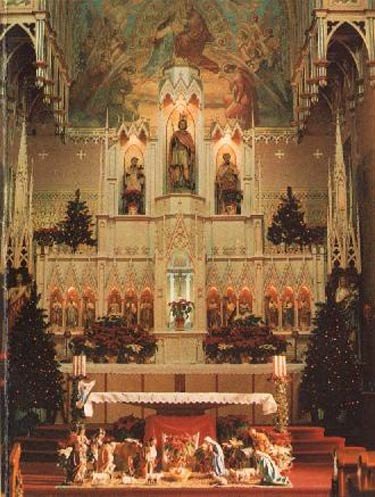
St. George Church, Shenandoah, Pennsylvania, Christmas, 1979. This church, built by immigrant coal miners in 1891, was torn down by the Diocese of Allentown in 2010.
“The movement towards androgyny occurs in late phases of culture, as a civilization is starting to unravel. You can find it again and again and again through history. In the Greek art you could see it happening. All of a sudden the sculptures of handsome nude young men, athletes, that used to be very robust in the archaic period, suddenly begin to seem like wet noodles toward the end. And the people who live in such periods (late phases of culture) — whether it’s the Hellenistic era, whether it’s the Roman Empire, whether it’s the Mauve decade of Oscar Wilde in the 1890s, whether it’s Weimar Germany — people who live in such times feel that they are very sophisticated, they’re very cosmopolitan: “homosexuality, heterosexuality, so what, anything goes, and so on…†But from the perspective of historical distance, you can see that it’s a culture that no longer believes in itself. And then what you invariably get are people who are convinced of the power of heroic masculinity on the edges. Whether they be the Vandals and the Huns, or whether they’re the barbarians of ISIS, you see them starting to mass on the outsides of the culture. And that’s what we have right now. There’s a tremendous disconnect between the infatuation with the transgender movement in our own culture and what’s going on out there.”
Crumpled near a rocky alcove (Green Boots’s Cave), jacket pulled up over his face as if still shielding from the wind, Green Boots serves as a popular marker for climbers ascending into the “Death Zone,†on their way to the summit. There are around 200 such body “guideposts†on Everest, becoming indicators of altitude more than anything else. As time passes, they literally freeze to the mountain and become hard to remove.
At heights where even taking a few steps takes great strength, using a pickaxe to free a body seems crazy, let alone hauling one back down.
It is believed that his real name is Tsewang Paljor. At one time, Paljor was an Indo-Tibetan border policeman from a small village called Sakti. He had summitted several other mountains in his career. He hoped to bring benefits to his family by summitting Everest as well, his mother told BBC after his death.
Accounts tell of how Paljor and two of his comrades, Tsewang Smanla and Dorje Morup, had either ignored or failed to see the signal from deputy team leader Harbhajan Singh to turn back when they were nearing the summit. Singh had sensed impending danger. Yet his colleagues pressed on.
One of the fatal mistakes that sometimes occurs in the Death Zone (near the summit, above 8,000 meters) is a euphoric “summit fever†that possesses some climbers. They are overcome by a desire to reach the top and disregard vital concerns for safety. This, according to Singh, seems to be what happened to his fellow climbers on that fateful day. Singh had turned back to camp, while they had plowed on. He received a radio call from them announcing that they had reached the summit, and there was momentary celebration. But the victory was short-lived. A blizzard hit during their descent, and they never returned.
For some 20 years, Green Boots remained where he had fallen. Ambitious climbers came to recognize his frozen form, his boots in particular, as a landmark, having to literally step over his legs along their push to the summit.
In 2014, Green Boots’s body was respectfully shoveled up and deposited on the lee-side of the mountain, perhaps out of respect. While retrieving a body is possible for the mountain Sherpas, it is both costly and dangerous. Over the years, the problem of visitors to Everest morbidly encountering bodies has led to some efforts to deal with the issue. Fallen mountaineers have traditionally been “committed†to the mountain, meaning their bodies were ceremoniously dropped into crevasses, pushed down steep slopes, or perhaps placed under a rock.
In the Rzhevsky district of the Tver region, near the village of Khoroshevo, a memorial to the Soviet Soldier will be installed, which will be visible from the federal highway M-9. The monument commemorates the heroism and courage of the Red Army soldiers who fought in the bloody battles for Rzhev and on the perimeter of the Rzhev-Vyazma ridge. The project of the memorial was designed by the sculptor Andrei Korobtsov from Belgorod. His work “I was killed near Rzhev†became the best among 19 projects. Construction will begin this year and will be completed by the 75th anniversary of the Great Victory in 2020.
The neighborhood around Howard University in D.C. has been improving, i.e. more whites are moving in, and white residents have taken to walking their dogs on the University’s grassy campus.
Howard students have freaked out over this horrible invasion of Black space, and complaints about “gentrification,” “colonization,” and memories of bloodhounds pursuing Little Eva and police dogs barking at demonstrators in Birmingham are flying.
Last Friday, the President of Howard issued a statement discouraging bringing dogs, other than service animals, onto the private university’s “beautiful,sacred space that provides comfort and, in many ways, sanctuary.” Meaning sanctuary from people with insufficient melanin.
Black news and cultural sites today are filled with expressions of the most extreme sorts of group chauvinism and racial animosity related to this story. One example
Piero della Francesca, Resurrection, circa 1463, Museo Civico, Sansepolcro
From Robert Chambers, The Book of Days, 1869:
Easter
Easter, the anniversary of our Lord’s resurrection from the dead, is one of the three great festivals of the Christian year,—the other two being Christmas and Whitsuntide. From the earliest period of Christianity down to the present day, it has always been celebrated by believers with the greatest joy, and accounted the Queen of Festivals. In primitive times it was usual for Christians to salute each other on the morning of this day by exclaiming, ‘Christ is risen;’ to which the person saluted replied, ‘Christ is risen indeed,’ or else, ‘And hath appeared unto Simon;’—a custom still retained in the Greek Church.
The common name of this festival in the East was the Paschal Feast, because kept at the same time as the Pascha, or Jewish passover, and in some measure succeeding to it. In the sixth of the Ancyran Canons it is called the Great Day. Our own name Easter is derived, as some suppose, from Eostre, the name of a Saxon deity, whose feast was celebrated every year in the spring, about the same time as the Christian festival—the name being retained when the character of the feast was changed; or, as others suppose, from Oster, which signifies rising. If the latter supposition be correct, Easter is in name, as well as reality, the feast of the resurrection.
Though there has never been any difference of opinion in the Christian church as to why Easter is kept, there has been a good deal as to when it ought to be kept. It is one of the moveable feasts; that is, it is not fixed to one particular day—like Christmas Day, e. g., which is always kept on the 25th of December—but moves backwards or forwards according as the full moon next after the vernal equinox falls nearer or further from the equinox. The rule given at the beginning of the Prayer-book to find Easter is this: ‘Easter-day is always the first Sunday after the full moon which happens upon or next after the twenty-first day of March; and if the full moon happens upon a Sunday, Easter-day is the Sunday after.’
The paschal controversy, which for a time divided Christendom, grew out of a diversity of custom. The churches of Asia Minor, among whom were many Judaizing Christians, kept their paschal feast on the same day as the Jews kept their passover; i. e., on the 14th of Nisan, the Jewish month corresponding to our March or April. But the churches of the West, remembering that our Lord’s resurrection took place on the Sunday, kept their festival on the Sunday following the 14th of Nisan. By this means they hoped not only to commemorate the resurrection on the day on which it actually occurred, but also to distinguish themselves more effectually from the Jews. For a time this difference was borne with mutual forbearance and charity. And when disputes began to arise, we find that Polycarp, the venerable bishop of Smyrna, when on a visit to Rome, took the opportunity of conferring with Anicetas, bishop of that city, upon the question. Polycarp pleaded the practice of St. Philip and St. John, with the latter of whom he had lived, conversed, and joined in its celebration; while Anicetas adduced the practice of St. Peter and St. Paul. Concession came from neither side, and so the matter dropped; but the two bishops continued in Christian friendship and concord. This was about A.D. 158.
Towards the end of the century, however, Victor, bishop of Rome, resolved on compelling the Eastern churches to conform to the Western practice, and wrote an imperious letter to the prelates of Asia, commanding them to keep the festival of Easter at the time observed by the Western churches. They very naturally resented such an interference, and declared their resolution to keep Easter at the time they had been accustomed to do. The dispute hence-forward gathered strength, and was the source of much bitterness during the next century. The East was divided from the West, and all who, after the example of the Asiatics, kept Easter-day on the 14th, whether that day were Sunday or not, were styled Qiccertodecimans by those who adopted the Roman custom.
One cause of this strife was the imperfection of the Jewish calendar. The ordinary year of the Jews consisted of 12 lunar months of 292 days each, or of 29 and 30 days alternately; that is, of 354 days. To make up the 11 days’ deficiency, they intercalated a thirteenth month of 30 days every third year. But even then they would be in advance of the true time without other intercalations; so that they often kept their passover before the vernal equinox. But the Western Christians considered the vernal equinox the commencement of the natural year, and objected to a mode of reckoning which might sometimes cause them to hold their paschal feast twice in one year and omit it altogether the next. To obviate this, the fifth of the apostolic canons decreed that, ’ If any bishop, priest, or deacon, celebrated the Holy Feast of Easter before the vernal equinox, as the Jews do, let him be deposed.’
At the beginning of the fourth century, matters had gone to such a length, that the Emperor Constantine thought it his duty to take steps to allay the controversy, and to insure uniformity of practice for the future. For this purpose, he got a canon passed in the great Ecumenical Council of Nice (A.D. 325), that everywhere the great feast of Easter should be observed upon one and the same day; and that not the day of the Jewish passover, but, as had been generally observed, upon the Sunday afterwards. And to prevent all future disputes as to the time, the following rules were also laid down:
‘That the twenty-first day of March shall be accounted the vernal equinox.’
‘That the full moon happening upon or next after the twenty-first of March, shall be taken for the full moon of Nisan.’
‘That the Lord’s-day next following that full moon be Easter-day.’
‘But if the full moon happen upon a Sunday, Easter-day shall be the Sunday after.’
As the Egyptians at that time excelled in astronomy, the Bishop of Alexandria was appointed to give notice of Easter-day to the Pope and other patriarchs. But it was evident that this arrangement could not last long; it was too inconvenient and liable to interruptions. The fathers of the next age began, therefore, to adopt the golden numbers of the Metonic cycle, and to place them in the calendar against those days in each month on which the new moons should fall during that year of the cycle. The Metonie cycle was a period of nineteen years. It had been observed by Meton, an Athenian philosopher, that the moon returns to have her changes on the same month and day of the month in the solar year after a lapse of nineteen years, and so, as it were, to run in a circle. He published his discovery at the Olympic Games, B.C. 433, and the cycle has ever since borne his name. The fathers hoped by this cycle to be able always to know the moon’s age; and as the vernal equinox was now fixed to the 21st of March, to find Easter for ever. But though the new moon really happened on the same day of the year after a space of nineteen years as it did before, it fell an hour earlier on that day, which, in the course of time, created a serious error in their calculations.
A cycle was then framed at Rome for 84 years, and generally received by the Western church, for it was then thought that in this space of time the moon’s changes would return not only to the same day of the month, but of the week also. Wheatley tells us that, ‘During the time that Easter was kept according to this cycle, Britain was separated from the Roman empire, and the British churches for some time after that separation continued to keep Easter according to this table of 84 years. But soon after that separation, the Church of Rome and several others discovered great deficiencies in this account, and therefore left it for another which was more perfect.’—Book on the Common Prayer, p. 40. This was the Victorian period of 532 years. But he is clearly in error here. The Victorian period was only drawn up about the year 457, and was not adopted by the Church till the Fourth Council of Orleans, A.D. 541.
Now from the time the Romans finally left Britain (A.D. 426), when he supposes both churches to be using the cycle of 84 years, till the arrival of St. Augustine (A.D. 596), the error can hardly have amounted to a difference worth disputing about. And yet the time the Britons kept Easter must have varied considerably from that of the Roman missionaries to have given rise to the statement that they were Quartodecimans, which they certainly were not; for it is a well-known fact that British bishops were at the Council of Nice, and doubtless adopted and brought home with them the rule laid down by that assembly. Dr. Hooke’s account is far more probable, that the British and Irish churches adhered to the Alexandrian rule, according to which the Easter festival could not begin before the 8th of March; while according to the rule adopted at Rome and generally in the West, it began as early as the fifth. ‘They (the Celts) were manifestly in error,’ he says; ‘but owing to the haughtiness with which the Italians had demanded an alteration in their calendar, they doggedly determined not to change.’—Lives of the Archbishops of Canterbury, vol. i. p. 14.
After a good deal of disputation had taken place, with more in prospect, Oswy, King of Northumbria, determined to take the matter in hand. He summoned the leaders of the contending parties to a conference at Whitby, A.D. 664, at which he himself presided. Colman, bishop of Lindisfarne, represented the British church. The Romish party were headed by Agilbert, bishop of Dorchester, and Wilfrid, a young Saxon. Wilfrid was spokesman. The arguments were characteristic of the age; but the manner in which the king decided irresistibly provokes a smile, and makes one doubt whether he were in jest or earnest. Colman spoke first, and urged that the custom of the Celtic church ought not to be changed, because it had been inherited from their forefathers, men beloved of God, &c. Wilfrid followed:
‘The Easter which we observe I saw celebrated by all at Rome: there, where the blessed apostles, Peter and Paul, lived, taught, suffered, and were buried.’ And concluded a really powerful speech with these words: ‘And if, after all, that Columba of yours were, which I will not deny, a holy man, gifted with the power of working miracles, is he, I ask, to be preferred before the most blessed Prince of the Apostles, to whom our Lord said, “Thou art Peter, and upon this rock will I build my church, and the gates of hell shall not prevail against it; and to thee will I give the keys of the kingdom of heaven†?’
The King, turning to Colman, asked him, ‘Is it true or not, Colman, that these words were spoken to Peter by our Lord?’ Colman, who seems to have been completely cowed, could not deny it. ‘It is true, 0 King.’ ‘Then,’ said the King, ‘can you shew me any such power given to your Columba? ’ Colman answered, ’ No.’ ‘You are both, then, agreed,’ continued the King, are you not, that these words were addressed principally to Peter, and that to him were given the keys of heaven by our Lord?’ Both assented. ‘Then,’ said the King, ‘I tell you plainly, I shall not stand opposed to the door-keeper of the kingdom of heaven; I desire, as far as in me lies, to adhere to his precepts and obey his commands, lest by offending him who keepeth the keys, I should, when I present myself at the gate, find no one to open to me.’
This settled the controversy, though poor honest Colman resigned his see rather than submit to such a decision.
On Easter-day depend all the moveable feasts and fasts throughout the year. The nine Sundays before, and the eight following after, are all dependent upon it, and form, as it were, a body-guard to this Queen of Festivals. The nine preceding are the six Sundays in Lent, Quinquagesima, Sexagesima, and Septuagesima; the eight following are the five Sundays after Easter, the Sunday after Ascension Day, Whit Sunday, and Trinity Sunday.
EASTER CUSTOMS
The old Easter customs which still linger among us vary considerably in form in different parts of the kingdom. The custom of distributing the ‘pace’ or ‘pasche ege,’ which was once almost universal among Christians, is still observed by children, and by the peasantry in Lancashire. Even in Scotland, where the great festivals have for centuries been suppressed, the young people still get their hard-boiled dyed eggs, which they roll about, or throw, and finally eat. In Lancashire, and in Cheshire, Staffordshire, and Warwickshire, and perhaps in other counties, the ridiculous custom of ‘lifting’ or ‘heaving’ is practised.
On Easter Monday the men lift the women, and on Easter Tuesday the women lift or heave the men. The process is performed by two lusty men or women joining their hands across each other’s wrists; then, making the person to be heaved sit down on their arms, they lift him up aloft two or three times, and often carry him several yards along a street. A grave clergyman who happened to be passing through a town in Lancashire on an Easter Tuesday, and having to stay an hour or two at an inn, was astonished by three or four lusty women rushing into his room, exclaiming they had come ‘to lift him.’ ‘To lift me!’ repeated the amazed divine; ‘what can you mean?’ ‘Why, your reverence, we’re come to lift you, ‘cause it’s Easter Tuesday.’ ‘Lift me because it’s Easter Tuesday? I don’t understand. Is there any such custom here?’ ‘Yes, to be sure; why, don’t you know? all us women was lifted yesterday; and us lifts the men today in turn. And in course it’s our rights and duties to lift ‘em.’
After a little further parley, the reverend traveller compromised with his fair visitors for half-a-crown, and thus escaped the dreaded compliment. In Durham, on Easter Monday, the men claim the privilege to take off the women’s shoes, and the next day the women retaliate. Anciently, both ecclesiastics and laics used to play at ball in the churches for tansy-cakes on Eastertide; and, though the profane part of this custom is happily everywhere discontinued, tansy-cakes and tansy-puddings are still favourite dishes at Easter in many parts. In some parishes in the counties of Dorset and Devon, the clerk carries round to every house a few white cakes as an Easter offering; these cakes, which are about the eighth of an inch thick, and of two sizes —the larger being seven or eight inches, the smaller about five in diameter— have a mingled bitter and sweet taste. In return for these cakes, which are always distributed after Divine service on Good Friday, the clerk receives a gratuity- according to the circumstances or generosity of the householder.