Fun, fun, fun! Matt Yglesias demonstrates the fine liberal art of feigning repentance as he throws the no-longer-useful Bill Clinton right under the feminist issues bus. Former heroes of the Left are all very well, but getting Roy Moore could mean one more vote in the Senate.
I, like most Americans, was glad to see Clinton prevail and regarded the whole sordid matter as primarily the fault of congressional Republicans’ excessive scandal-mongering. Now, looking back after the election of Donald Trump, the revelations of massive sexual harassment scandals at Fox News, the stories about Harvey Weinstein and others in the entertainment industry, and the stories about Roy Moore’s pursuit of sexual relationships with teenagers, I think we got it wrong. We argued about perjury and adultery and the meaning of the word “is.†Republicans prosecuted a bad case against a president they’d been investigating for years.
What we should have talked about was men abusing their social and economic power over younger and less powerful women. ….
Unfortunately for me, I’m a little too old to get away with claiming to have had no opinion on this at the time. My version of a sophisticated high schooler’s take on the matter was that the American media should get over its bourgeois morality hang-ups and be more like the French, where François Mitterrand’s wife and his longtime mistress grieved together at his funeral.
As a married 30-something father, I’ve come around to a less “worldly†view of infidelity. As a co-founder of Vox, I’d never in a million years want us to be the kind of place where men in senior roles can get away with the kind of misconduct that we’ve seen is all too common in our industry and in so many others.
Most of all, as a citizen I’ve come to see that the scandal was never about infidelity or perjury — or at least, it shouldn’t have been. It was about power in the workplace and its use. The policy case that Democrats needed Clinton in office was weak, and the message that driving him from office would have sent would have been profound and welcome. That this view was not commonplace at the time shows that we did not, as a society, give the most important part of the story the weight it deserved.
As the current accountability moment grows, we ought to recognize and admit that we had a chance to do this almost 20 years ago — potentially sparing countless young women a wide range of unpleasant and discriminatory experiences, or at a minimum reducing their frequency and severity. And we blew it.
And, if no Republican were in the cross-hairs, let us ask ourselves: what would Matt Yglesias be saying? We know perfectly well he’d be taking the same position he did twenty years ago.
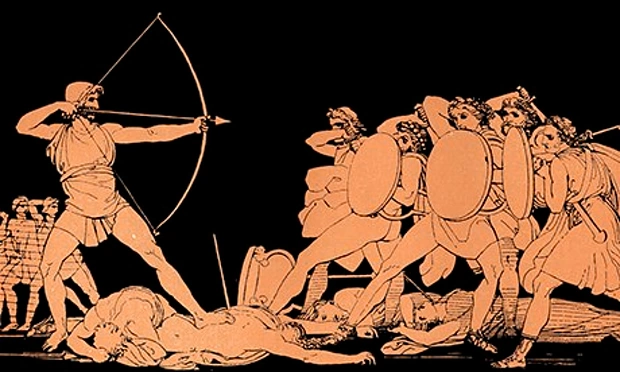
Emily Wilson has recently become the first female, after 60 male predecessors, to have a go at translating The Odyssey into English.
Wyatt Mason demonstrates that her new version has its points.
Throughout her translation of the “Odyssey,†Wilson has made small but, it turns out, radical changes to the way many key scenes of the epic are presented — “radical†in that, in 400 years of versions of the poem, no translator has made the kinds of alterations Wilson has, changes that go to truing a text that, as she says, has through translation accumulated distortions that affect the way even scholars who read Greek discuss the original. These changes seem, at each turn, to ask us to appreciate the gravity of the events that are unfolding, the human cost of differences of mind.
The first of these changes is in the very first line. You might be inclined to suppose that, over the course of nearly half a millennium, we must have reached a consensus on the English equivalent for an old Greek word, polytropos. But to consult Wilson’s 60 some predecessors, living and dead, is to find that consensus has been hard to come by. Chapman starts things off, in his version, with “many a way/Wound with his wisdomâ€; John Ogilby counters with the terser “prudentâ€; Thomas Hobbes evades the word, just calling Odysseus “the man.†Quite a range, and we’ve barely started. There’s Alexander Pope’s “for wisdom’s various arts renown’dâ€; William Cowper’s “For shrewdness famed/And genius versatileâ€; H.F. Cary’s “craftyâ€; William Sotheby’s “by long experience triedâ€; Theodore Buckley’s “full of resourcesâ€; Henry Alford’s “much-versedâ€; Philip Worsley’s “that heroâ€; the Rev. John Giles’s “of many fortunesâ€; T.S. Norgate’s “of many a turnâ€; George Musgrave’s “tost to and fro by fateâ€; the Rev. Lovelace Bigge-Wither’s “many-sided-manâ€; George Edgington’s “deepâ€; William Cullen Bryant’s “sagaciousâ€; Roscoe Mongan’s “skilled in expedientsâ€; Samuel Henry Butcher and Andrew Lang’s “so ready at needâ€; Arthur Way’s “of craft-renownâ€; George Palmer’s “adventurousâ€; William Morris’s “shiftyâ€; Samuel Butler’s “ingeniousâ€; Henry Cotterill’s “so wary and wiseâ€; Augustus Murray’s “of many devicesâ€; Francis Caulfeild’s “restlessâ€; Robert Hiller’s “cleverâ€; Herbert Bates’s “of many changesâ€; T.E. Lawrence’s “various-mindedâ€; William Henry Denham Rouse’s “never at a lossâ€; Richmond Lattimore’s “of many waysâ€; Robert Fitzgerald’s “skilled in all ways of contendingâ€; Albert Cook’s “of many turnsâ€; Walter Shewring’s “of wide-ranging spiritâ€; Allen Mandelbaum’s “of many wilesâ€; Robert Fagles’s “of twists and turnsâ€; all the way to Stanley Lombardo’s “cunning.â€
Of the 60 or so answers to the polytropos question to date, the 36 given above couldn’t be less uniform (the two dozen I omit repeat, with minor variations, earlier solutions); what unites them is that their translators largely ignore the ambiguity built into the word they’re translating. Most opt for straightforward assertions of Odysseus’s nature, descriptions running from the positive (crafty, sagacious, versatile) to the negative (shifty, restless, cunning). Only Norgate (“of many a turnâ€) and Cook (“of many turnsâ€) preserve the Greek roots as Wilson describes them — poly (“manyâ€), tropos (“turnâ€) — answers that, if you produced them as a student of classics, much of whose education is spent translating Greek and Latin and being marked correct or incorrect based on your knowledge of the dictionary definitions, would earn you an A. But to the modern English reader who does not know Greek, does “a man of many turns†suggest the doubleness of the original word — a man who is either supremely in control of his life or who has lost control of it? Of the existing translations, it seems to me that none get across to a reader without Greek the open question that, in fact, is the opening question of the “Odyssey,†one embedded in the fifth word in its first line: What sort of man is Odysseus?
‘I do think that gender matters. I’m not going to not say it’s something I’m grappling with.’
“I wanted there to be a sense,†Wilson told me, that “maybe there is something wrong with this guy. You want to have a sense of anxiety about this character, and that there are going to be layers we see unfolded. We don’t quite know what the layers are yet. So I wanted the reader to be told: be on the lookout for a text that’s not going to be interpretively straightforward.â€
Here is how Wilson’s “Odyssey†begins. Her fifth word is also her solution to the Greek poem’s fifth word — to polytropos:
Tell me about a complicated man. Muse,
tell me how he wandered and was lost
when he had wrecked the holy town of Troy,
and where he went, and who he met,
the pain he suffered in the storms at sea,
and how he worked to save his life and bring his men
back home. He failed to keep them safe; poor fools,
they ate the Sun God’s cattle, and the god
kept them from home. Now goddess, child of Zeus,
tell the old story for our modern times.
Find the beginning.
First there was a god of night and tempest, a black idol without eyes, before whom they leaped, naked and smeared with blood. Later on, in the times of the republic, there were many gods with wives, children, creaking beds, and harmlessly exploding thunderbolts. At the end only superstitious neurotics carried in their pockets little statues of salt, representing the god of irony. There was no greater god at that time.
Then came the barbarians. They too valued highly the little god of irony. They would crush it under their heels and add it to their dishes.
Severian argues that a high tax regime isn’t just about the money.
Taxes have an effect, and it isn’t an accidental side-effect, it’s an ulterior but central purpose: To weaken and distort the messages that bind civilization together, that keep it functioning.
Civilization is made up of very few of these messages: “It is wrong to kill or hurt other peopleâ€; “If someone has something you want, you need to acquire consent from them before you take it and that usually means paying for itâ€; “If you help me get things done I want to get done, I will give you this money.†Liberals and democrats want taxes higher, higher, higher, all the time and they don’t have a set amount in mind, nor do they want to pay for “police, fire departments and park benchesâ€; they just want the taxes to be high, so they can attack that 3rd message that keeps civilization working and functional. Ideally, for them, the tax rate would be 100% and we’d all be fed & sheltered by living on the dole. Then, dependency on the state would also be 100%. Then they’d reach the “fun part†— they tell the rest of us what to do, and we go do it. …
Yes, taxes are required to keep civilization working.
Higher taxes bring civilization to a stop. They’re supposed to do this. They remove the ability, as well as the incentive, for children to grow into strong, complete, capable adults. They’re supposed to do that, too. Minimal taxes are a lubricant. Higher taxes are a solvent.
Remember this next time you hear someone monologue away about the evils of a tax cut.
Unless, of course, it’s a case of a member of a prominent leftist Nomenklatura family seeking to enforce property rights, as one oblivious Yale alumnus from the Class of 1972 inadvertently reveals in this month’s Class Notes.
NW writes:
The most interesting thing I learned was that [PL]’s law firm represented Woody Guthrie’s daughter Nora, fighting an unjustified attempt to put ‘This Land Is Your Land’ into the public domain. Woody wrote it in 1940. (It was originally titled ‘God Blessed America For Me’ in his manuscript—which I’ve seen—as a protest against ‘God Bless America’ from Irving Berlin’s jingoistic World War I musical, Yip, Yip, Yaphank and later recorded by Kate Smith to sell war bonds in the ’40s.) It includes my favorite verse: ‘As I went walking, I saw a sign there, And on the sign it said No Trespassing. But on the other side it didn’t say nothing; that side was made for you and me.’ (Emphasis is my own: a very important, influential American protest song, not just a folk anthem.)
Fifth Generation Californian Steve Baldwin says good-bye to the Golden State, refuting in the process all the liberal boasting about California’s prosperity under Leftism.
[L]iberals like to claim California socialism is working by pointing to the much heralded statistic that “California’s economy is the 6th largest in the world†as calculated by the state’s Department of Finance. Indeed, California’s $2.62 trillion economy is larger than that of France, Canada, Brazil, Russia, and Italy. However, that GDP stat does not factor in California’s cost of living, which is 36.2% higher than the national cost of living. As Carson Bruno writes in Real Clear Markets, “using the cost of living adjusted data from the International Monetary Fund and adjusting California’s GDP data provides a better snapshot of California’s economic standing in the world. Doing so shows that California is actually the 12th largest economy — a drop of 6 spots — and actually puts the state below Mexico.â€
Moreover, as Bruno points out, Silicon Valley “accounted for 50% of California’s private industry real GDP growth.†In other words, without a few dozen mega profitable high-tech Silicon Valley firms such as Apple, Google, and Facebook, California’s GDP would be significantly smaller.
However, as economic blogger Richard Rider points out, the aggregate GDP statistic is really not a good indicator of a state’s economic health, especially since one industry appears to be propping up the “6th largest economy†myth. California has over 39 million people, more than any other state, so a far more accurate assessment of its economy, Rider writes, would be per capita GDP as compared to the rest of the country. After adjusting the GDP figures to account for the cost of living (COL), the Golden State ends up with a paltry 37th place ranking within the U.S.A., with a $45,696 per capital GDP. Even rustbelt states, such as Michigan and Ohio, have a higher adjusted per capita GDP. Despite Silicon Valley’s high-tech giants, California barely squeezes past impoverished New Mexico. Rider also reports that when one looks at per capita GDP stats for the rest of the world, California ranks 19th, but those stats don’t factor in the COL data; if they did, California would be even further down the rankings internationally.
One should not also assume that high-tech companies are a permanent feature of California’s economy. Already, the extremely high cost of living in Silicon Valley has, since 2016, caused more Silicon Valley employees to leave the state than it has attracted. With a few high-tech companies having left California for other states such as Virginia, Texas and North Carolina, it’s only a matter of time before this turns into a flood.
But it’s not just Silicon Valley employees fleeing California; it’s productive — and job-creating — citizens from all over the state. As Joel Kotkin and Wendell Cox wrote in the Mercury News last April, “the largest group of outmigrants tends to be middle-aged people making between $100,000 and $200,000 annually.â€
Indeed, California has done everything possible to make it difficult for businesses and employers to produce goods and services. California now has the highest state income tax rate and the highest state sales tax rate in the country. Our gas tax rate is fourth-highest, but if you add in the 10-12 cent “cap and trade†cost per gallon, we have the highest gas tax in the country. Based on 2014 numbers, California’s single-family residence property tax is the eighth highest in the country with the median homeowner property tax bill 93% higher than the average property tax bill for the other 49 states. As for the state’s corporate income tax rate, it is also eighth in the country. And let’s not forget our small business tax, a minimum of $800, even if no profit is earned.
Overall, the Tax Foundation ranks California as fifth worse in overall tax burden, but the state is especially hostile to its high earners who start businesses and create most of the jobs. Indeed, the top 1% pays 50% of all state income taxes. Moreover, the Small Business and Entrepreneurship Council ranked California as having the worst anti-business climate in the country; the American Tort Reform Foundation ranks the state as the “worst state judicial hellhole†in the U.S. and the national Chamber of Commerce rates California as having the fourth-worst business climate.
If California is such a prosperous state as liberals claim, why does it have the highest poverty rate in the nation? According to the Census Bureau, the poverty rate is 23.4%, which is 17% higher than second place Nevada. Indeed, while California has 12% of the nation’s population, it is home to 33% of the nation’s TANF (Temporary Assistance for Needy Families) welfare recipients, more than the next seven states combined.
What’s clear is that the producers are leaving the state and the takers are coming in. Many of the takers are illegal aliens, now estimated to number over 2.6 million. The Federation for American Immigration Reform estimates that California spends $22 billion on government services for illegal aliens, including welfare, education, Medicaid, and criminal justice system costs. Liberals claim they more than make that up with taxes paid, but that’s simply not true. It’s not even close. FAIR estimates illegal aliens in California contribute only $1.21 billion in tax revenue, which means they cost California $20.6 billion, or at least $1,800 per household.
WWI came to an end by an armistice arranged to occur at the eleventh hour of the eleventh day of the eleventh month of 1918. The date and time, selected at a point in history when mens’ memories ran much longer, represented a compliment to St. Martin, patron saint of soldiers, and thus a tribute to the fighting men of both sides. The feast day of St. Martin, the Martinmas, had been for centuries a major landmark in the European calendar, a date on which leases expired, rents came due; and represented, in Northern Europe, a seasonal turning point after which cold weather and snow might be normally expected.
It fell about the Martinmas-time, when the snow lay on the borders…
—Old Song.
From Robert Chambers, The Book of Days, 1869:
St. Martin, the son of a Roman military tribune, was born at Sabaria, in Hungary, about 316. From his earliest infancy, he was remarkable for mildness of disposition; yet he was obliged to become a soldier, a profession most uncongenial to his natural character. After several years’ service, he retired into solitude, from whence he was withdrawn, by being elected bishop of Tours, in the year 374.
The zeal and piety he displayed in this office were most exemplary. He converted the whole of his diocese to Christianity, overthrowing the ancient pagan temples, and erecting churches in their stead. From the great success of his pious endeavours, Martin has been styled the Apostle of the Gauls; and, being the first confessor to whom the Latin Church offered public prayers, he is distinguished as the father of that church. In remembrance of his original profession, he is also frequently denominated the Soldier Saint.
The principal legend, connected with St. Martin, forms the subject of our illustration, which represents the saint, when a soldier, dividing his cloak with a poor naked beggar, whom he found perishing with cold at the gate of Amiens. This cloak, being most miraculously preserved, long formed one of the holiest and most valued relics of France; when war was declared, it was carried before the French monarchs, as a sacred banner, and never failed to assure a certain victory. The oratory in which this cloak or cape—in French, chape—was preserved, acquired, in consequence, the name of chapelle, the person intrusted with its care being termed chapelain: and thus, according to Collin de Plancy, our English words chapel and chaplain are derived. The canons of St. Martin of Tours and St. Gratian had a lawsuit, for sixty years, about a sleeve of this cloak, each claiming it as their property. The Count Larochefoucalt, at last, put an end to the proceedings, by sacrilegiously committing the contested relic to the flames.
Another legend of St. Martin is connected with one of those literary curiosities termed a palindrome. Martin, having occasion to visit Rome, set out to perform the journey thither on foot. Satan, meeting him on the way, taunted the holy man for not using a conveyance more suitable to a bishop. In an instant the saint changed the Old Serpent into a mule, and jumping on its back, trotted comfortably along. Whenever the transformed demon slackened pace, Martin, by making the sign of the cross, urged it to full speed. At last, Satan utterly defeated, exclaimed:
Signa, te Signa: temere me tangis et angis:
Roma tibi subito motibus ibit amor.’
In English—
‘Cross, cross thyself: thou plaguest and vexest me without necessity;
for, owing to my exertions, thou wilt soon reach Rome, the object of thy wishes.’
The singularity of this distich, consists in its being palindromical—that is, the same, whether read backwards or forwards. Angis, the last word of the first line, when read backwards, forming signet, and the other words admitting of being reversed, in a similar manner.
The festival of St. Martin, happening at that season when the new wines of the year are drawn from the lees and tasted, when cattle are killed for winter food, and fat geese are in their prime, is held as a feast-day over most parts of Christendom. On the ancient clog almanacs, the day is marked by the figure of a goose; our bird of Michaelmas being, on the continent, sacrificed at Martinmas. In Scotland and the north of England, a fat ox is called a mart, clearly from Martinmas, the usual time when beeves are killed for winter use. In ‘Tusser’s Husbandry, we read:
When Easter comes, who knows not then,
That veal and bacon is the man?
And Martilmass beef doth bear good tack,
When country folic do dainties lack.’
Barnaby Googe’s translation of Neogeorgus, shews us how Martinmas was kept in Germany, towards the latter part of the fifteenth century
‘To belly chear, yet once again,
Doth Martin more incline,
Whom all the people worshippeth
With roasted geese and wine.
Both all the day long, and the night,
Now each man open makes
His vessels all, and of the must,
Oft times, the last he takes,
Which holy Martin afterwards
Alloweth to be wine,
Therefore they him, unto the skies,
Extol with praise divine.’
A genial saint, like Martin, might naturally be expected to become popular in England; and there are no less than seven churches in London and Westminster, alone, dedicated to him. There is certainly more than a resemblance between the Vinalia of the Romans, and the Martinalia of the medieval period. Indeed, an old ecclesiastical calendar, quoted by Brand, expressly states under 11th November: ‘The Vinalia, a feast of the ancients, removed to this day. Bacchus in the figure of Martin.’ And thus, probably, it happened, that the beggars were taken from St. Martin, and placed under the protection of St. Giles; while the former became the patron saint of publicans, tavern-keepers, and other ‘dispensers of good eating and drinking. In the hall of the Vintners’ Company of London, paintings and statues of St. Martin and Bacchus reign amicably together side by side.
On the inauguration, as lord mayor, of Sir Samuel Dashwood, an honoured vintner, in 1702, the company had a grand processional pageant, the most conspicuous figure in which was their patron saint, Martin, arrayed, cap-Ã -pie, in a magnificent suit of polished armour; wearing a costly scarlet cloak, and mounted on a richly plumed and caparisoned white charger: two esquires, in rich liveries, walking at each side. Twenty satyrs danced before him, beating tambours, and preceded by ten halberdiers, with rural music. Ten Roman lictors, wearing silver helmets, and carrying axes and fasces, gave an air of classical dignity to the procession, and, with the satyrs, sustained the bacchanalian idea of the affair.
A multitude of beggars, ‘howling most lamentably,’ followed the warlike saint, till the procession stopped in St. Paul’s Churchyard. Then Martin, or his representative at least, drawing his sword, cut his rich scarlet cloak in many pieces, which he distributed among the beggars. This ceremony being duly and gravely performed, the lamentable howlings ceased, and the procession resumed its course to Guildhall, where Queen Anne graciously condescended to dine with the new lord mayor.
RPS ORDERS
No. 47 (Series 1921)
HEADQUARTERS U.S. MARINE CORPS
Washington, November 1, 1921
759. The following will be read to the command on the 10th of November, 1921, and hereafter on the 10th of November of every year. Should the order not be received by the 10th of November, 1921, it will be read upon receipt.
(1) On November 10, 1775, a Corps of Marines was created by a resolution of Continental Congress. Since that date many thousand men have borne the name “Marine”. In memory of them it is fitting that we who are Marines should commemorate the birthday of our corps by calling to mind the glories of its long and illustrious history.
(2) The record of our corps is one which will bear comparison with that of the most famous military organizations in the world’s history. During 90 of the 146 years of its existence the Marine Corps has been in action against the Nation’s foes. From the Battle of Trenton to the Argonne, Marines have won foremost honors in war, and is the long eras of tranquility at home, generation after generation of Marines have grown gray in war in both hemispheres and in every corner of the seven seas, that our country and its citizens might enjoy peace and security.
(3) In every battle and skirmish since the birth of our corps, Marines have acquitted themselves with the greatest distinction, winning new honors on each occasion until the term “Marine” has come to signify all that is highest in military efficiency and soldierly virtue.
(4) This high name of distinction and soldierly repute we who are Marines today have received from those who preceded us in the corps. With it we have also received from them the eternal spirit which has animated our corps from generation to generation and has been the distinguishing mark of the Marines in every age. So long as that spirit continues to flourish Marines will be found equal to every emergency in the future as they have been in the past, and the men of our Nation will regard us as worthy successors to the long line of illustrious men who have served as “Soldiers of the Sea” since the founding of the Corps.
Tun Tavern, Philadelphia, Pennsylvania, November 10th 1775
Captains Nicholas and Mullens, having been tasked by the 2nd Continental Congress to form 2 battalions of Marines, set up the Corps’ first recruiting station in the tavern.
The first likely prospect was, in typical recruiters fashion, promised a “life of high adventure in service to Country and Corps”. And, as an extra bonus: If he enlisted now he would receive a free tankard of ale….
The recruit gladly accepted the challenge and, receiving the free tankard of ale, was told to wait at the corner table for orders.
The first Marine sat quietly at the table sipping the ale when he was joined by another young man, who had two tankards of ale.
The first Marine looked at the lad and asked where he had gotten the two tankards of ale?
The lad replied that he had just joined this new outfit called the Continental Marines, and as an enlistment bonus was given two tankards of ale.
The first Marine took a long hard look at the second Marine and said, ” It wasn’t like that in the old Corps.”