
Nervous drivers (and their equally nervous passengers) beware! You should really prepare yourselves for the sight of Storseisundet Bridge in Norway. The road connection from the mainland Romsdal peninsula to the island of Averøya in Møre og Romsdal county doesn’t look as if it actually connects as you drive towards it.
26 May 2017
Bridge to Nowhere
Norway, Optical Illusions, Photography, Storseisundet Bridge

25 May 2017
This is India — The Place You Call When You Have Technical Problems
Call Centers, India, Technology

25 May 2017
Making Bronze Swords
Arms and Armor, Bronze Age

At Sarah Hoyt’s site, J.M. Ney-Grimm wondered exactly how the ancients manufactured swords in the Bronze Age.
Making a sword was resource intensive, both because of the valuable metals required and because of the labor from many skilled individuals that went into it. …
Bronze is made by mixing a small part of tin with a larger portion of copper. The ancients didn’t have modern strip mines or deep underground mines. Nor did they have sophisticated machinery run by deisel engines. How did they get copper and tin out of the ground?
Copper mines bore some resemblance to my expectations. The copper deposits needed to be relatively near the surface, but the ancients actually did tunnel down to a vein of ore. There, at the working face, they built a fire to heat the ore-containing rock. Once the rock reached a high enough temperature, they doused it with cold water. This process increased the brittleness of the rock and induced a preliminary degree of cracking. Blows from a hammer or pick could then break it into rubble, which could be heated in a smelting furnace to extract the copper.
Tin was another matter, one entirely new to me.
Tin was found in alluvial deposits in stream beds, usually as a very pure tin gravel well stirred with gravels of quartz, mica, and feldspar (gangue). So the trick was to separate out the tin gravel from the others.
The method of the ancients, as far back as 2,000 BC, was this:
• Dig a trench at the lowest end of the deposit.
• Dig a channel from the nearest water source to pour water over that part of the deposit
• Allow the stream of water to wash the lighter gangue into the trench
• Pick up the heavier tin gravel that remained
• When the lower portion of the deposit had yielded all its tin, dig another trench a bit higher and redirect the water channel, to allow the next section of the deposit to be harvestedThe tin gravel thus obtained would be roughly smelted on site, simply roasting the gravel in a fire. The pebbles resulting from this rough smelt would then be transported to a dedicated furnace for a second smelting that yielded the purer tin needed by bladesmiths.
Modern ingots are rectangular blocks, but those of the ancients took several different forms. The earliest were so-called “biscuit†ingots, round on the bottom like a muffin, gently concave on the top. They took the shape of the earthen pit into which the molten metal dripped from the smelting furnace.
But metal is heavy, and the biscuit shape awkward to carry. Around our own Mediterranean, an “oxhide†form was developed. It weighed about 80 pounds and possessed four “legs,†one at each corner, that allowed it to be tied between pack animals or gripped and carried by men.
I became fascinated with an ingot form used much later by the Chinese in the Malay Penninsula. These were hat shaped, much smaller (weighing only a pound), and actually used as currency.
Bronze has one very peculiar property in the smithy.
Most metals, such as iron or even copper, when heated and cooled slowly to room temperature, become more ductile and more workable. They are less prone to internal stresses.
Bronze does not behave like this. When slow cooled, it becomes brittle and difficult to work. Thus it must be heated to cherry-red and then quenched in water. This quick cooling makes it so soft that it can then be hammered. The hammering condenses the metal, giving it more rigidity.
A bladesmith will hammer near the edge of a blade to harden it and help it keep its sharpness, while allowing the center rib to retain more of its resilience.
Were These Swords Any Good?If you compare a bronze sword to a steel sword, the steel is always going to win. But when the Bronze Age gave way to the Iron Age, bronze metallurgy was at its peak. Several thousand years had gone into the development of the most superb techniques. Iron metallurgy was in its infancy, and getting the iron swords to be rigid enough was a problem. The iron swords just weren’t as good as the bronze ones, which were light, strong, just rigid enough, and held an edge well.
——————————
25 May 2017
Peter Salovey’s False Narrative
Diversity, Peter Salovey, Political Correctness, Ressentiment, Yale

Heather MacDonald debunks Peter Salovey’s sanctimonious PC nonsense.
Yale University’s president recently provided a window into the modern university’s self-conception—an understanding embraced by both liberals and conservatives but flawed in essential ways. A primary purpose of a Yale education, President Peter Salovey told Yale’s freshman class last year, is to teach students to recognize “false narratives.†Such narratives, Salovey claimed, are ubiquitous in American culture: “My sense is that we are bombarded daily by false narratives of various kinds, and that they are doing a great deal of damage.†Advocates may “exaggerate or distort or neglect crucial facts,†Salovey said, “in ways that serve primarily to fuel your anger, fear, or disgust.†(Salovey repeated this trilogy of “anger, fear, and disgust†several times; it was impossible not to hear a reference to Donald Trump, though Salovey tried to stay nonpartisan.)
According to Salovey, the Yale faculty is a model for how to respond to false narratives: they are united by a “stubborn skepticism about narratives that oversimplify issues, inflame the emotions, or misdirect the mind,†he said.
Two things can be said about Salovey’s theme: first, it is hilariously wrong about the actual state of “stubborn skepticism†at Yale. Second, and more important, Salovey mistakes the true mission of a college education.
To assess whether Yale is, in fact, a bastion of myth-busting, it is necessary to return to one of the darkest moments in Yale’s history: the university’s response to a shocking mass outbreak of student narcissism in October 2015. The wife of a college master had sent an e-mail to students, suggesting that they were capable of deciding for themselves which Halloween costume to wear and didn’t need oversight from Yale’s diversity commissars. (Halloween costumes have been the target of the PC police nationally for allegedly “appropriating†minority cultures.)
The e-mail sparked a furor among minority students across Yale and beyond, who claimed that it threatened their very being. In one of many charged gatherings that followed, students surrounded the college master, berating him for the pain that his wife had caused them. One female student was captured on video violently gesturing at the master and shrieking, “Be quiet!†as he gently tries to answer her tirade. She then screams: “Why the fuck did you accept this position [of college master]? Who the fuck hired you?â€
Of all the Black Lives Matter–inspired protests that were sweeping campuses at that moment, Yale’s shrieking-girl episode was the most grotesque. In reaction, Yale groveled. President Salovey sent around a campus-wide letter declaring that he had never been as “simultaneously moved, challenged, and encouraged by our community—and all the promise it embodies—as in the past two weeks.†He proclaimed the need to work “toward a better, more diverse, and more inclusive Yaleâ€â€”implying that Yale was not “inclusive†—and thanked students for offering him “the opportunity to listen to and learn from you.†That the shrieking girl had refused to listen to her college master—or to give him an opportunity to speak—was never mentioned; she suffered no known repercussions for her outrageous incivility. Salovey went on to pledge a reinforced “commitment to a campus where hatred and discrimination have no place,†implying that hatred and discrimination currently did have a place at Yale. Salovey announced that the entire administration, including faculty chairs and deans, would receive training on how to combat racism at Yale and reiterated a promise to dump another $50 million into Yale’s already all-consuming diversity efforts.
If ever there were a narrative worthy of being subjected to “stubborn skepticism,†in Salovey’s words, the claim that Yale was the home of “hatred and discrimination†is it. There is not a single faculty member or administrator at Yale (or any other American college) who does not want minority students to succeed. Yale has been obsessed with what the academy calls “diversity,†trying to admit and hire as many “underrepresented minorities†as it possibly can without totally eviscerating academic standards. There has never been a more tolerant social environment in human history than Yale (and every other American college)—at least if you don’t challenge the reigning political orthodoxies. Any Yale student who thinks himself victimized by the institution is in the throes of a terrible delusion, unable to understand his supreme good fortune in ending up at one of the most august and richly endowed universities in the world.
But the ubiquitous claim that American campuses are riven with racism is not, apparently, one of the “false narratives†that Salovey had in mind. Not only did the president endorse that claim, but the husband-and-wife team who had triggered the Halloween costume furor penned a sycophantic apology to minority students in their residential college: “We understand that [the original e-mail] was hurtful to you, and we are truly sorry,†wrote Professors Nicholas and Erika Christakis. “We understand that many students feel voiceless in diverse ways and we want you to know that we hear you and we will support you.†Yale’s minority students may “feel†voiceless, but that feeling is just as delusional as the feeling that Yale is not “inclusive.â€
So Salovey’s claim that Yale resolutely seeks out and unmasks “false narratives†is itself a false narrative.
25 May 2017
The Casual Revolution
Fashion, History, United States
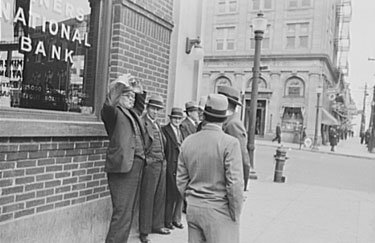
Shenandoah, Pennsylvania, corner of Main & Centre in front of Miners’ National Bank, circa 1940: coal miners on their days-off would customarily wear suits, neckties, and hats.
G. Bruce Boyer contemplates contemporary society’s abandonment of formality and dignity in favor of “casualness,” i.e. self-indulgent comfort and the absence of effort.
In the early years of the nineteenth century there had been what fashion hisÂtorians have called the “Great Masculine Renunciation†in Western male dress, as men turned their collective backs on all the silks and satins, buckled shoes and powdered wigs of court dress, and assumed the Victorian black worsted suit and cotton shirt of bourgeois middle-class business attire and propriety. The theory, first popularized in 1930 by the psychologist J. C. Flügel, attempted to account for the radical shift that men made to more sober attire after 1800, and the shift is usually seen as an expression of the triumph of the middle class, Âenlarging democracy, and the Industrial Revolution. A more ornate and chivalric ideal was replaced by the modest masculinity of a bourgeois gentleman in a democratic society. A gentleman’s clothes became more sober and standardized, his manners more reserved and proper. The very idea of a “gentleman†seems stuck in the nineteenth century.
At the end of the twentieth century, dress underwent another great change; call it the “Tailored Renunciation†or the “Casual Revolution.†Underlying it is not the triumph of one class but rather the loss among all classes of a sense of occasion. By “occasion†I mean an event out of the ordinary, a function other than our daily lives, an experience for which we take special care and preparation, at which we act and speak and comport ourselves Âdifferently—events which could be called ritualistic in matters of Âpropriety and appearance. There used to be many of these events, social rituals that filled our non-working lives: weddings and funerals, going to church, restaurants, parties, and theaters. Meeting important people of various stripes, people who had greater social standing than we did, was an occasion for our parents and grandparents to dress up, and that included going to the doctor’s office when you were sick, because the doctor was thought to be an important person worthy and deserving of that outward sign of respect. Respect for the event and those in attendance was what made the occasion special.
It can now be said that this sort of an outward sign or almost any of the older outward signs of ritual are considered pure snobbery. After all, wasn’t the Edwardian Age the last time the really rich could hope to think that showing off their wealth in public display gave the poor a nice bit of entertainment and ray of sunshine in their drab lives?
But then, if these outward signs are socially discouraged today, what makes an occasion special? And how do we know? Can an event be an occasion if there’s no attempt to outwardly manifest it? ÂRitualized behavior of one sort or another may be considered an outward sign of our inward disposition. But how complete can this be if it is not expressed in our appearance? We need not agree with Nicolás Gómez-Dávila’s claim that evening dress is the first step toward civilization to think that something has gone amiss. Is it possible to believe that when we now wear polo shirts, khakis, and hyper-designed athletic shoes to weddings, funerals, and graduations, it’s a sign that we have forgotten how to enjoy the events by which we measure life?
Hat tip to Karen L. Myers.
25 May 2017
Portland Burrito Shop Put Out of Business
Cultural Appropriation, Portland (Oregon)

“Cultural Appropriation” has consequences in Portlandia. Fox News:
Just one week after Kooks Burritos in Portland, Ore., was featured in a profile for local publication Willamette Week, the pop-up Mexican food cart has closed down amid accusations that they ripped off their recipes.
Kali Wilgus and Liz “LC†Connelly, the two white women who started Kooks earlier this year, have been accused of stealing their techniques from the “tortilla ladies†of Puerto Nuevo, Mexico — because Connelly told Willamette Week that they gathered their recipes and tortilla-making processes during a holiday road-trip to the Baja California village.
“I picked the brains of every tortilla lady there in the worst broken Spanish ever, and they showed me a little of what they did,” she told the site. “They told us the basic ingredients, and we saw them moving and stretching the dough similar to how pizza makers do before rolling it out with rolling pins.â€
In the profile, which first ran May 16, Connelly also claimed that, when the Mexican cooks wouldn’t give up their trade secrets, she and Wilgus “were peeking into the windows of every kitchen, totally fascinated by how easy they made it look.â€
Connelly then said she used a trial-and-error process to recreate a tortilla with the same flavor and texture after returning to Portland. She and Wilgus then opened their weekend pop-up inside a taco truck on SE Cesar Estrada Chavez Boulevard, and began serving their Mexican-style tortillas filled with California-inspired ingredients.
Though the eatery had been open for several months, the owners of Kooks were only recently accused of cultural appropriation by The Portland Mercury and Mic.com based on Connelly’s revelations.
“Because of Portland’s underlying racism, the people who rightly own these traditions and cultures that exist are already treated poorly,” The Portland Mercury said, calling the closure of Kooks a “victory.”
The article continues,”These appropriating businesses are erasing and exploiting their already marginalized identities for the purpose of profit and praise.”


23 May 2017
P.J. O’Rourke Remains Sanguine
2016 Election, Donald Trump, P.J. O'Rourke
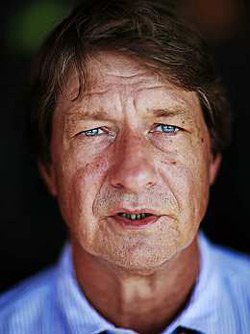
The libertarian humorist interviews with (T)Reason Magazine’s Nick Gillespie.
The politician creates a powerful, huge, heavy, and unstoppable Monster Truck of a government,” P.J. O’Rourke writes in his new book, How the Hell Did This Happen? (Atlantic Monthly Press). “Then supporters of that politician become shocked and weepy when another politician, whom they detest, gets behind the wheel, turns the truck around, and runs them over.”

23 May 2017
Statism
Friedrich Nietzsche, Statism
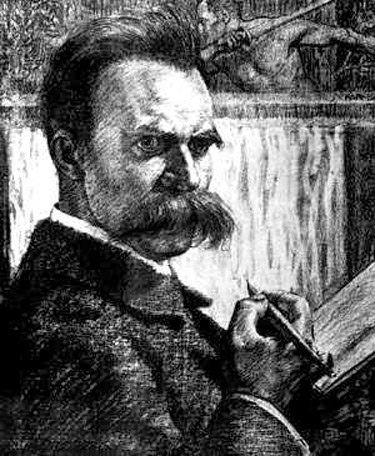
“The State is the coldest of all cold monsters- and this lie creeps from its mouth: “I, the state, am the peopleâ€.”
— Friedrich Nietzscheâ€
23 May 2017
Shrapnel From Monmouth Battlefield Tests Positive for Human Blood
American Revolution, Archaeology, Battle of Monmouth

It’s a hexagonal piece of lead, maybe the size of a fingertip. Canister shot, it was called, and the Continental Army used it to shred British lines at the Battle of Monmouth in June of 1778.
When his team of volunteer archaeologists found this and other pieces of ordnance in the ground at Monmouth Battlefield State Park last summer, Dan Sivilich suspected they were not your typical artifacts.
“Two appeared to have fabric impressions on them which suggested they might have hit a uniform,†Sivilich said.
He sent them to PaleoResarch Inc. in Colorado for testing. Nine months later his hunch was proven correct — and then some. One of the pieces tested positive for human blood protein.
“In other words, it hit a soldier,†Sivilich said. “This is the only piece of Revolutionary War canister shot ever found that’s been positively tested for human blood.â€
That’s not all. Based on where they were discovered, Sivilich believes the pieces probably were fired by Proctor’s Pennsylvania artillery. One of its cannon is associated with the legendary heroine Molly Pitcher, whose real name likely was Mary Hays.
“It could have been a round that Molly Pitcher handled,†Sivilich said. “We can’t say for sure, but it makes for interesting speculation.â€



