Category Archive '2010 Election'
16 Mar 2010


Dick Armey thinks the democrats will succeed in ramming through a health care bill somehow, by hook or by crook, and he tells us that Americans are wrong about Nancy Pelosi.
Former Republican House Majority Leader and current Tea Party leader Dick Armey said today that House Speaker Nancy Pelosi is “inept” but that Congress would likely still pass health care reform.
“What has probably surprised me more than anything else about Speaker Pelosi is her ineptness,” Armey said at luncheon at the National Press Club in Washington, DC. “I didn’t realize anyone could rise to the position of Speaker and be that inept.”
Despite his harsh criticism of the Speaker, Armey said that he personally liked Pelosi and he defended her from people who say she’s mean.
“She’s more inept than I thought she was, but she’s not as mean as people think she is,” Armey said.
But even with Pelosi’s “inept” leadership, Armey says Democrats will most likely pass health care reform legislation that has been debated for the last year and is expected to come to a vote this week.
“They’ll probably force this through,” he said. “But you can’t discount the number of people who can be moved by a ruthless and powerful political leader or group of political leaders.”
The Freedom Works chairman also had harsh word for the rest of Congress – the “self-serving” people he suggests are equally to blame for the passage of health care legislation.
“The average member Congress – House and Senate – is first and foremost only a self-serving inconvenience-minimizer who doesn’t have a lot of principle they stand on the first place,” he said. “It doesn’t take much to move a jellied spine, so they’ll probably get their votes.”
Asked if Democrats will get a bounce in poll numbers if they pass health care reform, Armey said Democrats “will get politically bounced” from office. Armey is confident that Harry Reid will lose his Senate seat in November and that Republicans will regain a majority in both houses of Congress either this election cycle or the next.
16 Mar 2010

Everybody, even Lindsey Graham, recognizes the insane futility of what House democrats are about to do.
Republican Sen. Lindsey Graham (R-S.C.) on Monday used language that compared House Democrats’ efforts to pass healthcare reform legislation to a Japanese kamikaze mission.
“Nancy Pelosi, I think, has got them all liquored up on sake and you know, they’re making a suicide run here,” Graham said on the Keven Cohen Show on WVOC radio in Columbia, S.C.
15 Mar 2010

Peter Beinart describes very accurately what has happened to the democrats.
Barack Obama is a representative of the younger, more ideologically-committed, much more naive generation of left-wing democrats, typical of that party’s radical base. He’s the type of democrat who is too young to have seen George McGovern lose 49 states or see Jimmy Carter shredded by Ronald Reagan.
[A] generation of Democrats, which includes Al From, Mark Penn, Joe Lieberman, William Galston, Elaine Kamarck, Dick Morris, Ed Koch, Jane Harman, Evan Bayh, and to some extent Bill and Hillary Clinton, being a liberal is like walking past a bear. Move cautiously and reassuringly and the bear will purr contentedly. But make any sudden or threatening gestures, and you’ll be mauled because, fundamentally, the bear distrusts liberals. As Galston and Kamarck wrote in their famed 1989 essay “The Politics of Evasionâ€â€”a document that helped define the “don’t scare the bear†wing of the party—Democrats can pass liberal programs “but these programs must be shaped and defended within an inhospitable ideological climate.†To pretend that the American people are liberal at heart is to evade political reality, with devastating results.
By the late 1990s, “don’t scare the bear†Democrats pretty much dominated Washington. But in the Bush years, a new faction began to emerge. These Democrats were mostly newer to politics. They had never seen a McGovern or Mondale mauled for being too far to the left. What they had seen was the post-1994 Bill Clinton, who shied away from ambitious liberal reform. And they had seen the Iraq War, which DLC types largely supported, partly out of fear that opposing it would allow Republicans to paint Democrats as soft on defense.
By 2003, this new group of Democrats was angry as hell. The Iraq War, which party elders had mostly backed, was proving a disaster, and to make matters worse, Republicans were clobbering Democrats as weak anyway. So these Democrats began fashioning a different theory: Perhaps the problem wasn’t that Democrats looked weak because they were too liberal, perhaps the problem was that Democrats looked weak because they didn’t stand up for what they really believed. In 2005, the historian Rick Pearlstein—who became something of a hero to these folks—published a book entitled The Stock Ticker and the Super Jumbo. Republicans, he argued, were like Boeing: a company that persevered in building a super jumbo airplane even when the market was bad, and thus built a dominant brand. Democrats were like the stock ticker, constantly shifting with the public mood and thus winning momentary victories but failing to build a brand people could identify with.
To change, Perlstein argued, “Democrats need to make commitments, or a network of commitments, that do not waver from election to election.†They must stick with them “even if they don’t succeed†at any given moment because doing unpopular things because you believe in them convinces Americans that you have core beliefs, which in the long term strengthens your brand. …
When Scott Brown won his Senate seat, he made Obama choose. On the one hand, he handed the White House an excuse to abandon comprehensive reform and return to the incremental, small-bore approach that Clinton pursued after 1994. The Brown victory, in fact, seemed to illustrate the “don’t scare the bear†theory perfectly. Obama had passed the stimulus and bailed out the banks and taken over part of the auto industry and for the American people, it was too much liberal activism too fast. Polls not only showed Americans turning against Obama’s health care bill, they showed them turning against big government more generally. Continuing to pursue comprehensive reform in this inhospitable environment, warned former Carter pollster Patrick Caddell and former Clinton pollster Douglas Schoen, in language that echoed “the Politics of Evasion,†would bring political calamity. “Wishing, praying or pretending†that the American people support health care reform more than they do, they insisted, “will not change these outcomes.â€
Superjumbo Democrats, by contrast, argued that the public wasn’t so much anti-reform as they were anti-the legislative process that had produced reform. But more fundamentally, they argued that the American people would respect Democrats for not backing down in the face of adversity. The party might still lose seats this fall, but over time health care reform would prove popular, and the party’s willingness to fight for it would strengthen the Democratic brand.
Why exactly Obama—advised by David Axelrod, Rahm Emmanuel and Valerie Jarrett—decided to double down on health care remains unclear. But it’s a good bet that President Hillary Clinton—advised by Mark Penn—would have acted differently. And in acting the way he did, Obama has turned himself into a superjumbo Democrat. For the foreseeable future, he has forfeited any chance of bridging the red-blue divide. Prominent Republicans have already announced that if Democrats try to pass health care via reconciliation, they will not work across the aisle to pass anything major this year. Conversely, Obama has cemented his bond with the netroots. It doesn’t really matter that the health care reform bill he is fighting for isn’t particularly left-wing. For the netroots, a politicians’ ideological purity has always been less important than his willingness to resist pressure from the other side, which is exactly what Obama has just done.
Whether health care reform passes or not, Obama has embraced polarization over triangulation. He has chosen Karl Rove’s politics of base mobilization over Dick Morris’s politics of crossover appeal, with consequences not merely for how he campaigns for Democrats in 2010, but for he campaigns for himself in 2012. And that’s a disaster for “don’t scare the bear†Democrats whether Obamacare passes or not. The reason is that the DLC wing of the party is much more top-down than the MoveOn wing. It has always wielded influence primarily through elected leaders rather than grassroots activists. But today, Obama is the only leader in the Democratic Party who really matters. As the retirement of Evan Bayh illustrates, there are few nationally prominent DLC-aligned politicians left. (The one person who could have rallied that faction of the party against Obama is now his secretary of state). The DLC wing’s best hope for relevance, therefore, was that Obama himself would restrain the party’s base, that his White House would nurture a new generation of centrist candidates.
That hope is now gone. From top to bottom, Democrats have decided to bet the party’s future on the belief that Americans prefer bold liberals to cautious ones. Now it’s up to the bear.
05 Mar 2010
Looking at Drudge Report this morning, I read the following headlines:
9.7%… 36,000 JOBS LOST IN FEB…
Unemployment Rate Including Discouraged Workers Rose To 16.8%…
Federal pay ahead of private industry…
Those are ugly headlines testifying to hard times for Americans and sure evidence that come November there is bad news coming for democrats.
04 Mar 2010
The leftist democrat base waves flowers
Political strategists on both sides are wondering aloud why it is that democrat members of Congress seem willing to climb aboard the health care flying bomb and head into a one-way legislative mission trying to sink Americans’ free choice in health care. Are they crazy? Do they believe the Emperor Obama’s promises that they will live forever in the Socialist equivalent of the Yakukuni Shrine? Quite a lot of them surely won’t be coming back to Washington next year. So why are they doing it?
Gary Andres explains the thinking of the democrat kamikaze.
One Democratic lobbyist advanced the “public education thesis.†“Sure, this might seem controversial now. But once it’s done, Members of Congress will have a chance to explain what they did, why, and how it’s going to make a difference.â€
According to this theory, support will rise and opposition will ease, but only after the bill is enacted. The strategy, however, hinges on lawmakers’ ability to do an effective post-passage marketing job. It also assumes the opposition will not mount any kind of successful counter mobilization to protest its passage.
A variation on the public education thesis is the “Americans support success†conjecture. It goes something like this: Voters like accomplishments. Seeing the president in the Rose Garden, signing health care reform legislation into law will improve Mr. Obama’s approval numbers, which helps his party politically in the midterm election. Getting a bill done – almost irrespective of its contents – will help boost the White House’s and Democrats’ political fortunes, according to this view.
Next there is the “good as it gets†hypothesis. After two successful election cycles (2006 and 2008) Democrats amassed large majorities in the House and the Senate. But now they have reached their maximum majority size, based on this theory. With the prospects of their party strength only shrinking next year, now is the time to act on health care.
George Crawford, a former chief of staff to Speaker Pelosi and now a senior government affairs advisor at King and Spalding wrote an opinion piece recently in The Hill underscoring this point. Crawford argues that after “successful campaigns over the past several cycles, Democrats had come closer to their potential high-water mark.†He goes on to posit the party’s majority would get smaller irrespective of the House’s actions in the 111th Congress. So they might as well do it while Democrats have the votes.
Finally, there is the “energize the base†argument. This one has perhaps the most appeal because it includes some empirical support. Public polling on health care always masks huge variation in opinion between Republicans and Democrats.
For example, in a recent Rasmussen poll, President Obama’s health care plan lagged overall by a 41 percent (oppose) — 56 percent (favor) margin among likely voters. Yet looking at the crosstabs tells a very different story. Nearly 7 out of 10 (71 percent) self-identified Democrats favor the legislation, while only 12 percent of Republicans approve. This nearly 60 point spread between the parties on this issue has emerged in poll after poll in the last several years on this issue.
In other words, passing health care reform is a bit of a Holy Grail for Democrats. It is one of the most important debates and potential accomplishments for the party’s most ardent partisans – and has been for many years. Failure to enact this legislation would render a crippling blow to those most apt to volunteer, talk to their friends about politics, give money and vote in the upcoming midterm election. These base voters may not always guarantee the party’s victory, but without them defeat is assured.
Some combination of these four theories is the driving force behind the Democrats’ end game on health care. Of course, each of these conjectures includes a host of counter arguments that could prove disastrous for congressional Democrats in November. But for now, the president and his party’s legislative leaders agree – the only thing worse than passing health care reform is doing nothing at all.
It is very odd, distinctly in the “man bites dog” category of events falling into the opposite of normal reality, to see the democrats, the party of competent political tactics and mechanics, the party contemptuous of theory, the party dedicated above everything else to winning at any price and governing, deliberately marching into political destruction, openly defying a substantial majority of public opinion, in full knowledge of the consequences.
We can only conclude, I think, that ideology really has triumphed over there. They are willing to sacrifice their Congressional majority, and many of their political careers, for Socialism.
Obviously, they believe that, once they pass their health care bill, it will become another third-rail entitlement. Americans will become dependent and addicted, and no one will ever be able to alter the new order of reality and repeal it. Curiously, they seem to have overlooked their own Rube Goldberg design (intended to bring costs under a trillion dollars) of starting revenue collection immediately, but delaying most of the system’s arrival until 2013 and after. Republicans have plenty of time to recapture Congress and then repeal all this, and Republicans are promising to do exactly that.
In the end, the democrat’s kamikaze health care push is very likely to prove just as futile as the Japanese precedent in the final stages of WWII.
02 Mar 2010

Mickey Kaus
Relatively rational liberal commentator Robert Michael “Mickey” Kaus has filed his nomination papers to run against Barbara Boxer in the democrat primary in California for that party’s nomination to the US Senate.
Kaus went to Harvard and has been a prominent blogger since 1999. Although he’s a liberal, he fairly frequently posts well-reasoned analyses I agree with and link.
Investor’s Business Daily describes his politics as follows:
Kaus is a strong supporter of national health care, though he harshly criticized the White House “cost control” marketing strategy. However, he is a harsh critic of labor unions, a skeptic of affirmative action and an opponent of amnesty for illegal immigrants. Kaus is known for his honesty about the motivations of his allies, his opponents and himself.
I’m not sure that Mickey Kaus is any worse than Carly Fiorina overall, and either of the two would be a definite improvement over Barbara Boxer. I think Kaus has a chance of winning the primary, and is bound to make it an interesting race.
01 Mar 2010

Elizabeth Vargas of ABC News interviews Lamar Alexander (R- TN) on the democrat attempt to use reconciliation to pass the health care bill.
The democrats seem willing to destroy themselves for socialism, and as Lamar Alexander promises, we’ll run candidates promising to repeal it.
2:49 video
VARGAS: You had said in your opening remarks at the health care summit, you quoted Senator Byrd when you said — you called on the president to renounce using reconciliation to push the bill through the Senate with a simple majority vote, saying, quote, “It would be an outrage to run the health care bill through the Senate like a freight train with this process.”
Why — why are you so opposed to this, given the fact that Republicans have used reconciliation more often than Democrats in the past?
ALEXANDER: Well, the outraged words were Senator Byrd’s words, not mine.
VARGAS: True…
ALEXANDER: You’re correct. The reconciliation procedure is a — where you use legislative (ph) procedure is a (ph) — where you use — legislative procedure 19 times it’s been used. It’s for the purpose of taxing and spending and — and reducing deficits.
But the difference here is that there’s never been anything of this size and magnitude and complexity run through the Senate in this way. There are a lot of technical problems with it, which we could discuss. It would turn the Senate — it would really be the end of the United States Senate as a protector of minority rights, as a place where you have to get consensus, instead of just a partisan majority, and it would be a political kamikaze mission for the Democratic Party if they jam this through after the American people have been saying, look, we’re trying to tell you in every way we know how, in elections, in surveys, in town hall meetings, we don’t want this bill. ….
VARGAS: When you say political kamikaze, are you saying that if the Democrats push this through, they will lose all their seats in November? I mean, what are we talking about here?
ALEXANDER: Well, here’s what I think. I mean, the people are saying, “We don’t want it,” and the Democrats are saying, “We don’t care. We’re going to pass it anyway.” And so for the next three months, Washington will be consumed with the Democrats trying to jam this through in a very messy procedure an unpopular health care bill.
And then for the rest of the year, we’re going to be involved in a campaign to repeal it. And every Democratic candidate in the country is going to be defined by this unpopular health care bill at a time when the real issues are jobs, terror and debt.
16 Feb 2010

Evan Bayh is retiring rather than face a fight for reelection. California’s Barbara Boxer appears to be in serious trouble in recent polls.
Peter Wehner, at Commentary, discusses the wave of fear and acrimony sweeping over the democrat party as their control of the Senate appears may actually be going to swept away in an unprecedented mid-term electoral bloodbath.
The news that Democratic Senator Evan Bayh is retiring is another stunning blow for a Democratic party that is already reeling. This development — because of who Bayh is (perceived as a moderate/centrist); because of the state he represents (a traditionally Red one but won by Barack Obama in 2008); and because of his political situation (it was assumed he was in a comfortable position to win re-election) — will have significant ramifications. It will accelerate almost every bad trend for Democrats (more retirements, fewer entries into national races, more intra-party acrimony, and more panic).
The last time we saw a double-digit shift in Senate seats in a single election was when a former movie actor by the name of Ronald Reagan was elected president (Republicans won a dozen seats back in 1980). A shift of those dimensions in a non-presidential election year would be basically unheard of. But as Jen points out, a pickup of 10 GOP seats — and recontrol of the Senate — is no longer out of the question. America’s political tectonic plates are shifting in a fairly dramatic and rapid fashion; and the resulting dislocation will batter and crush many Democratic candidates, perhaps on a scale we have not witnessed before in our lifetime, at least in a midterm election.
Such an outcome can still be averted — but as many of us have been predicting for a while now, the news for Democrats is continuing to get worse rather than better. Evan Bayh’s retirement is a body blow for the president and his party. It will cause more than a few knees in the Obama White House to buckle. It is beginning to dawn on them just what awaits them.
13 Feb 2010
Interviewing Robert Duvall about his new film “Crazy Heart” (2009), co-starring Jeff Bridges, in which a broke-down alcoholic country singer is salvaged by the love of a good woman, got Hugh Hewitt reflecting on addiction in a different context.
Thus I was thinking about addicts and their troubles when yesterday’s story about a new “jobs bill” hit the news. Senators Baucus and Grassley had appeared to announce a new era of bipartisanship and an $85 billion dollar spending bill to help create jobs.
The United States doesn’t have $85 billion. It would simply be added to the deficit, the enormous, gigantic and growing deficit.
The “deal” had collapsed by the end of the day as Republicans shuddered and Harry Reid beat a retreat, but the message to the country was clear: The Congress still doesn’t get it. It is still addicted to spending money it doesn’t have in pursuit of a political redemption they cannot earn after TARP and the stimulus that wasn’t, after the takeover of GM and the still underway attempt to takeover all of banking and of course the undead Obamacare monster.
Congress is still hitting the bottle, hard. Even though it is going to kill many of its members politically. Most of the Republicans are in recovery, but as Senator Grassley proved yesterday, each one of them is one shiny press availability away from falling back into the depths of the governing style that proved their undoing in 2006 and 2008.
I doubt we can find anything like the required number of good women needed to redeem all the incorrigibles making up the majority of the current Congress. We’ll have to settled for a major intervention come November.
09 Feb 2010

New York Post says independents are deserting the president an his party.
The near-total loss of independents could prove catastrophic for Democrats if the trend holds through Election Day this year.
Democrats lost independents in off-year elections in New Jersey and Virginia, and most recently in Massachusetts last month, when the party lost Ted Kennedy’s old Senate seat.
“The independents have become a problem,” said Lee Miringoff, who conducted the poll. “They were his ticket to Washington, and now they’re a problem.”
Independents don’t just disapprove of the job Obama is doing, they’re tiring of him personally. His favorability rating among them is down to 39 percent, with a 59 percent unfavorable rating.
Last December, Obama’s favorability rating among independents was just under 50 percent. …
Independents aren’t buying into Obama’s brand of “change,” either: 45 percent say he is changing the country for the worse, while 26 percent believe it’s for the better.
In December, the numbers were equal at 36 percent.
Fifty-three percent of independents, who make up about a third of the electorate, now believe Obama has fallen below expectations. In December, the figure was 43 percent.
“The independents have jumped ship,” concluded Miringoff.
Obama won independents in 2008, making him the first Democrat to do so in a presidential election since 1972, when exit polling began.
Part of Obama’s problem: Independents, along with plenty of other voters, are hopping mad. According to the latest Rasmussen poll, a stunning 78 percent of voters not affiliated with either party report being angry at the government’s policies.
Overall, 75 percent of likely voters said they were at least somewhat angry at the feds, up 4 points from November.
Forty-five percent reported being very angry, up 9 points from September. Just 19 percent said they weren’t angry at all or weren’t very angry.
——————————————-
And the Weekly Standard has a new article (not readable at the moment due to a web-site glitch) about Hilary Clinton democrats bailing as well. Perhaps the Standard didn’t want it released just yet.
26 Jan 2010
Barack Obama told ABC News that he is determined to continue to try to pass the health care bill, even if it hurts him politically. “The one thing I’m clear about is that I’d rather be a really good one term president than a mediocre two term president.”
Charles Krauthammer responds that “Well, there is a third option he didn’t consider. He could be a mediocre one term president, and that’s what he been thus so far in his first year. And because mediocrity does not usually encourage the electorate to re-elect you that might account for being a one termer.”
Krauthammer describes the democrat response to their defeat in Massachusetts as “a marvel of obliviousness, of obtuseness, and of unbelievably condescending arrogance.”
3:04 video
24 Jan 2010

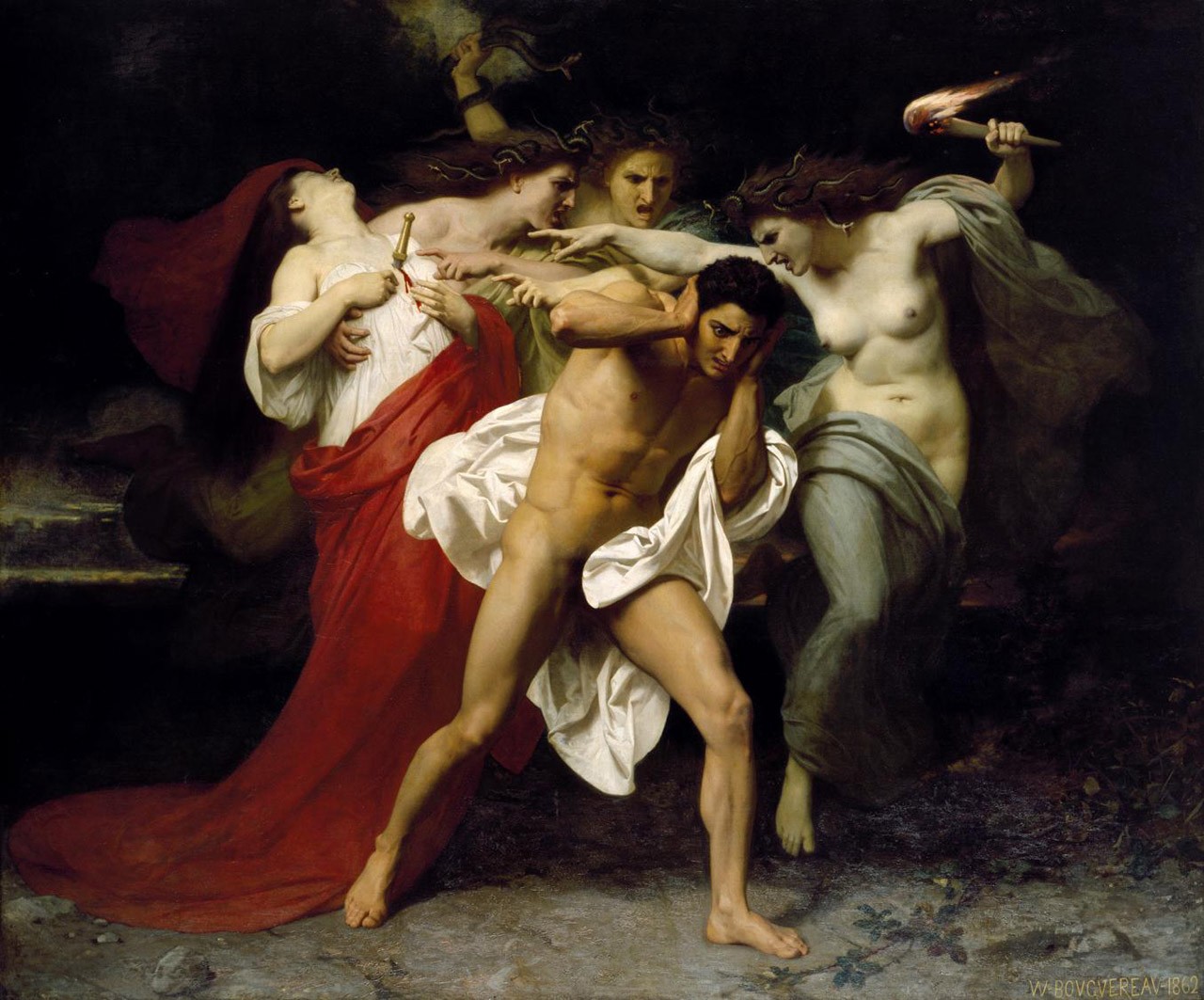
Willem-Adolphe Bouguereau, Liberal Democrat Pursued By the Furies, 1862, Chrysler Museum of Art
Jay Ambrose takes on the role of Greek chorus, chanting about the lessons “Progressives” should have learned when they were turned out of office last time and didn’t.
Go back some decades, and it looked as if liberals were going to be the death of America. They wanted to take it really easy on criminals. They favored welfare programs that destroyed families. They backed foreign aid that buttressed tyrannies. Their way of dealing with enemies was unilateral disarmament. Still other proposals could have spent, taxed and regulated us into oblivion.
The voters didn’t like all of this, the L-word became a curse, and so liberals went into something akin to a witness protection program. They changed their name to “progressives” and if they did not quite hide out, they became less obtrusive with some of their views. Yes, they griped, fumed, engaged in numerous sneak attacks and thumbed their noses at the opposition, but they did turn the lights dimmer than before on their grand vision of free-enterprise destruction and runaway statism.
Ah, but then after their surprising 1990s ascension came the self-destruction of earmark-happy, spendthrift congressional Republicans who seemed to assume power was theirs forever, even if many of their principles were proving strangely evaporative.
So first off, the Democrats took back Congress. Then Barack Obama used unexcelled rhetorical skills, a recession, an unpopular war in Iraq and George W. Bush’s deep decline in public estimation to capture the White House. Conservative values had supposedly been rejected, and behold, it was the liberal hour, a time for the enlightened few to strike back, to fix things – glory, glory hallelujah!
The arrogance was suffocating. Resurrected liberals were practically smirking as they instructed us to sweet-talk our way out of terrorist threats, advised we should quickly duplicate Europe’s semi-socialist mistakes and condescendingly dished up all manner of other liberty-smothering ideological inanities that would transform America into a poor imitation of what it once was. …
Ordinary Americans have caught onto all of this, and so, I am sorry, liberals, but the word of the day for you is “lose.” Your side has lost elections in New Jersey and Virginia, and now your side has lost the Senate seat previously held by the very liberal Ted Kennedy in very liberal Massachusetts to Scott Brown, a Republican.
The message to the Democrats is simple. Either give up your liberal ways and veer toward the center or face political catastrophe in November’s general election. The message to liberals generally is also simple: Get back into your witness protection program.
No, Senators and Congressmen, the message of 2008 was not, “Go ahead and repeat the New Deal.” What 2008 really proved is that Americans are, for the most part, pragmatic and apolitical. When politics gets too noisy or too scary, when things start going to pot economically, they throw out the incumbents and send in the other team.
The Clintons alarmed America with Hillarycare, and the voters took away their Congressional majority. So Bill Clinton pulled in his horns and tried to govern competently, making noises like a Centrist. The economy caught fire as the Republican Congress favorably impacted economic policies, and Bill Clinton ironically even escaped removal from office, despite the Monica Lewinsky scandal and his perjury, because the public was decidedly content with a divided government featuring a competent democrat administration (however corrupt) as long as the economy was good.
Barack Obama has a very undeserved reputation for high intelligence. He is so stupid that he never even understood that there has come to exist, post the unhappy 1970s, a fundamental and unspoken contract between voters and leaders in American national politics: Don’t screw up the economy and you can be in office.
Your are browsing
the Archives of Never Yet Melted in the '2010 Election' Category.
/div>

Feeds
|