A moving and nostalgic video which adds a musical background to 19th century hand-colored sketches of palaces and manor-houses in the former Grand Duchy of Lithuania (today’s Lithuania and Belarus) by the artist Napoleon Orda. Orda’s drawings record the romantic architecture of an aristocratic world swept out of existence by Revolutionary violence and totalitarianism.
The “Eastern Borderlands” is a translation of the Polish word kresy.
Death and Taxes describes the latest development in exhibition art works.
Sleeping Beauties†in heavy make-up and long white nightgowns are lying on beds at National Art Museum of Ukraine, waiting to be kissed by the general public. Each girl has signed a contract with artist Taras Polataiko, promising to marry any man who can open her eyes with just a kiss.
And any unmarried male suitor over the age of 18 who comes to view the exhibit has to sign a similar contract: if the Sleeping Beauty opens her eyes during the kiss, he’ll be her husband.
While installations involving real people are always weird, this one is something special: How does one open a sleeping person’s eyes with a kiss without actually prying her eyelids open with his mouth?
One of the beauties explains: “If it’s my true love, I will feel it on an intuitive level. Secondly, if I don’t feel it, I won’t open my eyes. Anything can happen in life. And suddenly it’s fate. What if it’s the only way I’ll meet my soul mate?†Which means the kisses will be mouth-to-mouth, and she’ll be choosing a husband based entirely on his kissing skills.
I thought for a moment this might be an amazingly sharp photo of the surface of Jupiter or Saturn or one of their moons, but, no, that couldn’t possibly be right. It had to be some sort of art.
I tracked it down and found it was an image created by Markus Mrugalla, an artist, photographer, and graphic designer, born in Poland in 1985, who currently lives in Germany.
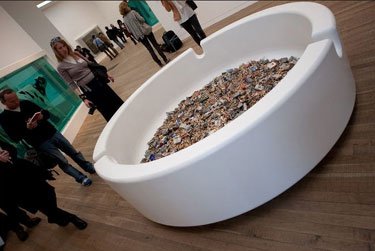
Damien Hirst, Crematorium [a giant ashtray filled with cigarette butts and packets], Tate Gallery, London
“‘Charles,’ said Cordelia, ‘Modern Art is all bosh, isn’t it?’
“‘Great bosh.’
—–Brideshead Revisited
Not all Modern Art is bosh really, but an ever-increasing percentage certainly is. How did it come to this? Jacob Willer, in an absolutely brilliant essay in Standpoint magazine, explains how the ideology of Romantic Rousseauianism has transformed the art schools and, along with them, most artists’ abilities and goals. Today, nobody learns to draw or paint at Art School. When you mess up a print, the instructor applauds your spontaneous expression and awards your blunder top marks.
[T]he brochure of one prestigious art school reads:
The course… encourages you to test the boundaries of drawing practice… You will be asked to explore drawing as an end in itself as well as a means for exploring other modes of art practice such as sculpture, installation, performance and film … the course offers a distinct approach to drawing fine art practice.
“Test the boundaries of drawing” means to do anything but drawing. Exploring drawing “as a means for exploring other modes of art practice such as sculpture, installation, performance and film” really means dissolving drawing into everything else, and calling everything else drawing, until drawing has been redefined, and defined out of existence — till it can mean pins and strings and bus-rides. A “distinct approach to drawing” indeed, but sadly, it is “distinct” in many art schools today.
My head of painting did writing, albeit on canvas, and the head of sculpture did performances which he sometimes filmed. I remember a fellow student once “testing the boundaries” of painting, and no doubt using it to “explore other modes of art practice”, by hanging a torn blank canvas on the wall through which protruded a pink plastic vibrating penis. I found it impossible not to laugh as we were gathered to contemplate this “piece” and the head of the school pronounced that it had a certain pathos. But, comedy aside, note that paint was nowhere involved, although this was the painting term. The violated canvas was judged a sufficient reference to the accoutrements of painting, and irreverent enough to be passed as “painting” — and four full weeks’ painting at that.
This is the deathbed portrait of an unknown man with the hairstyle of the 1640s, commonly described as being the portrait of James, Duke of Monmouth, executed in 1685.
The Telegraph informs us that art historians are proposing to employ facial recognition software developed for Counter-Terrorism to identify the unknown subjects in some well-known works of art.
Software developed to recognise terrorist faces is being adapted to solve the mystery of portraits of unidentified people. …
A feasibility study is being conducted by two art historians and an electronic engineer at the University of California. They describe FACES (Faces, Art and Computerised Evaluation Systems) as a “new tool for art historians”. The project has received a $25,000 government grant.
Conrad Rudolph, professor of art history at the university, said: “Before the advent of photography, portraits were, almost by definition, depictions of people who were important in their own worlds. But, as a walk through almost any major museum will show, a large number of these unidentified portraits from before the 19th century have lost the identities of their subjects.”
His paintings are hanging in an estimated one of every 20 homes in the United States. Fans cite the warm, familiar feeling of his mass-produced works of art, while it has become fashionable for art critics to dismiss his pieces as tacky. In any event, his prints of idyllic cottages and bucolic garden gates helped establish a brand — famed for their painted highlights — not commonly seen in the art world.
“I’m a warrior for light,” Kinkade told the Mercury News in 2002, alluding not just to his technical skill at creating light on canvas but to the medieval practice of using light to symbolize the divine.
———————————–
Art Critic Jerry Saltz did not have very kind words for the deceased or for his artistic pronouncements.
Kinkade’s “serene simplicity” wasn’t limited to his ideas about imagery. They had everything to do with what Andy Warhol called “business art.” Kinkade was willing to go the full Warhol. He mass-produced his pictures, making prints and images painted by factories filled with assistants. A recent ad advertised “a Master Highlighter Event … an 8-hour personal stage appearance by a certified Thomas Kinkade Master Highlighter. At the event, a highlighter enhances images of the gallery’s choice.” Needless to say, these are the very things that artists like Kinkade, and of late David Hockney, have railed about when they’re done by Jeff Koons, Takashi Murakami, or Damien Hirst. In fact Kinkade makes Koons & Co. look like a boutique. After all, Jeff Koons never built his own gated communities in California, with houses and grounds in the likeness of his paintings, with starting prices at $425,000. (As for creating serenity, it’s often mentioned that Kinkade “has a long history of cursing and heckling other artists and performers … that he openly groped a woman’s breasts … and once relieved himself on a Winnie the Pooh figure while saying “This one’s for you, Walt.”
This Hopper-esque painting of houses in Manayunk, a neighborhood in the northwest section of Philadelphia, viewed from the Cynwyd Trail by Nancy Herman reminded me very powerfully of the view of house roofs I saw looking out the attic window of my boyhood home in Shenandoah, Pennsylvania. I was startled and a bit moved by nostalgia. It seems that densely built, working class Pennsylvania neighborhoods have a pretty strong degree of architectural similarity.
The artist writes:
This is the last painting from the Cynwyd Trail for now. I know I will be returning to these close-ups of Manayunk from the trail sooner or later as I love the shapes created by the roof tops. While I am painting them I imagine living in these houses, which adds to the fun. Everything looks so cheery on this sunny afternoon but what is it really like to live there?
She actually sells these for only $125. If that one weren’t already sold, I’d have liked to have acquired it.
Hat tip to Vanderleun. How did he find it, I wonder?
The Aurignacian culture of the Upper Paleolithic (Late Old Stone Age) flourished between 45,000 and 35,000 years ago (or so we think, theories of carbon dating are subject to revision).
The Aurignacians are generally awarded the title of being our earliest genuinely human ancestors in Europe on the basis of artistic achievement. It was they who produced the Hohle-Fels Venus, the Chauvet cave paintings, and the Stadel cave Löwenmensch (“Lion Man”), all powerfully moving, but cryptic and fundamentally incomprehensible to us, artistic expressions.
The last object, the Löwenmensch, was discovered in a cave in the Swabian Alps in 1939. WWII resulted in its being neglected for 30 years, but eventually scholar attention arrived. The fragments were assembled, and interpreted. First, as a deity or a shaman representing a lion god, later as (Gawd help us!) a “cave lioness” and an icon of Stone Age Feminism.
Near the end of the last century, a few more pieces were discovered, so scientists are now in the process of removing earlier “restored” bits and having a go at reassembling the original artifact absent recent interpolations. The results will be very interesting.
Harry B. Nielson, Mr. Fox’s Hunt Breakfast on Christmas Day, chromolithograph print published in Vanity Fair, Christmas, 1897
The hunter characteristically admires, and even identifies with, his quarry, and that sense of identification commonly leads to the visualization in the hunter’s imagination of the animal object of the chase as a fellow sportsman, participating in the hunt with equal pleasure and enthusiasm and equal relish of tradition.
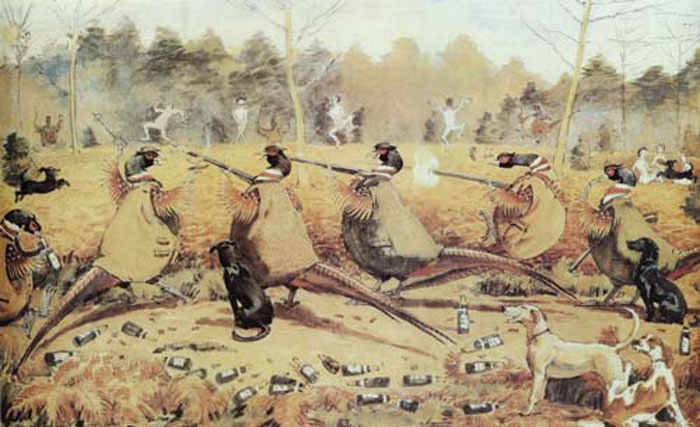
The same comedic effect, and the same sportsman’s pleasure in thinking of his adversary in the field as fellow sportsman, can be found in shooting prints, like the very well-known contemporary print by Alexander Charles-Jones “Cocks Only,” which gleefully depicts a line of Ringnecked Pheasants in hunting vests, smoking cigars and drinking while peppering a discomfited group of incoming naked men.
Another classic example of the same humorous genre by Snaffles, published in Hoghunter’s Annual in the 1930s, depicts a couple of senior ranking boars smoking cigars and admiring trophy mounts of British officers acquired in the hunting field.
I had assumed, without any special investigation or thought on the matter, that this genre of sporting humor was specifically British and Victorian, but I was decidedly wrong.