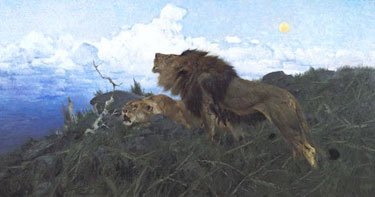
Friedrich Wilhelm “Lion†Kuhnert, as his contemporaries knew him, was born in Oppeln, Germany, in 1865. After beginning an apprenticeship at age 17, Kuhnert moved to Berlin in 1883 and studied with renowned animal painter Paul Meyerheim at the Berlin Academy of Arts. Kuhnert first traveled to Africa in 1891, going on safaris in the German and English colonial territories. He sketched and made field notes along the way, later turning them into impressive oil paintings in his Berlin studio.
A hunter as well as a painter, Kuhnert traveled to Africa annually to capture its wild animals in the flesh and on the canvas. Between Kuhnert’s extended visits to Africa, he returned to Germany and continued his wildlife studies, traveling throughout Europe in pursuit of its indigenous species, including red stag, elk, bison, wild boar, and moose.
It’s estimated that Kuhnert’s body of work once totaled 5,500 paintings. Today there are less than a thousand known works in existence. The remainder of his artwork was destroyed or lost in World War II.
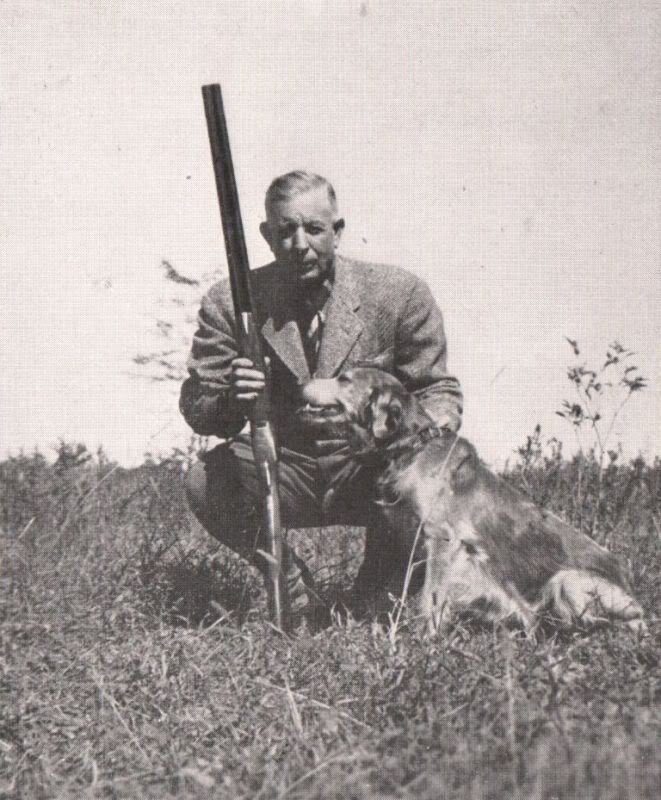
On December 1, 1948, two hunters emerged from the cool wetlands of Clarendon, Arkansas, and ambled along a country road. The men—Nash Buckingham and Clifford Green—had spent a long morning in a duck blind and were headed back to Green’s car, on their way home. Buckingham, then sixty-eight years old, was at the time one of the most famous writers in America, a sort of Mark Twain for the hunting set. At Green’s car, they met a warden, who asked to see their hunting licenses. The warden quickly realized that he was in the presence of the celebrated writer. He asked Buckingham if he could see the most famous shotgun in America, Buckingham’s talisman, an inanimate object that the writer had referred to—in loving, animistic terms—in a great number of his stories. The nine-pound, nine-ounce gun was a side-by-side 12-gauge Super Fox custom-made by the A. H. Fox Gun Company in Philadelphia.
The carbon steel plates on the frame were ornately engraved with a leafy scroll. The gun company’s signature fox, nose in the air, was engraved on the floorplate. The barrels had been bored by the renowned barrel maker Burt Becker and delivered 90 percent patterns of shot at 40 feet, an uncharacteristically tight load for a waterfowling shotgun. It was named Bo Whoop. A hunting buddy had designated it so, after the distinct deep, bellowing sound it made upon discharge.
The warden chatted up Buckingham, handling and admiring the writer’s gun, like a kid talking to Babe Ruth while holding the slugger’s bat. At some point during the conversation, the warden laid the gun down on the car’s back fender. Buckingham and Green soon bid the warden farewell and drove off, forgetting about Bo Whoop until many miles into their trip home. In a panic, they turned around and retraced their route, painstakingly eyeing every inch of the road, to no avail.
Buckingham spent the next few years in a desperate hunt for Bo Whoop. He lamented the loss of Bo Whoop in print, likening it to the death of a treasured hunting dog. He took out ads in local newspapers, offering rewards. He befriended local wardens and police, appealing to them to be on the lookout.
He would never find it. …
Sometime in the 1950s a foreman at a sawmill in Savannah, Georgia, was offered an elegant but well-used Fox shotgun with a broken stock. The seller wanted $100. The Savannah foreman took one look at the fractured stock and countered with an offer of $50. The sale was made at that price. The foreman then put the gun in his closet, where it remained for the next three decades.
The foreman’s son, who also lived in Savannah, eventually inherited the gun upon his father’s death. He, too, left the gun in his closet, this time for nearly twenty years. But in 2005, for reasons unknown (the consignor’s family wishes to remain anonymous), he brought the gun to Darlington Gun Works, a South Carolina shop owned by Jim Kelly, a noted gunsmith. The foreman’s son wanted to repair the broken stock. Kelly, a student of hunting history, saw that on the top of the right barrel there was a hand stamp that read: “Made for Nash Buckingham.†On the top of the left barrel: “By Burt Becker Phila. PA.†Kelly was floored. “I couldn’t believe that this gun had walked right in here,â€
Bo Whoop was sold by James D. Julia in 2010 for $201,250. Its purchaser donated the historic shotgun to Ducks Unlimited.
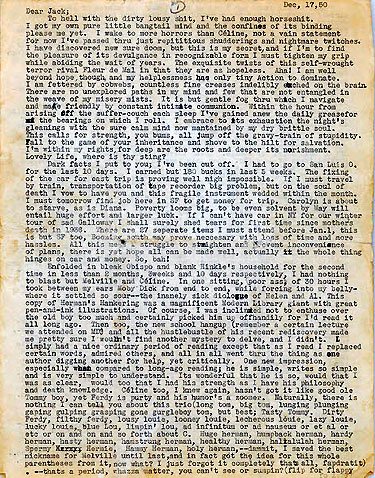
At Christie’s Books and Manuscripts Sale 12260, 16 June 2016, in New York, Neal Cassaday’s 40-page Lost Letter to Jack Kerouac, Lot 146, Estimated price: $400,000 — $600,000.
Considered ‘lost’ for 66 years, Neal Cassady’s visionary ‘Joan Anderson letter’ is a foundational document of the Beat era and the inspiration for Kerouac’s literary revolutions, beginning with On the Road.
Neal Cassady’s long-lost letter to Jack Kerouac, dated 17 December 1950, has permeated virtually every conversation about the Beat era. Referenced not only by Kerouac but by Allen Ginsberg, Laurence Ferlinghetti, Herbert Hunke, and a host of their contemporaries, Cassady’s fluid, incantatory, and deeply revealing prose influenced the entire generation of Beat writers.
The letter was written on a three-day Benzedrine high, Cassady later confessed. It contained, by Kerouac’s first calculation, at least 13,000 words and ran to 40 pages, offering a compelling, unaffected and discursive account of Cassady’s frenetic love life in 1946, particularly with Joan Anderson (whom he visited in a hospital after a failed suicide), and ‘Cherry Mary’, recounting an acrobatic escape through a bathroom window when they were surprised by Mary’s aunt. The uninhibited, non-literary narrative pointed the way to the free, truthful style to which Kerouac aspired.
The world’s most expensive rifle–setting the record at auction for $1.265 million–is a lever-action Winchester, with a blued and case-hardened finish, engraved only with “Albee to Lawton.†It’s an unadorned Model 1886, serial number 1, given to Captain Henry Ware Lawton to celebrate his successful campaign against Geronimo, the fierce leader of the Chiricahua Apache tribe, a key event leading to the end of the brutal Apache Wars.
The rifle was auctioned as part of a lot of Lawton’s belongings including an engraved gold-plated C. Howard & Co. pocket watch and matching engraved gold chain, also in recognition of his work hunting down Geronimo. Lawton received prominent awards and medals during his career, including the Medal of Honor, rising to the rank of Major General before dying in battle during the Philippine–American War.
————————————
Rock Island Auctions, 29 April- 1 May 2016, Lot 1025
Guyette & Deeter Auction, 22 April 2016, Lot 483, A turkey call hand-made circa 1950 by famous Outdoor Writer and Poet Laureate of South Carolina Archibald Rutledge.
Estimate: US $1,250.00 – US $1,750.00 — Opening Bid: $650.00
Archibald Rutledge was heir to Hampton Plantation, Poet Laureate of South Carolina, and the direct descendant of a signer of the Declaration of Independence, a governor of South Carolina, and a Chief Justice of the US Supreme Court. He published numerous articles on hunting and the out-of-doors in Field & Stream, Outdoor Life, and similar serial publications, as well as close to 40 books. He taught English for many years at Mercersburg Academy in Pennsylvania.
Czerny’s International Auction House, Sarzana, Italy, Fine & Scarce Antique Arms & Armor Sale, 26 March 2016, Lot 574.
Estimated Price: €7,000 – €8,500
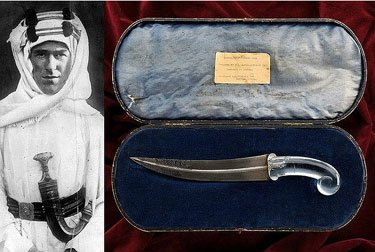
A very interesting rock crystal hilted kandshar from the property of Lawrence of Arabia
dating: mid-19th Century
Curved, double-edged blade with a raiser made of fine, wootz damask at the centre (areas of rust); rock crystal grip (sliver near the quillon).
Kept in a wooden case covered with black, gilt-hemmed paper, lined with light-blue silk and bue velvet, the cover featuring a label with the writing “Jambia/Rock Crystal Hilt – Property of T. E. Lawrence/Clouds Hill – Lawrence of Arabia – Purchased S. W. Cottee & Son Wareham Dorset”.The lieutenant colonel Thomas Edward Lawrence (Tremadog, 16th August 1888 — Wareham, 19th May 1935) was a British intelligence agent, a military officer, archaeologist and writer, mostly known as Lawrence of Arabia; he was renowned for his liaison role during the Arab Revolt at the beginning of XX Century.
Sale: S. W. Cottee & Son (known today as “Cottees”);
The relic dating from the fifteenth century was sold for 297,600 pounds (376,833 euros –$410,361.72) to a Frenchman who wished to remain anonymous, said the spokesman for the Timeline auctions.
The opening bid was 14,000 pounds (19,051 euros — $20,746.06).
According to representatives of the auction house, Joan of Arc gave a detailed description of the ring during her interrogation at Rouen 17 March 1431. It contains the inscription Jhesus Maria and three engraved crosses.
The ring, accompanied by authentication documents, is kept in a wooden casket. After the execution of Joan, the precious object was worn by King Henry VII of England.
“The ring returns to France,” the spokesman for the auction house told reporters without revealing the name of the French citizen who acquired the relic.
The jewelery was sold by the son of Charles de Gaulle’s personal physician. Earlier, the French government had proposed to examine the possibility of buying this relic.
—————————————–
——————————————
——————————————
Timeline Auctions, Antiquities, 25 February 2016, Lot 1220
MEDIEVAL JOAN OF ARC DEVOTIONAL RING WITH CASKET AND DOCUMENTS
15th century AD
With a published Joan of Arc association dating back over a century, exhibited twice in France in the 1950s and in the Museum of Lancashire Millennium Exhibition, January to December 2000, this ring has a silver-gilt hoop with facetted outer face, expanding shoulders and two rectangular and angled fields to the bezel; the hoop with incised niello-filled florid lozenges and triangles, the design giving the appearance of three crosses, the ends of the shoulders with blackletter ‘I’ and ‘M’ (for ‘Iesus Maria’), the lateral faces with blackletter ‘IHS’ and ‘MAR’ (as abbreviations for Jesus and Maria); a small section inserted later to the hoop, sufficient possibly to enlarge it from a band suitable for a small, feminine finger to a larger male(?) hand; the degree of wear generally evident to the ring, including to the hoop insert, suggesting an extended period of wear, long after the date of making, perhaps indicative of the ring’s appeal as a talisman; contained in an antique, small oak casket in the form of an architectural reliquary with pitched and hipped lid, the ridge surmounted by a plain cross in iron, the box red velvet-lined, with a removable rectangular holder (the compartment beneath possibly having once held a small document or label), arranged to display the bezel and purpose-made to hold the ring, indicating the reverence in which the ring was already held when the box was made for it; the ring is very unusual in that the vast majority of rings with angled rectangular bezels have them engraved with pictures of saints rather than being inscribed (generally termed as iconographic rings); inscriptions on such rings are normally on the hoop part.
Accompanied by a professional drawing showing the ring extended, with the three crosses forming part of the design to the shank clearly depicted; also with publications, documents, press cuttings and correspondence including a photocopy of the 1917 Oates privately printed catalogue; a cuttings book containing an extract from the Sotheby’s sale of 1947 (including an image of the ring), with press cuttings from such publications as the Evening Standard, Daily Telegraph and Le Figaro at the time of that sale, followed by others (some illustrated, showing both ring and casket) including from English, American and French newspapers and periodicals in the 1950s, from when the ring was exhibited in France (at La Turbie and also at Rouen and Paris); associated correspondence with the mayor of La Turbie and further referring to the 500th rehabilitation anniversary exhibition; typescript research notes and a signed note by Cyril Bunt (dated 1949) discussing Cardinal Beaufort and the ring and its descent to Lady Morrell; papers relating to two interviews with the British Broadcasting Corporation (BBC) in 1953 and 1956; correspondence with the French embassy in London, shipping documents and permissions for the ring to be sent to France for exhibition; a photocopy of the last letter (with transcript) of Joan of Arc; the exhibition pamphlet for La Turbie (4 copies, 3 in English, 1 in French, 1952), the catalogue for the Jeanne d’Arc et Son Temps exhibition (Rouen and Paris, 1956); documents, including the mounted display caption, from the AD 2000 – The Story of Christianity in Lancashire exhibition at the Museum of Lancashire held in 2000; other correspondence of various dates from 1950s to 1980s regarding the ring, most of the letters with envelopes. Ring: 4.90 grams, 21mm overall, 18.27mm internal diameter (approximate size British Q, USA 8, Europe 17.49, Japan 17); casket: 127 grams total, 79 x 58 x 77mm (Ring: 3/4″ casket: 3 1/4 x 2 1/4 x 3″). Good condition; surfaces worn.
Provenance
Property of an Essex gentleman; inherited 1979 from Dr James Hasson of Harley Street, London; acquired Sotheby’s sale, 1 April 1947, lot 37; formerly in a private collection (1929-1947); previously with the F. A. Harman Oates collection (sold Sotheby’s, 20 February 1929, lot 21); earlier with Augustus John before 1914, the gift to him of Lady Ottoline Morrell; by descent, through the Cavendish-Bentinck family (Duke of Portland) from cardinal Henry Beaufort (1375-1447), who was present at the trial and execution of Joan of Arc in 1431; the ring stated by Joan at her trial to have been a gift from her parents. Supplied with a positive X-Ray Fluorescence metal analysis certificate.
But they will certainly speak volumes, and what a display for a Texas oilman’s wall this collection of rare and rusty firearms would make!
James D. Julia Auction, Quality Firearms, March 14, 2016, Lot 1160
WONDERFUL COLLECTION OF TEXAS RELIC FIREARMS FOUND IN TEXAS AND ASSEMBLED OVER MANY YEARS BY BILL STEWART OF SONORA, TEXAS FEATURING A 9″ FLAT CYLINDER NO. 5 TEXAS PATERSON REVOLVER.
SN NSN. Cal. 34. 1) Texas Paterson revolver with 9″ bbl and flat cylinder. This revolver was found by a young boy near the Burgess Spring Waterhole on the outskirts of Alpine, Texas in 1962. This relic was displayed at the T.G.C.A. “Parade of Texas Patersons†in November of 1994 and also in early 2000’s at the T.G.C.A. show in San Antonio, Texas. The revolver has 3 loaded chambers. This revolver is accompanied by a letter from Bill Stewart telling the story of this wonderful relic and states that he believes this relic is one of the orig group purchased by Republic of Texas and issued to Texas Rangers. Also included is a letter form Victor Friedrichs to Mr. Stewart discussing this gun. Also included is a handwritten note from Paterson experts Linda Lassister and Steve Evans stating that they would “someday like to have a “Rusty†Paterson of their ownâ€. 2) Colt model 1839 Paterson carbine of type ordered by the Republic of Texas. 3) Cal. 44 revolver with flat-sided frame that appears to be a Dance. 4) Large-framed Dragoon revolver with rnd trigger guard and small loading cut. Appears to be Tucker, Clark, and Sherard. 5) Colt model 1848 “Baby Dragoon†with rammer. SN 7042 on backstrap and trigger guard. 3 cylinders capped and loaded. 6) Colt model 1860 Army Richard/Mason conversion no. 147249 on trigger guard. 7) Model 1855 Colt receiver and cylinder in 52 Cal.. Accompanied by orig cartridge for this model. 8) Colt model 1855 Root rifle. 9) Whitney-Kennedy lever action rifle. 10) Bbls from double-gauge percussion. PROVENANCE: The Estate of G. W. “Bill†Stewart of Sonora, Texas. CONDITION: 1) As found. 3 loaded chambers. Grips and straps are missing. 2) Bbl, cylinder and loading lever present. Buttstock is missing. 3) Bbl, cylinder and frame present. Grips and straps are missing. 4) Bbl, cylinder, frame and brass straps. Grips missing. 5) Bbl, cylinder, frame, backstrap and trigger guard. Grips are gone. SN visible on trigger guard and backstrap. 6) Bbl, cylinder, frame, and trigger guard. Hammer, backstrap and grips are gone. SN and some silver visible on trigger guard. 7) Frame, cylinder, and arbor. Clear Colt marking. Cleaned with naval jelly. 8) Bbl, frame, and cylinder. Stocks are gone. Frame cracked in front of cylinder. 9) Bbl, magazine, receiver, lever and hammer. Stocks are gone. Silver blade front sight on bbl. 10) Bbls only. A very unique opportunity to obtain a wonderful collection of relics that were all found in Texas by an old time collector featuring an award winning no. 5 Paterson revolver and a model 1839 Paterson carbine. 49973-162, 49973-159, 49973-160, 49973-161, 49973-163, 49973-250, 49973-251, 49973-252, 49973-389, 49973-390, TEP (10,000-20,000)
9″ Barrel Texas Patterson Revolver, one of original group purchased by the Republic of Texas and issued to Texas Rangers for use against the Comanches in the 1830s.
A 1957 Ferrari driven by the great British motor racers of the 1950s broke the record for the world’s most expensive racing car sold at auction after fetching just over €32 million ($35.7 — £24.7 million) on Friday.
Despite the stratospheric price at the Artcurial auction in Paris, the buyer cannot use the vehicle on the roads as it was designed purely for racing.
Chassis 0674 left Enzo Ferrari’s Maranello workshop in 1957 and in March of that year was entered in the 12 Hours of Sebring in Florida. It was driven by Peter Collins and Maurice Trintignant in the endurance race and finished sixth. In May, Ferrari brought the car back to Italy and entered it in the 1,600 km Mille Miglia with Wolfgang von Trips at the wheel. It was one of four cars Ferrari entered in the race and it finished second behind Piero Taruffi and his Ferrari 315 S.
Following the 1957 Mille Miglia, which turned out to be the last-ever edition of the road race after 12 people were killed, the car was returned to the Maranello factory and upgraded to ‘335 S’ spec. This entailed boring out the 3.8-liter V12 to 4.1-liters, which boosted output from 360 horsepower to 400 and raised the top-speed to 186 mph (300 km/h).
Following the modifications the car was entered in the 1957 24 Hours of Le Mans where it was raced by F1 champion Mike Hawthorn and Luigi Musso. It was unfortunately retired in the fifth hour due mechanical problems, but not before it took the lead ahead of the Maserati and Jaguars and set the first lap record at Le Sarthe with an average speed of over 200 km/h (203.015 km/h).
Following its Le Mans showing the car finished fourth in the Swedish Grand Prix, second in the Venezuela Grand Prix and helped Ferrari win the World Constructors’ Title. In 1958 it was piloted to victory in the Cuba Grand Prix by Masten Gregory and Stirling Moss and was also raced in various American races by Gaston Andrey and Lance Reventlow.
The car has sat in Bardinon’s collection since 1970.
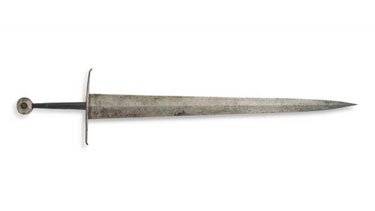
This 600-year-old Italian broadsword (Oakeshott Type XVIIIC) came out of the armory at Alexandria, having been made as a diplomatic gift from the king of Cyprus to the Mamluke Sultan of Egypt in 1419. It became part of the collection of the renowned arms historian Bashford Dean (1867-1928) and was left by him to his sister Harriet Martine Dean. Harriet died in 1943 and the sword was sold into an unknown private collection from which it recently emerged.