R.L.G., writing in the Economist, wants to see the real ideological opponents square off and come out swinging. I’m with him.
[W]atching Mitt Romney pivot to the centre with the smoothness of a consultant flipping to his next slide, a manoeuvre we can all expect him to execute the minute he wraps up the nomination, will be depressingly predictable. The perception that he will say whatever he feels he must to become president is not founded on sand. Mr Gingrich, by contrast, can almost certainly be counted on to be the same Mr Gingrich we’ve seen in the primaries. Say what you like about the man, but he has ideas, says arresting things, and most of all, would make the clearest possible contrast with Barack Obama in the general election.
While some people groan at his idea for a series of “Lincoln-Douglas” debates, for example, I’d relish the chance to see Mr Gingrich and Mr Obama have long and freewheeling exchanges. …
t I can very easily imagine Mr Gingrich repeating the “food-stamp” line in a general-election debate with Mr Obama several feet away. This would be a natural extension of his claim that journalists asking him questions about the story of the day was “despicable”. He is fearless, reckless, filterless; in any way, -less all of the things Mr Romney has too much of.
I want to see Mr Obama reply to “food-stamp president”, to the idea that annoying appeals courts should be de-funded, to the Gingrich claim that he is the most radical president in history, and so much more. I dread the scripted turns the election will take if Mr Romney is the nominee. I think America could use a straight fight between two boldly different visions of America. I don’t expect I’ll get my wish, but a journalist can dream, anyway.
The Wall Street Journal yesterday explained the Obama administration’s astonishing decision.
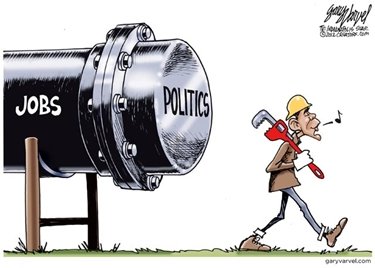
The central conflict of the Obama Presidency has been between the jobs and growth crisis he inherited and the President’s hell-for-leather pursuit of his larger social-policy ambitions. The tragedy is that the economic recovery has been so lackluster because the second impulse keeps winning.
Yesterday came proof positive with the White House’s repudiation of the Keystone XL pipeline, TransCanada’s $7 billion shovel-ready project that would support tens of thousands of jobs if only it could get the requisite U.S. permits. Those jobs, apparently, can wait.
Unless the President objected, December’s payroll tax deal gave TransCanada the go-ahead in February to start building the pipeline, which would travel 1,661 miles from Alberta to interconnections in Oklahoma and then carry Canadian crude to U.S. refiners on the Gulf Coast.
The State Department, which presides over the Keystone XL review because it would cross the 49th parallel, claimed yesterday that the two-month Congressional deadline was too tight “for the President to determine whether the Keystone XL pipeline is in the national interest.” The White House also issued a statement denouncing Congress’s “rushed and arbitrary deadline,” which merely passed with overwhelming bipartisan support.
This is, to put it politely, a crock.
Keystone XL has been planned for years and only became a political issue after the well-to-do environmental lobby decided to make it a station of the green cross. TransCanada filed its application in 2008, and State determined in 2010 and then again last year that the project would have “no significant impacts” on the environment, following exhaustive studies. The Environmental Protection Agency chose to intervene anyway, and the political left began to issue ultimatums and demonstrate in front of the White House, so President Obama decided to defer a final decision until after the election.
—————————
Robert J. Samuelson, in the Washington Post, calls the decision to block the pipeline an act of insanity, noting that it is an act of pure symbolism, no utility, not even supposititious enviro-utility is actually thereby served. But reality is never allowed to stand in the way of ideology by this administration.
President Obama’s rejection of the Keystone XL pipeline from Canada to the Gulf of Mexico is an act of national insanity. It isn’t often that a president makes a decision that has no redeeming virtues and — beyond the symbolism — won’t even advance the goals of the groups that demanded it. All it tells us is that Obama is so obsessed with his reelection that, through some sort of political calculus, he believes that placating his environmental supporters will improve his chances.
Aside from the political and public relations victory, environmentalists won’t get much. Stopping the pipeline won’t halt the development of tar sands, to which the Canadian government is committed; therefore, there will be little effect on global-warming emissions. Indeed, Obama’s decision might add to them. If Canada builds a pipeline from Alberta to the Pacific for export to Asia, moving all that oil across the ocean by tanker will create extra emissions. There will also be the risk of added spills.
Now consider how Obama’s decision hurts the United States. For starters, it insults and antagonizes a strong ally; getting future Canadian cooperation on other issues will be harder. Next, it threatens a large source of relatively secure oil that, combined with new discoveries in the United States, could reduce (though not eliminate) our dependence on insecure foreign oil.
Finally, Obama’s decision forgoes all the project’s jobs. There’s some dispute over the magnitude. Project sponsor TransCanada claims 20,000, split between construction (13,000) and manufacturing (7,000) of everything from pumps to control equipment. Apparently, this refers to “job years,†meaning one job for one year. If so, the actual number of jobs would be about half that spread over two years. Whatever the figure, it’s in the thousands and thus important in a country hungering for work. And Keystone XL is precisely the sort of infrastructure project that Obama claims to favor.
The big winners are the Chinese. They must be celebrating their good fortune and wondering how the crazy Americans could repudiate such a huge supply of nearby energy.
Andrew Sullivan prefaces his recent Newsweek article offering an unusually optimistic assessment of the current president’s prospects and achievements by confessing:
I write this as an unabashed supporter of Obama from early 2007 on. I did so not as a liberal, but as a conservative-minded independent appalled by the Bush administration’s record of war, debt, spending, and torture. I did not expect, or want, a messiah. I have one already, thank you very much.
Barack Obama is, only too obviously, a political figure originating from the most extreme fringe of the radical left remodeled into a merely aggressively Progressive democrat. Barack Obama deliberately chose to break with the New Democrat/New Labour 1990s center leftism model successfully adopted by William Clinton and Tony Blair, in which politicians of the left offered an implicit understanding that their efforts to deliver more benefits to labor and the less well off would be pursued with restraint and never in such a way as to jeopardize economic growth and the general welfare of the country.
How it is, in any way, shape, or form, legitimately possible for a “conservative minded” person to be a supporter of Barack Obama is a mystery to me.
If one were so pacifistically-inclined that George Bush’s wars made one into a democrat, well, it is difficult to fail to notice that Barack Obama has continued the same military efforts.
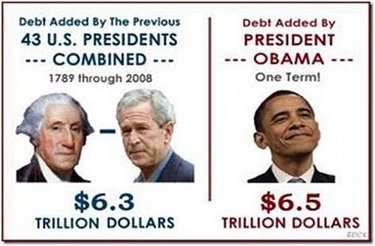
Pointing to Bush’s war-time debt increases as justification for supporting Obama goes beyond obliviousness, on the other hand, far, far into hypocrisy. Barack Obama presided over a domestic spending spree utterly unprecedented in history in straightened economic times, multiplying dramatically all previous debt and, finding himself faced with a imminent crisis in funding existing entitlement obligations, proceeded, in defiance of an enormous public outcry of protest, to add a new massive entitlement.
Referring to mildly coercive interrogation techniques, carefully limited so as to inflict no real injury or permanent effects, as torture, while indulging in wildly exaggerated rhetoric and striking sanctimonious poses has become one of the principal exercises of Andrew Sullivan’s journalism. Sullivan has thereby become one of the foremost practitioners of the school of moral instruction combining flamboyant and in-your-face sexual latitudinarianism with Pecksniffian priggery applied to defense activities.
So, I start out, even before evaluating Sullivan’s analysis, arguments, and appraisals, confronted with a set of obviously fraudulent credentials. Andrew Sullivan is not “conservative minded.” He is a notoriously unstable and emotionally volatile partisan of the Homintern, who used to be on the right, but who has transferred his political loyalties to the left, partly in order to further the political agenda of his sexual subculture, and partly simply because the opportunities and accommodations are so much better over there.
No wonder that Ann Althouse didn’t even bother reading through the article. She knew perfectly well what she was going to find.
Over lunch with Peter Robinson, Victor Davis Hanson remarked reflectively:
When you think about it, Obama has kept the detention camp at Guantanamo. He’s going ahead with military tribunals. And where Bush only waterboarded three terrorists, Obama has used drones to execute about 2,600.
John Podhoretz explains that Barack Obama’s end-run around the Constitution this week is really evidence of his political weakness and desperation.
President Obama’s executive power-grab this week — making four “recess†appointments when the Senate isn’t in recess — is a mark not of his strength, but of his relative weakness. He is asserting an authority he does not possess through the Constitution because he has precious little personal authority left to assert.
He had it and he lost it, and he can’t figure out how to get it back — so he’s just going to take it.
“When Congress refuses to act, and as a result hurts our economy and puts people at risk, I have an obligation as president to do what I can without them,†Obama said Wednesday as he trumpeted his installation of Richard Cordray as head of his new consumer-activism bureau.
This is rhetoric designed to thrill liberals and Democrats, who (like all partisans and ideologues) love what they take to be the “good fight,†and don’t particularly care how it’s waged. That’s true even if they spent eight years screaming about supposed unconstitutional actions on the part of the Bush administration, every one of which had a far firmer foundation in constitutional law than Obama’s unprecedented action this week.
They also love it because they think it represents an awakening by Obama to the nature of the obstructionist efforts against him (and a winning re-election strategy) when he says he’ll do “what I can†to combat Washington’s brokenness.
This supposedly a) acknowledges the public sentiment against the city whose most powerful resident he is, b) alleges he’s not the reason for the problems and c) places the blame on the recalcitrant Congress.
Maybe it’s the best hand Obama has to play, but it’s not a very good hand. For one thing, the voters who have turned on him don’t think he has exercised too little power, but rather too much — so bragging about doing things without congressional sanction may not play well.
Second, no matter how resolute he sounds, the fact that he has to act in a somewhat rogue manner is an expression of a profound loss of presidential authority — and one that he can’t successfully blame on Congress.
Obama lost his ability to push his agenda through Congress when he received what he himself called a “shellacking†in the November 2010 elections. That shellacking was primarily the result of massive policy overreach when he had a Democratic Congress in his pocket.
He spent 2009 and 2010 getting what he wanted: a trillion dollar stimulus. Auto-industry nationalization. And, of course, his health-care law. It was a wildly successful first 18 months — and it led directly to the bruising defeat he suffered as soon as the American people could render their judgment on those actions.
The independent voters who’d put him over the top in 2008 were horrified by the results. Exit polls showed a 24 percent swing among them, from 8 percentage points in favor of Obama and the Democrats in 2008 to 16 points against in 2010.
What may have been even more painful for Obama’s vanity was his discovery in 2011 that his rhetorical gifts had lost their oomph. He gave speech after speech on topics dear to his heart — and found, each time, that the talk was either ineffectual or actually convinced more people to oppose him.
Podhoretz is perfectly right. Obama’s discreditable (and illegal) ploy is only a short-term strategy to gratify his base and keep the small body of support he still possesses behind him by making a strong gesture of partisanship that makes them happy. Who cares that his action will set a really terrible precedent? Who cares that the appointments will probably be struck down in court? Just as long as he can fire up the base.
Peter Wehner marvels as the doomed democrat administration moves phantom divisions around its political positions map.
We are now reaching the point in which the president is running a truly post-modern campaign, in which there is no objective truth but simply narrative. Obama’s campaign isn’t simply distorting the facts; it is inverting them. This kind of thing isn’t unusual to find in the academy. But to see a president and his campaign so thoroughly deconstruct truth in order to maintain power is quite rare. The sheer audacity of Obama’s cynicism is a wonder of the modern world.
It is all so terribly sad, but actually pretty funny, too.