F.X. Mozart (1791-1844) was the youngest son of Wolfgang Amadeus Mozart. The Canadian pianist Julie Holtzman has specialized in the study and performance of the works of F.X. Mozart for more than three decades.
I wonder if anyone on my followers list would respond to this prompt: write a short poem on the work—character—life of Franz Xaver Mozart. Karl, the older son, became a financial clerk and translator, but F.X. Mozart ended his career as a piano teacher and as the Kapellmeister of the Salzburg Mozarteum. (He died of stomach cancer in 1844, at the age of 53.)
For reasons that don’t need to be given, it should be easier to write and speak about Franz than Wolfgang. Dead clay that did me kindness, I can do none to you…
This scherzo is the most dramatic of the four. It was dedicated to Adolf Gutmann because, according to Wilhelm von Lenz, only Adolf could play the chords in the bass, which cannot be spanned by any left hand (D# F# B D# F# in bar 6). Adolf was one of Chopin’s pupil who could apparently punch a hole in a table. It is also the most ironic and forcefully constructed of the four scherzos, with an almost Beethovenian majesty. The Schezro opens with two mysterious questions that are answered by two striking octaves that even seem uncompromising. The scherzo is built upon two sharply contrasting elements. The first theme in C sharp minor starts with a series of strong accents and thundering scales and follows by a fast and heroic march. As soon as the second theme appears in D flat major, the calmness and serenity wipe out the whole tension. These graceful and luminous passages consist of richly harmonized chorale phrases with shimmering waves of falling notes. It is said that these chorale phrases echo songs sometimes heard at the monastery in Valdemosa. The first theme then repeats, not less striking as when it first appears, but ends in a more shocking way that leads to the second theme, which is now in E major, not D flat major. The second theme follows using the same motif as the previous part, but the transition to the repetition in E minor calls for a sad memory that does not even exist before. After several quiet questions, a silent moment, several waves of sound, and falling octaves, the coda finally comes with a lot of agitation and turbulence. When the coda reaches the high E, a series of rolling waves runs up to a high G#, falls down to a daring stroke A in the bass, and concludes the work with brilliant masterstrokes in C#.
For me, there are two kinds of Chopin players: Apollonian and Dionysian – those who aim at some ideal, unchanging interpretation and those who, like jazz players, allow themselves to ride the musical wave, to discover things while they play. Both players run risks. The Platonists can fall into stultification. The Bacchantes can become merely eccentric or the performance can simply break apart into chaos. The Platonist’s reward is a kind of “naturalness.” Perfect beauty seems to come from “just playing.” The Dionysian’s reward is ecstatic discovery. It forces the listener to “hear anew.” Argerich clearly belongs to the second group. That at so young an age she could bring off something so individual and so right amazes me. No wonder the Poles [at the Chopin Competition in Warsaw in 1965] went nuts.
Nothing in the interpretation betrays the music. Still, the interpretation remains one-of-a-kind. Argerich chooses to emphasize the instability of the piece. The opening measures harmonically and rhythmically leave the listener up in the air. The confusion lasts only a moment, as she launches into the main strain. This unleashes a demonic energy, which runs smack into a chorale idea. This usually signals pianists to switch straight into their “nobilmente” gear. Yet, Argerich doesn’t take it straight, preferring to contrast the chords with a glittering arpeggio. Again, this destabilizes the texture, leading to (after the reappearance of the chorale idea) an inexorable rush to the end. What Argerich has done, in contrast to other pianists, is essentially extend the arch of the piece. Her command of dynamics and color here is superb.
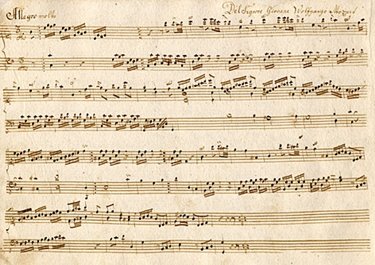
Last Friday, the harpsichordist Florian Birsak performed in the Dancing Master’s Hall of the Mozart Residence in Salzburg, for the first time in something like two centuries, a small, 84-measure, Allegro Molto for keyboard believed to have been written by the eleven-year-old prodigy Wolfgang Amadeus Mozart circa 1767.
The composition was found last year in a 160-page collection of musical pieces discovered in the attic of a private home in the Tyrol. The manuscript was apparently written by a John Reiserer, born 1765 in Rattenburg, while a student at the Universitätsgymnasium in Salzburg, which he attended between 1778 and 1780.
Musicologists agree that the Allegro is a composition of Wolfgang Amadeus Mozart unrecorded in the Köchel directory of his compositions.
The classical recording industry is managing to experience sales growth despite the recession, and capitalist enterprise is gradually excavating the enormously valuable recorded repertoire lost to contemporary humanity in the cataclysmic media transition which eliminated the long-playing record.
Nielsen SoundScan’s report for the first half of 2011 indicates that classical music had the biggest gain in sales of all genres, 13%, over the first half of 2010, for a total of 3.8 million albums.
Granted, that’s still a small percentage of the total market (about 2.4%), but it shows that classical is holding its own and then some, with other genres up slightly or slipping.
Moreover, the majors are being supplanted by a swarm of activity from other, smaller, nimbler sources.
Many orchestras increasingly take matters into their own hands, no longer relying on the majors for exposure. The Chicago Symphony has its own label, CSO Resound, so do the Boston and St. Louis symphonies, as well as the London Symphony, London Philharmonic and several other foreign orchestras. With Telarc reduced to a shell of its former self after the takeover by Concord, its two once-regular orchestras, the Cincinnati and Atlanta symphonies, have just formed their own labels.
Probably the most successful and luxuriously packaged inhouse orchestra label is the San Francisco Symphony’s SFS Media, which in 2010 completed its decade-long Mahler project on 17 SACDs and just issued a capstone documentary, “Keeping Score: Mahler,” on DVD and Blu-ray. SFS Media claims to have sold more than 130,000 Mahler CDs worldwide at premium prices — a roaring success for a classical series.
Likewise, individual artists and small ensembles now routinely bypass the majors and minors alike in favor of their own boutique CD labels — like New York new music collective Bang on a Can’s Cantaloupe, pianist Wu Han and cellist David Finckel’s ArtistLed, plus composer Philip Glass’ Orange Mountain Music.
Free of the old restrictions, these labels can offer as many choices to their fans as their markets will bear. In the prolific Glass’ case, Orange Mountain Music has issued at least 75 releases since its launch in 2003, and the Music@Menlo festival in Silicon Valley exhaustively documents its concerts in massive annual boxed sets.
Naxos, the budget label that upended the classical record industry in the 1990s with its no-frills, high-quality recordings, has turned itself into a big distributor of small labels, with 148 of them (mostly classical) now under its umbrella. Harmonia Mundi, once and still a specialist in early music, also distributes a long string of small labels.
If the majors don’t want to keep their rich classical catalogs in print, others are happy to step into the breach. The online retailer ArchivMusic, now owned by piano manufacturer Steinway, has been making deals with the majors that allow it to press custom copies of out-of-print classical CDs and sell them on its website (the titles now number well in the thousands).
Ravel was expressing a curious personal nostalgia for the culture and sensibilities of Antique Spain, but his Pavanne mysteriously also seems to go nicely with the melancholy image of this 1869 Hudson River School painting of Lake George by John Frederick Kensett.