Category Archive 'Culture Wars'
29 Nov 2011


Moe Lane marvels that, after so long a time, the Democrat Party’s New Deal coalition, consisting of “unions, city machines, blue-collar workers, farmers, blacks, people on relief, and generally non-affluent progressive intellectuals,” is being pronounced dead by the New York Times. The new coalition of the American left is simply writing off the white working class, period.
Whether you agreed with the New Deal program or not, you could always actually define it in terms that were internally self-consistent. Broadly speaking, it was a broad agreement among various groups that America’s most pressing problems could be managed and ameliorated on a broad scale through ‘expert’ and judicious government intervention; and that such intervention dampened the uncertainty and anxiety that might otherwise cause societal panics and economic dislocations. Again: you don’t have to agree with that (I don’t) to recognize that it existed as a coherent policy.
But now that has gone by the wayside, to be replaced with a system that . . . apparently plans to trade support for permanent government dependency programs for minorities, in exchange for legislating the fringe progressive morality of affluent urbanites. Aside from the utter lack of an unifying intellectual or moral framework to such an arrangement, it’s unclear exactly who benefits less from it; while it’s certainly not in minority voters’ long, medium, or short-term interests to become a permanent underclass, it’s not exactly clear that minority voters are even particularly ready to vote for a progressive social policy (as an examination of recent reversals in same-sex marriage movement in California and Maryland will readily attest). But then, that is not really the goal, is it? The goal is to re-elect President Obama — which is something that poor African-American and rich liberal voters both wish to do — and if that is accomplished, then anything else is extra. Which is just as well, because nobody really expects Obama to have much in the way of coat-tails this go-round.
Jim Geraughty, in his Morning Jolt email, responds:
Ah, but look, today’s Democratic party isn’t really about addressing economic opportunity or even dealing with America’s most pressing problems. For starters, many Democrats are not persuaded in the slightest that the annual deficit, accumulating debt, and ticking time bomb of entitlements are pressing problems at all. If Democrats really expected electing Obama would solve problems, they would be angrier with him than we are. No, for most Democrats, their political party is about a cultural identity. That identity is heavily based on not being one of those people — i.e., Republicans or conservatives. As far as I can tell, there are three inviolate principles in the modern Democratic Party:
Any form of consensual sexual behavior is to be accepted — if not celebrated. With that central belief comes the policies of abortion on demand for any woman at any age free, free contraceptives in schools, and gay marriage, and the insistence that Bill Clinton’s lying under oath about Monica Lewinsky didn’t matter because it was about sex. Complaining about explicit sexual content in pop culture reaching an audience that isn’t ready for it — e.g., Tipper Gore in the 1980s — is the sign of the square and the prude. As no less an expert political philosopher than Meghan McCain told us, “the GOP doesn’t understand sex” and has “an unhealthy attitude about sex and desire.” (Republicans are supposedly repressed and sexless, even though they generally have more children.)
America is a deeply racist country, even though you have to look far and wide to find anyone who openly expresses the belief that one race is superior to another. Everybody recoils when Imus says something snide and obnoxious about the Rutgers womens’ basketball team. Racism is never found in the central tenet of affirmative action, that minorities must be judged by a lower standard, or in the until-recently all-white lineup of MSNBC, or in the claims that Clarence Thomas and Herman Cain are Uncle Toms, or in the career of Robert Byrd. The fundamental belief of the Democratic party is that racism remains a serious problem in America today, and that the problem is found entirely in the GOP.
Credentials are to be respected, and any scoffing or skepticism at, say, the Ivy League is a sign of anti-intellectualism, ignorance, jealousy, and insecurity. Those who go there are indeed the best and the brightest; undergraduate and graduate degrees from those schools are key indicators of one’s intelligence, good judgment, and overall character. The success of dropouts Bill Gates, Steve Jobs, and Mark Zuckerberg are strange anomalies, and no serious reevaluation of the higher-education system is needed. As Rush Limbaugh observed, Bill Clinton said he wanted a cabinet that “looked like America” and declared he had achieved it after assembling a group that consisted almost entirely of Ivy League-educated lawyers.
Everything else is negotiable. For a while, it appeared that Democrats were organizing themselves around the principle that almost every dispute with every other nation and group can be resolved through “tough, smart diplomacy.” But now President Obama has started killing foreigners left and right, and not too many Democrats complain at all. Obama even used a drone to kill an American citizen, Anwar al-Alwaki, with nary a peep. Don’t get me wrong, Alwaki had it coming, but this is precisely the sort of don’t-bother-me-with-legal-details-I’m-fighting-a-war philosophy that Democrats spent seven years denouncing.
You think the Democratic party cares about wealth? Come on. In their minds, George Soros spending his money to help out his political views is noble, but the Koch Brothers are evil incarnate. Higher taxes are good, but no one will complain if Tim Geithner or Charlie Rangel cut corners on paying them. One might be tempted to argue that the righteousness of unions represent an inviolate principle to Democrats, but in New York, Democratic governor Andrew Cuomo is trimming here and there and living to tell the tale.
No, the party really is about identity politics now — us vs. them. And everybody knows which side they’re on.
02 Apr 2011

Our driveway, locusts, decrepit shed barn, Fogg Mountain in background. Photo: Karen L. Myers.
Liberals like Chauncy deVega and the editors of The Atlantic are feeling the shift of population and prosperity from preferred-by-the-educated-elite blue states to more rural and conservative red states and don’t like it one bit.
Cobb, in response, takes a shot at explaining why a lot of Americans, even some of the smart and well-educated flavor, much prefer red state backwaters to the fashionable metropolis where one breathes the air of international elite culture and feels every pulsebeat of contemporary fashionable opinion.
Poorer, less educated, less diverse all seem to be horrible deviations from a proper norm, but only in America. Because in the small towns just inside the Indiana border where the well-maintained Ohio roads suddenly get all gravelly, they still make more money than in 5/6ths of the world. They still have 12 years of free education, polio vaccines, orange juice in the winter, and electricity that hasn’t failed in 75 years.
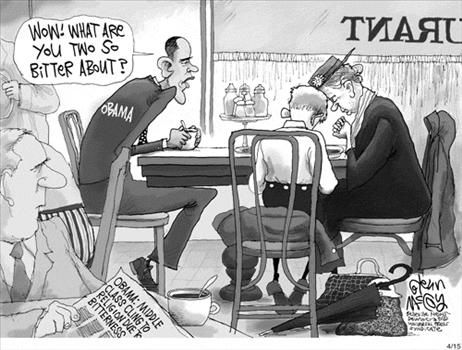
Of course liberalism is shrinking, because the promises it thinks it can make to Americans who cling to Bibles and guns are too expensive and its benefits are so marginal that it finally realizes(?) it will never change all of those minds. There is no more low hanging fruit. There are no more economic rabbits (except in IT industrialization and bioengineering) to pull out of hats. There are already so many chickens in so many pots that the Left has to attack the chicken industry for operating so cheaply.
Somebody wrote of the culture of Japan in the post-tsunami aftermath that of course there was no looting and that everyone cooperated. Japan pulls together into a uniquely cohesive society, but same thing makes it fragile because there are not hundreds of acceptable ways to do the same thing. Japanese make smaller cars and live in smaller houses because they prefer the urban lifestyle that brings millions of them together in the ways they prefer to organize. They like to follow the same rules for everyone, the exact opposite of the American cowboy spirit. 75 years ago there, they all serve an emperor.
America resists totalitarianism because we have the opportunity to get out of Dodge. There’s someplace to go. We can migrate from the South to the North. We can move from East to West. And there are times when we want to be left alone, off the grid, answerable to nobody, off the plantation. It means we have to buy a truck that resists the dents and can go offroad, not a hybrid made for the carpool lane. It means we need to shop at the one Costco in the county once a month, not stroll through the galleria of shops in the CBD. It means we leave our email unanswered, not follow every tweet. It means we try not to follow the fashion of the top 40 as it changes every week, but maybe memorize something our great grandparents would have recognized. It means going downscale, spreading out and being robust and not being affected by the global supply chain that cascades its failures to every Tom, Dick and Harry because your name is Eustace. …
We will never know if red state of mind, independent America is as happy with their disconnected lives as those in the urban liberal cosmopolitan feng shui. But we will always know that riches are limited and that everybody cannot be better educated, richer, and more sophisticated than average. We will always know that the road towards totalitarianism is straight, well-paved and is designed for mass transit.
What is conservatism? It’s a lot of things. But it’s important to understand the limits of centrally standarized, synchronized, culture of singular progress of upward mobility. It always needs the attention and support of the masses, and it fails spectacularly.
Hat tip to Vanderleun.
24 Feb 2011

The church where Washington was a vestryman.
Bryan Preston reports on the lengths that the Episcopal Church has been willing to go to punish parishes attempting to break away as the result of the ordination of an avowedly practicing homosexual as bishop.
I’m not at all religious and this story makes my blood boil. It must be seriously annoying to actual believing Christians.
The town of Falls Church, VA, gets its name from the beautiful historic church at its heart. The Falls Church was built in the time of George Washington, who was himself a vestryman at the church, and the original chapel still stands amid a far larger and more modern campus, and today boasts about 2,500 members. According to a historical marker nearby, the Falls Church was a recruiting station for the fledgling army that Washington led. But today the Falls Church is the target of a scorched earth campaign that the Episcopal Church USA, now called The Episcopal Church (TEC) is waging against several of its own congregations.
The Falls Church’s differences with TEC began over doctrinal issues in the 1970s, but came to a head in 2003 with the Episcopal Church’s ordination of the first non-celibate gay bishop. Many Episcopal churches, including the Falls Church and seven others in northern Virginia, elected to separate from TEC and created a parallel church network aligned with the Anglican Communion. But TEC claimed ownership of the Falls Church’s sprawling campus, and a lawsuit soon followed to wrest the property away from the congregation. Claiming alienation of property, the Episcopal Church went to courtroom war against its breakaway flocks.
The TEC’s lawsuit against the eight churches hinges on property ownership: Who owns the buildings and lands where the congregations meet? What would seem to be a straightforward issue, isn’t, thanks in part to how Episcopal churches are governed. Episcopal churches exist somewhere between Catholic parishes, the properties of which rest solely in the hands of bishops, and most Protestant churches, which own their own properties independent of their denomination or larger structural organization. Unlike Catholic churches, Episcopal churches exercise some independence from the larger church and have the power to vote on whether to sever ties with TEC. These churches did just that. But unlike other Protestant churches, Episcopal churches exercise somewhat less independence from their larger church. But the deeds to the properties in question are in the names of the local trustees, not the TEC itself.
These churches also predate the founding of the Episcopal diocese in Virginia itself. In fact, they are among its founding churches. Falls Church itself dates back to 1734. The diocese that is suing it is three decades its junior.
Nevertheless, the Episcopal Church has continued to wage a very expensive war in court. Jim Oakes, chairman of the Anglican Division of Virginia, estimates that the case has cost the local churches and TEC between $5 million and $8 million on both sides, or between $10 million to $16 million total. For churches that exist to provide ministry to families and towns, those millions could have surely been put to much better use than hiring lawyers and engaging in legal proceedings that have now lasted five years.
As the years have worn on, the churches have offered to settle out of court at each stage, only to be rejected by the Episcopal Church, and then have prevailed over TEC in court. That changed when the case made it all the way to the Virginia Supreme Court, which handed the case back down to the circuit level after finding that the law at the heart of the case – called the division statute – did not apply in this case.
That trial is now set for the end of April, and is expected to take about six weeks. One Falls Church congregant I spoke with worries not just about the eventual ownership of the properties, but about the eventual intentions of the Episcopal Church itself. When I asked what was the worst case scenario, he pointed me to the outcome of a similar case in Binghamton, New York. The Episcopal Church’s victory over a breakaway church there led to this:
The Church of the Good Shepherd, which has stood at #79 Conklin Avenue since 1879, has been willingly turned over to a Muslim entity by the Episcopal Diocese of Central New York, rather than have it remain in the hands of traditional Anglicans who practice the faith once for all delivered to the saints.
The death knell for the structure as a Christian house of worship was delivered on February 9, 2010, when it was sold to Imam Muhammad Affify, doing business as the Islamic Awareness Center, for a mere $50,000, a fraction of the church’s assessed $386,400 value.
Now, two months later, the classic red Anglican doors have been repainted green, the simple cross on top of the steeply peaked bell tower has been lopped off, and a windowpane cross in the side door has been disfigured leaving only narrow vertical glass with the cross beam being painted over to hide it. The Muslims consider the cross a pagan symbol.
Meanwhile the Rev. Matt Kennedy, his wife and partner in ministry Anne, their young family and congregation were sent packing in the bitter cold and deep snow in January 2008 when the New York Supreme Court ordered them to relinquish the 130-year-old church building which stands overlooking the meandering Susquehanna River.
Good Shepherd had offered to purchase the property before any legal proceedings began, but TEC refused, just as it has refused to settle with the majority of the Virginia churches. After winning the Binghamton suit, TEC sold the historic church to the Islamic group for about a third of what the congregation had offered. …
[An Episcopalian source describing a similar case in Leesburg, VA, notes:]
Presiding Bishop Katharine Jefferts Schori is on record saying she would sooner see fleeing parishes sold for saloons than see them affiliate with African and Southern Cone dioceses that uphold “the faith once delivered for all to the saints.â€
Saloons rather than traditional churches? That is why the word “jihad†is in the title of this article. The Episcopal Church’s actions in Binghamton and elsewhere defy reason, unless they were intended to send a very strong and unmistakable message to traditional congregants who might be thinking of breaking away: Defy us, and we will not only hound and possibly crush your congregation through expensive lawsuits, we will see that your cherished houses of worship are desecrated. And we will go to any lengths to send this message, even if we must turn your houses of worship into saloons, or mosques. Even if George Washington himself once worshiped there.
Hat tip to Karen L. Myers.
30 Sep 2009
Brendan O’Neill, like yours truly, finds the Roman Polanski left-right skirmish a competitive exercise in narrative-framing with a lot of posing.
(T)he worst aspect of the Polanski affair is the competition of victimhoods. It is testimony to the domination of the victim culture in contemporary society that both Polanski haters and Polanski defenders, both sides in this bizarre re-enactment of the Culture War of the 1960s and its aftermath, have used the language of victimology to make their case. For many American and British commentators this is all about Samantha Gailey, whom they have transformed into the archetypal and eternally symbolic victim of the alleged great evil of our time, Child Abuse. ‘Remember: Polanski raped a child’, says a headline in Salon, in an article that provides sordid, misery-memoir-style details of what Polanski did with his penis… (Remember, Roman Polanski raped a child, Salon, 28 September 2009 ). For European observers, by contrast, Polanski’s actions can be explained by his own victimised past, especially during the Holocaust. We have to understand his ‘life tragedies’ and how they moulded him, says one filmmaker (Roman a Clef: Wanted and Desired, Documentary.org, 2003). Anne Applebaum, the American commentator who spends much of her time in Europe, says Polanski fled America in 1978 because of his ‘understandable fear of irrational punishment. Polanski’s mother died in Auschwitz. His father survived in Mauthausen. He himself survived the Krakow ghetto.’ (The outrageous arrest of Roman Polanski, Washington Post, 27 September 2009 ) (Applebaum fails to disclose that she is married to the Polish foreign minister, Radoslaw Sikorski, who is actively campaigning against Polanski’s extradition.)
This spat in victimology confirms that the politics of victimhood, the pursuit of law, politics and morality in the name of respecting and helping victims, dominates debate on both sides of the Atlantic, but in the Anglo-American sphere it is the victim of child abuse that is most sacrosanct, while in Europe it is the victims of the Holocaust who enjoy the greatest, most unquestioned moral authority – to the extent that Polanski’s pretty cowardly fleeing of America in 1978 can be excused as a latent reaction by a tortured man to the emotional horrors of Auschwitz.
L’Affaire Polanski has become a Culture War that dare not speak its name, a pale and dishonest imitation of the debates about values and morality that have emerged at various times over the past 50 years. As a result we are none the wiser about the legal usefulness of 30-year-old arrest warrants or contemporary extradition laws, as desperate political observers have instead turned Polanski into either a ventriloquist’s dummy or a voodoo doll for the purposes of letting off some cheap moral steam.
David Zincavage, failed to disclose when he editorialized against the Polanski extradition, that he is married to Karen L. Myers, who has seen several Roman Polanski films. She also alerted me to Brendan O’Neill’s article.
29 Sep 2009
Willam M. Chace, in the American Scholar, identifies the decline in study of the Humanities in general with the internal collapse of the English Department following the overthrow of the idea of the canon.
Perhaps the most telling sign of the near bankruptcy of the discipline is the silence from within its ranks. In the face of one skeptical and disenchanted critique after another, no one has come forward in years to assert that the study of English (or comparative literature or similar undertakings in other languages) is coherent, does have self-limiting boundaries, and can be described as this but not that.
Such silence strongly suggests a complicity of understanding, with the practitioners in agreement that to teach English today is to do, intellectually, what one pleases. No sense of duty remains toward works of English or American literature; amateur sociology or anthropology or philosophy or comic books or studies of trauma among soldiers or survivors of the Holocaust will do. You need not even believe that works of literature have intelligible meaning; you can announce that they bear no relationship at all to the world beyond the text. Nor do you need to believe that literary history is helpful in understanding the books you teach; history itself can be shucked aside as misleading, irrelevant, or even unknowable. In short, there are few, if any, fixed rules or operating principles to which those teaching English and American literature are obliged to conform. With everything on the table, and with foundational principles abandoned, everyone is free, in the classroom or in prose, to exercise intellectual laissez-faire in the largest possible way—I won’t interfere with what you do and am happy to see that you will return the favor. Yet all around them a rich literature exists, extraordinary books to be taught to younger minds.
Consider the English department at Harvard University. It has now agreed to remove its survey of English literature for undergraduates, replacing it and much else with four new “affinity groupsâ€â€”“Arrivals,†“Poets,†“Diffusions,†and “Shakespeares.†The first would examine outside influences on English literature; the second would look at whatever poets the given instructor would select; the third would study various writings (again, picked by the given instructor) resulting from the spread of English around the globe; and the final grouping would direct attention to Shakespeare and his contemporaries.
Daniel Donoghue, the department’s director of undergraduate studies, told The Harvard Crimson last December that “our approach was to start with a completely clean slate.†And Harvard’s well-known Shakespeare scholar Stephen Greenblatt also told the Crimson that the substance of the old survey will “trickle down to students through the professors themselves who, after all, specialize in each of these areas of English literature.†But under the proposal, there would be no one book, or family of books, that every English major at Harvard would have read by the time he or she graduates. The direction to which Harvard would lead its students in this “clean slate†or “trickle down†experiment is to suspend literary history, thrusting into the hands of undergraduates the job of cobbling together intellectual coherence for themselves. Greenblatt puts it this way: students should craft their own literary “journeys.†The professors might have little idea of where those journeys might lead, or how their paths might become errant. There will be no common destination.
As Harvard goes, so often go the nation’s other colleges and universities. Those who once strove to give order to the curriculum will have learned, from Harvard, that terms like core knowledge and foundational experience only trigger acrimony, turf protection, and faculty mutinies. No one has the stomach anymore to refight the Western culture wars. Let the students find their own way to knowledge.
18 Sep 2009
Arnold Kling sees the culture wars spinning further and further out of control and experiences despair.
I think the long-term significance of what is going on, both at the progressive end and at the Tea Party end of the political spectrum, is an open rupture. In the 1960’s, a Hubert Humphrey or Robert Kennedy could connect with uneducated white voters. The idea of blowing them off was unthinkable, if only because they were such a large majority of the voting population at the time.
Now, the elitism of President Obama and his supporters has reached in-your-face levels. They have utter contempt for the Tea Party-ers, and the Tea-Party-ers know it.
I wouldn’t want the Tea Party-ers at the faculty picnic, either. But my sense of class solidarity with Obama and other educated progressives does not make me want to see them exercise power. If anything, being a member of the educated elite and knowing knowing them as well as I do makes me share the Tea Party-ers’ fears.
I come back to my view that this is white, small-town America making its last stand. However, I think, also, that the progressive elite is making a last stand. My guess is that doubts are mounting among many independent voters about whether they want such a highly-charged politics. I am sticking with my bet that the Democrats will hold onto their House and Senate majorities as well as the Presidency through the elections of 2016, but relative to six months ago I feel that I am depending more on Republican incompetence than overall political trends to win that bet.
One could argue that this country is on the verge of a crisis of legitimacy. The progressive elite is starting to dismiss rural white America as illegitimate, and vice-versa. I see the chances of both sides losing as much greater than the chance of either force winning.
14 Jun 2009
The most devastating response to David Letterman’s joke attacking Sarah Palin’s daughter comes from the inimitable James Lileks who does to Letterman approximately what Rome did to Carthage.
[I]t must be funny, because David is funny and hip. Right? Or maybe not; maybe he’s actually a brackish, hermetically-souled guy who’s spend the last twenty years going from table to table with a giant wooden grinder, asking anyone if they want some fresh-ground scorn with that. Say when. Or maybe he’s about as edgy as a soccer ball, and exists only to remind people they were Edgy once, and hence must be ever-blessed with the gift of Wryness and Irony. With those shields we can never grow old, you know. We’ll always be as sharp and perceptive as we were when we were sitting on a cast-off sofa in college, working through a midweek buzz, happily fellated by the preconceptions the TV so charitably provided. …
What’s amusing is how unamusing he is in the clip. How sour he seems. Compare him to his predecessors: Carson was all midwestern charm, with unreadable yet mannerly reserve; Steve Allen was almost as smart as he was certain you thought he must be, but he was cheerful; Parr was a nattering nutball covered with a rich creamy nougat of ego, but he was engaging. Letterman is empty; he’s inert; he stands for nothing except disdain for people foolish enough to stand for anything – aside from rote obesciance to all the things Decent People stand for, of course, all those shopworn assumptions passed around in the bubble.
This posture was fresh in ’80; it even had energy. But it paralyzes the heart after a while. You end up an SOB who shows up at the end of the night to reassure that nothing matters. I think he may have invented the posture of Nerd Cool, an aspect so familiar to anyone who reads message boards – the skill at deflating enthusiasm, puncturing passion with a hatpin lobbed from a safe distance. The instinctive unease with the wet messy energy of actual people.
Yes, reading too much into it. Really, it’s just a rote slam: If your mother is a loathed politician, and your older sister gets pregnant, famous old men can make jokes about you being knocked up by rich baseball players, and there’s nothing you can do. That’s the culture: a flat, dead-eyed, square-headed old man who’ll go back to the writers and ask for more Palin-daughter knocked-up jokes, because that one went over well. Other children he won’t touch, but not because he’s decent. It’s because he’s a coward.
Oh, one more thing: it’s okay for David to say that because someone said something else about someone, and since I didn’t write about that, I’m a hypocrite. Just so we’re clear.
17 Nov 2008
Mark Stinson, in the Chatham (North Carolina) Journal Weekly, laments the invasion, and take-over, of Siler City by intolerant representatives of the contemporary community of fashion.
We have a certain number of people that are transplanted here because they wanted some space. We have others that have money that wanted space too; that like the city life but want to live in the country. These people use their wealth to force the rest of us to do what they want. …
Bobby Smith of S&W Speed Shop in Siler City has occupied the same corner lot for almost 40 years. He has been a constant tax paying citizen and local fixture around this area. …
This brings me to the invasion of the jug making pot heads that want to turn Siler City into a smaller version of Chapel Hill. You see the arts incubator has grabbed a chunk of mid down town Siler City and proceeded to start transforming the town into a Chapel Hill / Carrboro clone. Bobby never in 40 years had one complaint about a vehicle sitting in his parking spots beside his shop or parts of vehicles stored in his lot behind his shop until the artsy bunch cleaned up town (as they put it) and located a pottery next to him. They have constantly whined and complained to the town forcing Bobby to move just about everything off his property to accommodate their desires to make downtown visually pleasing to them.
Recently they sent a police officer because Bobby had his truck. which he is repairing sitting in his parking spot “turned the wrong way” and they didn’t like the looks of that truck so they wanted it gone. …
Kenny Clark is feeling the effects of their constant complaints as well and Clapp Brothers will be next on the hit list if something isn’t done to balance things out again. They have already complained about things such as shipping crates temporarily stored in Clapps lot.
I personally love arts n crafts. I enjoy learning new ways to be creative but not at anyone else’s expense. If I want to see pottery I go to Jug Town where it is done the right way. I may be wrong, but in my opinion anyone can learn to make a pot. Not everyone can fix a bull dozer, build engines or repair a truck that helps members of our community make an honest living. …
does it make sense to bully the small established businesses out just because you want to make pots? The Arts incubator could never draw the kind of money some of these business have and never will. People involved with the Arts Incubator may have millions but that money isn’t being spread around the community. I was all excited about the arts incubator coming to Siler City until I saw how it grew to push people aside and trample those that are established in the community just to add “culture” to Chatham. …
I went through town to see a naked blue lady on top of a building, a half a naked man and a naked anatomically correct statue of a man on a street corner and honestly was upset. I don’t want my children to see such things in what is supposed to be a public place. I find it offensive. Is it better to be offended by art or annoyed with an eyesore of machine parts that are supposed to be outside a garage anyway?
Your are browsing
the Archives of Never Yet Melted in the 'Culture Wars' Category.
/div>

Feeds
|