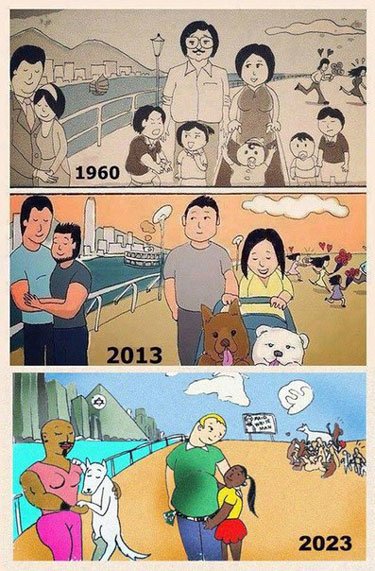
“When my father’s father’s father had a difficult task to accomplish, he went to a certain place in the forest, lit a fire, and immersed himself in silent prayer. And what had to be done was done. When my father’s father was confronted with the same task, he went to the same place in the forest and said; ‘”We no longer know how to light the fire, but we still know the prayer.” And what had to be done was done. Later, he too went into the forest and said: “We no longer know how to light the fire, we no longer know the mysteries of prayer, but we still know the exact place in the forest where it occurred. And that should do.” And that did do. But when I was faced with the same task, I stayed home and I said; “We no longer know how to light the fire, we no longer know the prayers. We don’t even know the place in the forest. But we do know how to tell the story.”
James Delingpole is not on board with the celebrations for the victory of the Irish Gay Marriage Referendum.
Which is worse:
a) opposing gay marriage
or
b) abducting a mother of ten in front of her weeping children, suffocating her with a plastic bag, shooting her in the head and burying her in an unmarked grave?
Well, obviously we know the answer is a) because we can see it in the above heartwarming picture, taken during the recent Irish referendum on same sex marriage.
It shows gay rights activist Rory O’Neill (aka drag queen Panti Bliss) sharing a lovely group hug with David Norris (an Irish Senator who lobbied for the 1993 decriminalisation of gay sex) and, of course, with the unmistakably vulpine figure of Gerry Adams, the sinister Sinn Fein president who continues to deny he was ever a member of the IRA.
Aaaahhh. Doesn’t it make you feel all warm and gooey inside?
Well it doesn’t have that effect on me, I’m afraid. In fact, if I’d voted “yes†in the Irish referendum and someone had subsequently showed me that photo, I’m pretty sure I’d want to stick an orange in my mouth, tie a noose around my neck and top myself for the very shame of it.
For, if a picture is worth a thousand words, that particular one is worth more like a hundred-thousand-word book entitled “Absolutely Everything That Is Wrong With The Modern World.â€
I am looking at Millenials from the POV of a member of one of the most pessimistic and ironic generations that has ever roamed the earth—Generation X—so when I hear Millenials being so damaged by “cyber-bullying†that it becomes a gateway to suicide—it’s difficult for me to process. And even my boyfriend agrees that Generation Wuss is overly sensitive, especially when dealing with criticism. When Generation Wuss creates something they have so many outlets to display it that it often goes out into the world unfettered, unedited, posted everywhere, and because of this freedom a lot of the content displayed is rushed and kind of shitty and that’s OK—it’s just the nature of the world now—but when Millennials are criticized for this content they seem to collapse into a shame spiral and the person criticizing them is automatically labeled a hater, a contrarian, a troll. And then you have to look at the generation that raised them, that coddled them in praise—gold medals for everyone, four stars for just showing up—and tried to shield them from the dark side of life, and in turn created a generation that appears to be super confident and positive about things but when the least bit of darkness enters into their realm they become paralyzed and unable to process it.
Thomas Babbington Macauley: “[The Roman Catholic Church] saw the commencement of all the governments and of all the ecclesiastical establishments that now exist in the world; and we feel no assurance that she is not destined to see the end of them all. She was great and respected before the Saxon had set foot on Britain, before the Frank had passed the Rhine, when Grecian eloquence still flourished at Antioch, when idols were still worshipped in the temple of Mecca. And she may still exist in undiminished vigour when some traveller from New Zealand shall, in the midst of a vast solitude, take his stand on a broken arch of London Bridge to sketch the ruins of St. Paul’s.”
Oscar Halecki, The Limits and Divisions of European History, 1950 is ultimately optimistic.
It has been frequently stressed that, from the point of view of the historical method, ancient history is so instructive to study because it is completed;we are able to contemplate the whole process of its evolution from beginning to end. The same can be said today [1950] of European history. That comparison with the ancient, Greco-Roman world is both suggestive and comforting, for it shows that the end of an age, and even of a whole cultural world, need not necessarily mean complete extinction like that which occurred, for instance, in the case of the pre-Columbian civilizations of America. Europe’s present decline need not lead to what Oswald Spengler calls an Untergang, although the crisis is much more acute today than it was when he wrote his sensational book. Nor need Macauley’s gloomy vision of a New Zealander meditating over the ruins of London ever come true, although this time seemed so near in 1940. …
Europe came into existence as an historical community because numerous peoples entirely different from each other, without effacing their particularities and without ever uniting politically, joined in a co-operation based upon common cultural conceptions, traditions, and principles. The individual nations which developed within that community were rather small if compared, for instance, with the peoples of India or China. Likewise small was the area in which they had their home; and compared with the length of other histories –to mention only that of Egypt– the age of their common greatness was of rather short duration.
But within these narrow limits of time we see the same variety of events in rapidly changing periods that is so striking in Europe’s physical and ethnical backgrounds. This certainly is an unusually dynamic history, whether proceeding through evolution or through revolutionary upheavals. And that is the first argument in favor of the conviction that the end of the European Age in history is not necessarily the end of Europe, or of a civilization which, though inseparable from the European heritage, has ceased to be exclusively European.