The search in Leicester for the remains of Richard III, the last Plantagenet monarch of England slain August 22, 1485 at Bosworth Field, may have achieved success.
The Telegraph reports the finding of remains that may very possibly be those of Richard.
Over 500 years since he was killed in battle, archaeologists believe they have finally found the skeleton of King Richard III, buried deep beneath a council car park.
Experts said a fully intact skeleton matched much about what they knew about the medieval king, and are hoping that DNA tests will put their beliefs beyond doubt.
The remains were found three weeks into an archaeological dig by a team from Leicester University, which recently pinpointed the site of the ancient Grey Friars church, where Richard was believed to be buried after being killed in the Battle of Bosworth in August 1485, and which was razed to the ground in 1538 during the Dissolution of the Monasteries ordered by Henry VIII.
To their astonishment, an excavation unearthed a result which experts said were “beyond out wildest dreamsâ€.
Five key aspects underlined their belief that appears to have ended a decade-long search for his remains.
The skeleton was an adult male, who appeared fit and strong. He had suffered significant trauma to the head where a blade had cut away part of the back of his skull; an injury consistent with battle.
A barbed arrow head was found lodged between vertebrae in his upper back, and spinal abnormalities pointed to the fact that he had severe scoliosis, a form of spinal curvature. This would have made his right shoulder appear visibly higher than his left, which is consistent with contemporary accounts of Richard’s appearance.
Richard’s two year reign was the subject of one of William Shakespeare’s most famous plays, which portrayed him as an evil, ugly hunchback, and which helped cement the public perception of him.
The remains were found in the Choir area of the church, again consistent with historical record of where he was buried.
Unknown artist, Richard III, mid-16th century, Society of Antiquaries, London
A search is on in Leicester for the remains of Richard III, slain in battle at Bosworth Field, and then buried at Greyfriars Church. The location of the burial, and even the exact location of the Franciscan Friary, have been lost to five centuries of development.
Philippa Langley, from the Richard III Society which has been involved with the project, said: “We know he was buried here but the church disappeared after the dissolution of the monasteries as did his grave so today we begin the search for Richard.
“We know his body was led into Leicester and put on display for three days by Henry Tudor before he was buried.
“I hope we do find him because I want to give him a proper resting place and also to explode a lot of myths around Richard III.”
Richard Buckley, co-director of the Archaeology Service at the university, said: “It is quite a long shot but it’s a very exciting project. We don’t know the whereabouts of any of the friary buildings at the moment. We don’t know precisely where the body would have been buried but we suspect it would be in the choir or near the alter.”
If bones are found they will be assessed for trauma to the skeleton, as the monarch was killed in battle, then be subject to DNA analysis.
King Richard III, the last Plantagenet, ruled England from 1483 until he was defeated at the Battle of Bosworth in 1485.
Richard may never be found as there is also a tradition that the late king’s remains were thrown into the River Soar at the time of the Dissolution of the Monasteries.
On 22 August 1485, Richard met the outnumbered forces of Henry Tudor at the Battle of Bosworth Field. He was astride his white courser. The size of Richard’s army has been estimated at 8,000, Henry’s at 5,000, but exact numbers cannot be known. During the battle Richard was abandoned by Baron Stanley (made Earl of Derby in October), Sir William Stanley, and Henry Percy, 4th Earl of Northumberland. Despite his apparent affiliation with Richard, Baron Stanley’s wife, Lady Margaret Beaufort, was Henry Tudor’s mother. The switching of sides by the Stanleys severely depleted the strength of Richard’s army and had a material effect on the outcome of the battle. Also the death of John Howard, Duke of Norfolk, his close companion, appears to have had a demoralising effect on Richard and his men. Perhaps in realisation of the implications of this, Richard then appears to have led an impromptu cavalry charge deep into the enemy ranks in an attempt to end the battle quickly by striking at Henry Tudor himself. Accounts note that Richard fought bravely and ably during this manoeuvre, unhorsing Sir John Cheney, a well-known jousting champion, killing Henry’s standard bearer Sir William Brandon and coming within a sword’s length of Henry himself before being finally surrounded by Sir William Stanley’s men and killed. Tradition holds that his final words were “treason, treason, treason!”, when he found Lord Stanley had turned against him. The Welsh accounts state that Sir Wyllyam Gardynyr killed King Richard III with a poleaxe. The blows were so violent that the king’s helmet was driven into his skull. The account reads, “Richard’s horse was trapped in the marsh where he was slain by one of Rhys Thomas’ men, a commoner named Wyllyam Gardynyr.” Another account has Rhys ap Thomas himself slaying the king.
Polydore Vergil, Henry Tudor’s official historian, would later record that “King Richard, alone, was killed fighting manfully in the thickest press of his enemies”. Richard’s naked body was then exposed, possibly in the collegiate foundation of the Annunciation of Our Lady, and hanged by Henry Tudor, now King Henry VII, before being buried at Greyfriars Church, Leicester. In 1495 Henry VII paid £50 for a marble and alabaster monument. According to one tradition, during the Dissolution of the Monasteries his body was thrown into the nearby River Soar, although other evidence suggests that a memorial stone was visible in 1612, in a garden built on the site of Greyfriars.[18] The exact location is now lost due to over 500 years of subsequent development. On 24 August 2012, the University of Leicester and Leicester City Council, in association with the Richard III Society, have joined forces to begin a search for the mortal remains of King Richard III. Led by University of Leicester Archaeological Services (ULAS), experts will be seeking to locate the Greyfriars site and discover whether the remains of Richard III may still be found. There is currently a memorial plaque on the site of the Cathedral where he may have once been buried, as well as a stone plaque on the bridge where his remains were allegedly thrown into the Soar.
Ron Black, writing from the North Countrie, where they hunt foxes on foot, and more vertically than horizontally, forwarded this morning a charming older video of a local hunter performing a major portion of The Mardale Hunt, accompanied by fellow patrons of the St. Patrick Well public house.
The Mardale Hunt composed by Winston Scott, circa 1904
[The morn is here, awake, my lads
Away, away
The hounds are giving mouth, my lads
Away, my lads, away
The Mardale Hunt is out today
Joe Bowman strong shall lead the way
Who ne’er has led his hunt stray
Away, my lads, away
Our Bowman is a huntsman rare
Away, away
His Tally-ho’s beyond compare
Away, my lads, away
We always find him just the same
At Grasmere Sports you’ll hear his name
His Mardale Hunts will live in fame
Away, my lads, away]
The Mardale pack is on the trail
Away, away
The fox is heading thro’ the dale
Away, my lads, away
Hound Miller’s on the scent, I’m told
So fast it lads thro’ frost and cold
Away, my lads, away
The mountain breeze is pure as gold
Away, my lads, away
On Branstree Fell the fox is seen
Away, away
The hounds are off, the scent is keen
Away, my lads, away
This music sweet to dalesman’s ear
When hounds give mouth so loud and clear
So off my lads and lend a cheer
Away, my lads, away
[The air is keen, our hearts are light
Away, away
We scale with glee the frowning height
Away, my lads, away
The fox has slipped and made his cave
So in we send the terrier brave
The fox will bolt his brush to save
Away, my lads, away
Our terrier Frail will win or die
Away, away
So too will Wallow Crag, say I
Away, my lads, away
On Roman fell in mountain cave
We lost alas, a terrier brave
For good old Frisk we failed to save
Away, my lads, away]
Who’d weary with a sport like this
Away, away
Or who a Mardale Hunt would miss
Away, my lads, away
Our hardy fellsmen, hunters born
Will rally to the huntsman’s horn
Nor heeded be by rain or storm
Away, my lads, away
[Who’d hunt the fox with spur and rein
Away, away
To have a mount we’d all disdain
Away, my lads, away
We love our hill, our tarns, our fells
We ken our moors, our rocks and dells
We love our hounds, we love our selves
Away, my lads, away]
When darkness comes to Mardale, hie
Away, away
For who the ‘Dun Bull’ dares decry
Away, my lads, away
Hal Usher kind will find a bed
To rest our limbs and lay our head
We’re welcomed, warmed, and housed, and fed
Away, my lads, away
In winter Mardale’s dree and drear
Away, away
But ’tis not so if Hunt is here
Away, my lads, away
We trencher well, we trencher long
We meet in dance, we meet in song
[For days are short, and nights are long
Away, my lads, away
We’re lads from East and lads from West
Away, away
And North and South, but all the best
Away, my lads, away
With Auld Lang Syne and Old John Peel
With foaming glass and nimble heel
We’ll drink to all a health and wealth
Away, my lads, away]
A nice Xmas present for sportsmen from Ron Black: his “The Mardale Hunt: A History,” a 166-page downloadable electronic text of the history of the oldest, and most famous, of the Lakeland Fell Shepherds’ Meets. This is the kind of simple, hard-bitten North Country hunting associated with John Peel: foot-following foxhounds on the often pretty vertical landscape of the Lakeland Fells.
Hunting in Mardale is a fundamental and immemorial feature of the season.
[T]he shepherds’ meeting at Mardale ” wasn’t founded in’t memory of man.” That the shepherds gave up a week to ‘ raking ‘ the fells and bringing down to the Dun Bull the sheep that were not their own. That though there is a Shepherds’ Guide with all the lug-marks and smit marks of the various flocks in it, it is very seldom referred to, for all the shepherds ken the marks as well as they ken their own bairns. From the time whereof the memory of man runneth not to the contrary, a hunt succeeded by a good dinner ushers in the shepherds’ ceremony of ‘ swortn ‘ the sheep; and after the sorting a hound trail and pigeon shooting at clay pigeons affords diversion till daylight fades; then tea is served and the shepherds who determine ‘to remain on spree,’ as they call it, instead of driving their sheep home, make a night of it. I gathered from the old farmers that they thought ‘ nowt ‘ to the hound-trail and pigeon shooting. They wur new-fanglements and mud varra weel be dispensed wid.’
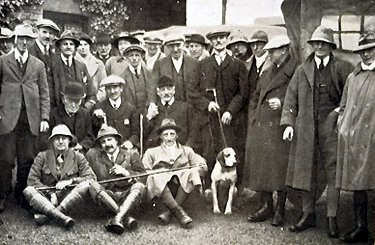
By the early years of the last century, the fame of the Mardale Shepherds Meet had spread and visiting sportsman often attended and participated.
For years the Mardale Meet’s popularity relied on the reputation of Joe Bowman (Hunty or Auld Joe) and his Ullswater Foxhounds. Visitors travelled to the meet from all parts of the country and some the world, they travelled in a variety of ways-“Rolls-Royces, carriages, horseback and on foot walking over the high mountain passes sometimes in bad weather (snow was not uncommon) and my Great Uncle Brait and Trimmer his hound actually got lost on the tops in bad weather. Trimmer subsequently won his trail. Expensive furs, kid gloves and silver mounted walking sticks mingled at the meet with woollen clothing, hand made walking sticks and fustian jackets. Most people walked and the general view was summed up by Tommy Fishwick who was once heard to say to a friend “Yan wants nowt wi’ riding as lang as yan legs ‘ell carry yan.â€
Hinchcliffe quotes that after a good days sport, huntsmen, shepherds, visitors, sheep dogs and terriers (hounds were not admitted) all turn towards the Dun Bull for a meal.
In the evening, a smoking contest took place. Skelton records “ the main portion of the pack, cast off in the large dining room and every room in the house filled with overflow meetings-or rather concertsâ€
The big room was the focal point, a tray was sent round and money subscribed for the evening’s refreshment. Each individual orders his choice of drink and the chairman pays out of the general pool. Toast’s and song follow in quick succession. The chairman selects the singer and everyone is supposed to sing at least one song and there was an element of pride in singing one that had not already been sung that evening. If the song had a good swing or chorus the men got particularly enthusiastic, the shepherds beating the tables with their sticks in time to the tune and the sheep-dogs and terriers howling either in enthusiasm or execration, no man knows which.
One song often sung paid tribute to the renowned local huntsman.
JOE BOWMAN
Down at Howtown we met with Joe Bowman at dawn,
The grey hills echoed back the glad sound of his horn,
And the charm of it’s note sent the mist far away
And the fox to his lair at the dawn of the day.
Chorus
When the fire’s on the hearth and good cheer abounds
We’ll drink to Joe Bowman and his Ullswater hounds,
For we’ll never forget how he woke us at dawn
With the crack of his whip and the sound of his horn.
Then with steps that were light and with hearts that were gay
To a right smickle spot we all hasten away,
The voice of Joe Bowman, how it rings like a bell
As he cast off his hounds by the side of Swarth Fell.
The shout of the hunters it startled the stag
As the fox came to view on the lofty Brook crag,
“Tally-Ho†cried Joe Bowman, “the hounds are away,
O’er the hills let us follow their musical bayâ€.
Master Reynard was anxious his brush for to keep,
So he followed the wind oe’r the high mountain steep,
Past the deep silent tarn to the bright running beck,
Where he hoped by his cunning to give us a check.
Though he took us oe’r Kidsey we held to his track,
For we hunted my lads with the Ullswater Pack
Who caught the fox and effected a kill,
By the silvery stream of the bonny Ramps Gill.
Now his head’s on the crook and the bowl is below,
And we‘re gathered around by the fire’s warming glow,
Our songs they are merry, our choruses high,
As we drink to the hunters who joined in the cry.
When this song is sung at Ullswater, the third verse should be given as follows:
The shout of the hunters it startled the stag,
As the fox came to view on the lofty Brook Crag,
“Tally-Ho†We’re away, o’er the rise and the fell,
Joe Bowman, Kit Farrar, Will Milcrest and all.
Darren Webster was meant to be going back to work after dropping his son off at home when, on a whim, he stopped by a field and decided to have a quick forage with his metal detector.
Within 20 minutes he made a discovery that was to introduce a new name to the turbulent history of medieval England.
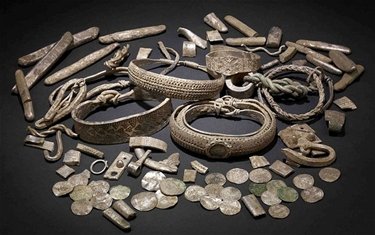
One of the objects in a hoard of silver buried one metre down in the earth was a coin marked with the name of Airedeconut, thought to refer to Harthacnut, a previously unrecorded Viking king powerful enough to have his own currency in 10th-century Northumbria.
Mr Webster, who has a stone tile workshop in Yealand Conyers, Lancashire, said that he had permission to search in the field near his home in Silverdale but did not choose it for any particular reason.
“My machine was telling me that I’d found some kind of silver. So I was slightly disheartened when I saw a lead pot. It was as I was lifting it that silver pieces started falling out of it.”
Once the lead container had been prised open there were 201 silver objects, including 27 coins, ten arm-rings, six brooch fragments, two finger rings, a fine wire braid and 14 ingots.
There were also 141 fragments of metal known as hacksilver, which would have been used for barter.
Gareth Williams, curator of early medieval coins at the British Museum, where the discovery was announced yesterday, said that the hoard would have been worth a midsized herd of cows in the 10th century, and would probably fetch a “high five-figure sum” today.
The exact value will be determined by a panel of experts in the spring, when museums will be allowed to bid for it. The Lancaster City Museum has already expressed an interest.
Under the Treasure Act, Mr Webster will be awarded half the value of the hoard, and the remainder will be given to the owner of the field, who has asked to remain anonymous.
Why someone hid a small fortune is a mystery, but burying treasure is usually an attempt to keep valuables safe in uncertain times.
“It is a period of political instability,” said Dr Williams. “The Vikings of Dublin were expelled and came to the North of England. There was also the Battle of Tettenhall, on the outskirts of Wolverhampton, where several northern kings were killed.”
The hoard was placed in a lead box and buried underground at a time when the Anglo-Saxons were attempting to wrest control of the north of the country from the Vikings.
Yesterday, the central London museum unveiled the hoard, the fourth largest ever found, which included Anglo-Saxon, Anglo-Viking, German and Islamic coins.
In total there were 201 silver objects, including the 27 coins which date the burial around 900AD, around the time the Vikings had been expelled from Dublin and were fighting the Anglo-Saxons to keep control of the north of England.
It also includes also coins from the time of Alfred the Great, who reigned from 871 to 899, and from the Viking kingdom of Northumbria.
One silver denier, bears the name Charles. Others bear the name Airdeconut, a Viking ruler in northern England.
Officials said the inscription Airdeconut, appeared to be an attempt to represent the Scandinavian name Harthacnut.
They said this was because many Vikings had converted to Christianity within a generation of settling in Britain.
On the other side were the words DNS (Dominus) REX, which was arranged in the form of a cross.
“The design of the coin relates to known coins of the kings Siefredus and Cnut, who ruled the Viking kingdom of Northumbria around AD900, but Harthacnut is otherwise unrecorded,†a museum spokesman said.
“It is a very significant find. It is a very large haul and it is the fourth large Viking find in the UK. Because it is recently discovered there is lots of research to be done.â€
Experts believe the hoard, which also includes 10 arm rings, two finger rings, 14 ingots, six brooch fragments and a fine wire braid which may have been worn as a necklace, could have been buried by a Viking warrior before he went into battle.
The collection of 10 bracelets and other jewellery are thought to have been worn to signify rank of the influential owner.
Dr Gareth Williams, the curator of early medieval coins at the museum, said: “Some of the coins reinforce the things we already know but with some of them it fills in the gaps where we didn’t even know we had gaps.
“It is always great when you get a new piece of evidence. This is the first new medieval King for at least 50 years and the first Viking King discovered since 1840. It is a very exciting find.”
It was found in September by Darren Webster, 39 using a metal detector on land around Silverdale, in north Lancashire.
The British Province of the Society of Jesus (the Jesuits) is clearly determined to raise a great deal of money. The Jesuits have arranged to sell to the British Library for £9m ($14.3m) the oldest surviving European book, the Stonyhurst Gospel, St. Cuthbert‘s own copy of the Gospel of St. John, a 7th century manuscript originally buried with the saint on the island of Lindisfarne in 687.
Lindisfarne was depopulated of its monks when the Danes sacked the island in 875. The saint’s relics were carried away and moved from one location in the north of England to another over the course of the next century. St. Cuthbert was finally reburied in the “White Church” built in 995 as the predecessor to Durham Cathedral.
The manuscript was discovered in 1104 when St. Cuthbert’s coffin was opened in the course of transporting his remains to a shrine behind the altar of the newly built cathedral.
St. Cuthbert’s shrine was destroyed in the time of the dissolution of the monasteries under Henry VIII, and the gospel manuscript at that point passed into private hands. George Lee, the third Earl of Lichfield (d. 1772) is the first recorded modern owner. Lichfield gave the manuscript to Reverend Thomas Phillips (d. 1774) who donated it to the English Jesuit College at Liège on 20 June 1769. The manuscript has been owned since 1769 by the Society of Jesus (British Province) and was formerly in the library of Stonyhurst College. The manuscript has been on loan to the British Library since the 1970s.
Christie’s negotiated the sale, as a result of which the manuscript will continue to be displayed half the time at the British Library and the other half at Durham Cathedral, referred to in the news articles as (God help us!) a UNESCO world heritage site in Durham.
Twelfth century painting of St Cuthbert in Durham Cathedral.
St. Cuthbert (feast day: March 20) is the patron saint of the North of England and was England’s most popular saint in the period before the martyrdom of Thomas Becket in 1170. His banner was carried into battle against the Scots up to the time of the Reformation, and in the Middle Ages the inhabitants of the Palatinate of Durham were referred to as haliwerfolc “the saint’s people.”
Princess Beatrice Elizabeth Mary of York, elder daughter of Prince Andrew, Duke of York, and Sarah, Duchess of York, and fifth in succession to the throne, startled the world by wearing a hat that looked as if it had been designed by Dr. Seuss.
Princess Beatrice’s hat is, I’m told, the kind of thing called “a fascinator.”
The New York Times offered a slideshow featuring other ladies’ (more becoming) hats as well.
This is believed to be the eighth sighting in the past five years of the mysterious hump-backed creature.
Tom Pickles, 24… and fellow kayaker Sarah Harrington, 23… who work for an IT firm in Shrewsbury, were staying at Fallbarrow Hall, Bowness, as part of a team-building residential training course.
They had paddled 300m out onto the lake near Belle Isle when they spotted a mysterious creature the size of three cars gliding across the lake.
“It was petrifying, we paddled back to the shore straight away,†said Mr Pickles.
“At first I thought it was a dog and then saw it was much bigger and moving really quickly at about 10mph.
“Each hump was moving in a rippling motion and it was swimming fast.
“I could tell it was much bigger underneath from the huge shadow around it. “Its skin was like a seal’s but its shape was completely abnormal, not like any animal I’ve ever seen before.â€
They watched it for about 20 seconds before it plunged out of sight.
Ms Harrington said: “It was like an enormous snake.
“It freaked us all out but it wasn’t until we saw the picture that we thought we’d seen something out of this world.
“All I could think was that I had to get off the lake.â€
Mr Pickles’s picture perfectly matches the description of an earlier sighting from the shores of Wray Castle in 2006 by journalism lecturer Steve Burnip.
“I’m really pleased that someone has finally got a really good picture of it. I know what I saw and it shocked me,†said Mr Burnip, of Hebden Bridge.
“It had three humps and it’s uncanny the likeness between this and what I saw five years ago.â€
Far more Lancastrians died in the rout than in the battle itself. (Graham Turner painting)
As many as 75,000 men (10% of the fighting age male population of England) participated in the Battle of Towton.
The Lancastrians had the larger army and occupied the high ground, but the weather was against them, and proved decisive. The Lancastrian archers fired against a strong wind, blinded by the snow blowing in their faces, and their arrows fell fell short. Yorkist archers fired volleys which hit home, and then moved back out of range. Advancing again, they were able to retrieve their enemies’ arrows from the ground and fire them back at them. The Yorkist archers were able to repeat this same maneuver to great advantage.
Both sides had resolved before the battle that no quarter was to be given. The subsequent hand-to-hand fighting was exceedingly bloody. It was reported that soldiers had to move piles of bodies out of the way to get at the enemy. The fighting went on for hours with neither side gaining a decisive advantage until the Duke of Norfolk arrived with Yorkist reinforcements on the Lancastrian left.
Out-numbered and out-flanked, the Lancastrian left was broken and before long the entire Lancastrian line collapsed and routed. Troops fled toward the river, being cut down by cavalry along a path that became known as Bloody Meadow. The River Cock was in full flood. Many were trapped and cut down with the river against their backs, and hundreds drowned. It is said that some men were able to escape because they were able to cross the flooded river over the bodies of the fallen. Lancastrian deaths are estimated to have been as many as 28,000.
The Economist describes the results of some recent archaeological investigations of the battlefield burials found in the vicinity of Towton.
The remains commonly exhibit evidence of death by violence with extreme prejudice.
On the run from the battle, with Yorkist soldiers in pursuit (some of them doubtless on horseback), the men would have soon overheated. They may have removed their helmets as a result. Overhauled—perhaps in the vicinity of Towton Hall, which some think may then have been a Lancastrian billet—and disorientated, tired and outnumbered, their enemies would have had time to indulge in revenge. Even at this distance the violence is shocking. “It’s almost as if they were trying to remove their opponents’ identities,†says Mr Knüsel of the attackers’ savagery.
Take the case of the skull designated Towton 25:
THE soldier now known as Towton 25 had survived battle before. A healed skull fracture points to previous engagements. He was old enough—somewhere between 36 and 45 when he died—to have gained plenty of experience of fighting. But on March 29th 1461, his luck ran out.
Towton 25 suffered eight wounds to his head that day. The precise order can be worked out from the direction of fractures on his skull: when bone breaks, the cracks veer towards existing areas of weakness. The first five blows were delivered by a bladed weapon to the left-hand side of his head, presumably by a right-handed opponent standing in front of him. None is likely to have been lethal.
The next one almost certainly was. From behind him someone swung a blade towards his skull, carving a down-to-up trajectory through the air. The blow opened a huge horizontal gash into the back of his head—picture a slit you could post an envelope through. Fractures raced down to the base of his skull and around the sides of his head. Fragments of bone were forced in to Towton 25’s brain, felling him.
His enemies were not done yet. Another small blow to the right and back of the head may have been enough to turn him over onto his back. Finally another blade arced towards him. This one bisected his face, opening a crevice that ran from his left eye to his right jaw (see picture). It cut deep: the edge of the blade reached to the back of his throat.
A man with a metal detector has made one of the largest finds of Roman coins in Britain.
The hoard of around 52,000 coins dating from the third century AD was found buried in a field near Frome in Somerset.
The coins were in a huge jar just over a foot below the surface, located by Dave Crisp from Devizes in Wiltshire.
Archaeologists believe the hoard, which sheds light on the economic crisis and coalition government in the 3rd century under Emperor Carausius, will rewrite the history books. …
It is thought the £250,000 find – known as the Frome Haul – represents the biggest single haul ever unearthed in Britain.
The hoard is one of the largest ever found in Britain, and will reveal more about the nation’s history in the third century, said Roger Bland, of the British Museum.
One of the most important aspects of the hoard is that it contains a large group of coins of Carausius, who ruled Britain independently from AD 286 to AD 293 and was the first Roman emperor to strike coins in Britain.
The hoard contains over 760 of his coins, making it the largest group of his coins ever found.
It is estimated the coins were worth about four years’ pay for a legionary soldier.
Carausius was a Roman naval officer who seized power in 286 and ruled until he was assassinated in 293.
‘The late third century A.D. was a time when Britain suffered barbarian invasions, economic crises and civil wars,’ Bland said.
Several books I was in the middle of, or planning to read next, temporarily vanished in the course of the great migration southward to our new home in Fauquier County, so I was obliged to forage.
I happened to pick up The Mortdecai Trilogy, which I purchased a couple of years ago, doubtless as the result of a recommendation from one of those “lists of mysteries you need to read” sort of articles.
Bonfiglioli served in the ranks of the British Army in West Africa in the 1950s before matriculating at Oxford (Balliol College). During his time at university, he was a widower with two young children. After graduating, he became an art dealer in London.
His detective hero, the Honorable Charlie Strafford Van Cleef Mortdecai obviously represents a more fortunate and affluent version of the author. Charlie Mortdecai is, more or less, what you might have gotten had Bertie Wooster been crossed with one of the more louche members of the Brideshead circle. I don’t suppose many of my readers know Simon Raven, but he and Bonfiglioli were indubitably kindred spirits, reactionary connoisseurs of the pleasures of art, snobbery, and the pleasures of the flesh (including those associated with the wrong element at British public schools). Not the sort of people you’d want to lend money to, or have marry your sister, but wonderfully amusing raconteurs over a drink at the club bar.
Charlie Mortdecai contrives, in Don’t Point That Thing at Me, to extort a Queen’s Messenger appointment conferring diplomatic immunity and allowing him to smuggle whatever he pleases into the United States in a classic Rolls Silver Ghost. Upon his arrival in Washington, he makes a courtesy call at the British Embassy:
Now, for practical purposes the ordinary consumer can divide Ambassadors into two classes: the thin ones who tend to be suave, well-bred, affable; and the fleshier chaps who are none of these things. His present Excellency definitely fell into the latter grade: his ample mush was pleated with fat, wormed with the great pox and so bresprent with whelks, bubukles and burst capillaries that it seemed like a contour map of the Trossachs. His great plum-coloured gobbler hung slack and he sprayed one when he spoke. I couldn’t find it in my heart to love him but, poor chap, he was probably a Labour appointment: his corridors of power led only to the Gents.
‘I won’t beat around the bush, Mortdecai,’ he honked, ‘you are clearly an awful man. Here we are, trying to establish an image of a white-hot technological Britain, ready to compete on modern terms with any jet-age country in the world and here you are, walking about Washington in a sort of Bertie Wooster outfit as though you were something the Tourist Board had dreamed up to advertise Ye Olde Brytysshe Raylewayes.’
‘I say,’ I said, ‘you pronounced that last bit marvellously.’
‘Moreover,’ he ground on ‘your ridiculous bowler is dented, your absurd umbrella bent, your shirt covered in blood and you have a black eye.’
‘You should see the other feller?’ I chirrupped brightly, but it did not go down a bit well. He was in his stride now.
‘The fact that you are quote evidently as drunk as a fiddler’s bitch in no way excuses a man your age’ — a nasty one, that — ‘looking and behaving like a fugitive from a home for alcoholic music-hall artistes. I know little of why you are here and I wish to know nothing. I have been asked to assist you if possible, but I have not been instructed to do so: you may assume that I shall not. The only advice I offer is that you do not apply to this Embassy for help when you outrage the laws of the United States, for I shall unhesitatingly disown you and recommend imprisonment and deportation. If you turn right when you leave this room you will see the Chancery, where you will be given a receipt for your Silver Greyhound [the insignia of a Queen’s Messenger – JDZ] and a temporary civil passport in exchange for your Diplomatic one, which should never have been issued. Good day, Mr. Mortdecai.’
With that, he started signing letters grimly or whatever it is that Ambassadors grimly sign when they want you to leave. I considered being horribly sick on his desk but feared he might declare me a Distressed British Subject there and then, so I simply left the room in a marked manner and stayed not on the order of my going. But I turned left as I went out of the room, which took me into a typists’ pool, through which I strolled debonairely, twirling my brolly and whistling a few staves of ‘Show Us Your Knickers, Elsie.’