“The Dark Knight” (2008) was widely taken as heavily freighted with political metaphors sympathetic to the perspective of the political right.
Andrew Bolt was one of several commentators explaining that Batman was really a metaphor for George W. Bush.
[D]irector Christopher Nolan had to disguise it a little, so journalists wouldn’t freak and the film’s more fashionable stars wouldn’t walk.
So he hides Bush in a cape. He even sticks a mask on him, with pointy ears for some reason.
Sure, when the terrified citizens of Gotham City scream for Bush to come save them, Nolan has them shine a great W in the night sky, but he blurs it so it looks more like a bird.
Or a bat, perhaps.
And he has them call their hero not Mr Bush, of course, or even “Mr Presidentâ€, but . . . Batman.
And what do you know.
Bush may be one of the most despised presidents in American history, but this movie of his struggle is now smashing all box-office records. …
Critics weep, audiences swoon – and suddenly the world sees Bush’s agonising dilemma and sympathises with what it had been taught so long to despise.
Well, “taught†isn’t actually the exact word.
As this superb Batman retelling, The Dark Knight, makes clear, its subject is a weakness that runs instinctively through us – to hate a hero who, in saving us, exposes our fears, prods our weaknesses, calls from us more than we want to give, or can.
And how we resent a hero who must shake our world in order to save it, or brings alive that maxim of George Orwell that so implicates us in our preening piety: “Good people sleep peaceably in their beds at night only because rough men stand ready to do violence on their behalf.â€
And the next year, an anonymous segment of the public signaled its agreement as Photoshopped posters depicting Barack Obama as the film’s villain The Joker, bearing the motto “Socialism” began appearing first in Los Angeles and Atlanta and later across the country.
—————————-
Ace has seen the preview for “The Dark Knight Rises” (2012), the sequel opening next Summer, and takes the High Church of Nerdiness position that director Nolan appears to be sinning by meddling with the comic book’s canon.
Based on what I see here, Catwoman is being shoehorned into the role of Economic Anarchist, someone who has a philosophical objection to private property. She says to Wayne, “When it’s all over, you’ll wonder how you all could have thought you could live so large while leaving so little for everyone else.”
Catwoman has never, AFAIK, been depicted as a revolutionary, or as having some philosophical commitment to bringing down the capitalist system. What she is is a thief who, while she’s not stealing from the very rich, likes mixing socially with the very rich.
She’s always been a bit comical in her larceny — she’s shameless about it. She just likes stealing. Maybe she actually considers herself an elite capitalist with the skill set of “taking the capital of others.”
But I never got the vibe that she wanted to end private property, or lead the poor in a revolution against the rich. She likes the rich. (And, she likes stealing their money.) Without the rich, she wouldn’t be rich herself.
This is what annoys me about Nolan– jamming square-peg human beings into the round holes of his pretty scheme of dialectical inquiry.
————————————
Allahpundit, on the other hand, evidently does not frequent the comics stores. He simply shrugs off the purist’s objections and relishes the real world metaphors (along with the explosions and fight scenes).
Anne Hathaway gets one line but it’s a neon sign for the subtext: Apparently, Catwoman is the 99 percent. Ace is weary of heavy-handed messages in “Batman†movies, but that’s actually the only reason I might see this. If, like me, you don’t know the whole mythology and you tend to find superhero flicks tedious in a been-there-done-that way (rich criticism coming from a zombie-flick fan, I know), a little topical allegory goes a long way. Besides, from what I understand, the interrogation scenes in “The Dark Knight†were more morally ambiguous than you’d expect from a Hollywood production addressing torture in the age of terror. If Nolan ends up teasing out the occupiers’ more anarchic impulses, which seems like a safe bet considering Catwoman is one of the villains (isn’t she?), I suspect the movie’s more dialectic aspects will go down pretty smoothly.
Looks like there are plenty of explosions and fight scenes, too. What’s not to like?
————————————
Jim Geraughty, in his emailed Morning Jolt,
Okay, call me crazy, but I’m getting a very Occupy Wall Street vibe from Bane (the bad guy) and Catwoman in the new trailer for the next Batman movie.
At one point, Catwoman explicitly says to Bruce Wayne, “A storm is coming. When it’s all over, you’ll wonder how you all could have thought you could live so large while leaving so little for everyone else.” The trailer shows only glimpses of scenes, but it looks as if a mob ransacks some luxurious location. (Does Wayne Manor get trashed again?) …
The comic fan in me would prefer a more traditional approach to the character — Catwoman was meant to be played by Catherine Zeta Zones — but tell me you can’t see the cultural upside of a movie in which the bad guys’ motives not-so-subtly mimic those of the Occupy Wall Street crowd. Obviously, the trailer only gives us about two minutes’ worth of material to examine, but there’s no sign of any misguided idealism or discernable Robin Hood heroism on the part of the villains: It appears Bane blows up the field at a football stadium, killing the Gotham Rogues (played by the real-life Pittsburgh Steelers). They’re motivated by envy and greed and resentment and rage. Bane’s nihilism extends to the point where he wants to reduce Gotham to “ashes.” Tell me a better way to communicate to the great apolitical mass of America that the Occupiers are villains. …
By the way, I pity the villain who tries to poop on the Batmobile.
Heritage Auctions is selling some of the famous actor’s personal effects and papers in Los Angeles in a sale ending October 6-7th.
I have glanced through some of the catalogue, and there is some fascinating stuff: costumes, hats, and even scripts from famous movies, including his eye patch from True Grit, a tweed overcoat from The Quiet Man, a Marine Corps uniform from Sands of Iwo Jima . There are letters from Jimmy Stewart, Frank Sinatra, Ronald Reagan, and John F. Kennedy, and some very amusing letters from director John Ford, full of bawdy humor. They are even selling Wayne’s driver’s license and American Express card.
Lot 44129 is kind of interesting. It seems that, in 1977, just two years before his death, The People’s Almanac sent Wayne (along with other winners of the Academy Award) a poll questionnaire asking “who were and are the 5 best motion picture actors of all time…(and)…the 5 …best motion pictures of all time.”
John Wayne wrote down, as his list of actors: “1) Spencer Tracy 2) Elizabeth Taylor 3) Kathrine [sic] Hepburn 4) Laurence Olivier 5) Lionel Barrymore,” as his list of movies: “1) A Man for All Seasons 2) Gone with the Wind 3) The Four Horsemen of the Apocalypse 4) The Searchers 5) The Quiet Man.”
The lot includes the actual handwritten lists, signed by John Wayne, and is currently bid at $800.
I thought it was odd that John Wayne shared the fashionable critics’ high regard for The Searchers, among his own films. I would argue strenuously myself that She Wore a Yellow Ribbon featured his most impressive all-time job of acting.
Roughly half of a 1923 silent film representing the earliest surviving work from Alfred Hitchcock’s pre-directorially-credited career was discovered, after sitting for 22 years in the collection of the New Zealand Film Archive.
The film’s discovery was the result of the American National Film Preservation Foundation‘s efforts to recover lost films preserved by New Zealand collector James Murtagh, which were donated to the New Zealand Film Archive at the time of his death in 1989. New Zealand’s remoteness and the high expense of shipping films caused distributors to treat the island as an end of the road screening destination. Films were sent there last, and were intended to be destroyed, rather than returned, after their theatrical run.
The White Shadow (1923), a melodrama revolving around the conflict between two sisters (both played by Betty Compson), one angelic, one “without a soul,” featured the 24 year-old Hitchcock serving as writer, art drector, assistant director, and editor.
The surviving half of the film was screened last Thursday for cineastes at the Samuel Goldwyn Theater in Los Angeles
Academy of Motion Picture Arts and Sciences article
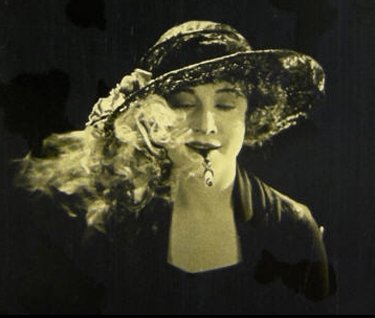
I’m a cinemaphile, and I cannot even identify the film that the above photo represents. I found few of her movies very interesting, and Elizabeth Taylor was never a fantasy girlfriend of mine. Her feminine personae were too old-fashioned and conventional, too guilty, and too campy. She always seemed to me to play roles embodying the notions about sexuality of my parent’s generation. I never even thought she could act particularly well until I saw her amazing performance in Who’s Afraid of Virginia Woolf? (1966). Her performance as Martha permanently changed my mind about her skills and abilities.
Her passing has clearly, however, provoked a deep response and many writers are pausing to contemplate her career and cultural significance.
Camille Paglia argues that Elizabeth Taylor was not only a better actress than Meryl Streep, that she was a “pagan goddess” who wielded “the world-disordering” sexual power of the eternal femme fatale. Quite a tribute.
Elizabeth Taylor’s importance as an actress was that she represented a kind of womanliness that is now completely impossible to find on the U.S. or U.K. screen. It was rooted in hormonal reality — the vitality of nature. She was single-handedly a living rebuke to postmodernism and post-structuralism, which maintain that gender is merely a social construct.
Chairman Hu Jintao and the visiting Chinese delegation deliberately insulted the United States by arranging for a Chinese pianist to play a Korean War-era anti-US propaganda song in the White House.
Lang Lang the pianist says he chose it. Chairman Hu Jintao recognized it as soon as he heard it. Patriotic Chinese Internet users were delighted as soon as they saw the videos online. Early morning TV viewers in China knew it would be played an hour or two beforehand. At the White House State dinner on Jan. 19, about six minutes into his set, Lang Lang began tapping out a famous anti-American propaganda melody from the Korean War: the theme song to the movie “Battle on Shangganling Mountain.â€
The film depicts a group of “People’s Volunteer Army†soldiers who are first hemmed in at Shanganling (or Triangle Hill) and then, when reinforcements arrive, take up their rifles and counterattack the U.S. military “jackals.â€
The movie and the tune are widely known among Chinese, and the song has been a leading piece of anti-American propaganda by the Chinese Communist Party (CCP) for decades. CCP propaganda has always referred to the Korean War as the “movement to resist America and help [North] Korea.†The message of the propaganda is that the United States is an enemy—in fighting in the Korean War the United States’ real goal was said to be to invade and conquer China. The victory at Triangle Hill was promoted as a victory over imperialists.
The song Lang Lang played describes how beautiful China is and then near the end has this verse, “When friends are here, there is fine wine /But if the jackal comes /What greets it is the hunting rifle.†The “jackal†in the song is the United States.
Song segment from “Shang gan ling” [Battle of Triangle Hill] (1956)
I know, I know, this morning I was fretting about nuclear war. But after reading this, I think it’s time to just flatten China completely. …
Just flatten the whole Middle Kingdom. What do you say? So it would be the end of the world. At least we’d go down with honor.
Well, maybe Claire is being just a little extreme. But I do think a responsible American administration would make a point of teaching China a lesson by sinking the next Chinese naval vessel that decides to play war games with the US Navy, by swatting down hard immediately one of China’s naughty little surrogates in the Axis of Evil, by arranging to supply Taiwan with some extra special kind of advanced weaponry that China really really wouldn’t like, by hosting the Dalai Lama at the White House as soon as possible, and by making a seriously punitive change in the American economic relationship with China.
Taggart Tunnel through Continental Divide: Obama voters, Beware!
On December 7, 6:30 to 9:30 PM, at The Millennium Broadway Hotel, Hudson Theatre, 145 West 44th Street, New York, New York 10036, purchasers of $100 to $500 tickets will get to drink cocktails, hobnob with the producers and cast of the Atlas Shrugged movie, receive an update on the film’s progress and watch a ten-minute preview film clip, including the film’s first scene.
If Whit Stillman were a blogger, I believe he’d be a contributor at Maggie’s Farm.
Ivy League conservatives rejoiced twenty years ago when Metropolitan opened in the art houses. Here, at last, was a directorial voice speaking for us, someone sharing our appreciation for the surviving remnants of the belle monde, a sophisticated storyteller focused on the lifestyles of urban haute bourgeoisie of old family and private school background, recounting the minor scale epics and tragedies of the younger part of Upper East Side society with rueful and self-deprecating wit.
He moved location, in his second film Barcelona, exposing his American Innocents Abroad to deeply-entrenched-in-European-culture Anti-American prejudices, and seemed to be proceeding from strength to strength artistically.
But then, in 1998, came Last Days of Disco. Whit Stillman’s cynical, frivolous, and preppified personal world view somehow successfully crossed political and social barriers to appeal to a broad-based audience in his first two films, but Last Days of Disco seemed overly subjective and repelled audiences. No one in the late 1990s, other than Stillman it seems, lamented the passing of the Disco music era (most people were happy to participate in Disco record bonfires) or the demise of Studio 54.
The negative reception received by Last Days caused its director to vanish for twelve years, but as Mara Altman learns in an interview with Stillman appearing in First Things, rejoicing is in order. Whit Stillman is currently shooting another film due to be released next year.
[W]hen Disco didn’t earn the accolades Stillman had come to expect, he decided to retreat from New York, his wife, two daughters, and wounded feelings in tow.
Mostly, though, Stillman just wanted to live somewhere cheaper. But he also had another problem: His trunk was empty. To him, a trunk means a body of material or manuscripts that a writer keeps around and, over time, can come back to rewrite and reconceive. He took his first stab at Barcelona in 1983. It took more than ten years and multiple rewrites before it hit the screen. “After I finished Disco, I had no trunk,†he says. “Since then, I have been recreating my trunk.†…
[T]he wait is almost over. Under the cloak of secrecy, Stillman has at last returned to the role of director. He has just finished shooting his first movie in twelve years, on the streets of New York, his home again after several years of self-imposed European exile. Its working title is Damsels in Distress, and it’s about a group of perfume-obsessed college girls—some suffer from nasal-shock syndrome at the faintest sniff of B.O.—who run a suicide-prevention center. Stillman has raised the money and written the script, which has a honed Whitonian perspective and Whit-icisms galore. And although the film offers the possibility of a cameo appearance by Stillman staple Chris Eigeman, who has appeared in all three of his movies, it will not make a quadrilogy of his trilogy. “This film is different,†Stillman says. “Completely different. Okay, not completely different, but it’s different.â€
I didn’t think much of Last Days when I saw it the first few times, but recently one of the cable networks was playing it and replaying it for several weeks. I not only grew fonder of the film. I found myself watching it over and over without tiring of it. Several individual performances, particularly Kate Beckinsale’s, inspired admiration, and the cad’s wronging of the sweet and intelligent Alice (Chloë Sevigny) increasingly moved this viewer.
Let’s hope that the years in exile have refilled the Stillman steamer trunk to overflowing, and that Damsels in Distress marks the beginning of a long and productive second career stage. Whit Stillman working in Dunkin’ Doughnuts. Whit Stillman frequenting diners. That just isn’t right. Hopefully Damsels will be a hit, and his Cobb Salads will be henceforward ordered in the Harvard Club.
Full-length theatrical trailer for the Coen Brothers remake of True Grit, to be released Xmas, 2010.
Shorter Mattie’s-eye-view version with music by the Peasall Sisters, labeled a teaser trailer:
The Dude standing in for the Duke will be interesting to see. The trailers suggest that the Coen Brothers’ version will be darker and scarier than the 1969 Henry Hathaway original.
According to Mr. Griggs, some prospective crew members on his new documentary, “I Want Your Money,†which takes aim at President Obama’s economic policies, said they would accept jobs on the condition that their names be left off the credits. Mr. Griggs suspects that a politically motivated makeup artist even tried to sabotage the movie by giving him a distinctly unflattering look.
But his film, like “Fahrenheit†before it, is now to be released in a heated political season. And that is at least a minor triumph for one of the less visible minorities: the Hollywood right.
Scheduled by Freestyle Releasing to open in about 500 theaters on Oct. 15.
Annie Oakley’s 150th birthday was last Friday. They say she used to be to able split an edge-on playing card in two from 90′ (27.432 meters) with a .22.
She appeared in the 11th Kinetoscope movie made by Thomas Edison in his Black Maria [see Hans-Jurgen Syberberg’s Hitler: ein film aus Deutschland (1977)] studio, November 1, 1894. Annie Oakley’s shooting wasn’t really displayed at its best in the tiny studio, but it’s fascinating to see even 0:24 seconds of film made when Grover Cleveland was in the White house.