Put aside your girly-man .458 Win Mag or your wimpy .50 cal and watch guys shoot a real gun, the largest center fire rifle ever made, the .950 JDJ by SSK Industries (Ohio).
Only three were ever made. This was the lightest, the carbine version, weighing in at 50 lbs. It shoots a .95 caliber 2,400 grain bullet at 2,100 fps using 240 grains of powder, which generates 25,400 f/lbs of muzzle energy and 277 f/lbs of recoil energy. This would make a great bear killer, ought to blow it off its feet by several yards. Better have a gun bearer.
As its name implies, rifles chambered for the cartridge have a bore diameter of 0.950 in (24.1 mm), which would normally classify them as Destructive Devices in the United States under the 1968 (1934) National Firearms Act. However, SSK sought and received a “Sporting Use Exception” to de-regulate the rifles, meaning they can be purchased like any other Title I rifle by a person over age 18 with no felonies on their criminal record. The rifles themselves, of which only a handful have been made, use McMillan stocks and extraordinarily thick Krieger barrels bearing an 18 lb (8.2 kg) muzzle brake. Overall, depending on options, the rifles weigh from 85 to 110 pounds (39 to 50 kg) and are therefore only useful for shooting from a bench rest or heavy bipod. Despite the weight, recoil is significant, and shooters must be sure to choose components (i.e., scopes and bipods) that can handle the abuse. The sheer size and weight of these weapons makes them impractical for hunting use, as they cannot be carried afield. Thus, they are largely “range queens”—rifles that are brought to the range for a fun time, but not usually used for hunting or other “more practical” uses. Additionally, the cost of owning and operating such a firearm is beyond most shooters; the rifles cost ~US$8,000, loaded cartridges are $40 each, and the individual lathe-turned bronze bullets are $10 apiece.
In the 1920’s and 30’s Hyman S. (Hymie) Lehman was a small time Jewish gunsmith who worked out of a leather and saddlery shop in San Antonio, Texas. At the height of his career he invented a new type of firearm based on similar concepts used in World War I; the machine pistol. Essentially Lehman took a Colt 1911, chambered for either .45 ACP or .38 Super, and converted it to fully automatic. At full auto the 7 round magazine of a 1911 would be instantly drained, so he combined his new weapon with a custom 20 or 30 round magazine. In addition, for more control when firing the weapon he attached the foregrip from a Thompson Submachine Gun, and installed a compensator on the muzzle. The result was a very small weapon that could pour out a ton of firepower.
Obviously an ingenious design, surely the military or police would be interested in such a weapon. In fact Lehman probably could have become rich if he was awarded a government contract. However, Lehman’s clientele was made up of some very seedy characters. Infamous names such as John Dillinger, Baby Face Nelson, Pretty Boy Floyd, and Roger “The Terrible†Touhy all purchased one of Lehman’s baby machine guns. Indeed, Lehman’s machine pistols became a part of the violence that was the gangster era. Baby Face Nelson even used his to kill Federal Agent W. Carter Baum and wound two others during a shootout at the Little Bohemia Lodge in Wisconsin. When questioned about the sales, Lehman simply maintained that he had no idea that the men he sold them to were dangerous criminals.
In 1934 the National Firearms Act was passed into law, outlawing the manufacture or possession of fully automatic firearms without a special government tax stamp. Early Texas had passed a similar state law. In 1935 Lehman was arrested for violating that law. Despite two trials he was never convicted. He died due to complications caused by Alzheimer’s Disease in 1990.
Stephen King is admired as a writer as much for his realism, for the acuity and accuracy of his observation of the details and textures of American life in our time, as he is for his fantasy and unhinged imagination.
You would never find King erroneously making an inaccurate reference to a 1960s television show or comic book, or having one of his juvenile characters consume an incorrectly described popular snack or candy bar, but to Stephen King guns just don’t seem to matter.
King’s latest, Doctor Sleep, is a sequel to one of his major hits, 1977’s The Shining, famous both in the book and in the film version directed by Stanley Kubrick. Dan Torrance, the little kid in The Shining, has grown up into an adult haunted by his visions, and driven by them to drink and personal ruin. He has become a recovering alcoholic, working in a New Hampshire hospice using his unique talents to comfort the dying, and faithfully going to AA meetings and performing his 12 steps, when he is drawn back into conflict with unnatural evil. A local young girl, even more gifted than Dan with psychic abilities, gets in touch with him. She has been targeted by an ancient company of psychic vampires, who unnaturally prolong their own lives by feeding on the essences of members of the tiny minority born with such gifts.
Dan drafts a couple of his local friends to help guard her from an imminent attack, including Billy Freeman, an older municipal handyman who helped Dan get his first local job.
Dave Stone, the girl’s father is skeptical of the old man’s capabilities.
All respect to you, Mr. Freeman,” Dave said, “but you’re a little old for bodyguard duty, and this is my daughter we’re talking about.”
Billy raised his shirttails and revealed an automatic pistol in a battered black holster. “One-nine-one-one Colt,” he said. “Full auto. World War II vintage This is old, too, but it’ll do the job.”
And the gun literate reader goes right up the wall.
Stephen King is so clueless that he thinks that you refer to John Browning’s Model of 1911 as the “One-nine-one-one Colt.” Worse, he does not understand that automatic pistols are typically only semi-automatic. The 1911 Colt was never officially produced in a full-auto version.
Stephen King is at least as ignorant about firearms as the late Ian Fleming, but the difference was that, after committing some howlers, Fleming began consulting with Major Geoffrey Boothroyd, who did know about guns, before mentioning any more of them in his books. Stephen King badly needs a Major Boothroyd.
In Doctor Sleep, the firearm misidentifications keep on coming. As our heroes prepare to ambush the villains, we find Dan equipped with one of two Glock .22s owned by the same Billy Freeman.
The problem is that there are no .22 caliber Glock pistols. Stephen King was confused by the existence of the Glock Model 22, chambered in .40 S&W.
The reader winds up actually uncertain if King means to have Dan shooting baddies with a Glock chambered in the potent man-stopping .40 S&W round, or making do with an imaginary .22 Long Rifle Glock which does not actually exist. From the effect on the villains, I’d guess that Dan was using a powerful center-fire cartridge, and that Stephen King just screwed up by referring to the Model number with a period in front of it.
This sort of thing isn’t the end of the world, but it seems to me that it signifies a very peculiar expression of contempt for accuracy which must be related to a deeply ingrained hoplophobic attitude.
Stephen King would never willingly put the wrong engine in one of his old-time American automobiles or talk about a “Ford Corvette.” He would never mess up on a point of technological nomenclature or misidentify a piece of popular culture. But where firearms are concerned, he just cannot be bothered to check his details.
Obviously, he thinks guns aren’t terribly important and expertise in the area of firearms is not important at all. Nobody who matters will notice. Only rubes and bitter clingers pay attention to that kind of thing anyway.
You can tell that, despite living in the city of Bangor in the state of Maine, where an awful lot of hunting and shooting goes on, the great author lives in an elite community of fashion bubble, the kind of lifestyle which caused Pauline Kael to marvel that Richard Nixon won re-election by a landslide when she herself had never met anyone who would consider voting for Nixon.
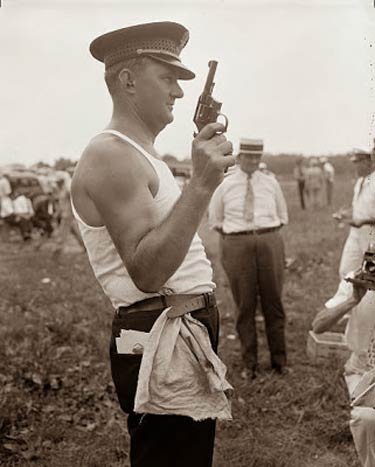
Today’s picture is from 1937, and it shows a White House police officer. This was after a shooting competition, and this officer had the top score. I am surprised however that in 1937 the officers would not be carrying more significant fire power . . . like maybe a Colt 1911 or a Tommy Gun.
Back in the old days, police officers could shoot and a six shot .38 Special revolver was thought perfectly adequate, even for defending the president.
[Griselio] Torresola had approached a guard booth at the west corner and took White House police officer Leslie Coffelt by surprise, shooting at him four times from close range and mortally wounding him with a 9mm German Luger. Three of those shots struck Coffelt in the chest and abdomen, and the fourth went through his tunic.
Torresola shot police officer Joseph Downs in the hip, before he could draw his weapon. As Downs turned toward the house, Torresola shot him in the back and in the neck. Downs got into the basement and secured the door, denying Torresola entry into the Blair House.
Torresola turned his attention to the shoot-out between his partner Collazo and several other police officers. He shot officer Donald Birdzell in the left knee.
Birdzell could no longer stand and was effectively incapacitated (he would later recover).
Torresola stood to the left of the Blair House steps to reload. President Truman had awakened from a nap to the sound of gunfire and looked outside his second floor window. Torresola was 31 feet (9.4 m) away from Truman’s window.
At that same moment, Coffelt left the guard booth, propped against it, and fired his .38-caliber service revolver at Torresola, about 30 feet (10 m) away. Coffelt hit Torresola two inches above the ear, killing him instantly. Taken to the hospital, Coffelt died four hours later.
Morocco has some amazing weapons still in common use. These muzzle-loading rifles with their silver chased barrels are used in the Fantasia [a traditional exhibition of horsemanship in the Maghreb performed during cultural festivals and to close Berber wedding celebrations], when a group of horsemen charge full tilt at the audience and at the last minute stand up in their stirrups, drop the reins, swing their rifles around in a circle and fire blanks into the ground with a deafening crash before pulling up short in a cloud of dust.
Pistols used in the Warsaw Uprising, 1 August — 2 October 1944, Muzeum Powstani Warszawskiego.
The Polish resistance inflicted more than 27,000 German casualties and destroyed 650 vehicles (including 310 armored), 22 artillery guns, and one aircraft.
The most common handgun, naturally enough, seems to have been the Russian Nagant Model 1895 revolver, but at least one lucky Polish fighter evidently had a US Model 1911 .45 (lower left) and there are two Smith & Wesson Model 10 “Victory” Models on the right.
Metrosexual Bryan Schatz, reporting for the red rag Mother Jones, impersonated a normal male American and attended a “build party.”
Build parties seem to be a California phenomenon (the only ones I can find reference to were advertized on the Calguns.net forum), in which people get together, in accordance with currently existing federal gun regulations, to complete personally the lower receiver (which is the element of modern semi-automatic rifles that is legally regarded as constituting the firearm as which is consequently the only part whose sale and transfer is regulated) and then assemble the complete AK or AR rifle using a parts kit.
A build party offers the opportunity to legally manufacture your own contemporary military-style semi-automatic-only rifle, which since you made it for your own use, has no serial number and need not be registered. Beyond that, a build party saves the prospective gun-owner at least a portion of the cost of a fully-assembled semi-automatic contemporary military-style rifle.
Schatz is your typical liberal pussy, who is intentionally milking for journalistic purposes all the shock and awe of actually handling, and even assembling, mechanical instruments that look war-like and can go boom! when you pull the trigger. These sorts of people always bask in the transgressive romance and machismo of it all.
Many kits come from stockpiles in former war zones. “I can guarantee you this one has bodies on it,” says one of the hosts as I peer down the barrel of a Yugo RPK. It’s lined with grit and soot. My host says the AK I’m building is an Egyptian “Maadi” that came to the United States via Croatia, likely having been shipped there during the Yugoslav wars. He tells me some wooden stocks come with tally marks notched in them.
But never for very long. Schatz quickly moves on to worrying about the absence of Big Brother monitoring all this. Since these build party guns are neither numbered nor registered, his liberal heart begins leaping with terror over the fact that they are “not traceable.”
Liberal efforts at gun control always begin with the fundamentally bogus idea that finding the perpetrator of a crime of violence is always, or even often, a question of identifying the actual weapon used or tracing its chain of ownership. In reality, the identity of the culprit is almost always determined from witnesses, motives and opportunity, or by the criminal’s subsequent actions, rather than by tracing ownership of the weapon.
Countless millions of unregistered guns, guns going back to the Beretta-manufactured wheel-lock that John Alden brought over on the Mayflower, are already out there. There are lots of Americans just as handy as the Afghan bazaar craftsmen who can make an entire AK-47 with hand tools in mud shack, and we are presently entering the age in which you can print out that lower receiver (or an entire gun) with a 3-D printer. The Canadians tried registering all of their guns, spent billions on the project, and finally concluded that gun registration, after more than a decade had never actually played any role in solving any crime.
The truth of the matter is that gun registration, keeping track of serial numbers and ownership, is not about solving crimes at all. It is really just a way of injecting friction and cost and potential legal jeopardy into firearms transfers and owndership, with the end goal being confiscation.
In the end, Schatz proves his liberal bona fides, naturally, by deliberately destroying the AK he had fun assembling and shooting. It would be wrong to own such a thing. After all, it might climb out of your closet and go on a killing spree.
I never knew that rational people actually read Mother Jones, but Schatz’s commenters really kicked Schatz’s nonsense around the block. The comments are a lot better than the article.
Build parties sound mildly intriguing, and I have actually begun to see the point of owning so-called “assault weapons.” That lower receiver is just the platform to which you can attach an extraordinary variety of optional barrels, stocks, and accessories, making it, in essence, a Swiss Army Knife-style shooting platform. Still, even with a build party, the cost of upper receivers and barrels, stocks, and accessories inevitably add up. Start with a few hundred for the lower receiver and the party, and add in the rest, and that black rifle plinking toy is always going to cost pretty close to a thou. It can easily cost more.
You can buy some awfully nice classic old-fashioned rifles for that kind of money. Who’d want a plastic semi-auto plinker, when for the same kind of money you could buy, for instance, a pre-WWI classic sporter? The way I figure it, if we ever get into a state of civil unrest in which one really seriously needs an AR, I can always just shoot some representative of the tyrannical government and take his, which will have full-auto too.
I’ve owned expensive rifles from top-end gun makers like Rigby, Jeffrey, and Griffin and Howe, but rifles don’t necessarily have to feature superb walnut, skilled engraving, or lots of hand work to be functional and pleasing.
I recently bought a little sporterized Model 1898 .30-40 Krag carbine for about as little money as you can spend these days and obtain a rifle that shoots.
What prompted this particular purchase was a lot of Krag carbine shopping on on-line Gun Auction sites in order to replace an old NRA Krag carbine my father acquired decades and decades ago. That old Krag must have a shot-out barrel because it produces 2-foot groups at 25 yards.
I have tried cleaning it and then shooting it again several times, but its accuracy didn’t improve. I have often thought of getting rid of it, but its action is so smooth, its carbine length is so handy, and the whole ensemble has a historic charm so potent that whenever I handle it, I can’t bring myself to part with it.
I thought of getting it sleeved or rebarreling it, but it seemed obvious that I could go and buy replacement Krags all day and spend less money. So I decided to buy another Krag carbine.
This one is sporterized, i.e. someone removed the upper handguard and the military ladder sight, then added a Redfield 102 aperture receiver sight which required no drilling. The Redfield just inserts into the hole used by the magazine cut-off and then locks into position with a set screw.
It’s probably my specific age that causes me to find guns from the period of the early 20th century, a few decades before I was around, terribly romantic and evocative. These old Krags were very popular out West. Krags shot best with round nosed 220 grain bullets and made good rifles for elk and bear.
The Krag gets a bad rap in the literature. The conventional wisdom is that the Spaniards’ 7×57 Mauser was the better rifle. And people generally find the Krag’s box magazine, sticking out on the right side, unprepossessing. Myself, I seem to have a weakness for the Krag action. Sure, Mausers and Springfields are better, but the Krag is slicker. That action may be weaker, but the fewer the bolt lugs, the smoother it works. And the action is certainly strong enough for the cartridge it was built for.
As to the box magazine, I absolutely love the crisp, military sound it makes when you snap it open or slam it shut. It is not the most intuitively obvious or logical magazine design, I will admit, but I suggest looking on it as a luxury item. Can you even begin to imagine what it would cost to get that magazine manufactured today, all that milling, all the hand-fitting?
I watched this amusing video yesterday. You know, there is a certain distinctive PING! associated with working the action of the Krag.
Bob Owens tells us that rush to stockpile guns is still heavily underway where he lives. People are lining up at the local gunshop and the shelves are empty.
I took my daughter to preschool this morning, and on the way back I drove past my local neighborhood gun store.
The owner was standing out front talking to the first customer in line as the clerks inside finished setting up for the daily rush. They would open promptly at 9:00 AM. The speed limit is just 25 MPH in that part of town, and I caught a red light as well, so I had plenty of time to count the number of people in line.
There were 25 souls patiently queued up from the front door down the sidewalk into the parking lot. This is the new normal, and has been for months. Sometimes the line is shorter, sometimes it is longer, and on days that it is cold and rainy, people sit in their vehicles until the store opens, but there is always a line.
I drop in every few weeks or so. Some of the more senior clerks there know my face if they can’t recall my name; this is the FFL (federal firearms licensee) that I most often used when a manufacturer transfers in a rifle or pistol for me to test and evaluate. I haven’t been inside in two weeks, but the last time I was there was the same as it has been from mid-January onward.
There are no AR-15s, no AK-pattern rifles, no M1As, no FALs, nor anything else that might reasonably impersonate a semi-automatic rifle. For that matter, there are no Garands worth their price, nor Enfields, nor Mosins.
Likewise, the glass handgun cases have largely been empties of service pistols. There are still a few, but most tend to be painfully expensive or the dogs that no one wants. Magazines for all of these are gone, of course, as are most common calibers of ammunition.
How much longer will this go on? …
In my estimation, this is the most heavily-armed the American people have ever been. I’m including the World Wars.